
KISS: End of the Road — One Last Look Behind the Makeup
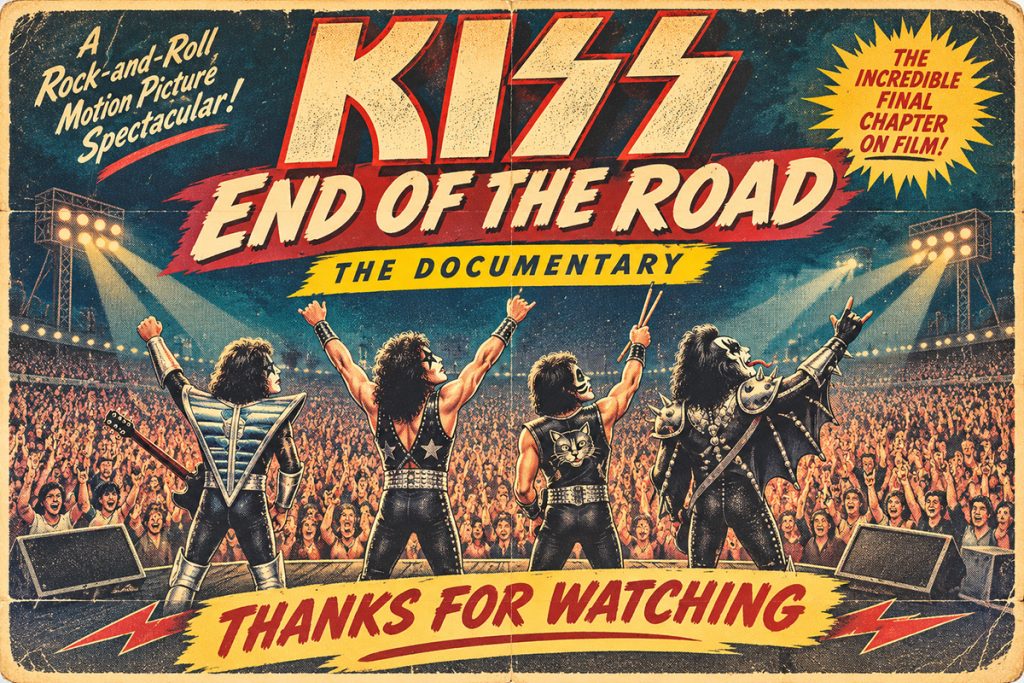
The new KISS documentary catches the band at an awkward, sometimes uncomfortable point: the shows are still enormous, but the men inside the costumes are getting older. There are backstage rows, a frightening night in Brazil, and an unexpectedly affecting ending. There are some things the film would clearly rather leave alone, too. Meanwhile, KISS has sold its rights for a reported $300 million and is preparing for a future that doesn’t necessarily require a band onstage.
KISS: End of the Road — The Essential Details
- The documentary: Directed by DJ Viola, the two-part film follows the closing stretch of the End of the Road tour through the final Madison Square Garden shows in December 2023.
- The premiere: November 19, 2026, as a paid streaming event, with access starting at about $14.99.
- The best material: Gene Simmons falling ill in Brazil, Paul Stanley’s health troubles, arguments and technical headaches backstage, and the last concerts in New York.
- The biggest disappointment: The backing-track controversy is barely examined, and the original lineup’s difficult history gets less attention than it should.
- The original members: Ace Frehley and Peter Criss are acknowledged, especially late in the film, but their place in the story deserved more room.
- The final concert: December 2, 2023, at Madison Square Garden in New York City.
- The business deal: In 2024, Pophouse Entertainment bought extensive rights to KISS’s catalog, brand, and image in a transaction reportedly worth more than $300 million.
- The next major production: A large-scale digital KISS attraction is being developed for Las Vegas, with 2028 as the target and a reported investment around $200 million.
- The verdict: There is enough backstage footage and fine New York material to recommend it, even though it stops well short of telling the entire story of those final years.
Nobody Really Expected KISS to Disappear
A quiet retirement from KISS would have been a surprise. This is a band that put its name on just about everything that would hold a logo and spent half a century finding ways to make four men in makeup look larger than life. Simply packing up the instruments and going home? Unlikely.
Still, the road had to end somewhere. Gene Simmons and Paul Stanley were well into their seventies when KISS reached Madison Square Garden in December 2023. Simmons was still stomping around in the Demon armor. Stanley was still flying above the audience.
There were enough explosions to make it feel like any other KISS night. What audiences couldn’t see so easily was the effort involved in getting those two men through a show.
KISS: End of the Road lets some of that effort show. Simmons becomes ill in Brazil. Stanley is dealing with years of wear and tear, then contracts the flu at the worst possible time. Equipment goes wrong; people argue backstage; members of the crew look as though they’d rather be anywhere else. These are the bits that stay with you. Not another explanation of how much KISS means to its audience. We’ve heard that one before, quite a few times.
There are also stretches where the film feels suspiciously comfortable with the familiar KISS story. Doc McGhee is on hand. Simmons and Stanley speak in the polished language of men who have been interviewed for decades.
The discussion wanders past a couple of subjects that might have made things less comfortable: the use of prerecorded material onstage, for one, and the long, difficult relationship with Ace Frehley and Peter Criss for another. Both get acknowledgment; neither gets a particularly thorough examination.
Then there’s the farewell itself. On December 2, 2023, the band finishes its final touring concert and promptly introduces digital KISS characters. In April 2024, Pophouse announces a rights deal reportedly valued above $300 million. Now a Las Vegas production, said to involve something in the neighborhood of $200 million, is being developed for a possible 2028 opening.
So KISS stopped touring. That isn’t quite the same as KISS going away.
The film is often good when it forgets about the grand KISS mythology and stays close to the people in the dressing rooms. Its closing stretch, especially, has some lovely material.
The pity is that the filmmakers don’t always seem to trust it. A few of the unanswered questions are every bit as interesting as the footage they chose to include.
Five Years Is a Long Time to Say Goodbye
The first End of the Road show took place in Vancouver on January 31, 2019. The plan seemed simple enough: take the huge KISS production around the world one last time, let fans have their final night with the band, then retire from touring.
There was some eye-rolling from the start. Fans had heard the word farewell before, most conspicuously around 2000, and KISS had found a way to keep performing for another two decades. But the pandemic was nobody’s marketing invention. Concerts stopped, dates moved, and a tour intended to bring the story to a close ran, with interruptions, for nearly five years.
By the time the final New York dates arrived, even the people who had bought the goodbye were probably ready for it to end.
The unusual thing about KISS is that the show itself couldn’t quietly grow old with the musicians. A singer in a more conventional rock band might sit for a few numbers or spend a song leaning against a microphone stand.
Simmons couldn’t stroll out wearing a cardigan and still be the Demon. Stanley couldn’t drop the Starchild routine without changing what people thought they’d paid to see. Tommy Thayer and Eric Singer had their Spaceman and Catman parts to play, too. And nobody was about to put the pyrotechnics in storage halfway through the tour.
Heavy armor. Platform boots. Constant movement. Fire and lifts and carefully timed effects. The musicians were older, but almost every expectation surrounding the show belonged to a younger band.
You can see how the production became difficult to escape. The bigger KISS made its identity, the harder it was to scale anything back. It had spent years promising people an enormous night.
Now the men wearing the costumes had to get through that night, over and over, regardless of what their knees, backs, or voices thought of the arrangement.
That problem is no longer theoretical when the documentary reaches Brazil.
Gene Simmons, the Brazilian Heat, and a Very Uncomfortable Concert
Manaus, April 2023. The heat and humidity are punishing, and Gene Simmons is wearing a costume that looks uncomfortable even in an air-conditioned room. Add stage lighting, a demanding performance, and the fact that he’s 73, and the situation doesn’t need much embellishment.
Partway through the concert, Simmons starts having trouble. He ends up sitting down. There is something genuinely odd about the sight: the Demon, the giant with the fire and blood and armor, suddenly needing a chair in the middle of a KISS show.
The film follows him backstage as he tries to recover. In Johnny Z’s YouTube review, Simmons vomits and asks whether the cameras caught what happened. Stanley is worried enough to discuss with McGhee whether they ought to stop.
For a few minutes, nobody seems especially concerned with keeping up the comic-book illusion.
The editing apparently leans into the drama. The episode is serious, but Simmons does recover enough to continue, and it doesn’t become quite the disaster the buildup seems to be promising.
The footage itself is still worth having. We rarely see that much of the effort, or the vulnerability, behind KISS’s costumes.
Simmons has always talked about giving fans their money’s worth, and I don’t doubt he means it. But he also knows a good story when he sees one. So there’s something almost funny about him reportedly worrying whether the cameras caught what happened, even while he’s feeling absolutely miserable. Only Gene Simmons could be that sick and still have one eye on the publicity.
The whole scene raises a less amusing point about what a performer owes an audience.
Yes, people paid for a full KISS concert. No, that doesn’t make finishing the show more important than the musician’s health. There is a point where the right thing to do is get the man offstage, enormous costume and all.
For once, the image that lingers isn’t a plume of fire or a smoking guitar. It’s Simmons sitting down because he has to. You don’t often get a clearer view of the difference between a rock star and the character he plays.
Paul Stanley Wasn’t Having an Easy Time Either
Stanley’s part of the KISS show looks exhausting before you even consider his age. He sings, plays rhythm guitar, works the crowd, moves around the stage and goes through all the familiar Starchild business. That routine had been developing for fifty years, during which he had also undergone significant medical procedures and dealt with the physical consequences of a lifetime of performing.
Kiss: End of the Road shows some of the less photogenic preparation: attention to aching joints, pain-relief products, the small things required to get a body ready to work again. It’s a world away from the usual backstage footage of musicians exchanging inspirational remarks before a big concert. Stanley is just trying to be ready when the lights go on.
He can still do the job. That doesn’t mean the job has become easy.
And then, with Madison Square Garden approaching, he gets the flu. KISS cancels shows scheduled for Ottawa, Toronto and Knoxville in November 2023. Suddenly the ending, planned and discussed for years, depends on whether the frontman can get well in time.
There is an almost ridiculous ordinariness to it. After everything KISS had built around the final performances, a virus was threatening the grand occasion. Not a malfunctioning lift, a misfired explosion or some spectacular stage disaster. The flu.
The stakes were real enough. People had bought tickets and arranged trips. The band was due to finish in New York, the city where it began, and these were supposed to be its last major touring appearances. Missing them would have been painful for everyone involved, not least Stanley himself.
He recovered. The Madison Square Garden concerts went ahead. But the episode is another reminder of what the last leg of the tour demanded. Simmons and Stanley spent decades presenting characters who hardly seemed to age. By 2023, playing those characters took a fair amount of work before a single note was heard.
End of the Road doesn’t try to make every difficult moment seem heroic. Sometimes a musician is simply exhausted, hurting, or feeling lousy. That’s interesting enough on its own. We don’t need the film telling us how we’re supposed to feel about it.
The Real Stars of a KISS Concert Aren’t Always the Four Guys on Stage
Try imagining the work required to move a KISS concert from one city to the next. The screens, moving platforms, lights, instruments, costumes, sound equipment and pyrotechnics all have to arrive, work in the right order and leave again. Somebody tests the effects.
Somebody checks what broke the night before. Somebody has to make sure a musician doesn’t step into the wrong place at the wrong time while an explosion goes off.
Then the show ends, everyone loads out, and they start over somewhere else.
The documentary gets into some of the things that go wrong. There are technical headaches, missed cues and frustration backstage. Stanley isn’t always pleased with how things are running, and the crew isn’t exactly having a relaxing afternoon either.
It makes sense that the band expects a high standard. People are paying to see KISS, not a rehearsal. But there’s a peculiar imbalance in a film that gives so much attention to the musicians’ irritation and somewhat less to the people solving the problems.
The technicians generally become noticeable when something doesn’t work. On the hundreds of nights when everything does, nobody in the crowd goes home discussing the person who made the lift operate on cue.
Those people are part of what made KISS special, too.
The touring business was still recovering from the pandemic, too. A lot of experienced crew members had moved on to other jobs, and companies were trying to get everything running again after years of disrupted schedules.
That doesn’t excuse mistakes, but it helps explain why things occasionally went wrong. It’s easy to blame the crew when you’re watching an irritated Paul Stanley. There’s usually more to the story.
I’d have liked more of the crew’s side. What do you do when a piece of equipment fails during a performance? How much room is there to improvise in a show so heavily timed? What’s it like trying to get the whole operation into another venue overnight? A working account of that machinery could have been fascinating without a single extra interview about how important the KISS production is.
The band came up with the spectacle. A lot of other people made sure it worked. Their story is woven through the footage, whether or not the film stops to hear much of it.
Tommy Thayer and Eric Singer Have a More Interesting Story Than They’re Usually Allowed to Tell
By the end, KISS consisted of Simmons, Stanley, Tommy Thayer and Eric Singer. That was the touring band, and it had been that way for years. For a certain kind of KISS fan, though, the sight of Thayer in Ace Frehley’s makeup and Singer in Peter Criss’s still caused irritation before either man played a note.
I understand the attachment. The Spaceman and Catman weren’t empty uniforms when KISS began. Frehley and Criss had helped invent those characters, and their personalities and musical styles were part of what made the original four memorable. To some fans, having other musicians wear the makeup will never seem right.
It shouldn’t erase what Thayer and Singer did. Thayer had been involved in the KISS organization long before becoming lead guitarist in 2002. He knew the music, the production, and the expectations. Singer had been playing with the group since the early 1990s, across different chapters of its history. Neither was an amateur walking into a borrowed costume without understanding the job.
Thayer comes across as one of the people helping keep the show on the rails. He’s not given to the grand declarations that make Simmons and Stanley instantly recognizable in interviews.
Singer, meanwhile, provides some welcome relief with his dry humor and apparent impatience with the camera crew. Johnny Z also describes a moment where the Catman makes a peanut butter and jelly sandwich for the Demon. That’s a better bit of KISS comedy than anything a writer could have scripted for them.
There is still an awkward subject underneath it all. Thayer reportedly discusses his guitar solo and its stage effects in a way that struck Johnny Z as claiming something that originated with Frehley. It’s worth being careful about that charge. A guitarist can call the solo he’s playing his solo without claiming to have written the original passage. Both things can be true: Thayer is describing his part of the show, and an older fan is hearing notes associated indelibly with Ace.
That was always a sticking point with the later versions of KISS. Simmons and Stanley believed the characters could carry on regardless of who was wearing the makeup. Thayer and Singer did their jobs well, and the band continued filling arenas. But Ace Frehley and Peter Criss were the original Spaceman and Catman. For a lot of fans, that was never going to change. The documentary doesn’t settle the argument, but then again, what could it possibly say that fans haven’t been fighting about for years?
Gene Simmons Likes Money. Paul Stanley Likes Pride. Apparently, Both Have Their Limits.
A conversation about extending the tour says rather a lot about the relationship between Simmons and Stanley. Simmons is presented with an attractive financial opportunity to keep going. He’s interested. Stanley isn’t, at least not in the same way. He talks about pride.
It’s such a perfect fit for their public personas that you almost want to laugh. Gene likes the money; Paul wants to preserve the reputation. They could have been cast in those parts forty years ago.
Simmons has never been shy about money. He thinks musicians should get paid, and he’s never understood why anyone would apologize for running a successful business. Stanley usually talks more about putting on a great show, giving fans their money’s worth, and protecting the band’s reputation.
Of course, Stanley has made plenty of money from KISS over the years, and Simmons cares about the music more than he sometimes lets on. Neither guy is quite as simple as he makes himself sound in interviews.
Still, the offer is intriguing. How much would another stretch of shows have been worth? KISS had a familiar name, an established audience and a gigantic production ready to earn more money. For a business that had spent decades turning concerts into events, continuing was hardly an absurd idea.
And really, how much longer could they keep this going? The tour started in 2019, and nobody was getting any younger. The shows certainly weren’t getting any easier to perform. Fans had already sat through one KISS farewell that wasn’t actually a farewell, and this one had dragged on for nearly five years. Announcing more dates would have made it pretty hard to take the word final seriously anymore.
Maybe Stanley felt it was time to quit while the band could still put on a good show. Maybe he was just tired of the whole thing. After years of touring in that costume, it’s easy to imagine that another big payday wasn’t enough to make him want to keep going.
KISS: End of the Road touches on the disagreement between him and Simmons, but it doesn’t dig much deeper. We get the familiar Gene-loves-money, Paul-cares-about-pride routine. There was probably a more interesting conversation to be had.
It’s a good scene. I just suspect there was a better conversation somewhere behind it.
The Problem With a Documentary That Knows Exactly What It Wants You to Think
The cameras got close. They went backstage, caught people at uncomfortable moments and recorded exchanges the audience wouldn’t otherwise have heard. That access is a real asset. It doesn’t follow that the resulting film gives us the whole story.
The KISS organization and Pophouse Entertainment, which now controls extensive rights connected with the band’s name and music, were involved in the production. That doesn’t automatically make the documentary dishonest. It does make its editorial choices worth looking at carefully.
KISS: End of the Road spends plenty of time showing how hard touring had become for Simmons and Stanley. We see them struggling physically, dealing with problems backstage, and getting frustrated when the production doesn’t run smoothly.
But when it comes to the less comfortable stuff, the documentary doesn’t have nearly as much to say. The backing tracks, the money surrounding the farewell tour, expensive fan packages, and all those years of fighting with former members get far less attention.
You begin to notice the pattern. The movie is happy to show things going wrong if the difficulty confirms how hard the band works to give fans a good show. It is less eager to linger on decisions the band itself made that might invite criticism.
Some of the conversations feel a little too rehearsed. Johnny Z points to an early exchange with Doc McGhee that looks more like a planned interview than a spontaneous conversation. That doesn’t mean anyone staged it.
Documentaries are edited, interviews are set up, and cameras don’t always capture people behaving naturally. Besides, Simmons and Stanley have been telling these stories for so long that they probably couldn’t make them sound spontaneous if they tried.
They know exactly how to handle an interview. They’ve got their stories down, they know where the jokes go, and they can turn almost any question into another familiar KISS anecdote. Sometimes you get a genuinely interesting conversation. Other times, it feels like you’ve heard the same interview a dozen times before.
That’s why the unexpected footage is so much better. Gene gets sick in Brazil. Something goes wrong during a concert. Gene and Paul want a private moment without cameras hanging around.
For once, they’re dealing with what’s happening instead of explaining it afterward. I would have liked more of that. The filmmakers had some terrific footage, and occasionally they seemed too eager to explain things that were perfectly interesting without the extra commentary.
The Backing-Track Question Isn’t Going Away
The subject missing most conspicuously from the documentary, at least in Johnny Z’s account of it, is the one that kept coming up during the actual farewell tour: prerecorded vocal support.
People talked about it for years. Concert clips circulated online. Fans compared nights, listened to particular passages and argued over what they were hearing. Was Stanley singing every line live? How much support was coming from recordings? Where did an acceptable addition to the mix end and an audience being misled begin?
KISS management had acknowledged using prerecorded vocal support, but that didn’t establish that every theory attached to a shaky phone video was correct. Live productions have long used programmed sounds, extra harmonies, recorded effects and other elements.
A background part isn’t the same as an entire lead vocal presented as though the singer is performing it in the moment. Those differences deserve attention, not a blanket accusation.
And that’s why I’d have liked to hear the band talk about it properly.
KISS built its reputation on the experience of a live show. Stanley spoke repeatedly about the responsibility to deliver; Simmons has never been shy about telling other performers to give paying fans their money’s worth.
Both men were older by the time the final tour ended. Stanley’s voice had already been carrying a punishing workload for decades. There was a serious, worthwhile discussion available about what it takes to keep a demanding show on the road when the original physical capabilities aren’t there anymore.
What was recorded? What was sung live? Who decided how much support to use, and why? Did everyone in the organization agree? Did they think audiences knew the arrangement? Those aren’t attempts to trap the musicians. They’re the kind of questions a film about this particular tour ought to ask.
Some fans have no problem with prerecorded material. Others object strongly, especially when a show is sold on the strength of the live performance.
You don’t have to choose sides before listening to an explanation. But you do need to get the explanation in the first place.
Instead, KISS: End of the Road seems to pass over the issue while continuing to make much of the band’s determination to finish at its best. That leaves a rather obvious gap. Stanley might have had good reasons for the decisions that were made; I would have been interested to hear them.
He might even have persuaded some of the people who were upset. We’ll never know from the footage described here.
A farewell tour can be impressive and imperfect. I wish the documentary had been comfortable saying so.
Ace Frehley and Peter Criss Shouldn’t Be Footnotes in Their Own Band’s History
Bring up the original KISS lineup in a room full of fans and see how long the peace lasts. Someone will tell you the band was never the same after Ace Frehley and Peter Criss.
Somebody else will point to later records or talk about musicianship. Eventually there will be an argument about money, old interviews, the reunion, or whose memory of 1977 ought to be trusted.
A lot of it is fascinating. Some of it has become tiresome. None of it changes how KISS began.
Simmons and Stanley were indispensable. Their songwriting and determination helped turn a peculiar New York group into an international attraction. But Frehley’s guitar gave the early records a personality that couldn’t simply be copied from a chart, and Criss brought a rhythmic looseness and musical background that made the original group sound different from many of its hard rock contemporaries.
The original four didn’t always get along, and they certainly didn’t agree on everything. They brought different things to the band, and some of their disagreements got pretty ugly. But put those four guys together, and something clicked.
Listen to the early records and you can hear it. Those albums tell you more about why KISS became so popular than another interview about how the band built its business.
And that’s not taking anything away from Tommy Thayer, Eric Singer, Bruce Kulick, Eric Carr, Vinnie Vincent, or anyone else who played in KISS. The band made some terrific music with later lineups, and there were plenty of great concerts along the way.
But Gene, Paul, Ace, and Peter started the whole thing. The makeup, the characters, the sound that first caught people’s attention. That was theirs.
KISS: End of the Road takes its time getting around to Ace and Peter. I understand that it’s about the final tour, not the complete history of KISS. But those last nights at Madison Square Garden wouldn’t have carried nearly the same weight without everything that happened back in the seventies.
And it’s hard to tell that story properly when two of the guys who helped make it happen barely get a mention until late in the film.
Ace Frehley Was More Than the Spaceman
Go back to the early records and listen to Ace. The melodic bends, the blues influence, the slightly unexpected turns in his solos — he sounded like himself, whether or not he was playing every note with textbook precision. In fact, the lack of polish was sometimes part of the appeal.
The early Kiss records all contain moments where Frehley’s guitar seems to give the song its mischievous grin. He wasn’t simply filling a required solo slot. His guitar was another personality in a band that already had four enormous ones.
That came across onstage, too. Stanley worked the crowd with all the confidence of a born frontman. Simmons was busy being terrifying. Criss had his own style behind the kit. Frehley often looked as though he had wandered in from a different party and was enjoying whatever happened next. The Spaceman character suited him remarkably well.
His history with KISS was messy. He left, came back during the reunion, and eventually left again. Performance issues, business disputes and personal relationships all contributed to those chapters.
It would be dishonest to pretend the problems never existed. It would be just as dishonest to allow them to swallow everything he did for the band musically.
Frehley died in October 2025. The original four can never share a stage again, and that makes the farewell documentary’s treatment of the band’s beginnings feel different now than it might have in 2023.
There’s a dedication to Ace, which is fitting. I’d still have preferred more time spent hearing what his playing and character brought to the music rather than simply acknowledging that he was there.
Peter Criss Brought Something the Later Versions of KISS Never Quite Recreated
Peter Criss can disappear in KISS discussions under a pile of old disagreements. There were battles about his playing, his behavior, his place in the band, and what happened during the reunion years. They’re all part of the history. They’re not the whole of the musician.
Criss came from jazz, rhythm and blues, and an older generation of rock music. Listen to the original band with that in mind and you’ll hear something that often gets lost beneath the costumes.
The songs move. They swing a little. The drums don’t always sit in the rigid pocket that became common in later hard rock.
Then there’s the voice. “Beth” was an enormous hit, but Criss’s singing had character elsewhere in the catalog, too. His grainier, more soulful sound added a color that Simmons and Stanley didn’t have. Together with Frehley’s guitar, it gave the early group a looseness that later KISS records rarely reproduced in quite the same way.
Later lineups had their strengths. Some were technically tighter. Some made excellent records. But the sound changed when the players changed; anyone listening rather than arguing about the makeup can hear it.
A film looking back from the end of the road has room to recognize the people who gave the band its first musical identity. It shouldn’t need a separate documentary to get that right.
The New York Ending Was Exactly Right
Madison Square Garden was really the only place KISS could have ended the tour. New York was where it all started, playing small clubs in the early seventies and trying to get somebody to pay attention. By 1977, they were headlining the Garden.
That’s quite a jump for four guys who’d spent their early days rehearsing, playing half-empty rooms, and wondering whether this whole makeup-and-costumes idea would ever catch on.
KISS: End of the Road also includes some old footage from those early years, which is a nice touch. It’s always fun to see vintage KISS, but here it means a little more.
Watching those four young guys tearing through a show in the seventies, then seeing Gene and Paul return to the same stage in December 2023, really brings home just how much time has passed.
When KISS started in 1973, those four guys couldn’t have imagined where it would all lead. The fame, the albums that flopped, the fights, the lineup changes, and eventually the reunion. Then there’s all the merchandise, some of it pretty ridiculous even by KISS standards.
Now, more than fifty years later, the band’s name and music have been sold, with plans for digital versions of the musicians to perform in Las Vegas. Try explaining all that to Gene Simmons back in 1973. Even he might have thought the last part sounded a little crazy.
Back in the early seventies, KISS was a pretty strange idea for a rock band. Four guys wearing makeup and comic-book costumes weren’t exactly guaranteed to be taken seriously.
They had to prove there was a good band underneath all that stuff. Eventually, the songs and live shows won people over, and the look that once seemed so unusual became a big part of their success.
By the time they returned to Madison Square Garden for those final concerts, the audience knew the whole story. Or at least enough of it to understand what those nights meant.
KISS: End of the End didn’t need to pile on the drama. There was already plenty of emotion in that building, and I’m glad they gave the footage room to speak for itself.
A Private Moment Between Gene and Paul Says More Than Another Hour of Interviews
One of the more touching moments described in the review is something we don’t actually get to see. Before the final Madison Square Garden concert, Gene reportedly asks the camera crew to leave the arena. He wants some time alone with Paul.
I like that. These two have spent so much of their lives in front of cameras that they can probably tell most of their KISS stories in their sleep. They’ve given thousands of interviews, appeared on countless television shows, and talked about the band’s history more times than either could possibly remember.
They’ve become pretty good at turning almost any memory into an entertaining story. But apparently, whatever Gene wanted to say to Paul that night wasn’t meant for the rest of us.
Think about everything they’ve been through together. They started a band that nobody quite knew what to make of, watched it become one of the biggest acts in rock, survived lineup changes, bitter disagreements, disappointing records, and plenty of ups and downs in the music business.
They’ve worked together for more than fifty years. I’m sure there are things they remember differently, arguments that never really got settled, and stories neither has any interest in sharing. You don’t spend that much time with somebody without accumulating a few of those.
Now they’re back at Madison Square Garden, in the city where KISS started, preparing to walk onstage for the last concert of their touring career. After everything that’s happened, Gene wants a few minutes with Paul, without cameras or anyone else listening.
I’d be curious to know what they talked about. Of course I would. But I’m glad KISS: End of the Road respected their privacy. After fifty years of sharing almost everything with their audience, I think Gene and Paul were entitled to keep that one conversation to themselves.
The Final Deli Scene Is the Ending the Documentary Needed
After the Garden shows, the film reportedly finds Simmons and Stanley in a deli in Bel Air, California. No makeup. No giant boots. No smoke machine. They’re sitting together, eating and talking about the early days.
It sounds almost comically un-KISS.
They remember meeting Frehley and Criss, and the conversation moves back to the circumstances that brought the original four together. It’s a long way from a band name valued in the hundreds of millions and digital characters being prepared for a future theatrical attraction.
For a few minutes, the story is simply about the young musicians who wanted to make records and play concerts.
There’s something welcome about hearing Gene and Paul remember Ace and Peter without the discussion turning into another trial of every old grievance. KISS has already supplied enough conflicting memoirs and interviews to keep the argument going for another century.
Nobody needs the deli scene to decide who was right about every dispute in the seventies or during the reunion.
At the beginning there were four of them. They created something strange and successful together. The relationship didn’t survive intact, but the songs and characters did. Simmons and Stanley can acknowledge that without surrendering their own considerable part in the band’s achievements.
It’s a lovely idea for a closing scene, precisely because it isn’t trying to be monumental. The film has access to fire, noise, crowds, the final concert and the financial machinery behind KISS. It finishes with two older men remembering people they knew when none of it existed.
If the rest of KISS: End of the Road had shown the same confidence in unguarded conversation, it might have been a much more revealing film.
And Then KISS Said Goodbye by Announcing That KISS Would Continue
The band takes its final touring bow on December 2, 2023. The audience has spent an evening celebrating the conclusion of a fifty-year career on the road. The emotional ending seems obvious.
And then the avatars appear.
Digital KISS characters are introduced as the next incarnation of the group. Not exactly the sort of curtain call most bands would choose, but entirely in keeping with this one. The musicians were finished with regular touring; the characters, apparently, were not.
The announcement left a lot unanswered. Would this be a straightforward digital concert? A recreation of the seventies? Would the characters represent the original players or the final lineup? Was new music involved? And who, beyond the most devoted collectors and curious tourists, would pay to see it?
The preliminary demonstration didn’t convince everybody. Some fans were excited by the possibilities, others found the figures unpersuasive, and plenty were probably too occupied with the emotional weight of the last show to start thinking about the next product.
The timing was awkward. A farewell concert generally asks an audience to accept an ending. KISS had barely reached that ending before pointing toward another beginning.
You could admire the ambition and still wish they’d allowed the final show to breathe for a few minutes.
The $300 Million Deal That Changed What KISS Actually Is
In April 2024, Pophouse Entertainment announced its acquisition of extensive KISS rights. The figure reported in coverage was more than $300 million, although the full financial terms weren’t made public.
The deal included the music catalog, the name, trademarks and image-related rights. This was not merely a royalty transaction.
Pophouse was buying an entertainment property.
In a way, KISS had been getting ready for a deal like this for years. You don’t have to hear Gene Simmons play a note to recognize the Demon. Put Paul’s Starchild makeup on a lunchbox, and just about anybody knows what they’re looking at. The same goes for the Spaceman and Catman.
Even people who couldn’t name five KISS songs recognize those characters. The band figured out a long time ago that the makeup and image could make money even when nobody was playing a concert.
Pophouse saw the possibilities. The company already had experience with digital entertainment through ABBA Voyage, along with the money and resources to take the KISS concept further.
So the avatar show wasn’t just another wild idea Gene came up with. There was now a company behind it that had the rights, the experience, and the financial backing to actually make it happen.
Gene and Paul are still involved, too. They didn’t simply take the money and walk away. But KISS is under different ownership now, and the band doesn’t have to tour to keep making money.
There can be movies, stage productions, merchandise, licensing deals, and probably a few things nobody has thought of yet.
From a business standpoint, it’s easy to understand why the deal happened. KISS had spent fifty years building something that could keep earning money long after the musicians stopped performing. Whether fans will embrace everything Pophouse does with it is another matter.
KISS Has Always Been a Business. That Doesn’t Mean Every Business Idea Is Good.
Anyone suddenly offended by KISS selling merchandise must have missed several decades of KISS merchandise. The band had lunchboxes, dolls, comics, posters, clothing and enough other branded objects to fill a respectable warehouse long before licensing became standard practice for rock groups.
Some of those products are great fun. Others look as though the only planning meeting consisted of someone asking, “Can we put the logo on this?” Simmons has always been comfortable defending the business side of entertainment, and there is no sensible argument that musicians shouldn’t earn money from their work.
But the avatar show brings a different question. Having the legal rights to make an attraction doesn’t mean anybody will find it entertaining. Neither does having the technology or an enormous budget.
The Demon could look fantastic on a screen. So could the Starchild. You might even be able to make the Spaceman fly through an imaginary galaxy while his guitar plays itself. The trick is building an evening that people enjoy rather than admire briefly and forget.
KISS has had plenty of commercial ideas over the years. A few seemed ridiculous at first and turned out to be clever. Others were just ridiculous. A proposed $200 million attraction has to make a much more demanding case than another coffee mug. Pophouse can start with a famous brand and a vast catalog. It still has to put on a good show.
The $200 Million Avatar Show Is a Big Gamble
The Las Vegas production being developed by Pophouse has a target opening in 2028 and a reported investment of approximately $200 million. Those figures could change; a finished show, a venue and a firm schedule still have to be delivered. But they suggest something far beyond a group of digital musicians miming along on a conventional theater stage.
Pophouse has discussed combining digital characters with visual effects, theatrical staging and physical elements intended to make the audience feel surrounded by the performance. Thierry Coup, a former Universal creative executive, has been associated with development. It sounds closer to a substantial theme-park attraction than another concert residency.
That approach offers possibilities the band never had on the road. The Demon could become an enormous creature. The Spaceman could appear in settings that no touring crew could construct and dismantle between cities. The production could move between music and visual storytelling without worrying about what Simmons and Stanley are physically capable of doing at their ages.
It could be spectacular. It could also be very expensive and curiously lifeless.
If the attraction simply tries to reproduce a 1977 KISS concert with more convincing digital figures, it has a problem from the start. Actual KISS concert footage exists, including performances by the original musicians. Those recordings have energy and rough edges and people responding to one another onstage. A polished simulation will have to offer something that the real footage can’t.
Maybe the answer is to stop thinking of the project as a concert at all. KISS was always part rock band, part comic book. A fully theatrical adventure built around the characters might be a good use of the technology, even for people who have no desire to watch a virtual replacement for Frehley or Criss.
The attraction could be entertaining on those terms. It would simply be a different kind of entertainment from the thing KISS did on the road.
The New Avatars Are Supposed to Look Nothing Like the 2023 Preview
There were updates during the November 2026 KISS Kruise: Land-Locked in Vegas event. Pophouse CEO Jessica Koravos discussed how the digital characters were coming along. According to reports of the presentation, the Stanley avatar was roughly 60 percent complete and the Simmons version about 20 percent complete. Those percentages referred to work on the individual figures, not the entire show.
Stanley also said the finished characters would be substantially different from the preliminary versions unveiled at Madison Square Garden. Anyone who found that original preview unconvincing will probably regard that as good news.
The plan is to lean toward younger likenesses, particularly the recognizable KISS appearance of the seventies. From a design standpoint it’s hard to argue. Those costumes and faces are instantly identifiable, and a computer-generated performer has no obligation to look like a man preparing for retirement. The virtual Demon won’t need a chair during a hot night in Brazil. The Starchild won’t have to spend time getting his joints ready to fly above an audience.
A digital character can stay young, move exactly as instructed and repeat a performance perfectly. It solves the aging problem in a fairly literal way.
But perfection was never the whole appeal of KISS. Which brings us to a rather bigger problem than getting the computer-generated faces right.
Can You Recreate the Personality of a Rock Band?
A digital figure can look like Gene Simmons. The designers can give it his armor, gestures and familiar stage moves. It can breathe fire on cue and never stumble. A digital Paul Stanley can move across an imaginary stage, point toward the crowd and sing to a perfectly synchronized recording. The Spaceman’s guitar can smoke. The Catman can play drums without getting tired.
All of that is technically possible, or at least the kind of thing a production with an enormous budget is setting out to accomplish.
What you can’t simply purchase is the peculiar chemistry of four musicians.
Frehley’s solos were interesting partly because he didn’t always play like anyone else. Criss brought a rhythmic feel that wasn’t the obvious choice for a hard rock group. Stanley could be outrageous and funny; Simmons could turn the most ordinary part of a concert into absurd theater. Sometimes those personalities worked beautifully together. Sometimes they fought. Either way, there were actual people behind what audiences saw.
A scripted production can borrow the gestures and familiar images. It can even create scenes that would have been physically impossible for the band. That may be plenty for the sort of theatrical attraction Pophouse is planning. But I hope nobody feels the need to sell it as a substitute for the musicians themselves.
An avatar performance can be exciting. It can introduce the music to younger people. It might be worth the ticket price. It won’t be the same experience as watching the men who played on the records walk onto a stage. It doesn’t have to be.
ABBA Voyage Is an Interesting Comparison, but KISS Isn’t ABBA
The most obvious comparison is ABBA Voyage in London, a carefully designed digital performance that demonstrated how an audience could enjoy virtual representations of musicians who were no longer touring together. Pophouse’s involvement in that production gives its KISS ambitions some credibility.
But the circumstances aren’t identical. ABBA had been away from ordinary touring for decades before Voyage opened. For many people, a modern theatrical version of the group was their only realistic chance to experience anything approaching an ABBA concert.
KISS finished touring in December 2023. The band has barely been gone from the road for three years. Many likely customers for a Las Vegas attraction saw the farewell tour. Others saw the reunion lineup, and some were lucky enough to catch the original four back in the seventies. They have vivid memories of actual concerts against which to measure the new experience.
And KISS shows were physical. Loud, hot, full of explosions, moving parts and musicians trying to get a reaction from the crowd. Even the occasional mistake became part of the evening. A computer can reproduce the sound and images, and an ambitious theater can add real sensory effects. Whether it can deliver the same excitement is another matter.
Then again, the attraction may be aimed at people who don’t have those memories. Las Vegas draws visitors who know the KISS characters without owning Hotter Than Hell. Tourists might want an entertaining evening more than a faithful concert recreation. Families might respond to the comic-book elements. Established fans might come out of curiosity, perhaps with different expectations.
Those audiences don’t necessarily want exactly the same show. Pophouse will have to decide how much to cater to the longtime KISS audience and how much to build something broader. The most commercially sensible answer may not be the one that feels most faithful to people who remember the real band.
We won’t know until there’s a finished attraction and an audience in the room. That’s a more useful test than another impressive technology demonstration.
New KISS Songs? That’s Where Things Could Get Interesting
Gene and Paul have talked about recording new music for the upcoming digital KISS show. I have to admit, I’m curious about that. In fact, I’d probably be more interested in hearing some new KISS songs than seeing whatever Pophouse eventually puts together in Las Vegas.
KISS hasn’t released a regular studio album since Monster in 2012. Since then, it’s mostly been touring and working on other projects. Writing music for a big theatrical production would be something different. The songs might be written around certain scenes or become part of a larger story. Maybe some will eventually be released on their own. Nobody has really explained how that’s going to work yet.
I’m also curious about who would actually play on the recordings. Would Tommy Thayer and Eric Singer be involved? Would Gene and Paul bring in other musicians? And would any new material officially be released under the KISS name?
There are plenty of questions, and not many answers.
But here’s what I’d really like to know. Are the songs going to be any good?
KISS has made some terrific records over the years, along with a few that even longtime fans probably don’t listen to very often. That’s what happens when you’ve been making music for decades. And no matter how impressive the technology gets, spending $200 million on special effects isn’t going to make a mediocre song sound any better.
If Gene and Paul still have some great KISS music in them, I’d love to hear it. But if they’re just recording a few songs to give the digital characters something new to perform, I suspect fans will figure that out pretty quickly.
For me, the test is pretty simple. Put the song on in the car. No makeup, no explosions, no giant digital Gene Simmons stomping around on a screen.
If it’s still a great KISS song, that’s all I need.
The KISS Biopic Could Be Great. It Could Also Be Another Argument About History.
Pophouse also has a KISS movie in the works called Shout It Out Loud.
The company has talked about getting production started in 2027, although nothing is set in stone. There’s no finished movie yet, and no confirmed release date.
There certainly isn’t any shortage of material. Four guys with very different personalities get together in New York and come up with the idea of playing rock music in makeup and outrageous costumes.
They struggle through the early gigs, try to convince people they’re worth watching, and eventually become one of the biggest bands in the world. Then come the money, the egos, the fights, the lineup changes, and all the other problems that followed KISS around for decades.
You could probably make three movies out of all that.
The tricky part is deciding whose story to believe.
Gene and Paul have been telling their version of KISS history for years. Ace and Peter told theirs, too, and anyone who’s read their books knows the stories don’t always match. Since Pophouse now owns the rights to the band,
I wouldn’t be surprised if the movie leans more heavily toward Gene and Paul’s side of things. That doesn’t automatically mean it’ll be unfair, but I hope the filmmakers make an effort to look beyond the familiar stories we’ve heard so many times.
The original four weren’t a bunch of best friends who got along wonderfully until fame ruined everything. There were disagreements and personality clashes practically from the beginning. Those guys could make terrific music together and still drive each other crazy. That’s part of what makes the early KISS story so interesting.
I’d hate to see Shout It Out Loud turn into another movie about four lovable young musicians overcoming the odds and becoming rock stars. The real story is a lot messier, and considerably more entertaining.
Besides, we’ve already heard Gene and Paul tell us how great KISS was. A movie ought to give us something we haven’t heard before.
The Best Way to Remember KISS Is Still to Listen to the Records
With all the talk about selling the KISS name, digital avatars, and what’s coming next, I keep going back to the music. Without those records, I doubt we’d still be talking about KISS fifty years later. The makeup might have gotten people’s attention, and the merchandise might have sold for a while, but the songs are what made people stick around.
And a lot of those songs still sound terrific.
“Deuce” still rocks. “Black Diamond” has everything I love about early KISS. “Strutter” has that unmistakable swagger, and “Detroit Rock City” is a great example of what the band could accomplish when the songs and production came together.
Then there’s Alive!, which is still one of the first records I’d recommend to somebody trying to understand why KISS became such a big deal.
The original four weren’t perfect musicians, and those early albums weren’t always polished. Sometimes that’s part of their charm. There was a certain looseness to the way those guys played together, and you could hear their different personalities in the music.
Whatever problems they had with one another, something clicked when they picked up their instruments.
And I wouldn’t write off the later versions of KISS, either. Creatures of the Night is a terrific hard rock album. Revenge still packs a punch.
The reunion gave a whole new generation the chance to see the original lineup, and there are plenty of good songs scattered throughout the catalog, including on albums that don’t get much love these days.
You don’t have to agree with every decision Gene and Paul made to appreciate what KISS accomplished. I can enjoy the final lineup with Tommy Thayer and Eric Singer and still believe Ace and Peter deserve more recognition. I can like the documentary and still be annoyed by some of the things it leaves out.
That’s pretty much what being a KISS fan has always been like. You love the music, question some of the decisions, argue about the different lineups, and then go right back to playing the records.
Is KISS: End of the Road Worth Watching?
If you care about KISS, I’d watch it. The original streaming admission was around $15, and there appears to be enough worthwhile footage to make it an easy recommendation at that price.
The incident in Brazil, the pressure on Stanley, the backstage material, and the closing Madison Square Garden scenes give viewers a look at a band reaching the end of a very long touring career.
Thayer and Singer add some personality. The crew footage is interesting, even when it could use more context. And the last stretch of the film sounds genuinely affecting. Johnny Z’s account of the private Simmons-Stanley moment and the later deli conversation is particularly persuasive.
I wouldn’t approach it as a definitive examination of those years, though. The familiar KISS explanations turn up too often. Some exchanges have an overproduced feel. The original lineup’s history gets less room than it deserves, and the backing-track issue should have been addressed directly.
Those shortcomings don’t ruin the good footage. They leave you with the feeling that the filmmakers had a more revealing film within reach and kept steering back toward the approved account.
There’s a scene of Simmons looking unwell, another of Stanley preparing to work through physical discomfort, and apparently a quiet conversation between the two men remembering their old bandmates.
Those things tell more about the final tour than another reminder that KISS is a historic rock group. Anyone buying a ticket to the documentary probably knew that much already.
KISS Didn’t Really End. Something Else Did.
That final Madison Square Garden concert really was the end of something. No more hauling that enormous stage setup from city to city, putting on the makeup and costumes, setting off the explosions, and playing the same songs night after night.
And after seeing what Gene and Paul went through during the farewell tour, I think they picked the right time to stop.
Of course, KISS isn’t going anywhere. Pophouse now owns the name, the music, and the characters, and it has plenty of ideas about what to do with them. The planned Las Vegas avatar show could become a huge attraction.
There’s also the KISS movie in development, talk of new music, and probably more merchandise and licensing deals than anyone can keep track of.
Some of it might be great. Some of it might be completely ridiculous. With KISS, you never really know. This is a band that figured out how to put its logo on just about anything, whether anybody needed it or not.
But there’s one thing all that money and technology can’t bring back: the actual musicians playing together at a particular moment in their lives.
You can recreate the makeup, the costumes, the stage moves, and the explosions. You might even get the digital characters to play every note perfectly. But you can’t go back to 1973 and put those four young guys in a rehearsal room again. You can’t recreate the excitement of seeing them figure things out, or pretend that all the fights and disagreements never happened.
That’s why I like the way the documentary reportedly ends.
After all the concerts, the money, the arguments, and the enormous production, Gene and Paul are sitting in a deli talking about the early days. They’re remembering four guys in New York trying to get a band off the ground, playing songs, wearing strange costumes, and having absolutely no idea whether any of it would work.
Eventually, that little band became a business worth hundreds of millions of dollars. But sitting there together, Gene and Paul are talking about the days when nobody knew who they were.
More than fifty years later, fans are still arguing about the albums, the different lineups, and everything Gene and Paul have done with the KISS name. Now we’ve got digital avatars to argue about, and the show hasn’t even opened yet.
For a band that started with four guys wearing makeup and trying to get noticed in New York clubs, that’s a pretty remarkable run.
KISS Albums, Books, Concert Films, and Collectibles Worth Exploring
KISS merchandise could fill a small museum, and quite a lot of it is entertainingly pointless. If you’re interested in the band behind this documentary, though, I’d start with the records, the concert footage and the books. These picks have something to say about the music or the people who made it, rather than just offering another surface for the logo.
KISS — Alive! (1975): The Record That Made the Concerts Famous
Start here. The original lineup sounds loud, confident and just ragged enough to be exciting. If somebody asks why KISS became a huge concert band, this record answers the question better than another retrospective interview.
KISS — Destroyer (1976): When the Band Got More Ambitious
Bob Ezrin gave the band room to try things it hadn’t attempted before. ‘Detroit Rock City,’ ‘Shout It Out Loud’ and ‘Beth’ don’t sound much alike, which is part of the pleasure. KISS was growing into its ambitions.
KISS — Rock and Roll Over (1976): The Band Gets Back to Business
After the elaborate production of Destroyer, KISS returned to a more straightforward guitar record. ‘I Want You,’ ‘Calling Dr. Love’ and ‘Hard Luck Woman’ catch the original four sounding comfortable with one another musically, whatever else was going on.
Find Rock and Roll Over on Amazon
KISS — Love Gun (1977): The Original Four Near Their Peak
KISS in full late-seventies flight. Alongside the title song, Ace Frehley’s ‘Shock Me’ is a good reminder of how much character he brought to this band. A must for anyone following the original lineup’s recordings.
KISS — Alive II (1977): The Arena Years
By this point KISS was filling arenas and sounding bigger than ever. Play it after Alive! and you can hear the change in scale, the later songs and the sheer size of the production the group had become.
KISS — Creatures of the Night (1982): The Heavy One
Big drums, heavy guitars, and a band that sounded determined to get its edge back. If your KISS collection ends with the seventies records, this is a very good place to pick up the thread.
Find Creatures of the Night on Amazon
KISS — Revenge (1992): A Strong Later-Career Album
‘Unholy’ comes out swinging, and ‘Domino’ and ‘I Just Wanna’ keep the energy up. The album is one of the stronger later KISS releases, with the group sounding tougher and less concerned with chasing whatever was on the radio.
KISS — Symphony: Alive IV: Rock Meets an Orchestra
KISS and the Melbourne Symphony Orchestra ought to be an odd pairing, and sometimes it is. But there are arrangements here that work better than expected. At the very least, it shows how far the band’s taste for spectacle could stretch.
Find Symphony: Alive IV on Amazon
KISSology — The Concert Footage Fans Should Own
Old performances and television appearances, with the musicians actually onstage rather than recalling what happened thirty years later. For a fan interested in how KISS changed from one era to another, these DVDs are hard to beat.
Nothin’ to Lose — The Making of KISS (1972–1975)
This gets into the early years, when the group was still trying to make its strange idea work. Useful reading before or after the new documentary, especially if you want to know what the famous band looked like before anybody knew it would become famous.
Find Nothin’ to Lose on Amazon
Paul Stanley — Face the Music: A Life Exposed
Paul tells the story his way: the music, the relationships, his childhood and the personal things audiences didn’t see. Read it alongside the other members’ books and you’ll quickly discover how differently people can remember the same band.
Ace Frehley — No Regrets: A Rock ‘n’ Roll Memoir
Ace has his own version of the early success and the arguments that came afterward. It’s a useful counterweight to the Simmons and Stanley accounts, particularly if you’re interested in how the original lineup came apart.
Peter Criss — Makeup to Breakup
Peter’s story covers his musical beginnings, his KISS years and the personal troubles that followed. It’s not always comfortable reading, but it adds a perspective you won’t get from the two men who ran the band after he left.
Find Makeup to Breakup on Amazon
Gene Simmons — KISS and Make-Up
Gene talks about the songs, the deals, the personalities and, unsurprisingly, Gene. He has a distinctive way of telling KISS history. It’s more interesting if you read it knowing the others don’t remember everything in quite the same fashion.
Find KISS and Make-Up on Amazon
KISS Funko Pop! Figures — The Characters in Collectible Form
If you want a collectible rather than another album, the familiar four characters make amusing display pieces. There have been several releases with different costumes and designs, so check which version is actually being sold before paying a collector’s price.
Find KISS Funko figures on Amazon
If you’re new to collecting KISS, buy Alive! before you buy an expensive figure. The records are what made the rest of this possible.
Frequently Asked Questions About KISS: End of the Road
What is KISS: End of the Road?
It’s a two-part film following the closing stretch of the band’s farewell tour, right through the December 2023 Madison Square Garden finale. Along the way you see backstage interviews, illness, technical troubles and some discussion of what KISS intends to do after regular touring.
When was the documentary released?
November 19, 2026. The premiere was sold as a paid online streaming event.
Who directed KISS: End of the Road?
DJ Viola directed it and Leslie Greif produced it. Pophouse Entertainment and Mercury Studios were also involved.
How can fans watch the documentary?
The launch was through the official KISS documentary website, with admission starting at roughly $14.99. The announced replay period ran through December 1, 2026, at 11:59 p.m. Pacific Time. Check the page before buying, since viewing arrangements can change.
Is KISS: End of the Road available on Netflix or Amazon Prime Video?
It debuted as a separate paid streaming event. Wider distribution has been discussed, but don’t assume it’s included with Netflix or Prime Video until a platform confirms it.
Does the documentary cover the entire farewell tour?
It covers the tour’s background, from its January 2019 beginning, but most of its attention goes to the later dates and the final New York concerts in December 2023.
Why did KISS stop touring?
The show was physically punishing, and Simmons and Stanley were both in their seventies. They wanted to stop regular touring while they could still deliver a full-scale KISS performance.
What happened to Gene Simmons in Brazil?
He became ill during an April 2023 performance in hot, humid Manaus. The show was interrupted, and he continued some of it while seated. The film shows the trouble backstage and the concern among people around him.
Did Paul Stanley almost miss the final concerts?
He came down with the flu in November 2023. KISS canceled Ottawa, Toronto and Knoxville, but Stanley recovered in time to play the final Madison Square Garden concerts.
Does the documentary discuss the backing-track controversy?
Very little, according to Johnny Z’s detailed account of the film. The use of prerecorded vocal support was a major discussion among fans during the tour, so its absence is hard to overlook.
Were Ace Frehley and Peter Criss involved in the final tour?
No. The final touring band was Simmons, Stanley, Tommy Thayer and Eric Singer. Frehley and Criss weren’t part of it.
Does the documentary acknowledge Ace Frehley?
Yes. Johnny Z describes archival material, memories of the original lineup and a dedication to Frehley, who died in October 2025.
Why didn’t the original four members reunite for the final concert?
A full reunion wasn’t arranged. The members had decades of musical, business and personal disagreements, and there’s no single public account that neatly explains every decision about possible guest appearances.
What was the last concert of the End of the Road tour?
December 2, 2023, at Madison Square Garden in New York City.
Did KISS ever perform again after December 2023?
That concert ended regular full-scale touring. There have been special appearances and performances since, so it wasn’t a guarantee that no member would ever perform in a KISS-related setting again.
What happened after the final concert?
The band introduced digital versions of its characters, giving fans a first look at how KISS might continue without a touring lineup.
Who owns KISS now?
Pophouse Entertainment acquired extensive rights to the music, name, trademarks and image-related assets in 2024. Simmons and Stanley remain involved in developing projects.
How much did Pophouse pay for KISS?
The reported figure was more than $300 million. Complete financial terms weren’t disclosed.
What is the KISS avatar show?
Pophouse is developing an immersive theatrical show with digital KISS characters, the music and large-scale physical and visual effects. The idea is broader than a conventional concert on a screen.
When will the KISS avatar show open?
The target is 2028 in Las Vegas, though no opening date should be treated as guaranteed yet.
How much will the avatar show cost?
Reports have put the planned investment around $200 million. A final budget hasn’t been independently confirmed.
Will the avatars look like the original KISS members?
That’s the intention: younger-looking versions associated with the band’s familiar characters. The actual designs and details of the likeness rights should be checked against official production announcements.
Is the technology the same as ABBA Voyage?
They share Pophouse’s involvement and the idea of digital performers. But the KISS show is being designed as a different experience, with extensive theatrical and sensory effects.
Will there be new KISS music?
They’ve talked about writing and recording material for the attraction. Exactly what will be recorded, and whether it gets a separate release, is still unclear.
Is a KISS biopic coming?
Shout It Out Loud is in development. Pophouse has discussed a possible 2027 start to production, but there’s no confirmed release date or finished movie yet.
What are the best KISS albums for new fans?
For the original band, try Alive!, Destroyer, Rock and Roll Over, Love Gun and Alive II. After that, Creatures of the Night and Revenge are strong ways into the later music.
Is the documentary worth the money?
I’d say yes if you want the backstage footage and the final Garden performances. If you’re expecting a tough, independent examination of every controversy, you may be frustrated.
Sources and Further Reading
KISS Announces End of the Road Documentary — RTTNews
The announcement, who made the documentary, when it was released and what the band said about the farewell.
KISS Take Their Curtain Call in New End of the Road Doc Trailer — Rolling Stone Australia
A look at the trailer, with attention to the strain of touring and the closing performances.
Read the Rolling Stone Australia article
KISS: End of the Road Documentary — David Frangioni
A behind-the-scenes account of the sound and music work that went into the film.
Pophouse Acquires the Music Catalogue, Brand Name and IP of KISS — Pophouse, April 2024
Pophouse’s own announcement of the agreement covering the KISS catalog and associated rights.
Read the official Pophouse announcement
KISS Sells Song Catalog to Pophouse for More Than $300 Million — Bloomberg
Reporting on the sale, the reported price and what the agreement means for the business.
KISS Forever at Pollstar Live! 2026 — Pollstar
Industry reporting on Pophouse’s plans, including the developing Las Vegas show.
Rock Legends Confirm $200 Million Show to Compete With Sphere — Las Vegas Review-Journal
The reported budget, the proposed location and the 2028 target.
Read the Las Vegas Review-Journal report
Pophouse CEO on Upcoming KISS Avatar Show — Blabbermouth, November 2026
Jessica Koravos discusses the digital figures and the sort of show Pophouse wants to build.
Read the Pophouse CEO interview coverage
Paul Stanley Says KISS Avatars Will Look Nothing Like What Was Shown in 2023 — Blabbermouth
Stanley’s remarks about why the finished digital characters should differ from the 2023 preview.
Read the Paul Stanley avatar update
Pophouse CEO Says KISS Biopic Has Secured Funding — Blabbermouth, November 2026
An update on the biopic’s financing and hoped-for production schedule.
KISS: End of the Road — Official Streaming Website
The documentary’s original streaming and admission information.
Disclaimer: This blog post contains affiliate links. If you click on one of these links and make a purchase, I may earn a small commission at no additional cost to you. As an Amazon Associate I earn from qualifying purchases. Thank you for your support!