

How to Choose Lab-Grown Diamond Jewelry You’ll Actually Love Wearing
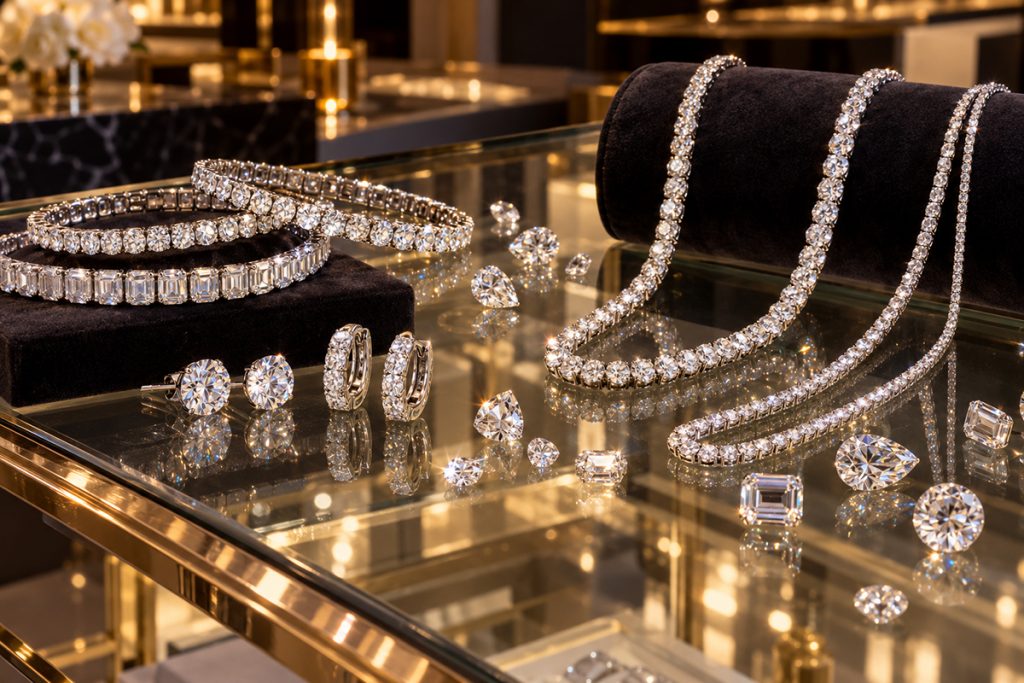
Shopping for lab-grown diamond jewelry? Learn how to choose beautiful earrings, rings, bracelets and necklaces without overpaying or missing important details.
A diamond doesn’t need an engagement ring to have a place in your jewelry box
A pair of diamond earrings with a favorite sweater. A necklace that works with nearly everything. A slim band worn alongside two rings you already own. A bracelet you put on for dinner and then decide you like enough to wear on an ordinary Tuesday.
That’s the part of diamond jewelry shopping this guide is about.
Lab-grown diamonds have given shoppers a much wider range of choices when it comes to everyday fine jewelry and more noticeable fashion pieces. A design that once seemed out of reach may now fit the budget. You can choose a larger pair of studs, put more sparkle into a bracelet, or spend more of your money on a setting you genuinely like instead of having the stone consume most of the budget.
That doesn’t mean every lab-grown diamond piece is a bargain, or that the largest diamonds automatically make the best jewelry. Some pieces are priced fairly for the amount of work and precious metal involved. Others look impressive in a photograph but feel less appealing when you examine the construction, the clasp or the way they sit against the skin.
Fashion jewelry is also a little different from shopping for an engagement ring. There usually isn’t one diamond at the center of every decision. A necklace might contain a dozen stones. A tennis bracelet could contain several dozen. Small earrings may not need individual reports, while a large diamond drop or statement ring deserves much closer inspection.
The question isn’t simply whether the diamond is real. It’s whether the whole piece makes sense for your wardrobe, your budget and the way you expect to wear it.
We’ll cover the diamond itself, of course. But we’ll also talk about gold versus silver, necklace lengths, earring comfort, bracelet security, colored diamonds, shopping online, warranties and what to do when a product description leaves out something important. There are examples of specific jewelry styles and Amazon listings later in the guide, plus questions you can take to a jeweler and AI prompts you can copy into ChatGPT, Gemini, Claude or another assistant.
One thing worth saying at the outset: use AI as a research assistant, not as the final authority on a diamond’s quality, a seller’s inventory or a store’s return policy. Ask for the reasoning, then verify important details with the actual retailer and independent documentation.
Helpful copy-and-paste AI shopping prompt: “I’m shopping for lab-grown diamond fashion jewelry, not an engagement ring. Help me narrow down the best type of piece for my lifestyle. My budget is [amount], I normally wear [metal colors], my style is [describe style], and I’d like to wear it [frequency and occasions]. Suggest three directions, explain the practical trade-offs, and tell me what information I should verify with the seller. Don’t make up prices or claim a product is in stock without a current listing.”
What a lab-grown diamond actually is
A lab-grown diamond is a diamond. It has essentially the same chemical composition, crystal structure, optical properties and hardness as a naturally formed diamond. Both are made of crystalline carbon, and both can produce the bright flashes and colored sparkle associated with diamond jewelry.
The difference is how the crystal formed. A natural diamond developed under geological conditions in the Earth. A laboratory-grown diamond was produced in a controlled manufacturing environment, using equipment that creates the conditions needed for diamond growth.
This matters because the term “lab-grown” sometimes gets lumped together with imitation stones. Cubic zirconia is not diamond. Moissanite is not diamond either, although both can be attractive in their own right. A properly identified laboratory-grown diamond belongs in a different category from these diamond lookalikes.
You generally cannot establish a diamond’s origin by glancing at it. Even a jeweler who has handled diamonds for years may need specialized testing equipment to distinguish laboratory-grown material from natural diamond. That’s one reason clear labeling and trustworthy documentation matter.
The same hardness is another advantage. Diamond ranks 10 on the Mohs mineral hardness scale, so it resists scratching exceptionally well. But hardness doesn’t mean indestructibility. A sharp blow can still chip a diamond, especially around a vulnerable corner or pointed tip. A ring setting can bend. An earring back can slip off. A bracelet clasp can wear out. Those are problems with jewelry that a high hardness grade cannot solve.
For fashion jewelry, the origin question is usually less interesting than what you can do with the design. Lab-grown diamonds allow a jeweler to use more stones, more generous sizes or unusual combinations while still making genuine diamond jewelry. That expands the possibilities for people who want diamonds without saving them exclusively for formal occasions.
Helpful copy-and-paste AI shopping prompt: “Explain the difference among laboratory-grown diamonds, natural diamonds, moissanite and cubic zirconia for someone buying earrings or necklaces. Compare appearance, scratch resistance, common price differences, care and accurate product labeling. Keep the explanation practical and avoid claiming that any material is better for everyone.”
Why lab-grown diamonds make sense for fashion jewelry
The familiar sales pitch is that lab-grown diamonds cost less than mined diamonds. That’s often true for comparable loose stones, and the difference can be substantial. However, there isn’t a reliable discount percentage that applies to every diamond, store, date or finished piece of jewelry. Prices change, especially in a market where manufacturing capacity and retail markups can change quickly.
A loose diamond is only part of what you’re paying for. A pair of studs needs two well-matched stones, two settings and secure backs. A tennis bracelet needs a long sequence of settings and moving links that work together. A pendant needs a properly made bail and chain. An intricate ring may involve a surprising amount of finishing and stone-setting labor even when the individual diamonds are relatively affordable.
That is why a reasonably priced lab-grown diamond does not automatically create inexpensive jewelry. A designer bracelet in substantial 18-karat gold may still carry a luxury price. On the other hand, an uncomplicated silver pendant could be a more accessible way to enjoy an actual diamond.
Where the difference becomes interesting is in the choices. You might prefer half-carat total-weight studs and use the money saved for solid gold rather than gold plating. You might decide that a slightly larger diamond pendant is worth the extra expense because it gets worn several days a week. You may discover that three delicate rings suit you better than a single oversized statement ring.
None of those choices requires following a fixed formula. In fashion jewelry, the right purchase is often the one that gives you the greatest pleasure when you’re getting dressed, not the one with the most impressive specifications on paper.
A common mistake is putting nearly all the attention on the stones because they have numbers attached to them. Diamond grades are easy to compare. The difference between an awkward clasp and a well-made clasp is harder to put on a product page. Yet the clasp may determine whether a bracelet becomes a favorite or spends most of its life in a drawer.
Helpful copy-and-paste AI shopping prompt: “Help me compare two lab-grown diamond fashion jewelry purchases: [describe item A and its price] and [describe item B and its price]. Evaluate diamond size and quality, metal, construction, comfort, maintenance, styling flexibility and return terms. Don’t pick the one with the larger carat weight just because it has more diamonds. Explain which unknown details could change the recommendation.”
Start with your wardrobe instead of the grading report
Before studying diamonds, open your jewelry box. This is more useful than it sounds.
Look at what you actually wear, not just what you own. Is there a small pair of gold hoops that seems to work every day? Are all your favorite necklaces approximately the same length? Do you reach for slim rings that sit close to your fingers, or does a larger ring feel more like you? Have you already stopped wearing certain bracelets because they caught on sleeves?
Those observations tell you what kind of diamond jewelry belongs in your life. A person who rarely wears earrings probably doesn’t need an expensive pair of diamond drops, no matter how beautiful the photographs are. Someone who prefers relaxed clothing might get far more use out of a casual station necklace than a formal-looking tennis necklace.
Think about the clothes you wear most often. Crewneck sweaters give necklaces a different background from open-collar shirts. A necklace that disappears under a high neckline can look terrific with a scoop neck. A bracelet that’s beautiful with bare arms might become annoying beneath fitted shirt cuffs.
Your other jewelry matters too. If you normally wear substantial yellow-gold pieces, a tiny white-gold pendant might seem disconnected. That doesn’t mean your metals must match. Mixed-metal styling can look deliberate and interesting. But proportions and visual weight should feel balanced.
It can help to decide whether the new piece has a job. Maybe it needs to make a simple outfit more interesting. Maybe it’s meant to live alongside your watch. Perhaps you’re building an ear stack or looking for a necklace you can wear alone. Each goal suggests different sizes, settings and designs.
Buying jewelry purely because a price dropped can be surprisingly expensive. If the piece never suits what you wear, the percentage off isn’t much of a consolation. A good sale helps only when the item itself already makes sense.
Helpful copy-and-paste AI shopping prompt: “Act as a practical personal stylist. I usually wear [describe clothes and colors], already own [list favorite jewelry], and dislike [styles or fit problems]. I want one lab-grown diamond jewelry piece that will get frequent use. Suggest a few jewelry types and proportions that would suit my wardrobe, then identify styles I should probably skip. Ask only for details that would meaningfully change your advice.”
Set a budget for the entire piece
It’s easy to search for a one-carat lab-grown diamond and forget that you’re purchasing an earring, ring or necklace rather than a loose stone. Keep the total finished price in mind from the beginning.
The stone may be affordable while the setting is not. Gold prices, metal weight, manufacturing, design, brand positioning, customization and retail service can account for a large portion of the bill. For bracelets and necklaces, the cost of setting dozens of stones securely can be substantial even when the stones are relatively small.
Think about your budget in layers. There’s the purchase price, including any additional charge for a longer chain, larger bracelet or preferred metal. There may be sales tax and shipping. You could need resizing, a different clasp, periodic maintenance or insurance for a particularly expensive piece. A purchase that only works if every additional cost is ignored may be the wrong choice.
It’s also worth deciding what deserves the extra money. For earrings, a comfortable secure backing may be worth more than an almost invisible clarity improvement. For a pendant, solid gold and a sturdy chain may matter more than moving one color grade higher. A tennis bracelet is often a place where construction deserves real attention because all those links move every time you wear it.
Don’t use the lowest-priced marketplace result as the automatic standard for every jeweler. A retailer who provides accurate documentation, careful matching, reliable repairs and helpful after-sale service may reasonably charge more. What you want is an understandable price difference, not a mysterious one.
Ask for an itemized explanation when spending a significant amount. A shop may not be willing or able to disclose its wholesale stone cost, and it doesn’t have to. But it should be able to explain the metal, diamond specifications, construction, warranty and services included in its selling price.
And resist the temptation to stretch the budget because a lab-grown diamond seems like a better deal than a mined one. A discount relative to another category of product isn’t extra money sitting in your account. Choose a price that feels comfortable for jewelry you’ll enjoy wearing.
Helpful copy-and-paste AI shopping prompt: “My all-in budget for lab-grown diamond fashion jewelry is [amount]. I’m considering [earrings/necklace/bracelet/ring]. Show me which features deserve the largest share of the budget, where I can compromise without an obvious loss in appearance, and the possible added costs to ask about. Don’t assume the least expensive listing is the best value.”
Cut matters, but it isn’t the whole design
Cut describes the diamond’s proportions, facet arrangement and how effectively it handles light. It has a major effect on brightness, flashes of color and the lively sparkle you notice as the jewelry moves. A very clear diamond can still seem dull if its proportions don’t work well.
For a single round brilliant diamond, an Excellent cut grade is a useful starting point. Some laboratories use Ideal terminology in their own grading systems. However, not every shape receives the same formal cut grade, and you should not assume that an emerald cut or pear shape is inferior simply because the listing doesn’t say “Excellent cut.”
Fancy shapes have their own visual personalities. An emerald cut produces broader flashes and reflective steps. An oval or pear can look elegant and elongated. A cushion may have a softer outline and a more varied light pattern. For these shapes, video and in-person inspection are often more informative than a grade alone.
Jewelry design also controls how the stone performs. A diamond inside a deep protective bezel may look different from the same diamond in an open prong setting. Closely packed pavé stones create a surface of twinkling light rather than a single large flash. A pendant that hangs at the right angle may sparkle more consistently than one that tips forward.
When shopping online, look for realistic video showing the jewelry moving. Some sellers use extremely bright lighting that makes almost every stone look dazzling. Natural daylight, ordinary indoor light and softer lighting are all useful. If the piece only looks convincing under a spotlight, you’ll want to know that before buying.
For a tennis bracelet, matched visual appearance matters as much as the individual cut specification. A line of well-coordinated small stones can look better than a bracelet where adjacent diamonds differ noticeably in brightness. The setting has to support the effect rather than interrupt it.
It’s fair to care about sparkle. Just don’t reduce an entire piece of jewelry to one cut grade. You are choosing a design that includes diamonds, not displaying a grading report on your wrist.
Helpful copy-and-paste AI shopping prompt: “I’m comparing [describe two lab-grown diamond jewelry designs]. Explain how the diamond shapes, cut styles and settings might affect their appearance in daylight and normal indoor lighting. Tell me what to look for in videos or store demonstrations, and point out which claims cannot be verified from photographs alone.”
Color: how white is white enough?
In the traditional D-to-Z grading scale, D represents the colorless end, while letters farther down the alphabet indicate increasing visible body color. A small shift in a laboratory report doesn’t always create an obvious difference once the diamond is mounted and worn.
There isn’t a universal reason to insist on D color for fashion jewelry. Many near-colorless diamonds look bright and attractive, particularly in smaller sizes or brilliant-cut shapes. In yellow-gold settings, the surrounding metal can add warmth to the overall appearance. White metals can make subtle warmth in the diamond more noticeable because of the contrast.
An emerald-cut diamond deserves a slightly different conversation from a tiny brilliant-cut accent. Its larger, open facets may make subtle color easier to see. A group of tiny stones along a bracelet offers a different viewing experience again. Their consistency as a group can matter more than pushing every one into the highest color category.
When selecting earrings, ask whether the pair is visually matched. The diamonds don’t necessarily need identical numerical grades to appear harmonious, but you don’t want one earring looking distinctly warmer than the other. The same principle applies to a symmetrical pair of drops or two matching stones in a ring.
Remember that colored diamonds use a different language. A deliberately pink or blue lab-grown diamond isn’t simply a poor colorless diamond. It belongs to a fancy-color category where hue, tone, saturation and even distribution affect how it looks. We’ll discuss those stones separately.
Don’t let a product page tell you that an expensive color grade will always be visible to the people around you. The lighting, setting, jewelry size and neighboring colors all change what your eye sees. Ask yourself whether the upgrade makes a difference you can actually appreciate.
Helpful copy-and-paste AI shopping prompt: “For [specific jewelry type] set in [yellow gold/white gold/rose gold/platinum/silver], explain how D-F, G-H and I-J color lab-grown diamonds may differ in appearance. Consider stone size and cut style. Avoid blanket claims that everyone can see or cannot see a one-grade difference. Recommend a practical comparison test.”
Clarity: pay for a clean appearance, not an impressive abbreviation
Clarity describes internal features and surface blemishes that may be present in a diamond. These characteristics are usually examined at 10-times magnification for traditional grading. Many of the marks that matter to a gemologist are impossible to spot when you wear the stone at normal conversational distance.
That is why the phrase “eye-clean” is useful, though it is not a formal universal grade. It generally means visible inclusions are not noticeable to the unaided eye under ordinary viewing conditions. What qualifies can depend on diamond size, cut, lighting, viewing distance and the person looking.
A VS1 or VS2 grade may be a comfortable range for many shoppers comparing a larger diamond with a detailed IGI report. Some SI stones can also look excellent. The grade by itself doesn’t guarantee an eye-clean appearance in every shape or size, and a higher grade doesn’t guarantee a prettier stone overall.
Emerald and Asscher cuts deserve closer scrutiny because their broad facets can make inclusions easier to notice. In tiny accent stones, those same subtle features may make practically no visual difference. It makes little sense to demand flawless grades for every diamond in a delicate pavé ring when the setting and overall consistency may determine most of what you see.
Some inclusions do matter beyond appearance. A feature that reaches the surface near a point, corner or edge may deserve examination for durability. A diamond can be hard and still be vulnerable to chipping. When buying an expensive featured stone, ask a qualified jeweler to review any concerning clarity characteristics rather than automatically trusting a simplified online description.
One other complication: photographs can magnify a diamond so much that tiny inclusions look enormous. If a retailer supplies a close-up image, ask for an actual-size reference. A dark speck that fills a computer screen may disappear when that diamond is mounted in a small pendant.
Your aim is jewelry that looks pleasing and holds up well, not the highest laboratory abbreviation at any price.
Helpful copy-and-paste AI shopping prompt: “I am considering a [shape] lab-grown diamond for [earrings/pendant/ring]. The report says [clarity grade] and the stone is [carat weight and measurements]. Explain what that grade does and does not guarantee. Tell me how to check whether it appears eye-clean, what inclusions might affect durability, and whether a higher grade would likely be worth paying for in this particular design.”
Carat weight is not the same as visual size
Carat is a unit of weight. One carat equals 0.2 grams. It’s a useful way to describe diamonds, but it doesn’t tell you exactly how large a stone will appear when viewed from the front.
Two diamonds with the same carat weight can have different proportions. One might carry extra depth and show a smaller face-up outline. Another may spread more visibly but have trade-offs in its light performance. That’s why measurements in millimeters deserve a look, especially when you’re comparing two oval, pear or emerald-cut stones.
Finished jewelry adds another layer of confusion: total carat weight. A pair of earrings advertised as one carat total weight generally means the combined diamond weight is one carat, not a full carat in each ear. A three-carat bracelet distributes that weight among many small stones. A ring with a one-carat center and surrounding accents may have a much larger stated total weight than the center stone alone.
This isn’t deceptive when labeled correctly, but it changes how you evaluate a piece. A bracelet with five carats spread across fifty stones won’t have the visual presence of five one-carat diamonds. A necklace with a large total may look delicate because the weight is distributed over a long length.
For earrings, think about millimeters, earlobe size and the weight your ears tolerate. Bigger isn’t automatically better. A heavy stud can tilt down, especially with a small backing. A moderately sized diamond with a supportive setting may sit better and be more comfortable.
For rings, remember that your hand moves constantly. A large stone can catch on pockets and cuffs. It may also turn more easily if the band is very thin or the setting is tall. For necklaces, the drop length, chain and pendant angle can change how large the diamond appears against clothing.
Once you know the total carat weight, ask how it is distributed. That single question clears up a surprising number of shopping misunderstandings.
Helpful copy-and-paste AI shopping prompt: “A seller describes this [type of jewelry] as [total carat weight]. Explain how that weight is distributed and what individual stone measurements I should request. Help me judge the likely visual presence and comfort using dimensions rather than assuming bigger total carat weight means larger-looking stones.”
Understanding diamond shapes as fashion choices
A round brilliant has a versatile look. It works in simple studs, classic pendants, tennis bracelets and rings that need to mix with other jewelry. Its lively sparkle also helps a relatively small stone draw attention. It’s popular for good reasons, though it isn’t the only sensible choice.
Oval diamonds have an elongated outline that can look graceful in drop earrings or a pendant. A north-south oval feels familiar and refined, while an east-west setting across a ring finger looks more contemporary. Check how dark areas appear as the stone moves, especially the central bow-tie pattern that can show up in some elongated cuts.
Emerald cuts have a calmer, architectural appearance. Their step-cut facets produce broader reflective flashes rather than the constant glitter of a round brilliant. They can look wonderful in a bezel pendant or a chunky signet-style ring. However, open facets also make clarity and color worth examining more carefully.
Pear shapes introduce asymmetry. They can be especially attractive as drops because the pointed end emphasizes length. A pear pendant with the point facing upward has a different feel from one worn point down. Because the tip is vulnerable, a protective prong or thoughtful bezel is worth discussing with the jeweler.
Marquise diamonds are narrow and pointed at both ends. Set horizontally, they can create a distinctive fashion ring; arranged as leaves or petals, they make interesting floral designs. Protecting the tips matters here too. A very long marquise also needs to be examined for balanced shape and dark areas.
Cushion cuts look a little softer, with rounded corners and a range of facet patterns. Princess cuts have a crisp square outline and often suit geometric designs. Asscher cuts lend themselves to graphic rings and vintage-inspired jewelry. Each brings a different mood to the finished piece.
Don’t let a trend make the selection for you. If you love tailored clothing and crisp lines, an emerald-cut pendant might suit you better than a very sparkly round one. If you normally wear delicate, romantic jewelry, a small pear or marquise may feel more natural. Try the shape in the setting you’ll actually wear before committing.
Helpful copy-and-paste AI shopping prompt: “Compare round, oval, emerald, pear, marquise, cushion, princess and Asscher-cut lab-grown diamonds specifically for fashion jewelry. My style is [describe]. Recommend shapes for [earrings/necklace/bracelet/ring], explain their visual character and vulnerable corners or tips, and suggest settings that work with each.”
The setting changes nearly everything
A setting does much more than hold a diamond in place. It determines the jewelry’s outline, the amount of visible metal, how the piece catches on clothing, how easy it is to clean, and in many cases how comfortable it feels.
Prong settings leave more of the diamond visible. They can give a pendant or stud a light, open appearance. The downside is that prongs can snag and must be checked periodically. Very thin or poorly finished prongs are not a sign of luxury, even if they make the stone appear less covered.
A bezel surrounds the diamond with a rim of metal. It gives a clean, defined outline and can protect vulnerable edges. Bezel-set studs can be comfortable with casual clothes, and a bezel pendant often has a pleasantly simple shape. But inspect the metalwork. An uneven bezel can be more noticeable than a small flaw in the diamond.
Pavé involves many tiny stones set close together, creating a sparkling surface. It’s attractive on bands, hoops and decorative pendants. The trade-off is maintenance. The smallest stones rely on tiny metal beads or prongs, and some designs offer little room for future sizing or repair.
Channel settings place diamonds between continuous metal walls. They’re often used on bands and structured designs where you want a smooth outer appearance. The channels should be even and secure. A channel-set piece that has distorted metal or poorly fitted stones may be difficult to repair neatly.
Flush or gypsy settings put the diamond into the metal surface. They can suit thicker rings, signets and jewelry meant to have a more understated look. Halo settings surround a featured diamond with smaller stones, increasing the overall sparkle and outline. Cluster settings use a group of diamonds to create a larger shape, sometimes giving more visual coverage than one stone would.
Don’t assume one setting is universally safer. Security depends on the workmanship and design, not just its category. A well-made prong setting may be more dependable than a poorly made bezel. A bracelet’s numerous connections are also part of its security, even when every diamond is perfectly set.
Helpful copy-and-paste AI shopping prompt: “I’m deciding among prong, bezel, channel, pavé and flush settings for a lab-grown diamond [type of jewelry]. I wear jewelry while [describe daily activities] and dislike [snagging, weight, frequent cleaning or other concerns]. Compare how each setting looks, feels, wears and can be repaired. Suggest questions I should ask about workmanship before buying.”
Choosing the metal without regretting it later
A lab-grown diamond can be mounted in sterling silver, gold, platinum and several other metals. The right choice involves budget and personal taste, but also wear, repairability and how long you want the finish to look the same.
Solid 14-karat gold is a practical option for many frequently worn pieces. It’s an alloy rather than pure gold, which helps it hold its shape. Solid 18-karat gold contains a higher proportion of gold and often carries a richer yellow color, depending on the alloy. It can cost more and may behave differently under wear because of its composition.
White gold is an alloy and is often finished with rhodium plating to achieve a bright white appearance. Over time, that outer finish may wear and need refreshing. Yellow gold has a warm color that’s easy to mix with many wardrobes. Rose gold gets its tone from the metals used in its alloy and can look particularly attractive with softer colored diamonds and skin tones.
Platinum is a dense precious metal frequently chosen for high-end fine jewelry. Its surface develops wear and patina over time, and it has its own maintenance considerations. It shouldn’t be sold as maintenance-free simply because the price is high.
Sterling silver offers a more accessible option for diamond fashion pieces. It can tarnish and may scratch or bend more readily than some gold alloys, depending on the construction. A well-made silver necklace may provide years of pleasure, but a very fine silver tennis bracelet needs close attention to link strength and clasp quality.
Gold vermeil, gold-plated silver, gold-plated brass and solid gold are not interchangeable descriptions. Plated finishes have an outer layer that can wear away. Vermeil has specific material and thickness requirements under U.S. guidance. Always ask what lies beneath the finish, what is plated, and whether the exposed parts can be renewed.
For people with metal sensitivities, “hypoallergenic” alone is too vague. Ask which alloys are used for posts, backs and other skin-contact surfaces. If you know you react to a particular metal, the manufacturer’s actual composition is more useful than an advertising label.
The most sensible compromise may be a smaller diamond in a better-made solid-metal setting. That’s not as exciting as a giant carat number, but it’s often more satisfying after six months of regular wear.
Helpful copy-and-paste AI shopping prompt: “Compare solid 10K, 14K and 18K gold, white gold with rhodium plating, platinum, sterling silver, gold vermeil and ordinary gold plating for a lab-grown diamond [item]. My budget is [amount], I wear it [frequency], and I have [any known sensitivity]. Explain expected maintenance, finish wear and questions to ask about the exact metal composition.”
Diamond stud earrings: small details make a big difference
Diamond studs are one of the easiest ways to introduce lab-grown diamonds into an everyday wardrobe. They can look polished with a button-down shirt, relaxed with a T-shirt, or dressy with an evening outfit. The design is simple enough that you might expect very little to compare. In practice, choosing a comfortable pair involves several decisions.
Start with diameter rather than the photograph’s dramatic close-up. A small stud can sit neatly on the earlobe and add a bright point of light. A larger pair becomes an obvious feature of the face. Neither is right for everyone. Hair length, earlobe size, personal style and other earrings all influence the effect.
Pay attention to total carat weight. If the description says one carat total for the pair, you are probably looking at two diamonds that together weigh approximately one carat. Check the details rather than assuming the listing photograph represents a specific variant. Many Amazon listings place multiple carat weights, metal colors and backing styles on one page.
Matching matters. The two diamonds should be reasonably coordinated in size, color and apparent brightness. You shouldn’t have to study them under magnification to see the match. Place the pair together in ordinary lighting, or request a photograph of the actual earrings rather than two separate stock images.
The backing is a surprisingly personal choice. Traditional friction backs are familiar and convenient, but they need to fit securely. Screw backs can provide additional reassurance for some wearers, though they can be more fiddly and aren’t automatically better in every design. Larger backs can help heavy earrings sit upright. The length and thickness of the post also affect comfort.
Think about the profile. A tall basket may push the diamond away from the ear, while a low bezel or basket can feel more compact. If studs tend to droop on you, the position of the post, the weight of the setting and the size of the backing are worth discussing before buying larger stones.
A pair intended for daily wear should survive ordinary routines, but remove earrings for activities likely to snag them. Check the posts for rough edges and ask how replacement backs are handled. If you have sensitive ears, ask about the entire post and backing material, not only the decorative setting in front.
For a first pair, a modest round brilliant set in well-made gold can be a very sensible place to start. But a sleek bezel, tiny pear or emerald-cut stud can feel more personal if that suits your style. Buy the pair you can imagine reaching for when you’re in a hurry.
Helpful copy-and-paste AI shopping prompt: “Help me choose lab-grown diamond stud earrings for everyday wear. My budget is [amount], my earlobes are [small/medium/large or describe], and I prefer [subtle/noticeable] earrings. Compare total carat weight, approximate diameter, bezel versus prong settings, friction versus screw backs, and metal options. Explain what to verify on a listing with multiple variants.”
Huggies, hoops and drops: diamonds that move with you
Huggie earrings sit close to the earlobe, usually forming a small hoop. That closeness can make them easy to wear with layered piercings, glasses and a range of hairstyles. Diamond huggies may have a row of small stones along the front, a single diamond hanging from the hoop, or diamonds arranged along a wider surface.
The fit is more important than it first appears. A small huggie can be uncomfortable if its inner diameter doesn’t leave enough room around your earlobe. On the other hand, one that sits too far from the ear may lose the compact look you wanted. Ask for the inner diameter in millimeters, not just an overall product measurement.
Check the hinge and catch. A hoop that clicks into place cleanly should feel more reassuring than one requiring force or repeated adjustment. Thin hinged sections are areas that deserve special attention. If the earring has dangling diamonds, confirm how the drops are attached and whether their movement is likely to catch on hair or clothing.
Diamond hoops can range from a light accent to a prominent fashion statement. Some place diamonds only along the front-facing surface. Others use an inside-out arrangement that puts stones on part of the interior back, helping them remain visible from certain angles. Compare actual photos of the earrings worn on a person. A front-view product shot cannot tell you exactly how the diamonds will show when your head turns.
Long drops introduce movement and can make even modest diamonds noticeable. For an evening piece, that may be exactly what you want. For daily errands, consider the length, overall weight and whether the drops swing into your neck or collar. Beautiful earrings that keep catching in your hair rarely become everyday favorites.
Fashion is the deciding factor here. A pair of tiny diamond huggies can feel casual and contemporary, while a dramatic pair of multi-stone drops asks for a different kind of outfit. It’s perfectly reasonable to have one pair for each purpose. What’s less useful is buying a formal design and expecting it to behave like an unobtrusive daily earring.
Helpful copy-and-paste AI shopping prompt: “I’m choosing between lab-grown diamond huggies, hoops and drop earrings. I have [ear piercings and earlobe description], often wear [hair and clothing styles], and want them for [daily use/events]. Tell me which dimensions, hinge details, metal composition and setting choices I should confirm, and how to judge comfort from retailer photos.”
Diamond pendant necklaces: where placement matters more than expected
A single diamond pendant sounds straightforward. You choose the stone, select a chain, and you’re finished. Yet the same pendant can look entirely different depending on where it falls against your neckline.
A shorter chain can position the diamond near the collarbone. A longer chain may work with layered necklaces or an open shirt, but can disappear beneath some clothing. Adjustable chains are useful if you regularly change necklines. Check the actual adjustable lengths rather than assuming an extender will give you every position you want.
A fixed pendant and a sliding pendant behave differently. A stationary design holds the stone in a chosen place along the chain. A sliding bail may allow more movement but also change the way the diamond sits. Some designs flip, tilt or drift to one side. When you’re looking at product videos, watch the pendant while the wearer moves, rather than only when it has been carefully arranged for a photograph.
The chain deserves as much attention as the diamond. An exceptionally delicate chain can look pretty but may be unsuitable if you’re hard on jewelry. Check the chain style, clasp, width, construction and whether a replacement can be purchased. If the listing includes a chain, confirm that it is made of the same advertised metal as the pendant.
A bezel pendant offers a clean outline and may feel less fussy than exposed prongs. A prong-set round diamond can produce a more traditional look with plenty of visible stone. An east-west oval or emerald-cut pendant feels more geometric. A pear creates a graceful vertical drop.
Pendant weight matters too. A large stone on an extremely thin chain may feel visually unbalanced. A small stone on a very substantial chain can be charming if the contrast is deliberate. Neither combination is automatically wrong; the proportions need to make sense together.
Consider how the necklace will be stored. A fine chain tossed into a jewelry drawer is an invitation to knots. If you’re buying as a gift, a simple storage solution and clear chain-length information may be more helpful than elaborate packaging alone.
Helpful copy-and-paste AI shopping prompt: “I’m shopping for a lab-grown diamond pendant necklace to wear with [clothing necklines]. My height/build is [optional description], I prefer [yellow/white/rose] metal, and I want [delicate/medium/noticeable] visual impact. Compare likely chain lengths, adjustable versus fixed chains, pendant shape, and bezel versus prong designs. Tell me what dimensions and chain specifications to request.”
Station necklaces and diamond necklaces for layering
A station necklace spreads small diamonds or diamond-set motifs along a chain, leaving sections of metal visible between them. It can add interest without the more formal appearance of a continuous line of stones. For people who enjoy wearing two or three necklaces at once, this style can be a particularly flexible choice.
Pay attention to where the diamonds sit. Some designs distribute stations evenly around the entire necklace. Others put most of the stones toward the front. If the necklace rotates, a decorative pattern may move out of view. If you normally wear long hair, consider whether stones at the back will be hidden or whether their settings could catch in your hair.
A station necklace can be more delicate-looking than its total carat weight suggests because the diamonds are separated. That’s part of its appeal. The style relies on rhythm and spacing, not a solid wall of diamonds. Look for balanced placement and smooth transitions between each setting and the chain.
When layering, vary lengths enough that the pieces do not sit directly on top of one another. A plain gold chain can provide contrast to a diamond station necklace. A small pendant can work alongside stations as long as the elements aren’t constantly tangling. Different link types and weights can influence how well the necklaces settle together.
If you are considering a full tennis or Riviera necklace, the buying process changes. A continuous line of diamonds has substantial weight and many connections. It should drape evenly around the neck rather than behaving like a stiff metal collar. It should also resist twisting so the diamonds stay facing outward.
Shorter tennis necklaces can sit high at the neckline, while longer styles have a softer drop. The total carat weight can become large quickly, but the individual stone sizes, necklace length and flexibility determine much of the appearance. An impressive number on a listing doesn’t tell you whether the necklace will lie comfortably.
Before spending heavily on a continuous diamond necklace, ask to see it worn and moving, ideally on someone with a similar neckline and build. A still photograph is not an adequate test of a piece with that many moving parts.
Helpful copy-and-paste AI shopping prompt: “Compare a lab-grown diamond station necklace, solitaire pendant and full tennis necklace for my wardrobe. I wear [necklines], layer [number] necklaces, and have a budget of [amount]. Explain differences in drape, chain strength, visibility, total carat weight, clasp design and everyday practicality.”
Tennis bracelets: inspect the links, not just the diamonds
The appeal of a diamond tennis bracelet is easy to understand. A continuous row of stones moves with the wrist and gives a simple outfit a noticeable amount of sparkle. Lab-grown diamonds can make this style more accessible, but a bracelet has more mechanical parts than many shoppers realize.
Every small setting is connected to the next. Those connections need enough flexibility to follow the wrist and enough strength to hold the bracelet together. A bracelet that is too stiff may sit awkwardly or turn. One with weak links may become a repair project.
Try the bracelet on if possible. It should move comfortably without sliding so far that it gets in your way. Too tight can make movement unpleasant and place stress on the construction. Too loose can allow the bracelet to catch or slip over your hand. Wrist circumference, preferred drape and clasp design all affect the correct length.
Examine the clasp, especially on more expensive pieces. Box clasps, safety latches and other mechanisms vary in quality. Ask whether the bracelet has an additional safety feature and whether the clasp can be serviced or replaced. A secure clasp is worth caring about even if the diamonds are beautiful.
The arrangement of stones affects appearance. Small, closely matched diamonds can produce a fine line of light. Larger stones create a bolder bracelet and may make the settings more noticeable. The number of diamonds, the width of the bracelet and the metal between stones help determine the final effect.
Four-prong, three-prong and bezel constructions all have their own look. A bezel-set bracelet has more visible metal around each stone but can produce a smooth, contemporary profile. A delicate prong-set bracelet may feel lighter and show more individual sparkle. The best choice is the one that balances appearance, security and your tolerance for maintenance.
Pay special attention when the bracelet is made of silver or plated metal. Those options can reduce the price, but the product’s price alone doesn’t tell you how the links and clasp will behave over years of wear. Ask about repair support and replacement stones before buying an expensive multi-stone piece through a marketplace.
A tennis bracelet can be a wonderful fashion purchase. Just remember that you’re buying a miniature chain of carefully fitted settings, not simply buying a pile of diamond carats.
Helpful copy-and-paste AI shopping prompt: “Help me evaluate a lab-grown diamond tennis bracelet. The listing says [carat total], [metal], [length], [stone count if known], [setting] and [price]. Tell me how to judge fit, flexibility, diamond matching, clasp security, link durability and maintenance. Explain what product photos cannot establish and draft questions for the retailer.”
Fashion rings, cocktail rings and stacking bands
A lab-grown diamond ring doesn’t need to look like an engagement ring. Some of the most interesting fashion choices use diamonds as part of a shape rather than as a single stone sitting high above a narrow band.
A stackable diamond band can add texture to a collection you already wear. Slim bands with spaced diamonds feel different from continuous pavé bands. A channel-set ring offers a cleaner outline, while a wider design with flush-set diamonds can look almost architectural.
Try stacking rings together before buying them as a set. Two individually attractive bands may rub against each other or sit at awkward heights. Diamonds or prongs on the side of one ring can scratch or damage the neighboring ring’s metal. A ring that feels smooth on its own can become uncomfortable when crowded between two others.
For a full eternity band, diamonds circle the finger. The design can look beautiful from every angle, but sizing and future alterations can be difficult. A partial eternity band leaves some plain metal, often making resizing easier and keeping stones away from the palm side where they may take more knocks.
Statement rings deserve a different kind of test. A broad ring can feel secure on the finger but may be uncomfortable when gripping a steering wheel or carrying bags. A tall cluster can catch on sweaters. A large east-west emerald cut may be more wearable in a lower, protective setting than in a high basket.
Fashion rings are an excellent place to consider unusual diamond shapes and layouts. A diagonal row of marquise stones, a bezel-set oval across the finger, or a mixture of round and baguette-like shapes can feel more distinctive than simply increasing the size of one center diamond.
Don’t forget the inside of the ring. Smooth finishing, comfortable edges and enough room for the finger to move are part of quality. Wider rings can fit differently from narrow bands; don’t assume the same size works in every design.
When buying online, inspect photographs of the underside and profile. If the seller shows only a flattering top view, ask for more. A fashion ring should be interesting from above and comfortable from below.
Helpful copy-and-paste AI shopping prompt: “I want a lab-grown diamond fashion ring, not an engagement-style solitaire. My everyday rings are [describe], my finger size is [size], and I prefer [delicate/bold/architectural/vintage] designs. Compare stackable bands, partial eternity bands, bezel rings, signets and cocktail rings. Address resizing, snagging, ring height and comfort.”
Colored lab-grown diamonds: choose the color you see, not the label
Lab-grown diamonds aren’t limited to colorless and near-colorless stones. Pink, blue, yellow and other colored diamonds can give fashion jewelry a very different personality. An understated gold pendant with a pale blue diamond may feel more relaxed than a white diamond of the same size. A strong pink diamond can make a small ring the center of an outfit.
Fancy-color diamonds are evaluated differently from diamonds on the D-to-Z colorless scale. The most important visual questions are what color you see, how strong it appears, whether the tone suits the setting, and how evenly the color is distributed.
Photographs can distort all of that. A diamond that looks saturated blue on a bright screen may appear softer in person. A yellow stone can become warmer beside yellow gold. Pink may look stronger or weaker depending on skin tone, background and lighting. Compare videos and photographs made under different lighting conditions where possible.
It’s also important to ask whether the color resulted from the growth process or from treatment after growth. Either can be legitimate, but the seller should describe the stone accurately and disclose treatments where required. A report or professional explanation may help clarify what was done.
Choose a setting that allows the color to read clearly. White metal can produce contrast around certain stones. Yellow or rose gold can harmonize with warmer tones. A halo of colorless lab-grown diamonds may emphasize a colored center, though it also gives the piece a more formal appearance.
Try not to buy colored diamonds purely because the color is fashionable this month. Jewelry can stay with you for years. A color you already enjoy wearing is generally a safer choice than one you admire only because it’s everywhere on social media.
For gifts, think carefully about personal taste. A neutral diamond stud is easier to give without knowing someone’s wardrobe. A vivid colored diamond makes a stronger statement and deserves more information about what the recipient actually likes.
Helpful copy-and-paste AI shopping prompt: “I’d like lab-grown diamond fashion jewelry in [pink/blue/yellow/another color]. My wardrobe colors are [describe] and I prefer [subtle/vivid] jewelry. Explain color intensity, color consistency, possible treatments, setting-metal choices and why online photos may be misleading. Help me draft questions to verify the exact color being sold.”
How diamonds are grown: CVD, HPHT and visible differences
You’ll probably encounter the abbreviations CVD and HPHT if you read enough diamond descriptions. They refer to two manufacturing methods used to grow diamond crystals. Knowing the terms can be useful, but the method isn’t a reliable shortcut for deciding whether a finished diamond looks beautiful.
CVD stands for chemical vapor deposition. In broad terms, diamond material grows on a seed crystal in a controlled chamber using a gas-based process. HPHT stands for high pressure, high temperature, a method that uses extreme pressure and temperature conditions to grow diamond material.
Both methods can produce attractive, high-quality diamonds. Both can also produce characteristics that a trained gemologist may identify. Some CVD-grown diamonds can show brownish coloration, growth strain or other optical effects. Certain HPHT-grown stones can show a faint bluish or grayish appearance. These are possibilities, not outcomes that apply to every diamond from either process.
Growth method and any subsequent treatment may appear on a laboratory report or in its comments, depending on the service and report type. Ask what the jeweler knows, but don’t reject a good-looking diamond solely because a sales article has described its growth method as inferior.
The better practical test is to view the actual stone or a reliable representation of it. Look for odd undertones, haze, dark areas and uneven light return. Rotate the diamond under ordinary lighting. See whether the concern is apparent to your eye or only appears in a greatly magnified photograph.
For a tiny diamond set into a bracelet, this level of individual inspection may not be possible or necessary. For a large featured diamond in a pendant or fashion ring, it’s entirely reasonable to spend more time on the details.
Remember that a salesperson may not know the growth method for every small mounted stone. That lack of detail doesn’t automatically mean the jewelry is questionable. The important thing is honest labeling, suitable quality for the price and accurate documentation where documentation is being promised.
Helpful copy-and-paste AI shopping prompt: “Explain CVD and HPHT lab-grown diamonds without assuming either process is always better. I’m considering a [diamond size and shape] for [jewelry type]. What appearance issues might I check for, what may be reported by an independent lab, and what questions should I ask if the seller doesn’t know the growth method?”
Grading reports in 2026: know what you’re looking at
Diamond documentation has changed, and this is one place where older shopping advice can mislead you. Traditionally, consumers learned to look for the 4Cs and compare detailed cut, color, clarity and carat information. That system is still important, but not every major laboratory now reports colorless lab-grown diamonds in the same way.
The International Gemological Institute, or IGI, offers laboratory-grown diamond reports with detailed assessments using the familiar 4Cs. It can also issue reports for finished jewelry, describing the article, gemstones and metal information within the limits of examination. Details vary by report and service.
The Gemological Institute of America, or GIA, introduced an updated system for qualifying colorless-to-near-colorless laboratory-grown diamonds on October 1, 2025. Instead of the traditional D-to-Z color and clarity nomenclature used for natural diamonds, its current laboratory-grown diamond quality assessment classifies eligible stones as Premium or Standard, based on defined quality criteria. GIA also offers a separate service for colored laboratory-grown diamonds. Older GIA laboratory-grown reports using a former format can still be encountered; a report’s issue date matters.
That means an article insisting that every GIA-graded lab-grown diamond must have an E color and VS1 clarity on a new report is out of date. It is also wrong to conclude that a diamond without an individual report must be fake. Many inexpensive or very small accent diamonds are sold as part of finished jewelry without separate reports for every stone.
For an expensive loose diamond or prominent center stone, ask for an independent report number and verify it directly with the issuing laboratory. Understand exactly which diamond the document describes. For finished multi-stone jewelry, a jewelry report, detailed retailer specifications and a credible return policy may be more practical than expecting fifty individual diamond reports.
Laser inscriptions can help connect a loose diamond to its report, but inscriptions are microscopic and need magnification. They are not automatically present on every stone in every piece. The inscription wording may also differ among laboratories. Do not rely on a seller’s claim that all genuine lab-grown diamonds must carry the same two-letter mark.
A grading report is not an appraisal, a warranty, a prediction of resale value or proof that a particular mounting is well made. It answers certain gemological questions. You still need to evaluate the jewelry itself.
Helpful copy-and-paste AI shopping prompt: “I have a lab-grown diamond report issued by [IGI/GIA/other] on [date], report number [number if I choose to share it], for [stone or jewelry]. Help me understand its terminology and explain how GIA’s post-October-2025 Premium/Standard assessment differs from IGI’s 4C reporting. Tell me how to verify the report with the laboratory and what the document cannot prove.”
What to ask a jeweler before you decide
A good jeweler should be able to talk about the piece in ordinary language. You shouldn’t need to pretend you understand a technical term just to keep the conversation moving. Ask to see the jewelry in different lighting. Ask what the metal is. Ask how the closure works. Ask what happens if something needs repair.
For a large featured diamond, ask whether there’s an independent report and how you can verify it. If the stone is mounted, ask which observations are still possible. Check whether the dimensions, identifying information and advertised quality match the supporting paperwork.
For earrings, ask whether the two diamonds were matched for appearance and whether the backs can be replaced. For a tennis bracelet, ask whether the links and clasp are serviceable. For an eternity ring, ask about resizing before you buy. For a necklace, check the chain metal, length, clasp, pendant attachment and whether the pendant tends to flip.
Ask directly about the metals. “Gold” may refer to solid gold, plated silver or another construction. “White” may describe rhodium plating rather than an underlying white metal. You deserve more precise information when you’re buying fine jewelry.
A retailer should also tell you about its return conditions without making you search through multiple pages of fine print. Find out whether sale items, customized pieces, resized rings or engraved jewelry are excluded. Ask whether shipping is refunded, whether return labels are supplied, and who bears the cost of an insured return.
Warranty language deserves careful reading. Some warranties cover manufacturing defects but not accidental damage, loose stones caused by a hard impact or normal wear. Some require regular inspections. Others cover cleaning but not repairs. None of these policies is necessarily unreasonable; the terms simply need to be clear.
If you shop in person, resist pressure to make an immediate decision. If you shop online, save a copy of the specifications and policies as they appeared when you ordered. Either way, the person selling you the jewelry should be comfortable answering reasonable questions before accepting your money.
Helpful copy-and-paste AI shopping prompt: “I’m about to contact a jeweler about this lab-grown diamond fashion jewelry listing: [paste description]. Draft a polite, concise message asking about the most important missing details, including the metal, total versus individual carat weight, report or verification, clasp or setting, repairability, return terms and warranty. Don’t ask irrelevant questions if the listing already answers them.”
Buying online: understand the photograph you’re seeing
An online jewelry listing is a carefully selected view of a product. That’s normal, but it means you need to look beyond the prettiest image.
A high-resolution close-up can make a tiny diamond look enormous. The same jewelry photographed on a model may appear very different from its isolated product photo. Some retailers use computer-generated images or representative photography for configurable pieces, so the photograph may not depict the exact metal and carat option currently selected.
Check every drop-down menu and variant. A listing may start with a small sterling-silver option but prominently feature a photograph of a larger gold version. Price and product specifications may change when you switch options. If the image remains the same, verify the actual dimensions in the selected variant’s written description.
Look for a side view and a rear view. These reveal the thickness of a setting, the way an earring post attaches, the underside of a ring and the mechanics of a clasp. A comfortable bracelet should be shown bending naturally. A pendant should be pictured on a model or beside a ruler so you can judge scale.
Reviews can be useful when they describe details that photographs miss: whether earrings are heavy, whether a clasp is difficult, whether a chain feels fragile, or whether a ring runs small. However, a review might refer to a different variant, color or seller. Read the actual review context rather than relying solely on the overall star rating.
Check who is selling and fulfilling the order. A familiar marketplace logo does not automatically mean the platform manufactured or inspected the jewelry. Look for seller history, clear contact information, accurate descriptions and a reasonable process for resolving problems.
If an item is described as independently graded, verify that the report belongs to your specific stone or clearly understand whether the report describes a representative sample or the complete jewelry piece. Promotional phrases like “certified sparkle” are not substitutes for a recognized document.
Finally, use the return window deliberately. Inspect the jewelry promptly in good light, before removing tags that affect eligibility. Compare it with the order confirmation. A problem noticed on the first day is much easier to resolve than one raised after a return period has expired.
Helpful copy-and-paste AI shopping prompt: “Evaluate this online listing for lab-grown diamond fashion jewelry: [paste title, specifications, seller name and return policy]. Identify ambiguities about product variants, stone size, metal, photos, independent grading and fulfillment. Make a short list of facts I need to verify myself before ordering. Do not infer inventory or seller reliability from the product description alone.”
The value question: what you’re buying and what you probably aren’t
Lab-grown diamond jewelry can be a very satisfying purchase without being a financial investment. Those are two different ideas, and confusion between them can lead to disappointment.
The market price of laboratory-grown loose diamonds has changed considerably as production has expanded and manufacturing has improved. That makes resale value unpredictable and, in many cases, modest relative to the original retail price. You shouldn’t purchase a diamond necklace expecting the stones to hold their retail value or appreciate just because they are diamonds.
Natural diamonds are not guaranteed investments either. Their resale results depend on many factors, including condition, quality, demand and transaction costs. But the economics of lab-grown diamonds are particularly important because the cost of manufacturing a comparable new stone can continue to change.
A finished jewelry piece has other sources of value. It may contain meaningful amounts of gold or platinum. It may feature difficult setting work, beautiful design or a respected designer’s craftsmanship. It may have sentimental meaning because of the occasion or person connected with it. None of those things necessarily translates into an attractive resale offer.
If resale value matters, ask a specialist what comparable secondhand pieces actually sell for rather than using the original retailer’s replacement valuation. Insurance replacement values and resale values answer different questions. A high appraisal doesn’t mean a buyer will offer that amount in cash.
For most fashion jewelry purchases, cost per wear is a more useful personal test than hypothetical investment performance. A well-made pair of studs worn several times a week may provide more satisfaction than a spectacular necklace that only leaves its box once a year. That doesn’t make an occasional statement piece a poor choice. It just means you should know what you’re paying for.
The pleasure of wearing beautiful jewelry is real, even when the resale return isn’t. Buy lab-grown diamonds because you like the design and want to wear them, not because a sales pitch promises future profit.
Helpful copy-and-paste AI shopping prompt: “I’m thinking about spending [amount] on a lab-grown diamond [jewelry piece]. Help me evaluate its personal value, expected use, craftsmanship, metal content, maintenance and possible resale limitations. Explain the difference between an insurance appraisal, a retail price and what a secondhand buyer might actually pay. Avoid predicting appreciation.”
Ethical and environmental questions deserve specific answers
One reason shoppers consider lab-grown diamonds is that producing them does not require extracting the diamond crystal from a mine. That is a meaningful difference, but it doesn’t justify treating every laboratory-grown diamond as automatically harmless to the environment or guaranteed free of labor concerns.
Growing diamond crystals uses equipment, energy and industrial processes. The environmental footprint can depend on electricity sources, manufacturing efficiency and what activities are included in the calculation. A diamond grown using electricity from renewable sources may have a different emissions profile from one produced using a fossil-fuel-heavy electricity supply.
Mining has its own environmental and social effects, and conditions differ among operations and supply chains. A responsible comparison looks at documented practices rather than simply placing all mined diamonds in one category and all lab-grown diamonds in another.
Be skeptical of blanket labels such as “100% sustainable,” “zero impact” or “completely ethical” without a precise explanation. The Federal Trade Commission cautions businesses about broad, unqualified environmental claims. More useful information includes where production occurred, what evidence supports renewable-energy claims, whether emissions were measured, and how the company describes labor practices and material sourcing.
For finished jewelry, remember to consider the metal, too. The diamond isn’t the entire product. Recycled precious metal, responsible sourcing, durable design and repair support can be part of a considered purchase, although any particular claim still deserves verification.
Some consumers prioritize avoiding newly mined diamond material. Others focus on recycled metals, proven manufacturing information, price or the ability to purchase a piece that will last. You are allowed to weigh those factors differently. What matters is making the choice with accurate information rather than slogans.
If a retailer publishes an environmental assessment, check who conducted it and what it actually measures. Energy used in the diamond-growing stage isn’t identical to the total footprint of a finished ring traveling through manufacturing, retail and delivery.
The clearest answer may sometimes be that the seller doesn’t have complete data. That is more useful than a confident but unsupported claim. If environmental considerations are central to your purchase, choose a business willing to supply specifics.
Helpful copy-and-paste AI shopping prompt: “I care about environmental and labor issues when buying lab-grown diamond jewelry. Review these claims from a seller: [paste exact wording]. Separate verifiable statements from vague marketing language. Suggest documentation I should request about manufacturing energy, electricity sourcing, metal content and labor practices. Do not assume lab-grown diamonds always have a lower footprint in every comparison.”
What luxury means when the diamonds were grown in a lab
There’s a misconception that jewelry made with laboratory-grown diamonds must be inexpensive because the stones may cost much less than comparable mined diamonds. Look at a complicated diamond necklace or a carefully constructed platinum ring and the weakness in that idea becomes obvious.
A luxury piece can require substantial precious metal, highly skilled stone setting, custom design, finishing and repeated quality checks. A multi-row bracelet needs dozens or hundreds of decisions about matching, alignment and security. The lower cost of the diamonds doesn’t make that work disappear.
Design also has value beyond material weight. A well-conceived piece might be beautifully balanced, distinctive without being awkward, and comfortable enough that you keep wearing it. Those qualities are harder to capture in a carat-weight comparison, but they are often what separates jewelry you merely own from jewelry you love.
Brand reputation can justify some differences in service, workmanship, design or customer experience. It can also contribute a sizeable premium that a shopper may not wish to pay. A brand name alone doesn’t guarantee better construction, just as a lower-profile jeweler doesn’t automatically offer better value.
For costly purchases, ask for the details that can support the price: metal weight where available, construction, stone specifications, repair policies, maker’s craftsmanship and the quality of the clasp or setting. Compare like with like. A handmade 18-karat gold bracelet and a plated silver bracelet can both be attractive, but they aren’t interchangeable products.
If a custom jeweler can make the design you want, ask about sketches, models, approvals, deposits and revision policies. Custom-made does not mean the work can be returned or altered indefinitely. The more you agree on before production, the fewer surprises you’re likely to face later.
Luxury should ultimately mean something beyond expense. In fashion jewelry, it often comes down to a design that suits you, materials you understand and craftsmanship you can appreciate each time you wear it.
Helpful copy-and-paste AI shopping prompt: “I’m comparing a designer lab-grown diamond piece costing [price] with a similar-looking piece costing [price]. Help me distinguish genuine differences in metal, weight, setting work, design, service, warranty and brand premium. Tell me what evidence would justify the higher price and which differences might be mostly cosmetic.”
Care, cleaning and the repairs you should expect
Lab-grown diamonds don’t need an entirely different cleaning routine from natural diamonds. The stone material is essentially the same, but the jewelry’s metal and setting still determine what cleaning is safe.
For many uncomplicated diamond pieces, warm water, a small amount of mild dishwashing liquid and a very soft brush can remove oils and everyday residue. Work gently around the setting, rinse carefully and dry with a soft lint-free cloth. Cover the drain or use a bowl rather than cleaning over an open sink.
That basic approach isn’t suitable for every piece. Delicate antique-style settings, fragile pavé, mixed gemstones, pearls, glued components and certain finishes may require a gentler method. If you’re unsure about a specific piece, ask the jeweler before using soap, brushes or water.
Avoid household bleach, abrasive cleaners and toothpaste. These can harm precious metals and finishes even when the diamond itself is resistant to scratching. An ultrasonic cleaner isn’t automatically safe just because the stones are diamonds. The vibration can aggravate loose settings, and some jewelry shouldn’t be exposed to it at all.
Make regular inspections part of the routine. Check for a prong that catches fabric, a bracelet link that feels stiff, an earring back that’s become loose or a clasp that no longer clicks decisively. For frequently worn fine jewelry, a periodic jeweler inspection is a reasonable precaution; the right interval depends on how the piece is worn and its construction.
Store pieces so that diamonds don’t rub directly against other jewelry. Diamond can scratch other gemstones and metals, and diamond-on-diamond contact can create damage as well. Separate soft pouches or lined compartments are useful. Give fine chains their own space to reduce tangling.
Remove jewelry for activities likely to cause impact, snagging or chemical exposure. Taking off a ring before rough physical work doesn’t mean the diamond is fragile. It means the entire piece has parts that can be damaged.
If a small diamond comes loose, keep it if you can find it and contact the jeweler. Don’t attempt to push a damaged setting back into shape yourself. A professional can assess whether the problem is limited to one stone or indicates a broader issue with the construction.
Helpful copy-and-paste AI shopping prompt: “Make a care plan for my lab-grown diamond [piece], made of [metal] with [setting] and any other gemstones [describe]. Explain safe routine cleaning, chemicals to avoid, storage, warning signs of loose stones or worn clasps, and when to have a jeweler inspect it. Don’t recommend ultrasonic cleaning unless the specific construction is known to be suitable.”
Buying lab-grown diamond jewelry as a gift
Diamonds have a reputation for being serious gifts, but fashion jewelry makes them much easier to give in an informal way. A small pendant can celebrate a new job. A pair of studs might mark a birthday. A diamond bracelet can be a holiday surprise without carrying the symbolism of an engagement ring.
The best gift usually starts with the recipient’s habits. Does the person wear yellow gold or white metal? Are their earrings mostly tiny and simple, or do they love larger hoops? Do they already layer necklaces? A pair of small diamond huggies may be appreciated more than a large ring if the recipient seldom wears rings.
Sizes matter. Earrings avoid the problem of ring sizing, though the fit of a small hoop still matters. Adjustable necklaces offer some flexibility. Bracelets need a reasonable wrist fit, so check whether the retailer offers more than one length. Rings are personal and harder to guess, especially wider designs that may fit differently from narrow bands.
For a gift, exchange terms are often as important as the product. Find out whether the recipient can select a different metal, length or size without paying a large penalty. Confirm deadlines and packaging options when the occasion is time-sensitive. Don’t assume a retailer’s standard return policy applies to customized or engraved items.
There’s no need to describe lab-grown diamonds as a compromise or apologize for their origin. They are diamonds, and a well-made piece can be a thoughtful gift on its own terms. At the same time, don’t conceal the laboratory-grown origin if the person receiving it has a known preference for natural diamonds. Accurate information is part of giving a considerate gift.
If you don’t know their taste well, keep the design simple and the return process easy. A beautifully made pair of modest studs is often easier to wear than an elaborate cocktail ring chosen for someone whose style you only partly understand.
Helpful copy-and-paste AI shopping prompt: “I want to give lab-grown diamond fashion jewelry to [relationship] for [occasion]. They usually wear [jewelry preferences], my budget is [amount], and I don’t know [ring size/wrist size/other detail]. Suggest gift ideas that minimize sizing and style risks, explain what to avoid, and identify exchange-policy questions to ask before buying.”
A practical way to compare the final choices
Once you have two or three pieces in mind, stop searching endlessly and compare them in a consistent way. More tabs do not always lead to a better decision. Sometimes they simply make every choice seem less certain.
Start with the photographs and dimensions. Could you describe how each piece will actually look when worn? Do you know the diamond size and distribution, metal composition and overall measurements? Do you understand whether it is meant to be subtle, medium-sized or a statement?
Next, think about the construction. Is the chain appropriate for the pendant? Does the bracelet have a dependable clasp? Does the ring sit comfortably? Are the earring backs suited to the weight? If an important answer is missing, get it before comparing prices.
Then consider the seller. Is the lab-grown origin clearly disclosed? Are grades and reports presented accurately? Does the business explain warranty limits and returns? Can it help if the jewelry needs repair? An attractive listing with vague terms may be less appealing once you account for the uncertainty.
Finally, return to your original reason for shopping. Did you want a daily piece to wear with work clothes, something with a little more personality, or a noticeable accessory for special occasions? The best answer should match that purpose. A formal necklace isn’t a better buy just because its retail price has been reduced more steeply.
If you can, sleep on a significant purchase. Look at the contenders again without the sales banners and countdown timers. The design that still appeals after the urgency fades often deserves serious consideration.
The last question is refreshingly simple: if you couldn’t tell anyone the carat weight, the color grade or the price, would you still like the piece? If the answer is yes, you’re probably concentrating on the right things.
Helpful copy-and-paste AI shopping prompt: “I have narrowed my choices to [paste up to three complete jewelry descriptions with prices]. Compare them by actual appearance, metal, construction, comfort, verification, after-sale care, return terms and fit with my wardrobe [describe]. Note missing facts, explain trade-offs, and recommend the strongest choice for my stated purpose rather than the highest carat weight.”
Amazon lab-grown diamond jewelry to look at while you compare styles
Amazon can be useful for seeing how much variety exists in lab-grown diamond fashion jewelry. The examples below are actual product listings found during research, not pieces personally inspected or tested for this article. Titles and descriptions here are original editorial summaries; gemstone and metal specifications come from the sellers’ listings and should be checked against the exact variant before purchase.
A live product-page link isn’t a promise that the item is in stock, sold by Amazon itself, or still offered at any particular price. Marketplace sellers, selected sizes, metal options and availability can change. Some listings also group very different variations together. Read the currently selected specifications, recent seller information and current return terms on the page itself. The examples are intended as useful starting points, not endorsements of a seller’s workmanship or every claim on its listing.
A classic little sparkle: Amazon Essentials lab-grown diamond studs
For shoppers who want an uncomplicated diamond look, these Amazon Essentials round solitaire studs provide an example of a familiar four-prong style. The product family includes different total carat weights and describes IGI certification, 14-karat gold and G-H color with VS1-VS2 clarity. Confirm the exact total weight and metal you have selected, especially if the main product photo stays the same when the variant changes. A straightforward choice to compare against more expensive designer studs, though the quality of the backs and the fit still matter.
Learn more and shop onlinet: https://www.amazon.com/Amazon-Essentials-Certified-Solitaire-Earrings/dp/B0DH8GRHWV
An everyday pendant with a shorter chain: Amazon Essentials solitaire necklace
This listing describes a quarter-carat lab-grown diamond pendant in solid 14-karat white gold on an adjustable chain with a 16-inch starting length and a two-inch extender. It’s worth considering when you want a small diamond that can work with casual necklines instead of a very large center stone. The important questions are whether the selected chain length fits your wardrobe, how the pendant hangs, and whether the chain feels sturdy enough for regular use.
Learn more and shop onlinet: https://link.amazon/B032nXzto
A diamond drop that adds movement: Carbon Atelier huggie hoops
Carbon Atelier’s listing combines hoop earrings with dangling round lab-grown diamonds. A listed variant includes a half-carat total diamond weight, four-prong settings and solid 14-karat white gold. The dangling design will look and feel different from compact studs, particularly if you wear long hair or high collars. Check the actual hoop diameter, the length of the drops and the fastening mechanism before deciding whether they belong in your daily rotation.
Learn more and shop onlinet: https://link.amazon/B05pXCOi5
Small hoops for a polished everyday look: Ross-Simons silver diamond huggies
This Ross-Simons listing describes half-carat total-weight lab-grown diamond huggie earrings in sterling silver, with round brilliant-cut diamonds and hinged post backs. Their compact form is appealing if you like hoops that sit close to the ear rather than hanging far below it. Silver is an attractive option at the right price, but the fit of the hinge, ease of fastening and expected metal maintenance deserve as much attention as the diamond total.
Learn more and shop onlinet: https://link.amazon/B0i78aJWk
A stronger diamond accent in gold: Ross-Simons white-gold huggies
For a bolder version of the huggie idea, Ross-Simons also lists two-carat total-weight lab-grown diamond hoops in 14-karat white gold. The listing describes round brilliant-cut diamonds and hinged post closures. With this much diamond weight in a small shape, comfort, closure strength and the amount of visible metal become especially important. Check whether the earrings feel balanced on the ear and confirm the exact dimensions of the selected pair.
Learn more and shop onlinet: https://link.amazon/B0eokrAgS
A familiar solitaire necklace with metal choices: The Diamond Deal pendant
The Diamond Deal offers a round brilliant lab-grown diamond solitaire pendant in a listing that includes different diamond weights and 14-karat yellow, white and rose-gold options with a chain. It can be useful for seeing how the same basic pendant changes its personality across metal colors. Because the page covers multiple combinations, make certain the report, chain metal, stone size and price correspond to the actual selection in your cart.
Learn more and shop onlinet: https://link.amazon/B00GUP6SQ
An alternate solitaire shape: Everyday Elegance diamond necklace
The Everyday Elegance product family advertises lab-grown diamond solitaire necklaces with round and princess-cut options in 14-karat gold. The listing describes a fixed necklace length and several diamond-weight choices. It’s a useful comparison if you’re deciding whether you prefer the familiar round outline or the cleaner square look of a princess cut. Check which shape and carat weight the photographs represent, and whether the corners are adequately protected in your chosen setting.
Learn more and shop onlinet: https://link.amazon/B05WHNmdl
Diamond accents along the chain: SZUL station necklace
This SZUL listing describes a bezel-set lab-grown diamond station necklace in 14-karat yellow gold with one carat total diamond weight. The distributed-stone design gives a different impression from a single pendant. It can work well on its own or with carefully spaced additional necklaces. Look closely at the distance between stations, the chain thickness and whether the diamonds are arranged only at the front or continue around more of the chain.
Learn more and shop onlinet: https://link.amazon/B03gJ6sLU
Another way to wear a diamond station necklace: multi-size gold design
A separate Amazon listing for a bezel-set station necklace advertises lab-grown diamonds in 14-karat gold, with different total carat-weight options and an 18-inch length. This is a useful example of why choosing the exact variant matters: a delicate low-weight station necklace and a heavier version can have very different proportions even when photographed similarly. Ask for the number of diamonds, individual sizes and actual chain width.
Learn more and shop onlinet: https://link.amazon/B0fst3Uik
An entry point into the tennis bracelet look: Belacqua silver bracelet
Belacqua’s product family features round lab-grown diamond tennis bracelets in sterling silver, including a one-carat total-weight listing. This is a practical reference if you’re deciding whether you enjoy a narrow line of diamonds before spending more on a heavier gold bracelet. Compare the width, clasp, diamond count and length of your selected variant. A delicate-looking bracelet still needs dependable connections and a secure closure.
Learn more and shop onlinet: https://link.amazon/B0cmF7scn
A more substantial gold tennis bracelet: TEX seven-carat design
For shoppers who want a more noticeable bracelet, TEX has a listing for a seven-carat total-weight lab-grown diamond tennis bracelet in 14-karat yellow gold. The page describes four-prong settings and a seven-inch length. This is a category where the details of the clasp and link articulation should be examined carefully, and a substantial purchase deserves a clear return policy. Make sure the selected bracelet’s total weight, length and metal match the description.
Learn more and shop onlinet: https://link.amazon/B0iRwMI1u
A silver tennis bracelet at a larger scale: ARAIYA fine jewelry
ARAIYA Fine Jewelry lists lab-grown diamond tennis bracelets with silver and gold choices and varying total diamond weights. The linked product family advertises a three-carat total-weight option. It’s worth comparing with solid-gold bracelets so you can see what part of the overall design changes when the metal changes. Examine the precise metal description and whether the selected version is silver, gold or a combination rather than assuming every photographed option has the same construction.
Learn more and shop onlinet: https://link.amazon/B0eqcZ9vU
A diamond necklace for dressier occasions: Belacqua tennis-style necklace
Belacqua’s tennis necklace listing describes round lab-grown diamonds set in sterling silver, with multiple carat options and a design that uses a diamond-covered front section plus a chain at the back. That last detail matters. It isn’t necessarily a continuous line of stones all the way around the neck, and the styling will be different from a full Riviera necklace. Check the advertised diamond coverage, length, drape and clasp before purchasing.
Learn more and shop onlinet: https://link.amazon/B0jgSm1FF
A continuous diamond look in gold: Shineadime Riviera necklace
Shineadime lists lab-grown diamond tennis necklaces with a 14-karat white-gold construction and several lengths and total weights. A Riviera necklace can look striking against a simple neckline, but it’s not a casual throw-on piece for everyone. With this kind of purchase, examine flexibility, stone matching, fastening and return terms closely. The listing’s stated grading and certification claims should be verified for the exact necklace selected.
Learn more and shop onlinet: https://link.amazon/B0gUYjGQs
Frequently asked questions about lab-grown diamond fashion jewelry
Are lab-grown diamonds real diamonds?
Yes. Lab-grown diamonds are genuine diamonds with essentially the same chemical, physical and optical properties as naturally formed diamonds. Their origin is different, not their basic diamond identity. They should be clearly described as laboratory-grown rather than simply presented in a way that suggests they were mined. Do not confuse them with cubic zirconia or moissanite, which are separate materials.
Can anyone tell the difference when I’m wearing them?
Usually not by ordinary visual inspection. A laboratory-grown diamond and a comparable natural diamond can look the same to the naked eye. Specialized gemological testing can identify differences in origin, and reliable reports can document the result. If somebody claims they can identify a lab-grown diamond from across a room, treat that claim with considerable skepticism.
Is lab-grown diamond fashion jewelry always inexpensive?
No. The loose diamond may cost less than a comparable natural stone, but a finished piece still includes precious metal, setting work, manufacturing, design and retailer services. A simple silver pendant may be relatively affordable, while a heavy gold necklace or intricate designer bracelet can cost thousands or considerably more. Compare the complete piece, not just the stones.
What’s the best first piece to buy?
That depends on what you already wear. Small diamond studs and modest pendants are popular starting points because they mix easily with different outfits. A delicate station necklace may suit someone who layers jewelry. A slim diamond band is appealing if you already wear rings every day. Choose the category you’re likely to wear most often, not the one with the loudest discount.
Should I buy the biggest diamonds I can afford?
Not necessarily. Bigger diamonds can be noticeable and attractive, but the scale needs to suit the design and wearer. Very large studs may tip forward, tall rings can snag, and heavy pendants may need stronger chains. A well-proportioned piece often looks better and feels easier to wear than a larger stone fitted into an inadequate setting.
What is total carat weight on a jewelry listing?
Total carat weight, often shortened to ctw or tcw, refers to the combined weight of the diamonds described. One carat total-weight earrings may contain two approximately half-carat diamonds. A five-carat bracelet may have that weight distributed across dozens of stones. Always ask for the number and approximate size of individual diamonds when the distinction matters.
What clarity grade should I look for?
For a larger featured diamond with a detailed traditional report, VS1 and VS2 can be useful comparison points, but they aren’t mandatory targets. Some SI-grade diamonds appear clean to the naked eye. Tiny accent diamonds can be attractive at a range of grades. Inspect the appearance, transparency, cut and durability considerations of the actual stone rather than paying solely for a higher abbreviation.
Do I need a D-color diamond?
Usually not. Colorless diamonds can be beautiful, but many near-colorless stones look excellent when mounted. Yellow and rose gold may make small differences less obvious, while white metals and step cuts can make warmth easier to notice. Compare the diamond in its intended setting and ordinary lighting. For earrings and multi-stone jewelry, matching can be more noticeable than a slight difference in a single grade.
Is an Excellent cut worth paying for?
A well-cut diamond can produce stronger light performance, so cut is worth attention. For round brilliant diamonds, an Excellent grade is a useful reference. Not all fancy shapes have the same formal cut grade, and different laboratories use their own reporting systems. Judge emerald, oval, cushion and other shapes in person or through useful video rather than expecting one grade to describe every visual characteristic.
Why does my GIA lab-grown diamond report say Premium or Standard?
GIA changed its assessment system for qualifying colorless-to-near-colorless lab-grown diamonds beginning October 1, 2025. It now uses Premium or Standard classifications for eligible stones rather than the traditional color and clarity grade terminology used for natural diamonds. IGI continues to provide detailed 4C assessments for laboratory-grown diamonds. Older reports may have different formats, so check the issuing lab and date.
Is IGI certification reliable?
IGI is a recognized gemological laboratory that provides detailed lab-grown diamond reports and also offers jewelry reporting services. A report can provide useful independent information about diamond identity and characteristics. Verify the report directly with IGI rather than relying on a seller’s image alone. Remember that grading does not guarantee the strength of an earring back, the quality of a clasp or the future value of the jewelry.
Does every diamond in a bracelet need its own report?
No. Individual reports for every tiny diamond in a bracelet or pavé ring are often unnecessary and impractical. More important are accurate overall descriptions, a consistent appearance, a credible seller and good construction. For a large featured diamond, individual documentation is more useful. Some laboratories also assess entire finished jewelry pieces, subject to the limitations of examining mounted stones.
Do all lab-grown diamonds have laser inscriptions?
No. Inscriptions are common on independently reported loose diamonds and can help connect a stone with a report, but they are not universal for every small or mounted diamond. The wording also varies by laboratory and service. A missing inscription on a tiny earring accent does not by itself prove that the diamond is fake. Ask what documentation applies to the specific piece you’re buying.
Are CVD diamonds better than HPHT diamonds?
Neither growth method is automatically better for every purchase. Both can produce attractive diamonds and both can be associated with particular growth characteristics. The actual diamond’s appearance, disclosure of relevant treatments, quality assessment and price are more useful than choosing solely by the manufacturing acronym. If you’re purchasing a large featured stone, inspect it carefully under different lighting.
Do lab-grown diamonds get cloudy over time?
A genuine diamond does not normally become cloudy simply because it was grown in a lab. Skin oils, lotions and other residue can make diamond jewelry look less lively until cleaned. Some diamonds can have transparency or growth-related characteristics from the outset, which is another reason to inspect the stone before buying. Persistent cloudiness after appropriate cleaning deserves a professional examination.
Can I wear lab-grown diamond earrings every day?
Yes, provided they’re comfortably designed and properly cared for. Diamond is scratch-resistant, but earring posts, backs and prongs still need attention. Choose secure backs, avoid unnecessary pulling or snagging, and inspect the earrings periodically. If the earrings are plated or made with metals that irritate your skin, those materials may be more important to daily comfort than the diamonds themselves.
What is a good size for everyday diamond studs?
There isn’t one correct size. A modest pair can be practical and understated, while a larger pair becomes a more obvious part of your appearance. Think about earlobe dimensions, hair, wardrobe and whether you like earrings to sit close to the ear. Ask for actual diamond diameters and compare them using a scale drawing or try-on photograph instead of relying entirely on carat weight.
Are bezel-set diamonds less sparkly?
A bezel changes the presentation because a metal rim surrounds the stone, but a well-cut bezel-set diamond can still sparkle beautifully. Prongs expose more of the outline and may create a different visual effect. For earrings or pendants that you want to wear casually, the clean, low-profile bezel look may be part of the appeal. Compare real examples rather than assuming any bezel automatically makes a diamond dull.
Are tennis bracelets practical for everyday wear?
They can be, depending on their construction and your routine. A well-made bracelet should have flexible links, secure settings and a reliable clasp. It may be unsuitable for activities that put repeated stress on the wrist. Check the fit and inspect the connections regularly. Even a beautiful bracelet can become frustrating if the clasp is difficult or the links catch on clothing.
Is sterling silver a bad choice for lab-grown diamond jewelry?
No. Sterling silver can be an attractive, more accessible choice. It does need care because it may tarnish, scratch and bend depending on the design. For an expensive or frequently worn multi-stone piece, examine the strength of the setting and clasp closely. A solid-gold alternative may be worth considering if long-term durability and repair options are priorities, but the details matter more than a simple metal ranking.
What is the difference between solid gold and gold-plated jewelry?
Solid gold jewelry is made from a gold alloy throughout the relevant component. Gold-plated jewelry has a gold finish over another metal, and that finish may gradually wear. Gold vermeil is a specific type of gold-plated sterling-silver jewelry subject to particular requirements. Ask about the base metal, plating thickness where applicable, and whether the piece can be refinished. Don’t assume a plated item will age like a solid-gold one.
Will a lab-grown diamond scratch or chip?
Diamond is extremely resistant to scratching, but it can chip if struck in an unfortunate way. Points and corners may be especially vulnerable. Rings experience more knocks than necklaces, which is one reason setting design matters. Ask about protective prongs or bezels for pointed shapes, and take jewelry off during work or sports that could expose it to hard impacts.
Can a lab-grown diamond ring be resized?
Sometimes. A simple ring with a plain section of metal is often easier to alter than an eternity band set with diamonds all the way around. Resizing also depends on the metal, design and amount of change required. Ask the jeweler about future adjustments before buying a fashion ring, especially if it contains pavé, full-circle stones or intricate side details.
Will the diamond keep its resale value?
Don’t count on it. Resale prices can be significantly below original retail prices, and the lab-grown diamond market has experienced considerable price changes. Some finished pieces have metal, design or brand value, but those factors don’t guarantee an attractive offer. If resale is important to you, seek actual secondary-market comparisons and don’t mistake an insurance appraisal for a resale quote.
Is lab-grown diamond jewelry environmentally friendly?
That description is too broad to accept without evidence. Growing diamonds avoids mining the diamond material but uses industrial equipment and energy. Impacts vary with production methods and electricity sources. Finished jewelry also contains metal and other components. Ask about substantiated manufacturing and sourcing information rather than assuming every lab-grown diamond has the same environmental footprint.
Are colored lab-grown diamonds natural colors or treated colors?
They can result from growth conditions or from processes applied after growth. A colored lab-grown diamond remains a diamond, but the seller should accurately describe the color and disclose relevant treatments. Since photos can alter the apparent hue, request normal-light images or video. The most important choice for fashion jewelry is whether the color suits your taste and the intended setting.
What if I receive jewelry that doesn’t match the listing?
Document the issue promptly. Photograph the piece, packaging and any discrepancies, then compare them with your saved order details. Contact the seller through the order system within the applicable return period and request a clear resolution. Don’t attempt to alter or repair a disputed item before learning how that might affect return eligibility. For a significant concern about diamond identity, consult an independent qualified professional.
Can I insure lab-grown diamond jewelry?
Many jewelry insurance providers can consider lab-grown diamond items, but coverage, valuation and documentation requirements differ. A grading report helps describe a stone but is not the same as a replacement-cost appraisal. For expensive pieces, ask an insurance professional about coverage for loss, theft, accidental damage and replacement with comparable lab-grown diamonds, and keep detailed purchase records.
Should I choose lab-grown diamonds instead of natural diamonds?
That depends on your priorities. A laboratory-grown diamond may let you choose a larger or more elaborate piece for the money. A natural diamond has a different origin and may hold particular meaning for some buyers. Neither automatically guarantees good jewelry construction or satisfying long-term value. If your main goal is a fashion piece you love wearing, evaluate the actual design, materials, price and service.
Can AI tell whether an Amazon diamond listing is legitimate?
AI can help you read descriptions critically, compare claims and draft questions. It cannot authenticate the physical diamond from a promotional photo or guarantee that a marketplace seller will deliver exactly what is pictured. Ask it to identify missing information and check specific claims, then confirm the answers with the seller, the issuing laboratory and current marketplace policies. A confident AI response is not independent gemological testing.
The final word: buy for the way you live
Good fashion jewelry doesn’t have to be complicated. It needs to fit, feel comfortable, suit your style and be made well enough that you can enjoy it without constantly worrying about the next repair.
Lab-grown diamonds have made it easier to consider pieces that once seemed reserved for exceptional occasions. A small pair of studs can become part of your everyday routine. A station necklace can work with an ordinary shirt. A substantial bracelet can turn a simple outfit into something you feel good wearing.
The sensible approach isn’t to chase the largest stone or the fanciest grading description. Look closely at the diamond, certainly, but spend just as much time on the metal, proportions, fastening, comfort and retailer’s promises. Those are the details that determine how the jewelry behaves once it leaves the display case.
And when two pieces are equally well made? Choose the one that makes you want to wear it. That’s usually a better reason than a specification nobody will ever see.
Sources and further reading
Gemological Institute of America — Laboratory-Grown Diamond Services. Current overview of GIA’s available laboratory-grown diamond reports, including its Premium and Standard quality assessments and its service for colored laboratory-grown diamonds.
https://www.gia.edu/gem-lab-service/laboratory-grown-diamond
GIA — GIA Launches Updated Laboratory-Grown Diamond Services October 1. The August 2025 announcement explaining the October 1, 2025 change to descriptive classifications for eligible lab-grown diamonds. Useful for understanding why recent GIA documents don’t always look like older grading reports.
International Gemological Institute — Lab Grown Diamond Report & Services. Explains IGI’s lab-grown diamond reporting, 4C assessments, inscriptions, jewelry reports and report verification.
https://www.igi.org/reports/lab-grown-diamond-report
GIA 4Cs — How to Buy a Quality Diamond. A detailed explanation of how cut, color, clarity, shape and jewelry setting influence diamond appearance, including the limits of grade-based shopping.
https://4cs.gia.edu/en-us/blog/how-to-buy-a-quality-diamond
GIA 4Cs — How to Choose Diamond Stud Earrings. Useful information about evaluating earring pairs, understanding total weight and balancing the 4Cs when shopping for diamonds worn on the ears.
https://4cs.gia.edu/en-us/blog/how-to-choose-diamond-stud-earrings
GIA 4Cs — How to Clean Your Diamond Jewelry. Practical guidance on gentle cleaning, protecting the drain, avoiding harsh chemicals and recognizing situations where fragile settings need professional care.
https://4cs.gia.edu/en-us/blog/how-to-clean-your-diamond-jewelry
Federal Trade Commission — In the Loupe: Advertising Diamond, Gemstones and Pearls. Explains the U.S. jewelry advertising guidance relevant to laboratory-grown versus imitation stones and the need for accurate, clear product descriptions.
https://www.ftc.gov/business-guidance/resources/loupe-advertising-diamond-gemstones-pearls
Federal Trade Commission — The Many Facets of Advertising Diamonds with Clarity. A useful discussion of how retailers should disclose lab-grown origin and why broad environmental claims require evidence and appropriate qualification.
https://www.ftc.gov/business-guidance/blog/2019/05/many-facets-advertising-diamonds-clarity
Federal Trade Commission — Green Guides. The FTC’s general guidance on environmental marketing claims, relevant when sellers advertise jewelry as environmentally friendly, low-carbon or sustainable.
https://www.ftc.gov/news-events/topics/truth-advertising/green-guides
GIA — Laboratory-Grown Diamond Trends. A gemological research overview describing laboratory diamond production, characteristics and technology, including CVD growth processes.
https://www.gia.edu/gia-news-research/gems-gemology-summary-latest-research-lab-grown-diamonds
Associated Press — Lab-Grown Diamonds Come with Sparkling Price Tags, but Many Have Cloudy Sustainability Claims. Reporting that places lab-grown diamond marketing claims in context and examines differences in manufacturing energy and substantiation.
https://apnews.com/article/b7820e4633585ee24b51f6a30ee23b8e
GIA 4Cs — The 4Cs of Diamond Quality. A clear reference for traditional cut, color, clarity and carat terminology, helpful when interpreting older reports or IGI-style grading language.
Legal Disclaimer, Product Information & Affiliate Disclosure
Editorial and Consumer Information Disclaimer
This article is intended for general educational and informational purposes only. The information provided is designed to help consumers better understand lab-grown diamonds, compare jewelry options and make more informed purchasing decisions. It should not be considered professional gemological, financial, investment, legal or appraisal advice.
While reasonable care has been taken to present accurate and helpful information, diamond characteristics, grading practices, manufacturing methods, product specifications, market conditions and retailer policies may change. Readers should independently verify important details with the manufacturer, retailer, recognized gemological laboratory or qualified jewelry professional before making a purchase.
Diamond Quality, Certification and Authenticity
Lab-grown diamonds have essentially the same chemical composition, crystal structure and optical and physical properties as natural diamonds, but they are produced through controlled manufacturing processes rather than geological formation.
Individual stones can differ in cut, color, clarity, carat weight, proportions, appearance and overall quality. Grading reports and certifications discussed in this article are provided by independent organizations with their own procedures, terminology and reporting standards. Not every lab-grown diamond or finished jewelry piece comes with an individual grading report, and the availability and scope of reports may vary.
Consumers should confirm the identity, authenticity and stated characteristics of any diamond before purchasing. Information about grading, laser inscriptions, laboratory reports or diamond quality should not be interpreted as a guarantee of a particular stone’s appearance, performance or value.
Pricing, Resale Value and Investment Considerations
Any prices, estimated savings, market comparisons or resale discussions in this article are provided for general reference. Actual prices depend on diamond quality, carat weight, jewelry design, precious metal content, craftsmanship, brand, retailer and current market conditions.
Lab-grown diamond prices and resale values can fluctuate, sometimes substantially. Neither lab-grown diamonds nor finished jewelry should be assumed to maintain their original purchase price or appreciate in value.
This article does not provide investment recommendations or guarantee future resale, trade-in or appraisal values.
Environmental and Ethical Considerations
Information concerning the environmental and ethical aspects of lab-grown diamonds is presented for general consumer education. The environmental effects of diamond manufacturing can vary according to production methods, electricity sources, manufacturing facilities, transportation and other factors.
Lab-grown diamonds should not automatically be considered environmentally sustainable, carbon-neutral or free from all labor and supply-chain concerns. Environmental and ethical claims made by manufacturers or retailers should be evaluated individually and supported by appropriate evidence.
Retailer Information, Product Availability and Warranties
Products, brands and retailers mentioned in this article are included for informational and shopping-reference purposes. Their inclusion does not constitute a guarantee of product quality, authenticity, merchant reliability, customer satisfaction or suitability for a particular buyer.
Product descriptions, materials, dimensions, diamond specifications, prices, availability, shipping charges, promotions, warranties, return policies and other purchasing conditions may change without notice.
Readers should review the complete product listing and the seller’s current terms before placing an order. Any warranties, guarantees, returns or exchanges are governed by the applicable retailer or manufacturer’s policies.
Artificial Intelligence Shopping Assistance
This article includes suggested prompts that readers can use with artificial intelligence services such as ChatGPT, Google Gemini, Claude and similar platforms. These prompts are intended to help consumers research jewelry styles, compare options and develop questions to ask retailers.
AI-generated responses may contain errors, outdated information, inaccurate product comparisons or recommendations. Do your research and ask a professional jeweler, friend, lawyer, friend of a lawyer or anyone that may be an expert in the field of lab-grown diamonds.


