
Tantalum Wedding Bands: Why This Dark Gray Metal Deserves a Closer Look
A practical guide to tantalum rings, how they compare with tungsten, titanium and other alternative metals, and what to know before you buy
Discover what makes tantalum wedding bands different, including color, weight, durability, resizing, care and comparisons with popular alternative metals.
The Wedding Band That Doesn’t Look Quite Like Everything Else
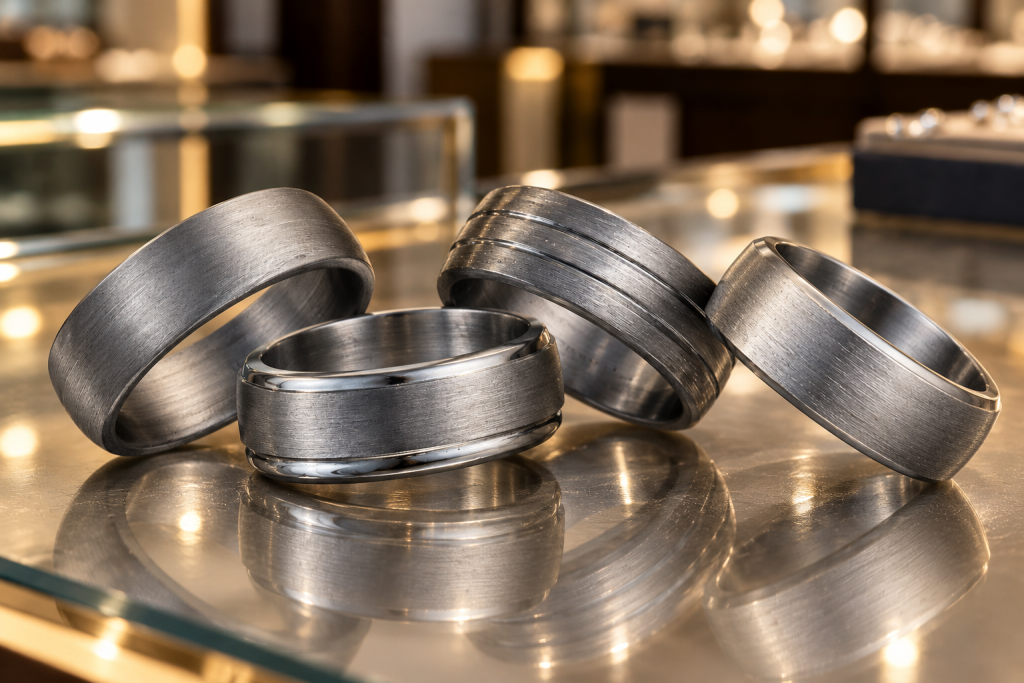
Walk past a jewelry counter filled with wedding bands and you’ll probably recognize the usual colors. There’s yellow gold, white gold, platinum and perhaps a row of rose gold rings. Then, somewhere among the more contemporary styles, you might notice a band that looks distinctly different. It’s gray, but not the ordinary silvery gray of steel. The finish has some depth to it, with a darker tone and, in certain lighting, a faint hint of blue.
That ring may be made from tantalum. It’s a metal many people still haven’t heard of, although they’ve probably used something containing tantalum without realizing it. Its better-known uses are in electronics, manufacturing and medical technology. Jewelry is a comparatively small part of the picture, but the material makes a surprisingly convincing case for itself as a wedding band.
A tantalum ring feels substantial. Its color comes from the metal, not simply from a dark coating applied over a bright surface. It handles moisture and ordinary exposure well, and it isn’t brittle in the same way a tungsten-carbide ring can be. Those qualities give it a practical appeal beyond the novelty of wearing an unusual metal.
It also has limitations. Tantalum is not scratch-proof. It isn’t the lightest choice, and not every jeweler can work on it. You’ll sometimes see broad promises about how easily it can be resized, but the truth depends on the ring and on who is doing the work. A buyer deserves to hear those details before making a purchase, not several years afterward.
If you’ve been comparing men’s wedding bands, tantalum deserves a place beside titanium, tungsten carbide, cobalt chrome, black zirconium and ceramic. The point isn’t that all those other materials are bad. Several are excellent choices. They simply solve different problems, and the best decision starts with knowing what matters to the person wearing the ring.
There’s another reason to spend some time on tantalum. Wedding bands have changed. Plenty of couples still love traditional precious metals, but others want a ring that looks more like their everyday style. A charcoal-gray band with a brushed finish can feel just as personal as a classic gold dome. It doesn’t have to make a statement about rejecting tradition. Sometimes it simply looks right on your hand.
This guide looks closely at what tantalum really offers, where competing metals may be preferable, how finishes and design influence daily wear, and the questions worth asking before you spend money. We’ll also look at online shopping, responsible sourcing and how to recognize the difference between a genuine material description and an attractive but vague product listing.
What Is Tantalum, Exactly?
Tantalum is a naturally occurring chemical element, represented by the symbol Ta and identified as atomic number 73. In its refined metallic form, it is dense, workable and highly resistant to many forms of corrosion. It is also capable of withstanding exceptionally high temperatures. Its melting point is approximately 3,017 degrees Celsius, a figure that helps explain why it has uses far removed from wedding jewelry.
Swedish chemist Anders Gustaf Ekeberg discovered the element in 1802. Tantalum takes its name from Tantalus, a figure in Greek mythology. Its story became complicated because tantalum and niobium frequently occur together in minerals and share certain chemical characteristics. Scientists spent decades untangling the two elements, a history covered in material from the U.S. Geological Survey.
In everyday jewelry language, tantalum is usually described as a blue-gray or gunmetal-gray metal. That’s a useful starting point, although it doesn’t tell the entire story. Pure refined tantalum can be relatively silvery and lustrous. The final appearance of a ring depends on surface preparation, lighting, design and any treatments or finishes the maker uses. Some bands look smoky gray. Others have a more charcoal-like appearance. A polished style can look quite different from one with a sandblasted or brushed exterior.
A genuinely solid tantalum band is different from a ring made of another metal with a tantalum-colored coating. That distinction matters because the material underneath determines much of the ring’s weight, wear behavior and repair options. If an online description uses tantalum as a color rather than naming it as the metal, stop and check the specifications.
You’ll also encounter tantalum carbide. It is not interchangeable with pure metallic tantalum. Carbides are compounds with different properties, and a listing using that phrase may describe a different material or even a questionable marketing label. Buyers looking for a tantalum wedding band should ask for a clear statement of what the band is actually made from, including any alloying ingredients or decorative components.
The word rare appears frequently in descriptions of tantalum. It is a less familiar jewelry material and an important industrial mineral, but rarity doesn’t automatically make every ring valuable as a collectible. What you’re buying is a manufactured piece of jewelry, with a retail price influenced by design, finishing, processing, craftsmanship and the seller’s policies as well as raw material costs.
It’s perfectly reasonable to appreciate the unusual origin of the metal without treating a wedding band as an investment in commodities. The thing that matters most is whether you enjoy wearing it.
Why So Many Tantalum Rings Have That Gunmetal Look
A lot of dark wedding bands need some explanation. A black tungsten-carbide ring, for instance, is often using a coating or surface treatment to achieve its color. A black zirconium ring gets its dark exterior from a specially formed oxide layer. Tantalum starts with its own naturally gray metallic appearance, although the precise shade of a finished ring is still influenced by the way it’s worked.
That natural gray gives designers some options. They can polish the metal to pick up highlights along the edges, use a brushed center for a quieter look, or add engraved grooves that catch a little light. A wide band with a flat profile may look architectural. A thinner domed ring can seem much more traditional, despite being made of exactly the same material.
In photos, tantalum sometimes appears almost black. Don’t assume that’s the color you’ll see indoors or in daylight. Dark photography, dramatic reflections and edited product images can make gray metal look deeper and more uniform than it does in person. Look for photographs taken under different lighting conditions, ideally with the ring on a hand as well as against a plain background.
The bluish undertone is another detail that can be subtle. You shouldn’t expect the vivid blue of anodized titanium or colored enamel. A better description is gray that sometimes leans cool rather than warm. People who like charcoal watches, stainless-steel accessories, black leather or darker clothing may find this especially appealing, but the metal can work equally well with a bright gold watch or a simple silver bracelet.
Mixed-metal tantalum designs are interesting because the contrast is so noticeable. A thin yellow-gold inlay can warm up the whole ring. Rose gold against gray creates a softer contrast; white gold or platinum is quieter. If you prefer one main color, a narrow groove in the tantalum may be enough detail without adding another metal at all.
Remember that any additional metal, coating, stone, resin or inlay can change care requirements. A plain tantalum band and a tantalum band with a delicate wood inlay should not be treated as though they’re the same product just because both contain tantalum.
The Weight Is Something You Notice
There are lightweight rings and then there are rings that you can feel immediately when you pick them up. Tantalum belongs in the second group. According to the Royal Society of Chemistry, tantalum has a density of approximately 16.4 grams per cubic centimeter. Titanium is much lighter, while platinum is denser still. Tungsten-carbide jewelry can also feel very heavy, although a finished ring’s exact weight depends on its composition and dimensions.
This means a tantalum band can have a reassuring, substantial feel without the visual brightness of traditional platinum. It’s a fairly distinctive combination. If you’ve worn titanium and found it almost too light, trying tantalum may be a pleasant surprise. If you dislike being aware of a ring on your hand, however, that same quality may become a drawback.
A ring’s width makes a big difference. So does its thickness. Two rings might both be advertised as eight millimeters wide, yet one can weigh considerably more because it has a thicker wall or a less hollowed-out interior. The term comfort fit describes a shape, not a guaranteed low weight. A thick comfort-fit tantalum band can still feel more substantial than a slim, flat titanium ring.
Imagine wearing the band during a full workday. You’re typing, driving, carrying bags, cooking or shaking hands. Does the weight feel familiar after an hour, or does it keep distracting you? There’s no wrong answer. Some people enjoy the presence of a heavier ring. Others would rather forget the ring is there until they happen to glance at it.
Try comparing similar widths in multiple metals. If the only available sample is a much wider tantalum band, it may create a misleading impression of what a narrower version will feel like. This is especially important for a person who hasn’t worn jewelry before. A substantial eight- or ten-millimeter ring can feel like a lot on a hand that is used to having nothing on it.
The pleasing weight is one of tantalum’s strongest selling points, but it should never be sold as proof that the ring is stronger, purer or more valuable. Density and toughness are different properties, and a good buying decision keeps them separate.
Hardness, Toughness and Scratch Resistance Aren’t the Same Thing
The jewelry business has a habit of putting several different ideas under the heading of durability. A ring can be hard but brittle, strong but easy to scuff, or resistant to corrosion while still being vulnerable to a deep scrape. Understanding these distinctions makes the whole alternative-metal category easier to navigate.
Hardness describes resistance to scratching or indentation. Toughness describes the ability to absorb energy or deform without breaking. Corrosion resistance describes how a material behaves when exposed to things such as moisture and chemicals. No single measurement tells you everything about a wedding band.
Tantalum is relatively tough and ductile, meaning it can deform under stress rather than behaving like a brittle ceramic. That’s a good quality in a ring. It doesn’t mean that the ring is immune to serious damage, or that any impact would be harmless. An accident capable of crushing a ring can injure a finger no matter what the ring is made from.
Tantalum is also resistant to corrosion in many ordinary environments, which helps explain why it generally doesn’t tarnish the way sterling silver does. The metal forms a stable protective oxide surface, and its chemical stability is one of the reasons it is so useful outside jewelry. For normal cleaning, you shouldn’t need special anti-tarnish products or regular plating to preserve its basic gray color.
Scratches are another matter. Tantalum can acquire fine marks from daily contact with rough surfaces. Polished bands may show those marks more readily because a scratch interrupts an otherwise reflective finish. Brushed, hammered and satin textures tend to make small changes less obvious, although they aren’t scratch-proof either.
When a seller says tantalum is durable, it’s fair to agree. When a seller says it will look completely untouched after decades of use, be skeptical. Some owners enjoy the gradual softening of the finish. Others prefer a fresh, uniform appearance and may choose professional refinishing when needed. Neither approach is more correct.
Tungsten carbide often wins on resistance to everyday surface scratches. Titanium usually wins when low weight is the priority. Gold and platinum offer a wider range of conventional repair and resizing possibilities. Tantalum’s appeal is how its own set of characteristics fits together, not a claim that it defeats every competing metal in every category.
What Really Happens When a Tantalum Ring Gets Scratched?
Picture a brushed tantalum band resting on a desk beside a set of keys. During a normal day, it may brush against tables, door handles, grocery carts and tools. Gradually, its surface can pick up tiny lines. Under direct light, these may become visible even when the ring looks perfectly fine from a normal viewing distance.
On a polished band, some marks appear brighter or duller than the surrounding metal. On a satin finish, new scratches can briefly look shiny because they interrupt the directional grain. After more wear, the difference may soften as the surface develops additional marks. Calling this a patina is reasonable in the everyday jewelry sense, but it shouldn’t imply that the metal is changing into some magically tougher protective finish.
A single deep gouge is different from ordinary wear. It may require a professional assessment, particularly if the mark crosses an inlay, a stone setting or a decorative groove. A jeweler familiar with tantalum may be able to restore a surface finish, but the result depends on the design and how much material would have to be removed.
Some websites suggest rubbing tantalum with an abrasive pad at home. That may be possible for certain plain brushed rings, with instructions from the maker, but it’s not universal advice. The wrong grit can create an uneven patch that looks worse than the original mark. It can also damage contrasting finishes. A customer who spent extra on a carefully machined pattern probably doesn’t want to improvise a new texture in the bathroom.
For routine cleaning, gentle methods are enough. Scratching isn’t dirt, so don’t assume aggressive scrubbing will solve it. If you’re unsure whether a mark is surface transfer from another material or actual damage, let the ring’s maker or a specialist jeweler inspect it before you polish anything.
One useful way to shop is to ask to see a worn sample rather than only a brand-new display ring. A real, regularly worn tantalum band tells you more about its long-term look than a perfect studio photograph.
Is Tantalum Hypoallergenic?
Tantalum has a strong reputation for biocompatibility and is used in certain medical applications. For jewelry, that makes it an attractive material for people who have had trouble with some conventional metal alloys. A plain, appropriately specified tantalum band may be a particularly sensible choice for a person concerned about nickel exposure.
Still, the word hypoallergenic deserves some care. No seller should promise that a particular ring can never cause a skin problem for every person. Skin irritation can come from trapped moisture, soap residue, friction or an unrelated condition, even when the metal itself is well tolerated. Decorative components can also introduce materials that aren’t tantalum.
Check the complete product composition, not just the front of the ring. A band with a tantalum exterior might include a different metal inside. The adhesive used in an inlay, a colored finish or a contrasting alloy may matter to a buyer with known sensitivities. If you have a diagnosed allergy, ask the manufacturer about the actual materials and consult your clinician when appropriate.
Nickel allergy is one reason people consider alternative metals, but don’t assume that every tungsten-carbide ring, stainless-steel band or cobalt-chrome alloy has the same chemistry. Tungsten carbide commonly uses a metal binder; the binder and manufacturing quality matter. Stainless steel comes in numerous grades, many of which contain nickel, even when the finished alloy is tolerated by many users. Cobalt itself can be an allergen for some individuals.
A seller who provides a detailed materials disclosure is more helpful than one who simply repeats the word hypoallergenic in every paragraph. With tantalum, the opportunity to wear a substantial gray metal without the usual concerns associated with some nickel-containing jewelry is genuinely appealing. The right promise, however, is a good material option, not a medical guarantee.
Can a Tantalum Wedding Band Be Resized?
This is the question that needs the most careful answer. You’ll find websites saying yes, some saying no, and others saying that every tantalum ring can be adjusted by one size. Those statements are too broad to trust on their own. Tantalum is ductile, but ductility in a laboratory does not automatically make a finished ring easy to alter at a neighborhood jewelry counter.
Traditional precious-metal resizing frequently involves cutting a ring, removing or inserting material, reshaping and joining the band. Tantalum’s very high melting point and manufacturing characteristics complicate conventional bench work. Some specialists can stretch or compress certain plain bands by a small amount. Other makers explicitly describe their tantalum rings as non-resizable and offer exchanges or replacement programs instead.
That distinction isn’t a contradiction so much as a reminder that manufacturing method, band thickness, finish and jeweler capability all matter. A plain band may offer more options than a ring with carbon fiber, wood, stones or a rigid contrasting inlay. A design that can tolerate a small adjustment may still be unsuitable for a larger size change.
Ask the actual seller whether the particular style you’re purchasing can be resized after the return period. Ask how much adjustment is supported, who performs it, what it costs, how the finish is handled and whether the warranty remains in force. If the seller can’t answer, assume you’ll need an exchange or a replacement if your finger size changes.
There’s no reason to present that as a dealbreaker. Many wedding bands sold in tungsten carbide, titanium, ceramic and other alternative materials are effectively replacement-only. Tantalum has the potential for more flexibility in certain styles, which is worth knowing. It simply isn’t wise to pay a premium for a resizing promise that isn’t written into the purchase terms.
A person expecting large changes in ring size over time may prefer gold or platinum precisely because those metals are more familiar to traditional jewelers. A person confident about their fit and comfortable with a manufacturer’s exchange policy may find tantalum a very good match. What matters is being informed before placing the order.
Sizing Comes Before Engraving
Buying a band online has become easy. Getting the fit exactly right can still be tricky, particularly when the material is difficult to modify afterward. A ring that feels perfect for ten minutes in an air-conditioned store may feel tighter during a hot afternoon, after exercise or when fingers naturally swell.
Width affects fit, too. A broad band covers more of the finger and can feel tighter than a thin ring in the same nominal size. Comfort-fit interiors often have a gentle curve that changes how a ring slides across the knuckle. Two brands using the same size label may not feel identical because their internal contours differ.
Start with a professional fitting whenever practical. Ask to try a band close to the width and profile you’re actually buying. If you’re ordering from another seller, see whether it supplies a physical sizing kit or trial band. Plastic measuring strips can offer a starting estimate, but they don’t reproduce the sensation of a substantial finished ring.
It’s useful to check the fit at different times. The ring should pass over the knuckle with reasonable resistance and sit securely without pinching. It shouldn’t spin so freely that it seems ready to fly off, but a ring that leaves a deep impression or becomes difficult to remove may be too tight.
Don’t engrave the band until you’re sure of the fit if personalization makes the item nonreturnable. That applies to metal rings of every kind. Couples sometimes order in a hurry, have a wedding date approaching and discover too late that the beautiful personalized band is a little uncomfortable.
If your hands swell significantly, your job involves frequent glove use, or you have larger knuckles, discuss those realities before ordering. A ring that suits your actual hand is much more enjoyable than one chosen entirely from the size printed on an old receipt.
Comparing Tantalum With Tungsten Carbide
Tantalum and tungsten carbide often appeal to the same shopper at first glance. Both can deliver a substantial ring with a modern gray appearance. Both are used for relatively simple bands as well as more elaborate designs. Both can look at home alongside a casual watch or a tailored suit. But once you examine how they behave, the similarities begin to disappear.
Tungsten carbide is particularly well known for its resistance to scratching. A well-made, uncoated tungsten-carbide ring can keep a crisp-looking surface through years of routine contact that would leave noticeable marks on many other wedding bands. If maintaining a polished finish is your leading concern, that’s a meaningful benefit.
The trade-off is brittleness. Tungsten carbide is a very hard compound rather than a ductile precious metal. Under a sufficiently sharp impact, it may chip, crack or fracture. This doesn’t mean a tungsten band will break whenever it falls on the floor, as some marketing claims suggest. It means its response to a strong impact differs from that of tougher, more deformable metals.
Tantalum typically scratches more readily than tungsten carbide, but it doesn’t have the same ceramic-like tendency to fracture. It may dent or deform under conditions where a brittle band could crack. Neither outcome makes a ring safe to wear around hazardous machinery, and neither should be described as indestructible.
Weight is another interesting comparison. Both materials can make hefty rings. Tungsten-carbide bands often feel exceptionally heavy, although size, thickness and composition matter. Tantalum has a considerable density in its own right, and some wearers prefer its particular balance of weight and appearance. The difference is best judged with two similarly sized rings in hand.
There is also a color question. Natural tungsten-carbide jewelry is commonly gray to silvery, depending on the composition and finish. Black, gold or other strongly colored versions may rely on a surface coating. Those finishes can wear differently from the underlying material. Tantalum’s basic gray identity doesn’t need a black decorative coating, although some tantalum rings are treated for additional effects.
Tungsten carbide is usually not resizable in the ordinary jewelry sense. Buyers often rely on an exchange policy or buy a new band when their size changes. As we’ve discussed, tantalum may offer limited specialist adjustments in certain designs, but the details require confirmation.
Price can separate the two as well. Many tungsten-carbide bands are inexpensive, especially simple designs sold online. Tantalum commonly sits higher in the alternative-metal market because of material processing, smaller production runs and design choices. That doesn’t automatically make the more expensive ring better. A simple tungsten band may be exactly what a price-conscious shopper wants.
Here’s the useful way to choose. If resisting visible scratches is more important than everything else, tungsten carbide deserves serious attention. If you would rather have a naturally dark-gray metal that feels substantial and is less brittle, tantalum has an appealing case. Neither material wins every comparison, and the best sellers should be comfortable admitting that.
Tantalum Compared With Titanium
Titanium approaches the wedding-band question from almost the opposite direction. Its reputation rests on strength relative to weight, corrosion resistance and comfort for people who don’t want a heavy ring. Put a titanium band beside a similarly sized tantalum band, and the difference in weight can be immediate.
For a first-time ring wearer, titanium’s lightness can be a gift. It can make a broad style feel less intrusive, especially if the person types all day or dislikes the sensation of jewelry pressing against neighboring fingers. Titanium also has a long record of use in applications where material compatibility and low weight matter.
Tantalum feels more substantial. Some people interpret that sensation as luxurious; others simply find it heavy. That’s a matter of preference, not a universal quality rating. If you’re buying for a partner, don’t assume that the person will enjoy a heavy ring because you do. Ask them, or arrange a try-on comparison.
The natural colors differ. Titanium is generally a lighter silvery gray in conventional jewelry finishes, whereas tantalum’s typical wedding-band presentation tends toward darker gray. Titanium can be anodized to create an assortment of colors, and black titanium rings may use additional treatments or coatings. The surface treatment matters when you judge whether a colored ring will retain its appearance.
Titanium is tough and resists corrosion, but normal wear can leave scratches and scuffs. It’s a mistake to confuse the strength of titanium as an engineering material with an inability to scratch its surface. Tantalum can scratch, too. The two may age differently depending on finish, environment and manufacturing methods, but neither offers the near scratch resistance associated with tungsten carbide.
Titanium bands are widely treated as non-resizable or difficult to resize, especially when they include special finishes or inlays. Some specialists may be able to make limited changes to certain constructions. Tantalum has similarly design-specific possibilities, so the buyer shouldn’t rely on either material without a clearly stated service policy.
Price often favors titanium, particularly for straightforward mass-produced bands. Its relatively accessible cost also makes it useful as a secondary wedding ring for travel or occasional wear. If the lighter color and low weight are what you want, spending more on tantalum won’t somehow improve your experience.
For people drawn to gunmetal gray and a heavier feel, however, tantalum offers a different sort of satisfaction. It’s not simply a darker titanium substitute. The tactile difference changes how the ring feels every day, and the gray tone can be exactly what attracts a buyer who doesn’t want the usual silver-colored band.
What About Black Zirconium?
If your main goal is a truly black ring, black zirconium deserves a close look. This material is generally created by treating zirconium so that a black oxide surface forms on the metal. That is different from putting black paint on a ring, but it is also different from a metal whose entire cross-section is naturally jet black.
The resulting appearance can be striking. Black zirconium has been used for clean, minimalist bands and contrasting designs that expose some of the lighter zirconium beneath. The contrast can be intentional and beautiful, particularly in engraved or patterned rings.
The important drawback is that a sufficiently deep scratch can break through the darkened surface and reveal the lighter metal below. This won’t necessarily happen during ordinary wear, but it is possible. A buyer who expects a permanently uniform black appearance should understand how the surface is formed and what repair options are available.
Tantalum usually doesn’t have that strong black-and-silver contrast. Its normal gray appearance runs through the metal, so an ordinary surface mark isn’t the same as scraping off an applied black layer to expose a bright substrate. That’s a point in tantalum’s favor for someone who likes gray rather than black.
Black zirconium also tends to be a lighter-feeling choice than tantalum in comparable ring designs. As with other alternative bands, resizing depends heavily on construction and jeweler capability. Many sellers treat finished black zirconium rings as replacement-only, especially when a change would disturb the oxidized exterior.
Choose black zirconium because you genuinely want black, not because you think gray tantalum will look black enough. Choose tantalum if you prefer a deeper metallic gray and would like its density and less brittle character. The distinction is mainly about appearance and feel, with some practical implications for long-term surface wear.
Cobalt Chrome Has an Entirely Different Personality
Cobalt-chrome wedding bands are usually intended to provide a bright white or silvery look with considerable hardness and resistance to routine scratching. Compared with tantalum, the visual effect is closer to platinum or polished white gold. A reflective cobalt-chrome band can look conventional at a glance, even though the alloy belongs to the alternative-metal category.
The ring also feels different. Cobalt-chrome alloys are significantly less dense than tantalum, although finished weight changes with ring dimensions. Their hardness can make them attractive for someone who wants a clean, polished appearance and doesn’t like the idea of frequent refinishing.
But the alloy matters. Cobalt chrome isn’t a single universal recipe, and some individuals have allergies involving cobalt or other alloy constituents. It would be careless to describe every cobalt-chrome ring as guaranteed safe for all sensitive skin. Buyers with known metal allergies should obtain a materials disclosure and medical guidance where relevant.
Resizing and removal are other areas where blanket statements don’t help. Cobalt-chrome rings can be difficult to work on, and resizing possibilities depend on their construction and the jeweler’s equipment. Emergency removal may require special cutting tools, but it isn’t accurate to announce that emergency personnel can never remove a cobalt-chrome band.
If you want the brightest alternative-metal option in this comparison, cobalt chrome is worth considering. If you’re attracted to tantalum specifically because it isn’t bright white, cobalt chrome probably isn’t what you had in mind. One offers a polished, familiar-looking surface; the other offers a darker and quieter presentation. They’re serving different tastes.
Ceramic Wedding Rings Are Not Metallic Rings
The word ceramic may make you think of plates and coffee cups, but jewelry-grade ceramics can be hard, polished and attractive. Black ceramic rings are especially popular for people who want a dark, uniform appearance with a relatively light feel. Some use a smooth high-gloss finish; others are matte or patterned.
A ceramic wedding band isn’t a metal ring. That’s an important difference, not an inferior one. Ceramic materials can provide excellent scratch resistance, but they may be brittle under sufficiently sharp impacts. The exact behavior depends on composition and manufacturing quality, and decorative inlays or coatings may change the result.
Ceramic is usually not traditionally resizable, which places a lot of importance on getting the initial fit right and understanding the retailer’s exchange rules. It can also be a useful choice for a person who wants a nonmetallic band, although nonmetallic doesn’t automatically mean a particular ring is safe for every workplace or medical setting.
Tantalum has a more obviously metallic depth and a distinctly heavier feel. The color is not ordinarily the same saturated black available in ceramic jewelry. Where ceramic attracts people who love smooth, dark surfaces, tantalum attracts those who like the subtler shade of real gray metal.
A fair comparison requires examining the actual rings, not just the category labels. Some ceramic bands are impressively well finished. Others are inexpensive products with minimal quality information. The same range of craftsmanship exists among metal rings. Buy based on the construction and seller as well as the material name.
Tantalum Versus Gold, Platinum and Palladium
Alternative metals are often presented as replacements for the old favorites, but gold and platinum haven’t suddenly lost their advantages. They remain especially appealing because jewelers know how to work with them, customers value their history, and many designs can be repaired or changed over time. A traditional precious-metal ring has a different ownership experience, not just a different color.
Gold offers tremendous design flexibility. Depending on karat and alloy, it can be yellow, white or rose, and it works in everything from a thin polished band to elaborate engraving and stone settings. It will scratch and may dent, but many gold rings can be resized by a qualified jeweler. White gold may also need rhodium replating if its original bright white finish was achieved with that surface treatment.
Platinum is naturally white, dense and widely used for fine jewelry. It can develop a patina of surface marks, but skilled jewelers can often refinish or resize suitably constructed platinum rings. Platinum’s high density means it has the weighty quality that some tantalum shoppers enjoy, although the two look quite different and often occupy different retail price ranges.
Palladium is another white precious metal used in jewelry. It is generally lighter than platinum and can appeal to buyers who want a precious metal without as much weight. Availability and servicing can be less convenient than with common gold or platinum pieces, so ask about a jeweler’s experience before treating it as an interchangeable substitute.
Tantalum typically costs less than comparable precious-metal bands in many mainstream offerings, though there are exceptions for custom, wide or mixed-metal designs. It also offers its distinctive gray without depending on a rhodium finish. That combination makes it appealing when the wearer likes a darker color and doesn’t need the traditional prestige of a gold or platinum ring.
The trade-off is long-term flexibility. A plain gold band can often be enlarged, reduced, engraved again or remade more readily than a complex tantalum ring. If a family wants to pass down a wedding band and have it altered for a future wearer, precious metal may be the more convenient choice. Tantalum can certainly be treasured and passed down, but the ability to modify it later shouldn’t be assumed.
You don’t need to choose between meaningful and modern. A tantalum wedding band can carry every bit as much personal meaning as one made from gold. The real comparison is about appearance, care, modification, cost and what each person wants from a ring they might wear for decades.
Stainless Steel and Other Less Obvious Options
Stainless steel is familiar, relatively inexpensive and available in a huge range of ring designs. Its silvery appearance can be attractive, and many grades perform well against everyday corrosion. But the phrase stainless steel covers multiple alloys. Some contain nickel, which may matter to people with allergies. Black stainless-steel jewelry may use a surface coating that has its own wear characteristics.
Compared with tantalum, stainless steel generally feels less dense and is less distinctive in color. It can be a practical budget choice, particularly when someone wants a backup ring or an inexpensive introduction to wearing a band. A higher retail price doesn’t make tantalum necessary for every shopper. It simply provides a different experience.
Niobium is worth mentioning because it has a close scientific relationship with tantalum. The two are frequently found together in nature. Niobium is lighter, and it is sometimes used in colorful jewelry because it can develop vivid surface colors through anodizing. Its use in wedding bands is more specialized than titanium or tungsten, so finding a maker who can service a design may take some effort.
Damascus steel and patterned steel bands appeal to buyers who want visible surface character, but you have to ask what alloys and construction methods are involved. Some patterns rely on layered metals; some products sold under evocative names may be etched or surface treated. Materials and corrosion behavior are not identical across every maker.
Meteorite inlays, carbon fiber, wood and other decorative additions are not metals in the same practical sense as a solid tantalum band. They can look wonderful, but they introduce their own demands. Some require protection from moisture or impact. Others have coatings or resins that may age differently from the base ring.
One useful lesson emerges from all these comparisons. A simple band made from a known metal is easier to evaluate than an elaborate ring containing five materials and three kinds of finish. Complexity isn’t necessarily bad; it just creates more questions. Tantalum is appealing on its own, and shoppers don’t have to add exotic accents to make it interesting.
Which Ring Looks Better With an Engagement Ring?
Tantalum is often discussed as a men’s wedding-band material, but there’s no rule limiting it to men. Anyone who likes gray metal may find the look attractive. The real challenge is deciding how the color works with another ring worn on the same hand.
A tantalum band beside a diamond engagement ring in white gold can create a gentle contrast. Both sit in the cooler part of the color range, but the gray band has more depth. Beside yellow gold, the difference is more noticeable. Some people love that contrast precisely because the rings look individual rather than perfectly matched.
Matching finishes are another option. A polished engagement ring and a polished tantalum band may feel more coordinated than a rough hammered wedding band. On the other hand, combining a smooth engagement ring with a finely brushed tantalum band can look intentional rather than mismatched.
Pay close attention to profile and height. Two rings can have complementary colors but still rub awkwardly against each other. A thick wedding band might push an engagement ring away from the finger or cause uncomfortable pressure between the rings. A jeweler should check the fit and how the pieces sit together, especially if either ring contains stones or projecting details.
If you want matching wedding bands for two people, the bands don’t need to be made from the same metal. Matching engravings, similar silhouettes or a shared texture can connect two rings more meaningfully than forcing both people to wear something that doesn’t suit them. One person can choose tantalum while the other prefers platinum, titanium or gold.
Color coordination can be fun, but comfort usually matters more after the wedding photographs are finished. Choose bands that feel good independently and look pleasing together, rather than expecting one requirement to cancel the other.
What Tantalum Rings Cost, and What the Price Actually Buys
In published consumer guides and retailer examples, relatively simple tantalum wedding bands have often appeared in roughly the several-hundred-dollar range. Prices around $300 to $500 have been common examples, but that is not a universal ceiling or a guaranteed current quote. Branded designs, wider profiles, precious-metal inlays, stones, engraving and custom work can take the total significantly higher.
A basic tungsten-carbide or titanium band sold online may cost a fraction of that amount. This can make tantalum seem expensive within the alternative-metal aisle even when it looks comparatively affordable beside certain gold or platinum designs. Price comparisons have to be made between genuinely comparable rings, not a plain six-millimeter band and a custom ring containing diamonds.
A manufacturer’s expense isn’t limited to the raw metal. Tantalum presents machining and finishing challenges. Small production runs, specialized equipment and labor-intensive patterns can add to retail cost. So can customer service policies, packaging, warranties and retailer overhead. A well-supported ring from a reliable maker may be worth more to you than a lower-priced listing with vague materials and no practical exchange program.
Don’t assume that high price guarantees fine workmanship. Inspect edge finishing, symmetry, engraving, the smoothness of the interior and how neatly any inlay joins the base metal. If photographs avoid showing the inside of the ring or the seams between materials, request additional images.
Likewise, don’t assume that every inexpensive alternative band is poorly made. There are respectable straightforward titanium and tungsten rings that meet exactly the needs of their owners. Tantalum’s higher typical price needs to earn its place through an appearance and wearing experience that you actually prefer.
When comparing two tantalum rings, look beyond the tag. Are both solid tantalum or do they contain other materials? Are they the same width and approximate thickness? Does one offer size exchanges? Can the maker refinish it? What happens if an inlay loosens? A five-year ownership picture is more informative than the price alone.
As tempting as it is to think about metal scarcity and industrial demand, a wedding band is not a sensible way to speculate on tantalum prices. There’s no reason to expect the resale value of a finished ring to move in step with mineral markets. Buy it for your hand, not a future commodities chart.
Tantalum Beyond the Jewelry Counter
There’s something satisfying about wearing a metal that has a much bigger life outside jewelry. Tantalum is used in specialized industrial and electronic applications because it offers a distinctive combination of properties. Electronics manufacturers value tantalum in certain capacitor technologies. Engineers also use it in components and alloys designed for difficult environments, while some medical products use tantalum because of its compatibility with the human body.
This doesn’t mean your wedding band is made from the same formulated material as a jet-engine component, or that a ring offers the performance specifications of a medical implant. Those are different products with different processing requirements. The connection is the underlying element and the properties that make engineers interested in it.
The semiconductor and electronics industries help explain why tantalum is considered strategically important. It is not mined principally so jewelry designers can create gray rings. Jewelry manufacturers are competing for refined material in a world where other applications can demand substantial amounts and have strict technical specifications.
A shopper doesn’t need to understand capacitor design to appreciate a tantalum band. Still, knowing the background makes the choice more interesting. Unlike a decorative finish invented primarily for fashion, the metal’s identity was shaped by science and industry long before it showed up in wedding-ring catalogs.
That history can be a nice conversation starter. But be careful when you encounter dramatic claims about the latest demand boom or a precise rise in raw material prices. Commodity prices change, and one metal’s market is not the same as the jewelry retail market. A headline about industrial supply doesn’t establish that a wedding ring has become scarce, collectible or more valuable overnight.
It’s more sensible to appreciate the material’s technical history and then return to practical questions: Can you try the ring on? Do you like the color? Is the inside comfortable? Does the seller have a dependable sizing policy? Those details shape your relationship with the jewelry much more directly than a global market estimate.
Responsible Sourcing Is Worth Asking About
There is a less comfortable side to the story of tantalum, and it’s important not to skip it. Some tantalum-bearing minerals are sourced from regions facing serious conflict and governance concerns. The OECD has described risks associated with mining and mineral supply chains in Central and East Africa, including the possibility of revenues benefiting armed groups and other human-rights problems.
This does not mean every tantalum product comes from a problematic source. Tantalum is produced and processed through different supply chains, and responsible procurement efforts exist. The problem is that a finished ring typically doesn’t reveal where the underlying mineral was mined or how it moved through smelters, processors and distributors.
The Responsible Minerals Initiative operates assessment programs relating to the due diligence practices of participating mineral processing facilities. The existence of a conformant smelter program gives buyers a more specific topic to ask about than a vague claim that the jewelry is ethical. It is still important to understand the limits of any certification or assessment, including which stage of the supply chain it covers.
If responsible sourcing matters to you, ask the seller where its tantalum is procured, whether suppliers use recognized due diligence systems, and whether any recycled tantalum is involved. A thoughtful answer may include documentation or a description of the manufacturer’s supplier standards. It may also acknowledge what the company doesn’t yet know.
Recycled metal can be part of a responsible procurement approach, but don’t automatically assume that the word recycled proves the absence of every environmental or labor concern. Likewise, the phrase conflict-free needs a clear explanation of how the company defines and verifies it. An honest, specific policy is better than a grand promise without evidence.
Tantalum jewelry can be a good choice for a buyer who cares about sourcing, provided the manufacturer is prepared to discuss the material’s origins and due diligence. Avoiding the subject doesn’t help; asking informed questions does. The same principle applies to gold, diamonds, tungsten and other jewelry materials.
How to Care for a Tantalum Wedding Band
For a plain tantalum ring, routine cleaning is refreshingly uncomplicated. Mild soap, lukewarm water and a soft cloth are generally enough to remove skin oils, dust and everyday grime. A soft brush may help reach grooves, provided the manufacturer approves it and the brush won’t affect a special finish.
Dry the ring thoroughly after washing, particularly if it has an inlay or any area where moisture could become trapped. Tantalum itself is highly resistant to corrosion, but a multi-material ring is only as straightforward to care for as its most sensitive component. Wood, carbon fiber, stones, resin and precious-metal accents can call for different methods.
Don’t assume that industrial corrosion resistance makes a wedding band an invitation to wear jewelry during cleaning with strong household chemicals. Harsh cleaners may affect a decorative material, and chemicals can irritate skin beneath a ring. Removing the band before messy cleaning jobs is an easy habit that protects both the jewelry and your hands.
Storage matters a little, too. If you toss a tantalum ring into a drawer with keys, loose tools and other jewelry, you increase the chance of surface marks. A small fabric-lined box or separate compartment keeps the band from rubbing against hard objects while it’s off your finger.
When the finish starts to look different, decide whether it actually bothers you. Many rings look better to their owners after they’ve been worn for a while. A satin-gray surface with a few small marks can be attractive, not a defect. If you’re unhappy with deeper wear, ask whether the seller can refinish the band and what effect that work will have on engraving or decorative details.
The best care routine is the one that fits the ring you bought. Follow the maker’s instructions rather than a generic cleaning trick online. A plain polished tantalum band may tolerate procedures that are unsuitable for an engraved, oxidized or inlaid version.
When You Should Take Any Metal Ring Off
Wedding bands may be sturdy, but fingers are not designed to act as anchors for heavy equipment. Ring avulsion is a serious injury that can happen when a ring catches on an object and force is transferred to the finger. Medical guidance from Cleveland Clinic recommends removing rings before working with tools, equipment or activities where jewelry could snag.
That advice applies to tantalum, titanium, tungsten carbide, gold and other ring materials. It isn’t a criticism of any one metal. A hard, tough band can still transmit dangerous force. Even a ring that can be cut off in an emergency should not be treated as safe to wear during hazardous work.
People with jobs involving machinery, electrical hazards, food-handling rules, medical procedures or frequent glove changes may need a separate strategy. Sometimes that means leaving the ring at home or wearing it on a chain when permitted. In other settings, no jewelry at all is the appropriate choice.
Flexible silicone bands are sometimes used as substitutes because they can stretch and may break under certain loads. They aren’t a universal safety certification, and workplace rules should always come first. A person should never assume a ring is safe for a particular job solely because the package describes it as a safety ring.
Emergency ring removal is similarly more complicated than the simple online claim that one metal can always be cut and another never can. Equipment, ring dimensions, injury severity and the situation all matter. Health professionals may use specialized cutting or fracture methods depending on the material. If a finger is rapidly swelling, injured, numb or discolored, seek prompt professional care rather than experimenting with tools at home.
A particularly sensible arrangement is a beautiful tantalum wedding band for normal wear and a no-ring policy during higher-risk tasks. There’s no need to prove the durability of the jewelry at the expense of your hand.
Choosing the Shape, Width and Finish
The metal might attract your attention, but the ring’s proportions determine much of its personality. A narrow tantalum band can look restrained and surprisingly delicate. A wide flat ring appears bolder, even without any stones or decorative inlays. Neither style is inherently more appropriate for a wedding. It’s a question of hand size, comfort and taste.
A six-millimeter band is a useful starting point for many people exploring men’s ring styles, but it isn’t a universal recommendation. Someone with slim fingers might prefer four or five millimeters. Another person may enjoy eight millimeters or more. Try several widths rather than assuming the most common one must be the correct choice.
Thickness deserves equal attention. The difference between a slim-profile band and a tall, thick ring can be more noticeable during daily wear than a small change in width. Thick rings can press against adjacent fingers when you grip something. They may also catch more readily on a pocket or glove. A carefully shaped interior and softened edges make a difference.
A rounded or domed exterior is a classic choice because it feels familiar and catches light in a gentle way. Flat designs look crisp and contemporary. Beveled edges introduce another line of reflection, while stepped profiles create a more architectural shape. All of them can work beautifully in gray tantalum.
For finishes, a polished surface creates brighter highlights and makes the metal appear somewhat lighter. Brushing adds a directional texture. Sandblasting or a matte treatment can make the gray look softer. Hammered designs introduce intentional irregularities and often disguise small marks more comfortably than a flawless mirror finish.
Engraved grooves can be elegant, but check whether they create edges that trap dirt or feel uncomfortable against neighboring fingers. The same caution applies to bold ridges and geometric patterns. A wedding band spends far more time against your skin than in a product photograph.
If you tend to change watches or accessories frequently, a simpler design may be more versatile. If your style is consistent and you know you want a blue accent or a gold inlay, personalization can make the band feel entirely your own. Don’t rush to add decoration just because it’s available.
Buying Online Without Guessing
Shopping online makes it easier to compare widths, profiles and finishes from several makers. It also creates a challenge: tantalum’s color and weight are difficult to judge on a screen. A convincing product page should give you more than one dramatic photograph and a paragraph filled with claims of unmatched strength.
Look for a clear materials description, ring width, thickness or profile information, available sizes, care instructions and the actual return policy. High-quality photographs should show the top, sides and interior. Images of the ring on a hand are useful for judging scale, although the model’s finger size will affect how wide the band appears.
Ask for a photograph in ordinary daylight if the gunmetal shade is the main reason you’re buying. A ring that looks almost black against a dark background may appear medium gray on a sunny day. If you want a specific shade, seeing different lighting conditions matters more than a seller’s color adjective.
Read reviews for patterns rather than isolated praise. Repeated complaints about inaccurate sizing, rough inside edges or inlays separating are useful warnings. A review saying that a ring feels heavier than expected may not be negative at all for a tantalum shopper, but it tells you something worth considering.
Understand whether the seller offers an exchange if the initial size is wrong. Check deadlines and whether engraved or customized pieces qualify. If a listing advertises lifetime resizing, read what the program actually provides. Sometimes the benefit is a discounted replacement, not physical alteration of the original band.
Ask about repairs, refinishing and lost-inlay coverage. Manufacturers vary widely, and a useful warranty should specify what is covered and how to make a claim. Ordinary surface wear is usually different from a manufacturing defect. That distinction ought to be clear before a problem arises.
Finally, compare the complete checkout price, not just the initial listing. Sizing kits, personalization, shipping, taxes and custom alterations can change the final cost. A straightforward purchase from a seller who answers questions clearly may be preferable to a slightly cheaper listing that leaves essential details unresolved.
Who Is Most Likely to Enjoy Tantalum?
Tantalum tends to appeal to people who like quieter colors, substantial jewelry and designs that don’t depend on bright shine. Its gunmetal look can be a comfortable middle ground between a traditional silvery band and a dramatically black ring. You notice it without needing to stare at it.
It can be especially satisfying for someone who wants an all-metal band but finds polished gold too conventional for their personal style. A brushed tantalum ring with simple edges can feel modern without looking like a novelty. It can also pair nicely with understated watches and other accessories without needing to match them perfectly.
The metal may suit people who want good corrosion resistance and who are comfortable with the possibility of everyday scratches. Its natural gray color is an advantage when you’re comparing it to dark rings that rely on contrasting applied finishes. Its toughness also makes it worth examining beside more brittle options.
On the other hand, choose carefully if weight bothers you, if you need the very lowest price, or if the ability to resize a ring repeatedly is central to your plans. Tantalum may not be the best fit in those situations. A lightweight titanium band, budget-friendly tungsten-carbide ring or resizable gold ring could meet your needs more directly.
There is no requirement to justify a wedding band’s color with technical data. It is acceptable to like tantalum primarily because of how it looks. The other qualities simply help you decide whether that attraction will hold up in daily life.
The strongest argument for tantalum isn’t that it’s perfect. It’s that its particular combination of naturally gray color, substantial feel, corrosion resistance and toughness is uncommon. For the right wearer, that combination can make a simple band feel unusually well chosen.
How to Make the Final Choice Without Overthinking It
Sometimes the search becomes more complicated than the wedding band needs to be. You start with a simple idea—perhaps a dark gray ring—and suddenly you’re comparing hardness scales, mineral supply chains, warranties and the tiniest difference between two surface finishes. All of that information can help, but eventually the decision comes back to the person wearing the jewelry.
If you love the look of a brushed tantalum band, try one on. Notice the weight before judging the price. Look at the gray color under ordinary lighting rather than only under a store spotlight. Move your fingers, make a fist, hold your phone and slide the ring off again. You’ll learn more in those few minutes than from another page of exaggerated specifications.
Then ask the seller about the questions that will matter later: what happens if the size is wrong, whether this exact model can be altered, how the finish can be restored, and where the material comes from. A retailer willing to answer those questions is giving you something beyond a beautiful product photograph.
It’s also fine to decide that tantalum isn’t right for you. Perhaps titanium feels better, tungsten suits your budget or a gold band is easier to imagine wearing for the rest of your life. None of those conclusions makes tantalum less interesting. They simply mean you compared your choices instead of trusting a sales pitch.
For someone who likes that distinctive gunmetal shade, enjoys a ring with some weight and appreciates a tough, corrosion-resistant metal, tantalum can be a particularly satisfying purchase. You don’t have to pretend it’s scratch-proof or universally resizable to make the case. Its real qualities are interesting enough.
Frequently Asked Questions About Tantalum Wedding Bands
Is tantalum a real metal or a brand name?
Tantalum is a genuine chemical element, not a trade name created for jewelry. It has the symbol Ta and atomic number 73. Manufacturers may use their own style names for particular bands, but the material itself is well established in industrial and scientific applications. When you’re shopping, look for a precise description of the metal in the product specifications. The term tantalum should identify the material, not simply describe a color. If the listing only says gunmetal or tantalum-style, ask whether the ring actually contains solid tantalum before purchasing.
Why does tantalum look different in different photographs?
Lighting, camera settings and surface finishing can change how gray metal appears. A ring photographed against black fabric may look darker than the same ring photographed on a hand outdoors. Brushed and sandblasted surfaces scatter light differently from polished edges, and the slight cool undertone associated with tantalum isn’t equally visible in every setting. Some product images are also edited to emphasize contrast. Before ordering, look at several photographs or ask the jeweler to show you an example in everyday lighting. A genuine tantalum ring doesn’t have to look almost black to be authentic.
Are tantalum wedding bands black or gray?
Ordinary tantalum wedding bands are best described as gray, commonly with a gunmetal, charcoal or blue-gray appearance depending on the finish. Some may be marketed as black because they look especially dark, but true jet black is a different visual effect. If black is a firm requirement, compare black zirconium or black ceramic and ask how their colors are produced. Tantalum is most compelling when you actually prefer gray metal, including the changes in appearance that come with different lighting. It’s better to enjoy the natural tone than to expect it to imitate another material.
Will a tantalum ring turn my finger green?
A plain, properly specified tantalum band isn’t typically associated with the green staining sometimes seen with certain copper-containing jewelry. Its resistance to corrosion is one reason people find it attractive. However, a ring with another metal, a decorative coating or an unknown alloy may behave differently, and skin reactions aren’t always caused by the metal. Moisture and soap trapped beneath a tight ring can irritate skin. If discoloration or itching develops, remove the ring and check the complete material composition. Persistent symptoms are worth discussing with a health professional.
Does tantalum rust or tarnish?
Tantalum is very resistant to corrosion under ordinary wearing conditions. A solid band usually won’t need the regular anti-tarnish treatment associated with sterling silver, nor should its basic gray color depend on frequent replating. That doesn’t mean dirt, skin oils or residue can’t build up on the surface. Cleaning still helps it look good. If the ring includes other metals, gemstones, resin or organic inlays, those components may require separate care. The right cleaning advice always depends on the finished ring, not just the tantalum inside it.
Is tantalum scratch-proof?
No. It’s a durable material, but normal use can leave fine scratches. The amount you notice will depend on the surface finish and what the ring comes into contact with. Polished designs often show tiny marks more clearly than textured ones. If a nearly unchanged surface is your top priority, tungsten carbide may be a stronger candidate, provided you understand its brittleness. With tantalum, it makes more sense to expect a ring that can develop a worn-in appearance while retaining its essential metallic gray character. Ask the jeweler about professional refinishing if you prefer a more uniform look.
How does tantalum compare with tungsten when dropped?
The two respond differently to stress. Tungsten carbide is extremely hard and generally highly resistant to scratches, but it can chip or crack if subjected to a sufficiently sharp impact. Tantalum is more ductile and less brittle, so its response is more likely to involve deformation than ceramic-like fracture. That doesn’t mean dropping a tantalum ring is guaranteed to leave it unharmed. Height, impact surface, design and the presence of stones or inlays all matter. For a wedding band, the useful distinction is between resistance to surface marks and the ability to withstand impact without brittle failure.
Can a tantalum wedding band be resized later?
Possibly, but never assume it. Some specialists may be able to adjust a particular plain tantalum band a limited amount. Other jewelers and manufacturers regard their tantalum rings as non-resizable and handle changes with an exchange or replacement. Inlays, patterns, thickness and manufacturing methods can narrow the options even further. Before ordering, ask whether that exact ring can be resized, who would perform the work, what range of adjustment is supported and what happens to its finish or warranty. A written answer is far more useful than a general website statement claiming every tantalum ring can move up or down one size.
Should I order a larger size for a wide tantalum band?
Not automatically. Wide bands can feel tighter than narrow bands, but how much that matters depends on finger shape, band profile and the exact sizing system used. A comfort-fit interior can also change the sensation. The safest approach is to try on a sample with a similar width and shape or use a physical sizing kit recommended by the manufacturer. Check your size at more than one time of day, since fingers can change with temperature and activity. Ordering larger based on a generic rule risks ending up with a loose ring that’s uncomfortable or easy to lose.
Is tantalum too heavy for daily wear?
That depends entirely on the wearer. Tantalum is a dense metal, so it often feels substantial compared with titanium. Some people enjoy that weight and become used to it quickly. Others prefer a much lighter band. Width and thickness affect the result as much as the material name. A narrow, low-profile tantalum ring may feel comfortable even to somebody who dislikes a thick, wide ring. If possible, wear a similar sample for a little while before making the decision. Weight should be a deliberate preference, not a surprise discovered after the return period expires.
Is tantalum safe for a person with a nickel allergy?
Tantalum is generally regarded as a biocompatible material, and plain tantalum jewelry may be a good option for people avoiding nickel-containing alloys. The key is to verify what the complete ring contains. An inlay, contrasting metal sleeve or other decorative feature might involve a different material. No seller can guarantee that an individual will never experience a skin reaction, and moisture or friction can cause irritation even with an otherwise well-tolerated band. For a diagnosed metal allergy, request full composition information and consider advice from the clinician managing your sensitivity.
Can hospitals remove a tantalum ring in an emergency?
Medical teams have procedures and tools for removing rings, but the exact method depends on the ring, available equipment and the condition of the finger. It isn’t responsible to promise that a particular metal will always be easy to cut or that another metal is impossible to remove. Tantalum’s physical properties differ from those of tungsten carbide or cobalt chrome, so removal approaches may differ too. Rapid swelling, numbness, impaired circulation or an injured hand are reasons to seek immediate professional help. Don’t try to solve a serious situation with improvised cutting equipment at home.
Is tantalum better for people who work with their hands?
It can be a practical everyday material in many settings, but work safety matters more than ring durability. Tantalum resists ordinary corrosion and isn’t as brittle as tungsten carbide, which some users appreciate. On the other hand, it can scratch, and its density means a wide band can feel noticeable under gloves. Most importantly, no metal ring should be worn during tasks where it could snag, conduct unwanted current or violate workplace safety requirements. Remove the jewelry when necessary. You can enjoy a tantalum ring away from hazardous tasks without asking it to function as industrial protective equipment.
Does tantalum have to be polished regularly?
No regular polishing schedule is required for a plain tantalum band. Gentle cleaning with mild soap and water is usually sufficient for ordinary dirt and oils. A ring with a brushed, hammered or matte finish may actually lose some of its intended character if you polish it indiscriminately. For deeper marks or finish restoration, consult the maker. Some specialist jewelers can refinish certain designs, but decorative details can complicate the job. In many cases, doing less is better. Keeping the ring clean and storing it separately when not worn will address most routine needs.
Will a tantalum ring always cost less than gold or platinum?
Not necessarily. Many uncomplicated tantalum wedding bands are priced below comparable rings in precious metals, but retail prices depend on design, width, added materials and labor. A custom tantalum band with gold inlays and diamonds can cost considerably more than a basic gold ring. Likewise, differences in gold prices and construction affect comparisons. Judge similar designs side by side and include shipping, engraving and service policies. If your budget is tight, titanium and tungsten carbide frequently offer less expensive alternatives. Tantalum’s value lies primarily in its particular appearance and physical feel, not a universal discount.
Is a tantalum wedding band a good investment?
It’s best treated as jewelry rather than a financial investment. Although tantalum is used in important industries and can be affected by commodity-market changes, the resale value of a finished wedding band doesn’t necessarily follow raw material prices. Retail prices also reflect manufacturing, finishing, distribution and branding. Secondary buyers may value those factors quite differently. If you like the ring and wear it for many years, that personal use may be its greatest value. If investment or eventual resale is your main goal, talk with a qualified professional about more appropriate ways to evaluate precious metals or other assets.
Where does the tantalum in jewelry come from?
Tantalum is obtained from minerals mined and processed through international supply chains. Production has included countries in Central and East Africa, Australia and elsewhere, with sources and volumes changing over time. The finished ring doesn’t ordinarily tell you its geographic origin. Because some mineral routes face conflict and governance risks, it’s reasonable to ask brands about supplier policies, due diligence and recycled content. Programs associated with the Responsible Minerals Initiative can help explain what supply-chain assessments involve. Avoid assuming a ring is responsibly sourced simply because a retailer uses a reassuring adjective on its website.
Can tantalum be engraved?
Many tantalum rings can be engraved, but the method and finish depend on the equipment and design. Laser engraving is one option used for difficult-to-work metals. Interior engraving can add a wedding date, short message or initials without changing the ring’s outward appearance. Check how many characters will fit, whether the lettering remains readable on a narrow band and how personalization affects returns. If the ring may need a size exchange, it’s often better to resolve sizing before engraving. Ask to see photographs of finished lettering rather than deciding entirely from a font menu.
Can I wear tantalum while swimming or showering?
The metal itself is highly resistant to ordinary corrosion, but the finished jewelry may contain more than tantalum. Chlorine, soaps, salt, sunscreen and other residues can affect decorative materials or accumulate beneath a band. There’s also a practical risk of losing a ring in cold water when fingers contract. Many owners choose to remove jewelry before swimming for that reason alone. Follow the manufacturer’s care guidance for the exact design, especially when wood, resin, gemstones or mixed-metal elements are involved. Water resistance doesn’t mean every activity is equally sensible.
Is a brushed finish better than a polished finish?
Neither is automatically better. Brushed tantalum usually has a quieter look and can make small surface marks less obvious. Polished tantalum reflects more light and highlights the distinctive shape of the ring. A polished surface can make fine scratches easier to notice, while a brushed finish may develop shiny interruptions where it gets scraped. Look at both in person if possible, and consider which matches the way you dress and the other jewelry you wear. If you’re unsure, a design with a brushed center and polished edges offers a measured combination of the two appearances.
What width is best for a men’s tantalum wedding band?
There isn’t one correct width. A band around six millimeters is a common reference point, but narrower and wider designs can look excellent depending on the hand. A broad ring has more visual presence and may feel tighter between the fingers. A narrow ring tends to look quieter and may be easier for someone new to wearing jewelry. Try the widths you’re considering, ideally in similar profiles. Pay attention to thickness and interior shape as well. A ring that looks beautiful when your hand is still needs to feel comfortable when you’re actually using it.
Can women wear tantalum wedding bands?
Of course. Jewelry materials don’t belong to one gender. Tantalum is marketed heavily for men’s wedding bands because of its gray appearance and substantial feel, but a narrow polished or satin tantalum ring can suit anybody who enjoys that color. The bigger questions are the available sizes, width, weight and whether the design pairs comfortably with other rings. A couple can also choose matching tantalum bands in different widths. The best result comes from choosing designs that suit each person’s hand rather than treating traditional advertising categories as rules.
How does tantalum work with diamonds and other gemstones?
The dark-gray metal can make a pale diamond or bright colored gemstone stand out, which creates an appealing contrast. But a stone-set ring requires more than a discussion of metal properties. Examine the setting, ask how the stones are secured and learn whether a jeweler can service the design later. Repair options may be more limited than those of certain gold or platinum settings. Small accent stones, channels and mixed-metal mounting details can also affect future sizing. Choose a maker experienced with the combination rather than assuming every decorative style is equally easy to maintain.
What should I check first if I’m buying a tantalum ring as a surprise?
Start with sizing and the recipient’s preferences. A beautiful band will be disappointing if the person dislikes heavy jewelry or the ring doesn’t fit. Ask about exchange rights, personalization restrictions and how the seller handles the possibility of a wrong size. If you want the gift to be a complete surprise, consider presenting a design choice or temporary sample and then choosing the precise fit together. That’s often more thoughtful than rushing to engrave a ring before the person has tried it on. Also confirm that the metal is genuine tantalum, not a vaguely described gray finish.
Which is the better choice: tantalum or tungsten?
Choose according to the trade-off you’re most comfortable making. Tungsten carbide generally offers superior everyday scratch resistance and is often available for less money. Tantalum offers a distinctive naturally gray appearance, a substantial feel and a tougher, less brittle response to stress. Neither material should be called indestructible, and neither offers the predictable traditional resizing experience of many gold bands. If you hate surface marks, tungsten may make more sense. If you care more about the gray color and the balance of weight and toughness, tantalum may be the ring you keep returning to.
Which is the better choice: tantalum or titanium?
Weight usually settles this question faster than a long technical comparison. Titanium is dramatically lighter, typically brighter in its natural color and often more affordable. Tantalum is heavier and often presented in a deeper gunmetal shade. Both offer strong corrosion resistance, and both can develop surface scratches. Neither should be assumed to be readily resizable without asking the maker about the specific band. If your goal is a barely noticeable ring, try titanium. If you enjoy substance and a darker metallic appearance, tantalum deserves serious consideration. Hold both before deciding if you can.
Is tantalum a passing jewelry trend?
No one can promise how fashion preferences will change, but the element itself has established industrial uses and a genuinely distinctive appearance. That gives tantalum more substance than a novelty finish that exists only because a particular color is fashionable. Wedding-band trends shift, though, and there’s no guarantee that a specific design will always be common or easy to replace. If you like a plain gray band today, it can remain personally meaningful regardless of whether it becomes more or less popular later. That’s a better reason to purchase one than any prediction about market share.
What’s the main reason to choose tantalum over other alternative metals?
For many people, it’s the combination of its natural gray appearance and noticeable weight. Add good corrosion resistance and a less brittle character than tungsten carbide, and the material becomes unusually appealing for a simple wedding band. It isn’t the cheapest, lightest or most scratch-resistant option, and those limitations are worth acknowledging. But jewelry doesn’t have to win a technical contest to be a good choice. If the ring looks right, feels comfortable and comes from a maker with dependable material and service information, tantalum can be an excellent everyday wedding band.
Sources and Further Reading
Royal Society of Chemistry — Tantalum: Element Information, Properties and Uses
https://periodic-table.rsc.org/element/73/tantalum
A science-based explanation of tantalum’s chemistry, physical characteristics and applications, including its density, melting point and corrosion resistance. Useful for separating facts about the metal from broad jewelry marketing claims.
U.S. Geological Survey — Niobium and Tantalum: Indispensable Twins
https://pubs.usgs.gov/publication/fs20143054
A geological and historical overview of these closely related elements, explaining their discovery, association in mineral deposits and the specialized properties that make each commercially important.
U.S. Geological Survey — Mineral Commodity Summaries 2026
https://www.usgs.gov/centers/national-minerals-information-center/mineral-commodity-summaries
An annual government reference for mineral production, trade and market data. A sounder place to check current tantalum supply information than promotional claims about a particular percentage increase in prices.
Organisation for Economic Co-operation and Development — Critical Raw Materials Supply Chains: The Example of Tantalum
A detailed discussion of sourcing concentration, conflict-related risks and due diligence challenges surrounding tantalum supply chains, particularly in the African Great Lakes region.
Responsible Minerals Initiative — Tantalum Smelters List
https://www.wp.responsiblemineralsinitiative.org/tantalum-smelters-list
An entry point for understanding the initiative’s assessments of tantalum-processing facilities and the difference between active participation and a conformant status. Useful background for asking retailers informed questions about sourcing.
Cleveland Clinic — Ring Avulsion: Injury, Causes and Prevention
https://my.clevelandclinic.org/health/diseases/22368-ring-avulsion
A medically reviewed explanation of the risks of rings catching on equipment and how people can reduce the chance of a serious finger injury. Relevant to every ring material, not just tantalum.
Jewelers Mutual — Strongest Metals for a Wedding Band
A consumer-oriented overview of popular band materials and the practical differences between scratch resistance, comfort, hardness and opportunities for resizing.
Ritani — Tantalum Rings: What You Need to Know
https://www.ritani.com/blogs/education/tantalum-rings-what-you-need-to-know
A jewelry retailer’s explanation of tantalum’s color, everyday characteristics and place among traditional and alternative wedding-band materials. Retailer claims about resizability should always be checked for the actual ring being purchased.
Alpha Rings — Can Tantalum Rings Be Resized? Here’s the Honest Answer
https://www.alpharings.com/blogs/forge-fusion/can-tantalum-rings-be-resized
An example of a manufacturer that treats its own tantalum bands as non-resizable. Especially useful for showing why material ductility alone doesn’t establish a universal sizing policy.
Spexton Jewelry — Black Zirconium Wedding Bands: Technical and Care Discussion
A jewelry maker’s explanation of how black zirconium is produced and why a deep enough scratch can reach the lighter material under its oxidized surface. Helpful for comparing black zirconium with gray tantalum.