
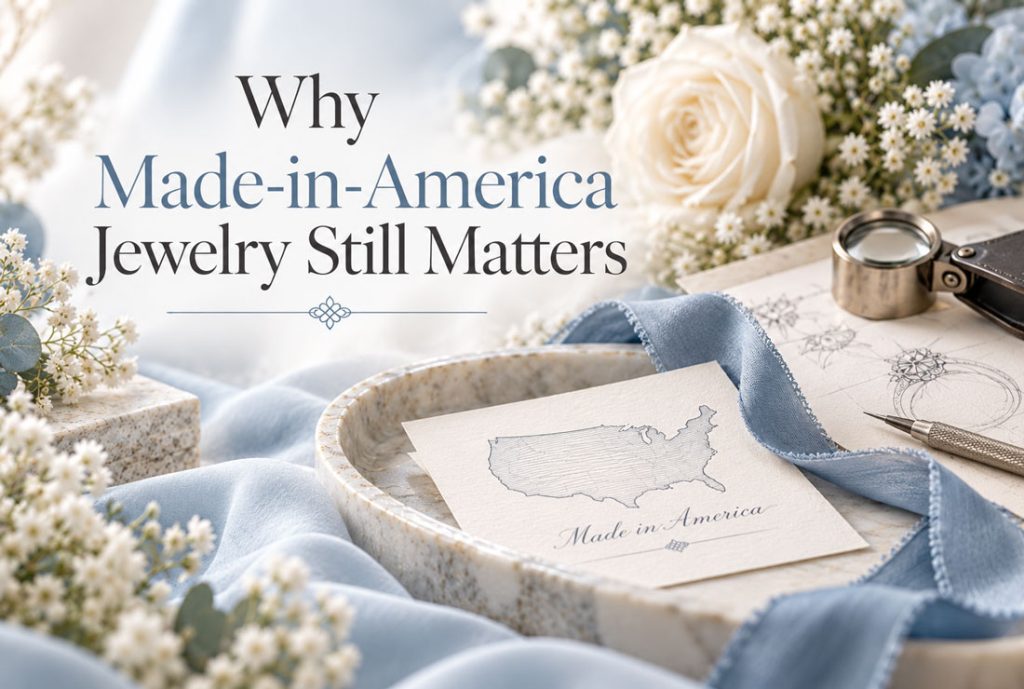
Why Made-in-America Jewelry Still Matters
ewelry purchases represent commitments meant to last decades.
Origin matters more than many shoppers realize. Rings, necklaces, bracelets, and earrings require complex manufacturing processes.
Design, casting, stone setting, finishing, and final inspections demand massive skill.
Made-in-America manufacturing grants consumers visibility into production.
Asking where a ring originated reveals essential details about quality and service.
Consumers today demand transparency. Knowing an engagement ring came from an American workshop builds immediate confidence.
Made-in-America production provides clearer sourcing, stronger communication, shorter custom timelines, easier service, better accountability, and a closer connection to true craftsmanship.
First, What Does “Made in America” Actually Mean?
Legal advertising standards regulate origin claims. “Made in America” carries strict marketing implications.
Federal Trade Commission (FTC) guidelines dictate strict standards for unqualified claims.
Marketers need evidence proving products originate almost entirely within Made-in-America borders.
Jewelry manufacturing involves many moving parts. Designing, modeling, casting, refining, stone sourcing, cutting, setting, and polishing all happen in separate stages.
Rings might feature Made-in-America casting alongside imported gemstones. Diamonds might come from overseas mines or Made-in-America laboratories.
Chains arrive from global sources, while custom pendants take shape locally.
Qualified claims offer better accuracy. “Designed Made-in-America ally” or “Cast and finished in America” provides clearer expectations.
“Manufactured in New York using globally sourced stones” tells a complete story.
Consumers should ask specific questions.
Discovering what parts originate locally brings peace of mind. Relying on simple slogans leads to confusion. Understanding exact production steps empowers shoppers.
Why Made-in-America Jewelry Builds Consumer Trust
Purchasing fine jewelry requires immense trust. Most shoppers lack deep gemology or manufacturing knowledge.
Consumers rely entirely on retailer honesty. Made-in-America manufacturing simplifies communication.
When retail stores work with local workshops, answering consumer questions becomes straightforward.
Jewelers can explain exactly where casting happens. Staff can point out who sets those diamonds.
roduction timelines become transparent. Customers learn about metal alloys and quality control standards. Knowing repairs stay local brings comfort.
This transparency reduces anxiety tremendously. Jewelry purchases feel less intimidating when stores share production stories openly.
Made-in-America Craftsmanship and Accountability
Made-in-America origin does not automatically guarantee superior craftsmanship. Poorly made pieces exist everywhere. Excellence exists globally. Accountability defines Made-in-America value.
Proximity changes business dynamics. When workshops sit closer to retailers, discussing construction quality happens faster.
Jewelers monitor metal weight, stone security, and finish quality directly. Local teams handle resizing and complex repairs swiftly.
Shoppers should seek specific craftsmanship details.
Secure prongs keep diamonds safe. Clean stone settings look professional. Smooth polishing prevents skin irritation.
Consistent finishes show attention to detail. Comfortable interior bands matter for daily wear. Strong clasps prevent lost necklaces.
Sharp, clean engraving adds elegance. Made-in-America workshops excel at maintaining high standards because retailer feedback arrives instantly.
Why Made-in-America Manufacturing Matters for Custom Jewelry
Custom design projects showcase Made-in-America manufacturing advantages beautifully.
Consumers wanting customized engagement rings, personalized wedding bands, or heirloom redesigns benefit from shorter communication lines.
Local custom work provides massive benefits. Design revisions happen quickly.
Communication between jewelers and local artisans stays clear. Production timelines remain predictable.
Sizing adjustments take days, not weeks.
Stone matching feels easier. Repair coordination requires minimal effort. Finishing options remain incredibly flexible.
Shipping across international borders creates anxiety; local production eliminates those worries.
Consider an engagement ring designed around a specific inherited diamond.
A Made-in-America workshop can quickly contour a wedding band to fit perfectly.
Family diamonds get reset smoothly.
Made-to-order platinum bands arrive quickly. Custom men’s bands customized to specific widths take shape without endless waiting.
Faster Timelines and Better Communication
Time dictates many jewelry purchases.
Proposals, weddings, anniversaries, birthdays, graduations, and holidays operate on strict deadlines.
Global supply chains occasionally add unwanted uncertainty. Imported inventory involves lengthy shipping times, customs delays, and communication gaps.
Made-in-America production solves timing issues. Short production runs keep inventory fresh.
Special orders complete quickly. Local workshops handle complex repairs efficiently.
Resizing happens almost overnight.
Replacing missing stones takes minimal effort.
Delivery updates remain highly accurate.
Local coordination ensures special gifts arrive precisely on schedule. Shoppers gain clarity and responsiveness.
Service After Purchase: Repairs and Maintenance
Ownership responsibilities continue long after checkout. Rings require periodic resizing.
Gold prongs wear down over time.
White gold needs rhodium replating.
Chains break. Clasps weaken. Stones loosen. Finishes fade.
Made-in-America manufacturers support long-term service beautifully.
Retailers knowing their manufacturing partners can easily arrange repairs.
Restoring vintage finishes takes expertise.
Replacing matching side stones requires skill. Remaking lost pieces relies on original CAD files.
Confirming metal details provides peace of mind.
Cheaper imported pieces lose appeal when repairs become impossible.
Made-in-America ally produced items offer serious value through dependable, accessible service support.
Made-in-America Wedding Bands: Why Couples Care
Couples wear wedding bands every single day.
Quality, comfort, and serviceability matter immensely for daily-wear items.
Made-in-America wedding band production offers huge advantages. Consumers browse extensive width ranges.
Custom sizing ensures perfect fits.
Special finishes add character. Exploring different metal options feels fun.
Engraving requests process quickly. Matching rings becomes simple.
Contour bands wrap around engagement rings flawlessly.
Men’s bands benefit from Made-in-America flexibility.
Shoppers choose specific profiles and comfort-fit interiors. Unique textures and custom metal combinations stand out.
Women’s bands easily match existing engagement rings.
Curved diamond bands fit flush. Anniversary bands coordinate perfectly.
Heirloom redesigns take on new life. Rings must look good, feel great, and remain serviceable for decades.
Made-in-America Engagement Rings: What Shoppers Should Consider
Engagement rings carry enormous emotional and financial weight.
Consumers demand confidence regarding construction, security, and representation.
Made-in-America engagement rings offer incredible benefits. Custom design support feels highly personal.
Setting adjustments happen rapidly. Jewelers communicate clearly about diamond security.
Coordinating matching wedding bands requires no guesswork.
Repair pathways remain direct and accessible.
Metal composition details stay transparent. Accountability remains high.
Always remember one important detail.
Center diamonds or gemstones might originate overseas even when mountings originate Made-in-America ally.
Ask where mountings originate and where diamonds grew or formed.
Transparency and Ethical Buying
Modern consumers demand sourcing details. Regularly ask about ethics, labor, manufacturing locations, recycled metals, and natural versus lab-grown options.
Environmental claims face intense scrutiny. Supporting Made-in-America jobs appeals to many communities.
Vague phrases mislead consumers – ask for exact explanations.
“Cast, set, polished, and inspected within our New Jersey workshop using imported diamonds” provides excellent transparency.
“American quality” provides zero useful information.
FTC Jewelry Guides help consumers receive accurate details.
Guides regulate gemstone, pearl, and precious metal marketing.
Made-in-America jewelry shines brightest when claims remain specific, highly truthful, and well-supported.
Local Manufacturing and Better Quality Control
Quality control relies entirely on process oversight. Consumers judge jewelry by outward appearance. True quality depends on hidden details.
Made-in-America manufacturing allows incredibly close inspection.
Jewelers scrutinize casting quality and metal porosity.
Stone setting precision undergoes strict review. Prong alignment receives careful checks.
Polish quality, rhodium plating, and engraving clarity must meet high standards.
Ring sizing accuracy ensures perfect fits.
Finish consistency across collections builds brand reputation.
Gemstone security prevents lost diamonds.
Proximity changes everything. Retailers working closely with Made-in-America workshops catch problems long before pieces reach consumers.
Quality control remains highly visible and responsive.
The Emotional Appeal: A Ring With a Closer Story
Jewelry represents deep personal milestones. Consumers crave meaningful stories attached to bridal, anniversary, and heirloom purchases.
Made-in-America production adds massive emotional value. Shoppers appreciate supporting local or regional workshops.
Family businesses gain loyal customers.
Knowing a jeweler actively participated in designing a piece builds strong bonds. Supporting Made-in-America craftspeople feels rewarding.
Having a local network that can service a ring forever brings comfort. Sharing production stories with gift recipients adds sentimental weight.
Origin claims transition from technical facts into beautiful stories.
Made-in-America Does Not Mean “One Size Fits All”
Honesty matters in retail. Price dictates many purchases. Brand prestige sways some shoppers. Others prioritize stone size, natural origin, or lab-grown availability.
Made-in-America origin matters highly for custom jewelry, bridal designs, wedding bands, and heirloom redesigns.
Repairs and special orders demand local access. Consumers valuing Made-in-America labor prioritize these options. Ongoing service access drives many decisions.
Origin matters less under different circumstances.
Future brides and grooms seeking specific international designer brands look overseas. When stone size outweighs setting quality, priorities shift.
Fashion jewelry relies less on origin. Strict budgets often dictate imported choices.
When retailers cannot explain origin claims clearly, Made-in-America labels lose value.
Price: Why American-Made Jewelry May Cost More
Consumers must understand why pricing varies. Made-in-America labor, strict quality control, premium materials, and smaller production runs affect final costs.
American-made jewelry sometimes costs more for valid reasons.
Skilled labor commands fair Made-in-America wages. Smaller batch production avoids mass-market shortcuts. Custom flexibility requires dedicated artisan time.
Detailed hand-finishing demands expertise. High-level quality control prevents future problems.
Fast repair support requires local staff. Compliance costs impact workshops.
Paying premiums makes sense under specific conditions. Valuing true craftsmanship justifies higher costs.
Custom work requires investment. Repair support brings lasting peace of mind. Transparent communication prevents costly mistakes.
Caution remains necessary. A Made-in-America label alone never justifies exorbitant prices.
Products still require stunning design, solid construction, premium materials, and stellar service.
How to Tell If a Made-in-America Claim Is Meaningful
Ask specific questions:
What exact parts originate Made-in-America ally?
Did casting happen here?
Did stone setting occur locally?
Did polishing take place nearby?
Were stones sourced Made-in-America ally or imported?
Do chains arrive from overseas?
Does your jeweler assemble pieces locally?
Look for explicit wording. Strong language clearly outlines processes. Weak wording relies on vague patriotism.
Understand unqualified versus qualified claims. Unqualified claims must meet strict FTC guidelines.
Qualified claims clarify exact limitations. Meaningful claims become clearer through questioning.
Questions Consumers Should Ask Before Purchasing
Ask about origin specifics.
Are components imported?
Are diamonds imported?
Is this claim documented on my invoice?
Ask about craftsmanship.
How was this piece created?
Was casting or hand-fabrication used?
Who sets these stones?
Can local jewelers resize this later?
Ask about materials.
What exact metal alloy is this?
Is this gold recycled?
Are these diamonds natural or lab-grown?
Are these gemstones treated?
Ask about service.
Can this retailer service this piece long-term?
Is resizing included?
What does warranty coverage entail?
How long do standard repairs take?
Ask about value.
Why does this cost more than an imported alternative?
What quality differences exist?
What long-term support accompanies this purchase?
Common Consumer Mistakes
Assuming Made-in-America labels mean every single component originated locally causes confusion. Jewelry utilizes global resources constantly.
Assuming Made-in-America automatically guarantees superior quality is dangerous. Craftsmanship depends on skill, not just geography.
Assuming imported automatically means inferior is equally wrong. Many imported pieces showcase exquisite craftsmanship.
Transparency remains true concern.
Not asking what specific claims mean leads to disappointment. “Designed,” “assembled,” “finished,” and “set” represent vastly different steps.
Ignoring after-sale service creates future headaches. Rings require ongoing maintenance.
Comparing prices without comparing structural construction leads to poor choices. Lighter imported rings never equal heavy, solid Made-in-America rings.
Consumer-Friendly Comparison: Made-in-America vs. Imported Jewelry
Made-in-America jewelry provides closer manufacturing oversight, rapid communication, custom flexibility, fast repairs, clear accountability, Made-in-America labor support, and transparent production details.
Imported jewelry provides wide mass-market variety, highly competitive prices, international design influences, global craftsmanship traditions, and strong value when properly disclosed.
Great jewelry combines quality, honesty, reliable service, stunning style, and true value.
How Retailers Can Explain Made-in-America Jewelry
Avoid vague patriotism. Consumers are smarter than slogans. Shoppers want clear information.
Better consumer-facing language helps.
“This wedding band is cast, finished, and inspected within our New York workshop.”
“This engagement ring mounting is made Made-in-America ally; center diamonds are imported and independently graded.”
“This custom ring is designed and produced through our Made-in-America manufacturing partner.”
“This piece is assembled and hand-finished locally using globally sourced gemstones.”
Educational, specific, and honest marketing always wins.
Made-in-America Rocks in Jewelry!
Demand more than just pretty finished products.
Consumers crave confidence.
Knowing exactly what a product is, who stands behind quality, how service functions, and whether pricing aligns with craftsmanship changes everything.
Made-in-America jewelry must still feature great design, excellent construction, proper disclosure, and fair pricing.
When jewelers clearly explain casting, setting, finishing, and inspecting processes, that information resonates deeply.
In modern retail environments where everything looks similar online, transparency becomes valuable.
Made-in-America manufacturing matters when retailers help shoppers see beyond glass showcases to understand craftsmanship, accountability, and care behind every piece.
Frequently Asked Questions About Made-in-America Jewelry
What does “Made in America” actually mean for jewelry?
For jewelry, the phrase can mean more than simply where the finished piece was sold.
A ring may pass through several different stages before reaching the customer. These can include design, modeling, casting, metal refining, stone sourcing, stone setting, polishing, engraving, sizing, and final inspection.
That is why shoppers should look beyond a simple label.
Ask which parts of the manufacturing process actually took place in the United States and whether any major components or gemstones were sourced elsewhere.
The more specific the explanation, the easier it is to understand what you are buying.
Does a Made-in-America engagement ring have to contain an American diamond?
Not necessarily.
The mounting can be manufactured domestically while the center diamond or gemstone comes from another country.
Jewelry manufacturing and gemstone sourcing are separate parts of the supply chain.
A ring might be cast, set, polished, and inspected in an American workshop while using a diamond that originated overseas.
If origin matters to you, ask about the setting and the stone separately.
Can a ring be American-made if some of its materials are imported?
That depends on exactly how the origin claim is presented.
Jewelry frequently uses materials and components from several countries.
A manufacturer may work domestically while using internationally sourced diamonds, gemstones, or other components.
Clear wording is therefore important.
A statement such as “cast, set, and finished in the United States using globally sourced gemstones” tells you much more than a vague phrase such as “American quality.”
Who regulates Made-in-America claims?
The Federal Trade Commission regulates Made-in-America marketing claims in the United States.
That matters because origin terminology is not supposed to be used casually.
Consumers should still read the wording carefully. A qualified statement explaining which production steps occurred in the United States is different from a broad, unqualified Made-in-America claim.
When in doubt, ask the retailer to explain exactly what the statement means for the specific piece you are considering.
Is “designed in America” the same as “made in America”?
No.
Design is only one part of production.
A piece can be designed in the United States and manufactured somewhere else.
Likewise, a piece might be cast overseas but set and finished domestically.
Words such as “designed,” “cast,” “assembled,” “set,” “finished,” and “manufactured” describe different stages.
That is why specific language matters.
Is “assembled in America” the same as American-made?
Not necessarily.
Assembly may be just one step in a longer manufacturing process.
For example, components could be produced overseas and then assembled, polished, or set with stones in the United States.
That does not automatically make the product inferior, but it is different from a piece that was manufactured domestically from the earlier production stages through final inspection.
The question to ask is simple: What exactly happened here?
Does Made-in-America automatically mean better quality?
No.
Country of origin alone does not guarantee craftsmanship.
Excellent jewelry is produced around the world, and poorly made jewelry can come from anywhere.
The potential advantage of domestic production is often accountability.
A retailer working closely with a nearby manufacturer may have better visibility into casting quality, stone setting, finishing, sizing, and repairs.
Quality still has to be judged by the piece itself.
Does imported jewelry automatically mean lower quality?
No.
Imported jewelry ranges from inexpensive mass-produced pieces to exceptional work made by highly skilled craftspeople.
International jewelry traditions have produced outstanding work for generations.
The better comparison is not simply American versus imported.
Look at construction, metal quality, stone setting, finish, weight, repairability, warranty support, disclosure, and overall value.
Why do some shoppers prefer American-made jewelry?
For many shoppers, the appeal comes from transparency and accessibility.
They may like knowing where the piece was manufactured, who can service it later, and how easily the jeweler can communicate with the workshop.
Others appreciate supporting domestic manufacturing jobs or smaller workshops.
For bridal jewelry in particular, shoppers may value the ability to customize dimensions, finishes, engraving, or matching bands without dealing with a long international production chain.
Why can domestic manufacturing make custom jewelry easier?
Custom jewelry involves a lot of communication.
A design may need to be adjusted after the first CAD rendering. A wedding band may need to contour around an engagement ring. A family stone may need a specially built setting.
When the retailer and manufacturing workshop work closely together, those changes may be easier to coordinate.
The customer can often get clearer answers about sizing, metal choice, setting style, finish, and production timing.
Is American-made jewelry better for custom engagement rings?
It can be particularly useful when customization matters.
A domestic workshop may be able to make small dimensional changes, modify a setting, alter a band width, change a finish, or create a matching wedding band more easily.
That can also help when an engagement ring must be built around an inherited diamond or unusual gemstone.
The real advantage is flexibility and communication rather than geography alone.
Why does local production matter for wedding bands?
Wedding bands often need more customization than shoppers initially expect.
Width, thickness, finger size, profile, finish, engraving, metal, and comfort-fit construction can all vary.
Domestic manufacturing can make those options easier to coordinate.
It may also simplify future resizing, refinishing, or remaking if the ring needs service years later.
Can an American-made wedding band be customized by width?
Often, yes, depending on the manufacturer.
One benefit of made-to-order wedding band production is the ability to offer more than a handful of standard widths.
A shopper may prefer something narrower, wider, heavier, lighter, flatter, or more rounded than the display sample.
Ask the jeweler which dimensions can actually be changed rather than assuming every design is fixed.
What does “comfort fit” mean on a wedding band?
A comfort-fit ring generally has a more rounded interior surface rather than a completely flat inside profile.
Some wearers find this more comfortable, particularly on wider rings.
If you are considering a made-to-order band, ask to compare profiles because two rings with the same outside width can feel very different once they are on the finger.
Can American manufacturers make matching wedding bands?
That is often one of the practical advantages of working with a manufacturer that supports custom work.
A wedding band can sometimes be shaped or contoured to sit more closely against an engagement ring.
The manufacturer may also coordinate metal color, width, finish, diamond style, and other design details.
For unusual engagement ring shapes, having direct access to the manufacturing process can make matching easier.
Can an heirloom diamond be placed into a newly made American setting?
Yes, when the jeweler and manufacturer are comfortable working with the stone.
An inherited diamond may require a setting designed around its exact dimensions rather than a generic mounting.
The jeweler should first inspect the stone and discuss whether the proposed design is suitable.
This type of project is one area where close communication between the jeweler and workshop can be especially valuable.
Does American-made jewelry usually arrive faster?
It can, particularly for made-to-order and custom pieces.
International supply chains may involve additional shipping, customs processing, and longer communication paths.
Domestic manufacturing can reduce some of those variables.
That does not mean every American-made piece is fast. Complicated custom work still takes time.
Ask for an actual production estimate rather than assuming that “made locally” means “ready immediately.”
Can domestic production help when I have a wedding deadline?
It may make scheduling easier.
Wedding jewelry often has a firm date attached to it, so knowing where the piece is being produced and having direct communication with the manufacturer can be reassuring.
If timing matters, tell the jeweler your actual wedding or travel date rather than simply asking how quickly the ring can be made.
Allow time for sizing adjustments or unexpected changes.
Why does manufacturing location matter after I buy the jewelry?
Fine jewelry requires maintenance.
Rings may need resizing. Prongs wear. Finishes change. Chains break. Clasps wear out. Stones loosen.
Knowing who manufactured the piece can make those repairs easier to coordinate.
The retailer may also have access to original specifications, CAD files, finish information, or other production details that help with future service.
Can the original manufacturer remake a lost ring?
Potentially.
If the manufacturer kept the original design files, measurements, specifications, engraving details, or CAD information, reproducing the piece may be much easier.
That can be especially important with custom engagement rings and wedding bands.
Ask your jeweler whether design records are retained and for how long.
Is American-made jewelry easier to resize?
Not automatically, because resizeability depends heavily on the design and metal.
However, access to the manufacturer can make the process easier to coordinate.
The workshop may know the original dimensions, construction method, alloy, finish, or engraving specifications.
Some rings—regardless of where they are made—are inherently difficult to resize because of their design.
Always ask about future resizing before buying.
Why is after-sale service so important with bridal jewelry?
Engagement rings and wedding bands may be worn for decades.
That means the relationship with the jeweler often continues long after the original purchase.
A ring may eventually need prong work, refinishing, sizing, stone replacement, engraving restoration, or other maintenance.
A lower initial price can become less attractive if nobody can properly service the piece later.
Does American-made jewelry cost more?
Sometimes.
Domestic labor, smaller production runs, hand-finishing, custom flexibility, quality-control procedures, and local service staff can increase production costs.
That does not mean every American-made piece should carry a large premium.
Price still needs to make sense when you consider the materials, construction, craftsmanship, design, and service provided.
Is paying more for American-made jewelry worth it?
That depends on what you value.
The additional cost may make sense if you want custom work, easy access to repairs, extensive sizing options, faster communication, specific production information, or the ability to work closely with the manufacturer.
For another shopper, design, budget, gemstone size, or a particular international brand may matter more.
There is no universal answer.
How can I tell whether the higher price is actually justified?
Ask what you are receiving for the additional money.
Is the ring heavier?
Is the construction more substantial?
Is it made to order?
Does it include hand-finishing or custom sizing?
Can it be easily serviced later?
Is engraving included?
Does the manufacturer retain production records?
Is the retailer offering meaningful warranty or repair support?
“Made in America” should be part of the value explanation, not the entire explanation.
Does American-made jewelry use better metals?
Not necessarily.
The quality of the metal depends on the alloy and manufacturing standards, not simply the country where the piece was made.
Ask for the actual metal specification.
For gold, ask whether it is 10kt, 14kt, or 18kt.
For platinum, ask about purity.
If recycled metal content is important to you, ask that separately too.
Specific information is more valuable than broad claims about quality.
Are American-made diamonds a thing?
Diamonds and jewelry mountings have separate origins.
Natural diamonds are mined in particular regions of the world, while lab-grown diamonds can be produced in different countries, including the United States.
If diamond origin matters to you, ask specifically where the diamond was mined or grown rather than assuming the origin of the ring tells you the origin of the stone.
Does buying American-made jewelry guarantee ethical sourcing?
No.
Manufacturing location and material sourcing are different questions.
A ring can be manufactured domestically while containing globally sourced gold, diamonds, or gemstones.
If ethical sourcing matters to you, ask about those materials directly.
You may want information about recycled metals, diamond sourcing, lab-grown versus natural stones, gemstone treatments, and manufacturing practices.
Does locally manufactured jewelry automatically use locally sourced gold?
No.
Precious-metal supply chains are global.
Gold may be refined, recycled, alloyed, and distributed through several channels before reaching a jewelry workshop.
If recycled or domestically sourced metal is important to you, ask for that information separately from the manufacturing-origin claim.
What should I ask about gemstones?
Ask whether the stones are natural or lab-grown where applicable.
For colored gemstones, ask whether treatments are present.
You can also ask where the gemstones were sourced if origin matters to you.
A domestic manufacturing claim does not tell you everything about the stones in the finished piece.
Why does transparency matter so much with fine jewelry?
Most consumers cannot look at a finished ring and know exactly how or where it was made.
You generally cannot determine from appearance alone where the casting occurred, who set the stones, whether components were imported, or who will handle future repairs.
Clear disclosure helps turn an unfamiliar technical process into something understandable.
That makes comparison shopping easier.
What is a good example of a useful origin statement?
Useful descriptions explain actual production steps.
For example:
“This ring was cast, stone-set, polished, and inspected in our U.S. workshop using globally sourced diamonds.”
That tells the customer far more than a phrase such as “American craftsmanship.”
Good origin language answers questions instead of creating more of them.
What kinds of wording should make me ask more questions?
Broad expressions such as “American quality,” “American designed,” “locally inspired,” or similar marketing language may not tell you where manufacturing actually occurred.
That does not mean the product is being misrepresented.
It simply means you need more information.
Ask where the ring was cast, where the stones were set, where finishing occurred, and which components were imported.
Should the origin information appear on my receipt or invoice?
If origin is important to your purchase decision, it is reasonable to ask whether that information can be documented.
The invoice might identify the manufacturer, production location, metal, gemstone type, or custom specifications.
Clear paperwork can be useful later for repairs, insurance, replacement, or resale.
What craftsmanship details should I look at besides country of origin?
Look closely at the actual jewelry.
Check whether prongs are even and secure.
Look at the quality of polishing and finishing.
Examine engraving for clean edges.
Check that the ring feels comfortable.
Inspect clasps on necklaces and bracelets.
Look for consistency in textures and finishes.
For rings, consider whether the shank feels substantial enough for the intended use.
Good construction should be visible in the details.
Can local manufacturing improve quality control?
It can improve the retailer’s ability to communicate with the workshop and respond quickly when something needs correction.
A jeweler working closely with a manufacturer may be able to discuss casting quality, stone setting, polishing, sizing, finishes, engraving, and repairs directly.
That proximity can make problems easier to identify and resolve.
It still does not replace good workmanship.
What is casting quality, and why does it matter?
Casting is one method used to create jewelry from molten metal.
Poor casting can result in surface problems or internal issues that affect finishing or durability.
Consumers are not expected to diagnose casting defects themselves.
The important point is that a reputable retailer and manufacturer should have quality-control procedures in place before the piece reaches the customer.
Why does stone setting matter so much?
The setting is responsible for keeping diamonds and gemstones securely attached to the jewelry.
Prongs should be positioned correctly. Stones should sit securely and evenly. Small accent stones should not move.
A beautiful ring is not useful if the stones are poorly secured.
Ask whether the finished piece receives a final inspection before delivery.
Is American-made jewelry a good choice for men’s wedding bands?
It can be particularly appealing because men’s wedding bands often involve a lot of dimensional choices.
Width, profile, thickness, finish, engraving, finger size, comfort fit, and metal combination can all change the appearance and feel of the ring.
A manufacturer that offers made-to-order production may give shoppers more freedom than a limited stock selection.
Is American-made jewelry a good choice for women’s wedding bands?
It can be useful when the wedding band needs to coordinate closely with an engagement ring.
A band may need a curve, contour, specific diamond placement, matching metal color, or custom dimensions.
Domestic custom manufacturing can make those adjustments easier to discuss and execute.
What if I want a particular international designer?
Then imported jewelry may be exactly what you want.
Country of origin is only one factor.
Some shoppers choose a piece because they love a particular international design house, artistic tradition, or style.
There is nothing inherently wrong with that.
The important thing is knowing what you are buying and having realistic expectations regarding repairs, sizing, warranties, and future service.
Is imported jewelry usually cheaper?
It can be, but not always.
Large-scale international production may offer lower costs in some categories.
At the same time, luxury jewelry imported from well-known international designers can be extremely expensive.
Price depends on many factors, including materials, labor, production scale, craftsmanship, branding, distribution, and design.
Is buying American-made jewelry mainly about supporting domestic jobs?
That is one reason some consumers choose it, but it is not the only one.
Other considerations include communication, customization, repair access, shorter production chains, accountability, and knowledge of the manufacturing process.
Different shoppers will place different value on those benefits.
What should I ask about repairs before buying?
Ask who will service the piece if something goes wrong.
Will the retailer repair it locally?
Will it go back to the original manufacturer?
How long do normal repairs usually take?
Can the ring be resized?
Can the finish be restored?
Can missing stones be matched?
Knowing the answers before purchasing can save frustration later.
What should I ask about warranties?
Ask exactly what the warranty covers and what it does not.
Find out whether periodic inspections are required.
Ask whether sizing, polishing, refinishing, rhodium plating, stone tightening, or other services are included.
Do not rely on a salesperson simply saying the ring is “covered.”
Read the actual terms.
What should I ask before ordering custom American-made jewelry?
Ask where the piece will be manufactured and which production steps take place there.
Ask about the metal, dimensions, stone specifications, finish, engraving, sizing, and expected completion date.
Find out how many design revisions are allowed.
Ask whether CAD renderings will be provided and whether the design records will be retained after the piece is finished.
Also ask what happens if the final fit or appearance needs adjustment.
What should I ask before buying any Made-in-America engagement ring or wedding band?
A few direct questions can tell you a great deal:
Where was the piece cast or fabricated?
Where were the stones set?
Where was it polished and finished?
Are any major components imported?
Where did the diamonds or gemstones come from?
Can the ring be resized?
Who handles future repairs?
Can the manufacturer remake the piece if it is lost?
What exactly am I paying more for compared with another option?
Those questions move the conversation beyond a label and toward the things that matter over the life of the jewelry.
What is the biggest mistake shoppers make with Made-in-America claims?
Assuming the label tells the entire story.
A piece of jewelry may combine domestic craftsmanship with materials sourced around the world.
Another common mistake is assuming domestic automatically means superior or imported automatically means inferior.
Neither is a useful shortcut.
Ask about the actual product, its construction, its origin, and the service behind it.
What matters more: where jewelry is made or how well it is made?
Both can matter, but they answer different questions.
Origin tells you something about the supply chain and manufacturing location.
Craftsmanship tells you how well the piece was actually produced.
A great piece of jewelry should offer solid construction, appropriate materials, secure stone setting, good finishing, honest disclosure, dependable service, and a design you genuinely want to wear.
Origin can add value to that story, but it cannot replace those fundamentals.
What is the best reason to consider Made-in-America jewelry?
For many consumers, the strongest argument is not patriotism or a label on a display card.
It is access.
You may have clearer information about how the piece was made, easier communication during custom work, a shorter route for repairs, and a manufacturing partner capable of supporting the jewelry years after the original purchase.
For jewelry meant to mark a wedding, anniversary, family milestone, or other important moment, knowing who made it—and knowing who can take care of it later—can be meaningful.
Related Amazon Products for Ring Care and Security
Magnasonic Professional Ultrasonic Jewelry Cleaner
Keep your inspected diamonds, sapphires, and solid gold rings sparkling like new between jeweler visits. Uses gentle sound waves to safely lift daily dirt and lotion.
Diamond Dazzle Stik Cleaning Pen
A highly portable, twist-brush cleaning solution designed specifically for safely reaching beneath tight diamond prongs. Keep this in your purse to maintain brilliance on the go.
PepeTools Metal Ring Sizer Measuring Gauge
Ensure your ring fits perfectly and safely. A loose ring spins and takes more damage. This durable metal ring sizer includes half sizes to help you measure accurately.
Mayflower Microfiber Jewelry Polishing Cloths
A gentle, chemical-free way to quickly wipe away daily fingerprints and safely restore the high-polish shine to gold and platinum settings without scratching.
30X Jewelers Loupe Magnifier with LED Light
Perform your own at-home visual checks! This pocket-sized 30X magnifying loupe lets you inspect your prongs and look for loose pavé stones like a professional.
Feramox Invisible Ring Size Adjusters
A comfortable, clear, and temporary solution if your engagement ring fits slightly too loose, providing instant security so the ring doesn’t slip off or spin dangerously.
Ceramic Engagement Ring Holder Dish
A beautiful, minimalist ceramic dish designed to safely hold your inspected rings next to the kitchen sink, preventing accidental exposure to harsh dish soaps and garbage disposals.
Bagsmart Travel Jewelry Organizer Case
Keep your engagement ring, eternity bands, and fine jewelry perfectly secure, untangled, and safe while traveling for your honeymoon or weekend getaways.
SentrySafe Compact Fireproof Lock Box
Keep your highly valuable engagement rings, GIA grading reports, inspection records, and appraisal documents perfectly secure and protected from fire damage at home.
Made in America Sources
Federal Trade Commission (FTC) – Made in America Policy
Description: Official government guidelines explaining Made-in-America origin claims, legal qualifications, and strict labeling rules for consumer products.
Link: https://www.ftc.gov/business-guidance/advertising-marketing/made-in-America
Jewelers of America – Guide to Jewelry Manufacturing
Description: Educational resources outlining traditional jewelry construction techniques, custom design processes, and ethical sourcing standards for retail jewelers.
Link: https://www.jewelers.org/education/
American Gem Society (AGS) – Buying Jewelry with Confidence
Description: Consumer protection guidelines detailing the importance of retailer transparency, repair accessibility, and honest origin disclosure in fine jewelry sales.
Link: https://www.americangemsociety.org/buying-diamonds-with-confidence/
Disclaimer: This blog post contains affiliate links. If you click on one of these links and make a purchase, I may earn a small commission at no additional cost to you. As an Amazon Associate I earn from qualifying purchases. Thank you for your support!