
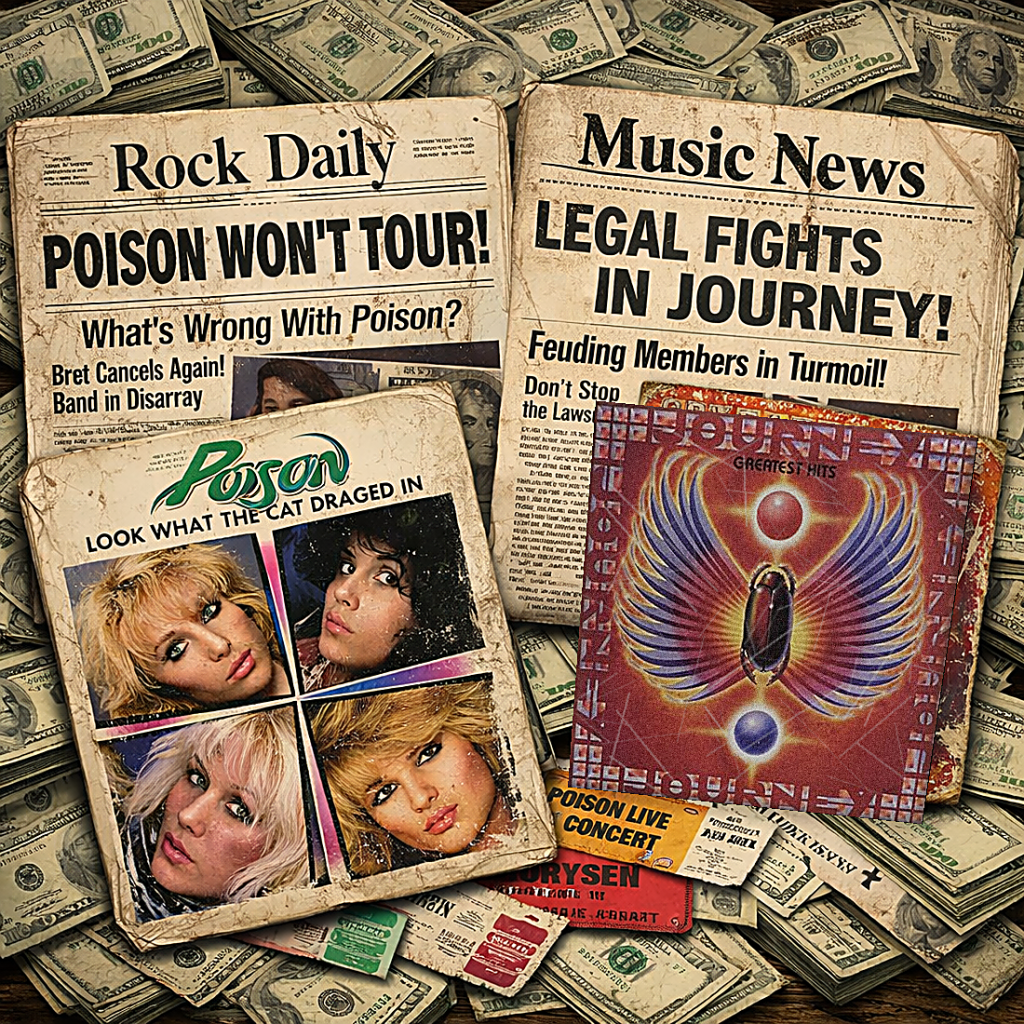
Look What the Poison Saga Dragged In – How Feuds Can Promote Music!
There is a lot of hand-wringing going on right now in the world of classic rock. If you’ve been following the news, you’ve seen the headlines.
Poison’s 40th-anniversary tour has reportedly imploded over a massive pay dispute. Journey is currently operating like a high-stakes divorce court that happens to play stadiums.
The general consensus from the critics and the purists is that this is sad. They say it tarnishes the legacy. They say it ruins the “brotherhood.” They say it’s the end of an era.
I’m here to tell you they are wrong.
This isn’t the death of rock and roll. This is the heartbeat. In an era where attention is the most valuable currency on Earth, these bands aren’t self-destructing—they are shouting from the rooftops that they are still here, they are still fighting, and they still matter.
If you look past the initial shock of the headlines, you realize that this chaos is actually driving a massive resurgence of interest in bands that haven’t released a hit single in thirty years. The drama isn’t killing the legacy; it’s the fuel that keeps the engine running in 2026.
The Great “Hey, I Remember Them!” Effect
Let’s be honest about how we consume music today. We are bombarded by new content every second. The biggest threat to a classic rock band isn’t a fight between the singer and the drummer; the biggest threat is silence.
The biggest threat is becoming a museum exhibit—quiet, dusty, and polite.
When Rikki Rockett hits the press and claims Bret Michaels wants a 600% raise, or when Neal Schon and Jonathan Cain start filing a lawsuit or two, something magical happens in the human brain.
It’s called the “Activation of Memory.”
You see the headline. Maybe you roll your eyes. Maybe you pick a side. But then, inevitably, the song starts playing in your head.
You remember when Look What the Cat Dragged In came out. You remember singing “Faithfully” at your prom.
And then, you do the one thing every band needs you to do: you pick up your phone, you open Spotify or Apple Music, and you type in their name.
Data researchers have been looking at this for years. While established brands usually fear bad press, entertainment acts often see a “curiosity spike.”
When the news cycle heats up, so do the search results. People want to know why they are fighting, and that search journey almost always ends with listening to the music.
The drama acts as a massive, free billboard. It creates a “cultural moment” for bands that otherwise wouldn’t get covered by major news outlets.
Suddenly, Poison isn’t just a band from the 80s; they are a trending topic in 2026.
Friction in Poison Creates Heat (and Heat Sells Tickets)
Let’s look at the Poison situation with a fresh pair of eyes.
The reports are that the 2026 tour is off the table because Bret Michaels allegedly wanted $6 for every $1 the other members made. That sounds steep. But look at what that headline actually communicates: Value.
It tells the world that Bret Michaels believes he is a superstar. It tells the world that the Poison brand is worth fighting over. If they were arguing over who paid for lunch, it would be pathetic.
But arguing over millions of dollars? That signals that the stakes are high.
This “Will They/Won’t They” dynamic is the oldest trick in the show business book. By publicly scrapping the tour, they have inadvertently created scarcity. Now, the fans don’t just want a tour; they crave a resolution.
If Poison announces a reconciliation in 2027, it won’t just be a concert; it will be a heavyweight title fight. It will be the Reunion of the Decade.
The friction we are seeing now is setting the stage for a much bigger, more lucrative redemption arc later. Peace is boring. Conflict—and the resolution of conflict—is what sells tickets.
Journey: The Soap Opera You Can Dance To
Then there is Journey. Their legal battles are legendary at this point, involving credit card limits, security guards, and court-appointed custodians.
And yet, look at the shows. They are pretty full.
Why? Because rock and roll was never meant to be a corporate retreat. We like our rock stars to be a little volatile. We like knowing that the guys on stage might hate each other, but for two hours, they are forced to lock in and create magic.
It adds a layer of tension and energy to the performance that you just don’t get from a band that gets along perfectly.
When you go see Journey now, you aren’t just seeing a band play the hits. You are watching a high-wire act. You are watching a soap opera with a guitar solo.
The headlines about their feuds don’t deter fans; they add a gritty texture of reality to the glossy ballads. It proves the passion is still there, even if it’s manifesting as anger.
The Algorithm Loves a Mess Like Poison and Journey
From a purely technical standpoint, these scandals are SEO gold.
Search engines and social media algorithms prioritize engagement. High-conflict stories generate comments, shares, and debates.
“Poison announces standard summer tour” gets a few likes. “Poison implodes over massive pay dispute” gets thousands of shares, reaction videos, and blog posts.
This pushes the band’s name up the rankings. It puts their back catalog in front of a new generation who might be clicking on the drama but staying for the riffs.
We saw this with the “Stinky Socks” marketing phenomenon—where even negative descriptors increased sales for unknown products because it increased awareness. For classic rock bands, they are fighting to remain “known” to a younger generation.
When a 20-year-old sees a TikTok about the Journey feud or the Poison money fight, they are learning the lore.
They are realizing these aren’t just faces on a t-shirt at Target; they are real, messy, chaotic people. That humanizes them. It makes them interesting.
The Silver Lining for Poison and Journey
So, the next time you see a headline about a rock legend behaving badly, or a band falling apart over money, don’t mourn.
Celebrate it.
It means they are still fighting for their worth. It means the blood is still pumping. It means that, 40 years later, Look What the Cat Dragged In is still causing trouble and making noise.
These headlines are a reminder to go back to the record collection. They are a prompt to blast “Nothin’ But a Good Time” and appreciate that, unlike so many things in this world that fade away quietly, these rock stars are refusing to go gently into that good night. They are going to scream, fight, and sue their way into our memories.
And honestly? That’s the most rock and roll thing they could possibly do.
Sources & Bibliography
Poison 40th Anniversary Tour & Financial Dispute
- Page Six: Poison’s 40th Anniversary Tour Nixed After Bret Michaels Demands 600% More Money Than Bandmates (January 18, 2026)https://pagesix.com/2026/01/18/entertainment/poisons-40th-anniversary-tour-nixed-after-bret-michaels-demands-600-more-money-than-bandmates/
- People Magazine: Bret Michaels Reacts After Poison Drummer Claims Anniversary Tour Wasn’t Happening Due to Frontman’s Financial Demandshttps://people.com/bret-michaels-reacts-poison-drummer-claims-anniversary-tour-wasnt-happening-11890344
- Daily Mail: Bret Michaels and Poison Reunion Implodes Over Moneyhttps://www.dailymail.co.uk/tvshowbiz/article-15489151/amp/Bret-Michaels-Poison-reunion-implodes-money.html
- Ultimate Classic Rock: Bret Michaels Reacts to Rikki Rockett’s Claims About Poison’s Scrapped Tourhttps://ultimateclassicrock.com/bret-michaels-rikki-rockett-response/
Journey Legal Battles & Tour News
- Rolling Stone: Journey’s Jonathan Cain and Neal Schon Reach Resolution in Legal Battlehttps://www.rollingstone.com/music/music-news/journey-jonathan-cain-neal-schon-resolution-legal-battle-1235090762/
- Rolling Stone: Jonathan Cain to Leave Band After One More Tour?https://www.rollingstone.com/music/music-news/journey-jonathan-cain-leave-band-one-more-tour-1235445237/
- Music Connection: Legal Beat: Journey Members Settle Legal Disputehttps://www.musicconnection.com/legal-beat-journey-members-settle-legal-dispute/
- Consequence Sound: Jonathan Cain Not Parting Ways with Journeyhttps://consequence.net/2025/10/jonathan-cain-not-parting-ways-with-journey/#
- Time Out: Journey Announced a Farewell Tour: Here Are All the Detailshttps://www.timeout.com/usa/news/journey-announced-a-farewell-tour-here-are-all-the-details-111025
- Ultimate Classic Rock: Journey Final Tour Lineup Revealedhttps://ultimateclassicrock.com/journey-final-tour-lineup/
Academic Context (Referenced in Analysis)
- Berger, J., Sorensen, A. T., & Rasmussen, S. J. (2010). Positive Effects of Negative Publicity: When Negative Reviews Increase Sales. Marketing Science, 29(5), 815–827.
Disclaimer: This blog post contains affiliate links. If you click on one of these links and make a purchase, I may earn a small commission at no additional cost to you. As an Amazon Associate I earn from qualifying purchases. Thank you for your support!