
KISS Destroys Anaheim ’76: Conquering California (Official Release)
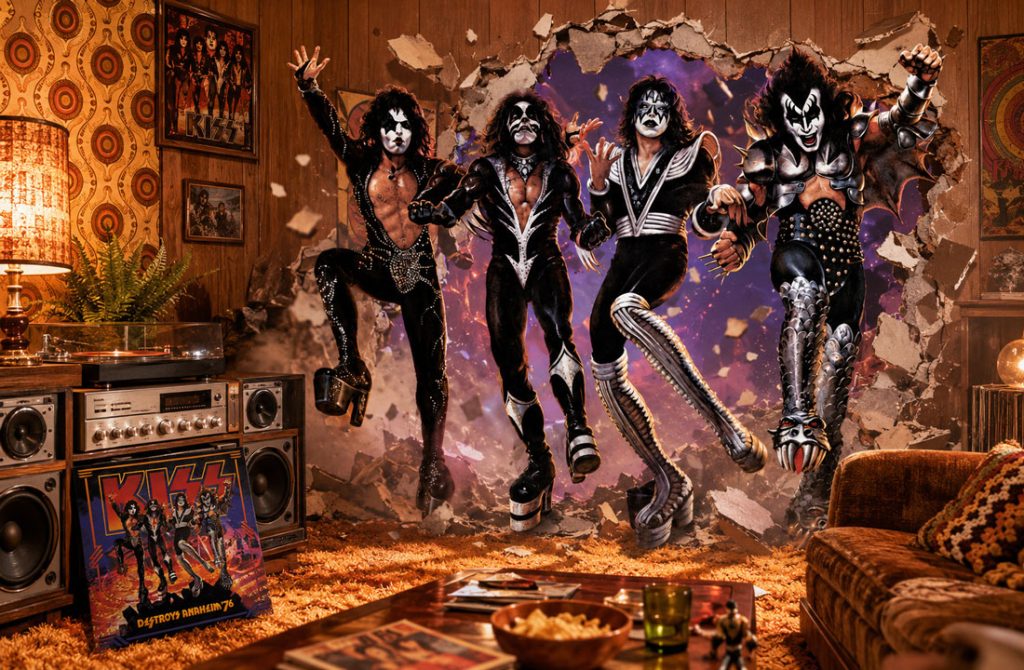
If you were a rock fan in the summer of 1976, there was one undeniable truth: KISS was everywhere.
You couldn’t walk into a record store or open a magazine without seeing the faces of Gene Simmons, Paul Stanley, Ace Frehley, and Peter Criss looking back at you.
They had transcended being just a rock band. They were a full-blown cultural phenomenon.
And on August 20, 1976, they took all that momentum, packed it into a massive stage setup, and unleashed it on Anaheim Stadium in California.
Playing to a crowd of over 42,000 screaming fans, it was a defining moment for the band. Up until that point, they were an arena act. A very successful arena act, sure.
But Anaheim was a stadium. That’s a whole different level of rock stardom.
For decades, stories of this legendary gig have floated around record fairs, fanzines, and online forums. Bootleg cassette tapes with muddy audio were traded like gold.
Now, the history books are getting an official update. The historic set is finally getting the treatment it deserves with the official live release, KISS Destroys Anaheim ’76.
Let’s dig into exactly what happened that night, why it matters, and what makes this new release an absolute must-have for anyone who calls themselves a member of the KISS Army.
Buy KISS DESTROYS ANAHEIM ’76 vinyl on Amazon
Buy KISS DESTROYS ANAHEIM ’76 CD on Amazon
🏟️ Setting the Stage: The Summer of ’76
To really appreciate the magnitude of the Anaheim show, you have to understand where KISS was at in their career.
The Destroyer album had dropped earlier that year, in March 1976. It was a massive departure from the raw, garage-rock sound of their earlier records.
Producer Bob Ezrin had brought in sound effects, children’s choirs, orchestrations, and a heavy dose of musical theater.
At first, fans didn’t quite know what to make of it. The album actually struggled out of the gate.
It wasn’t until a B-side ballad called “Beth” started getting radio play that Destroyer shot into the stratosphere, pulling the rest of the album up with it.
Suddenly, “Detroit Rock City” and “Shout It Out Loud” were anthems.
So, when KISS hit the road for the Spirit of ’76 tour (which morphed into the Destroyer tour), they weren’t just playing to their loyal underground fanbase anymore.
They were playing to everybody. The kids, the teenagers, the curious parents.
The Anaheim Stadium gig was the crown jewel of that summer run.
42,000 people. Just let that sink in.
A few years prior, these guys were playing clubs in Queens, New York, for fifty bucks and a case of beer.
Now, they were packing a baseball stadium in Southern California.
🎸 The Supporting Cast: A Heavyweight Bill
You know you’re dealing with a legendary era of rock music when you look at the opening acts for this show.
Back in the seventies, concert promoters loved to stack the deck. You didn’t just get one good band; you got a full day of heavy hitters.
The lineup for August 20, 1976, was insane.
First up, you had Montrose. This was a band that helped define American hard rock.
While Sammy Hagar had already left the group by this point, Ronnie Montrose was still slinging his guitar, bringing that heavy, bluesy rock to the California crowd.
Next up was Ted Nugent. The Motor City Madman was right in the middle of his Free-for-All era. Love him or hate him, Nugent in 1976 was an absolute force of nature on stage.
Loud, aggressive, and relentless. His guitar tone was deafening, and he knew exactly how to work a stadium crowd into a frenzy.
And right before KISS took the stage? Bob Seger and the Silver Bullet Band. Seger was on the verge of superstar status himself.
Night Moves was about to drop later that year, and he was already a seasoned live performer.
Having Bob Seger open for you is a flex. It takes a lot of confidence to follow a guy who sings with that much soul and plays with that much gravel in his voice.
But KISS had the spectacle. And they knew it.
🎛️ The Architect of Sound: Enter Eddie Kramer
When you talk about the way KISS sounds on a live record, you have to talk about Eddie Kramer. His fingerprints are all over the band’s most defining moments.
Before KISS even had a record deal, Kramer was working as the Director of Engineering at Jimi Hendrix’s Electric Lady Studios.
He had already carved out a reputation in the music industry. In 1973, he crossed paths with a young Gene Simmons and Paul Stanley.
Kramer ended up producing the band’s original five-song demo tape.
That exact tape was the golden ticket that helped them secure their management and recording contract with Casablanca Records.
Fast forward a couple of years. KISS had released three studio albums (KISS, Hotter Than Hell, and Dressed to Kill). While the songs were great, the records sounded a bit flat.
They failed to capture the raw, explosive energy of a KISS concert. Casablanca Records was bleeding money, and the band needed a miracle.
They called Eddie Kramer.
Kramer produced and mixed the landmark 1975 album Alive!.
He knew exactly how to mic the drums, how to blend the crowd noise, and how to make the guitars sound like they were jumping out of your speakers.
Alive! Was the band’s breakthrough. It defined the “KISS sound” and literally saved the band’s career.
Kramer famously handled some post-production and studio fixes to ensure everything sounded larger-than-life, but that was just par for the course in making a legendary live album.
While Bob Ezrin handled the studio magic for Destroyer, KISS brought Kramer back to the fold shortly after to produce their follow-ups like Rock and Roll Over and Love Gun.
Now, decades later, Eddie Kramer is back where he belongs.
For KISS Destroys Anaheim ’76, the audio has been newly mixed by Kramer directly from the original 1976 multi-track tapes.
This isn’t just a simple remaster. It’s a total reconstruction of the audio by the guy who knows exactly how this band is supposed to sound.
💥 Chaos on the Steps: The Show Begins
A KISS show in 1976 wasn’t just a concert. It was a circus, a horror movie, and a comic book all rolled into one.
And to match the sheer size of Anaheim Stadium, the production went completely over-the-top.
Before the band even played a note, the crowd was treated to a bizarre and hilarious introduction.
The eccentric musical comedy duo Flo & Eddie (Howard Kaylan and Mark Volman, formerly of The Turtles) walked out on stage.
To hype up the massive crowd, they were wearing full KISS makeup. It was a weird, quirky touch that fit perfectly into the surreal atmosphere of the night.
The stadium setup featured a high-wire tightrope walk over the audience. They had massive stadium fireworks ready to launch. Everything was cranked to eleven.
But rock and roll is unpredictable. As the dramatic intro to “Detroit Rock City” played, the band made their grand entrance.
They were supposed to descend a flight of stage stairs looking like unstoppable rock gods.
Instead, Gene Simmons tripped.
He stumbled right there on the stairs in front of 42,000 people. But here is the thing about Gene Simmons – he is a consummate professional when he’s in the Demon persona.
He recovered instantly. He didn’t miss a beat. If anything, that quick recovery set a wild, chaotic, high-energy tone for the rest of the night.
The adrenaline was pumping, and there was no turning back.
🎶 KISS Destroys Anaheim ’76 Track by Track: Breaking Down the Setlist
The official track listing for KISS Destroys Anaheim ’76 is a dream for old-school fans. It features 15 songs split across four vinyl sides, focusing heavily on their first four albums. Let’s take a walk through the setlist and look at what makes these performances so special.
⚡ KISS Destroys Anaheim ’76 Side 1: The High-Speed Assault
Detroit Rock City
Starting the show with this track was a no-brainer. It is arguably the greatest driving rock song ever written. The intricate twin-guitar harmony between Paul Stanley and Ace Frehley sounds massive in a stadium setting. Kramer’s mix brings out the heavy thud of Peter Criss’s kick drum right from the opening measures.
King of the Night Time World
They segue directly into this one, just like they do on the Destroyer album. It’s an upbeat, fast-paced rocker that keeps the energy in the red. Paul Stanley’s vocal delivery here is pure 1970s swagger. You can hear the hunger in his voice.
Let Me Go, Rock ‘N’ Roll
This is where the band really starts to loosen up. Originally from the Hotter Than Hell record, this song is a boogie-woogie rock jam played at punk-rock speed. Ace Frehley’s guitar work on this track is frantic and blistering. It’s a showcase of his frantic, off-the-cuff soloing style that influenced a million kids to pick up a Les Paul.
🔥 KISS Destroys Anaheim ’76 Side 2: The Classics
Strutter
A staple from their debut album. “Strutter” has that undeniable groove. Gene Simmons’ bass line walks perfectly underneath Paul’s rhythm guitar. In a live setting, this song always felt a little more dangerous and a little more urgent than the studio version.
Hotter Than Hell
The sludgy, Black Sabbath-esque riff of “Hotter Than Hell” sounds incredibly heavy with Eddie Kramer at the mixing board. The slower tempo gives the crowd a chance to catch their breath while Gene prowls the stage. It’s a masterclass in heavy metal restraint.
Shout It Out Loud
The ultimate party anthem. This was the big hit of the moment, and you can hear the crowd entirely lose their minds when the chorus kicks in. Gene and Paul trading vocal duties is a signature KISS move, and their harmonies (even live and running around in platform boots) hold up remarkably well.
Tom Tom Solo (Peter Criss Drum Solo)
You can’t have a 70s rock album without a drum solo. Peter Criss was deeply influenced by jazz drummers like Gene Krupa, and his soloing style was always more about groove and swing than just pure technical speed. He pounds the skins with an aggressive, tribal rhythm that shakes the stadium.
🦇 KISS Destroys Anaheim ’76 Side 3: The Heavy Hitters
Deuce
Gene Simmons’ signature song. The opening riff of “Deuce” is sharp as a razor. It’s the song they used to open shows with for years, and placing it right here in the middle of the set injects a massive dose of adrenaline back into the show. The synchronized swaying choreography the band does during this song is iconic.
Firehouse
Sirens wailing, red lights flashing. “Firehouse” is a slow-burning heavy rock track that ends with Gene breathing actual fire on stage. Musically, it’s a tight, focused jam, but visually, it was one of the peaks of the concert.
Bass Solo (Gene Simmons)
This isn’t a solo in the traditional musical sense. It’s an auditory nightmare. Gene aggressively plucks massive, distorted bass chords while spitting blood and looking like a gargoyle. The sound effects echoing through the massive stadium PA system must have been terrifying and thrilling for the kids in the audience.
God of Thunder
The heavy, plodding masterpiece. Interestingly, Paul Stanley wrote this song, but Bob Ezrin insisted Gene sing it. It became Gene’s ultimate theme song. Played live in Anaheim, the sheer weight of the riff is crushing. It sounds evil, dark, and massive.
Guitar Solo (Ace Frehley)
Ace’s time to shine. His smoking guitar routine is a piece of rock and roll theater, but don’t let the smoke bombs distract you from his playing. He weaves in and out of feedback, blues licks, and classical-inspired runs. Kramer, who had a deep creative bond with Ace, always knew how to mix his guitar perfectly to highlight his unique phrasing.
🎆 KISS Destroys Anaheim ’76 Side 4: The Grand Finale
Rock and Roll All Nite
The song that built the KISS empire. By 1976, this wasn’t just a song; it was a global mandate. The chorus is designed for 42,000 people to sing along to, and Kramer’s mix captures the sheer volume of the audience perfectly. It’s pure joy and rock and roll celebration.
Shout It Out Loud (Reprise)
A quick revisit to the anthem to keep the momentum going before the encore.
Beth
The curveball. Peter Criss steps out from behind the drum kit to sing this massive ballad. Hearing a tender, orchestral ballad in the middle of a heavy metal stadium show was unheard of, but “Beth” was the biggest hit they had. The crowd sings every single word.
Do You Love Me?
A fantastic, swaggering rock song to close out the night. It has a great stomping beat and a huge chorus. The newly mixed live version of this song is already available to listen to, and it proves exactly why this live album is going to be so special. The separation of the instruments, the clarity of the vocals, and the punch of the drums are lightyears ahead of old bootleg tapes.
📼 The KISS Destroys Anaheim ’76 Bootleg Legacy
For the hardcore KISS Army, the Anaheim ’76 show has always been a Holy Grail.
Because the concert was professionally recorded by Eddie Kramer but then locked away in a vault for decades, it became one of the most famous, heavily traded, and sought-after bootleg recordings in the history of rock music.
If you grew up in the era of cassette trading, you probably had a third-generation copy of this show.
It usually circulated under the title KISS Destroys Anaheim. Fans would pour over the muddy audio, trying to make out the stage banter and the solos.
Bootlegs were an essential part of rock culture. They were how fans connected and shared their passion before the internet existed.
Having the official release keep the fan-given title KISS Destroys Anaheim ’76 is a really classy nod from the band to their die-hard supporters.
It acknowledges the history of the tape and validates the decades of fan dedication.
🌟 Backstage at the Stadium: A Hollywood Scene
When you play a gig this massive in Southern California, the after-party is going to be ridiculous. And Anaheim ’76 was no exception.
The event featured an after-party right there on the stadium grounds.
Lead guitarist Ace Frehley later recalled it as a highly special night.
They were suddenly surrounded by major Hollywood celebrities of the era. Comedian Billy Crystal and actress Mackenzie Phillips were just a few of the names hanging out backstage.
It was a clear signal that KISS wasn’t just a fringe rock band anymore. They were A-list entertainment.
They were mingling with television stars and movie actors. The culture was shifting, and KISS was right at the center of it.
🧠 Different Memories of the Same Night
One of the most fascinating things about looking back at this concert is how differently the band members remember it.
Memory is a funny thing, especially when it’s filtered through the adrenaline of playing to a stadium crowd.
Drummer Peter Criss has been very vocal about this show. He called it his “favorite gig of all gigs.”
For him, the sheer physical sensation of the event was overwhelming. He vividly remembers the deafening roar of 42,000 fans stomping their feet on metal stadium seats.
Criss said the noise made his heart pound right through his chest.
For a guy who grew up playing small clubs in Brooklyn, that feeling of absolute power must have been intoxicating.
On the flip side, you have Paul Stanley. Paul has always been the perfectionist of the group.
While he deeply appreciated the crowd size and recognized it as a historical high point for the band’s career, he was more critical of the music.
He felt that from a purely technical standpoint, the band’s actual musical performance wasn’t their best. He didn’t consider it a “stellar show” musically.
But frankly, rock and roll isn’t about perfection. It’s about energy, attitude, and connection.
And based on what we can hear from Eddie Kramer’s new mix, the energy that night was absolutely explosive. Pure 70’s Kiss.
Minor flubs or tuning issues just add to the charm of a real live rock band flying by the seat of their pants.
💿 The KISS Destroys Anaheim ’76 Physical Release: Why Vinyl Still Matters
In an era where music is mostly streamed invisibly through the air, there is something incredibly satisfying about a physical record release. KISS Destroys Anaheim ’76 is getting the royal treatment.
It will be available on both 2-LP vinyl and CD formats. But it’s not just about the audio.
These packages feature previously unreleased photos from the gig and historical memorabilia.
When you buy a live album on vinyl, it’s an event. You have to take the record out of the sleeve, drop the needle, and commit to the journey.
You sit down, open up the gatefold jacket, and look at the photos of the band on stage. It transports you back to 1976.
You get to read the liner notes, see the massive crowd shots, and feel connected to the history.
KISS has always understood the importance of the physical product, and this release looks to be an absolute treasure trove for collectors.
🎚️ The Art of Analog: How Eddie Kramer Mixed the Magic
In today’s modern music industry, recording a live album is a very sterile process.
You run a digital feed directly from the soundboard into a laptop, and you can edit every single missed note or flat vocal perfectly using software.
But in 1976, capturing live lightning in a bottle was a massive physical undertaking.
When Eddie Kramer set up to record KISS at Anaheim, he was using a mobile recording truck parked outside the stadium.
Heavy, thick cables ran from the stage all the way out into the parking lot. The audio was being captured on massive two-inch wide magnetic tape running through spinning reels.
Every drum hit, every bass pluck, and every roar from the 42,000 fans was imprinted physically onto that tape.
The challenge with stadium recordings is sound bleed. The guitars bleed into the drum microphones. The PA system echoes off the back walls of the stadium and bleeds into the vocal microphones.
It’s chaotic.
Kramer’s genius was his ability to take that massive wall of muddy stadium noise and separate it into a cohesive rock record.
When he returned to these tapes decades later for the Destroys Anaheim ’76 release, he baked the old tapes (a literal physical process of heating old analog tape so it doesn’t disintegrate) and transferred them to modern systems.
He preserved the analog warmth but used his incredible ear to highlight the punch of Peter’s snare and the grit of Gene’s bass.
🎸 The Gear: What Powered the Hottest Band in the World
The visual of KISS in ’76 is iconic, but the gear they were plugging into is what created that bone-crushing sound.
Paul Stanley’s Arsenal
Paul was largely relying on Gibson guitars during this era, specifically the Flying V and the Firebird.
These guitars, plugged into massive walls of Marshall amplifiers, provided the thick, mid-range crunch that serves as the bedrock of the KISS sound.
His right-hand rhythm playing is highly underrated; he plays with a swinging, percussive attack that drives the songs forward.
Ace Frehley’s Les Pauls
Ace is synonymous with the Gibson Les Paul. During the ’76 tour, he favored a three-pickup Les Paul Custom.
The Les Paul naturally has a very thick, singing sustain, which is why Ace’s solos on tracks like “Let Me Go, Rock ‘N’ Roll” sound so fluid and massive.
He utilized a unique technique where he would toggle his pickup selector switch rapidly to create a stuttering, almost synthesizer-like effect.
Gene Simmons’ Bass Rigs
Gene’s bass tone on the Destroyer tour was heavily distorted and aggressive. He played custom-made basses, most notably his LoBue and early prototypes of his famous Axe bass.
He ran his signal through Ampeg SVT bass amplifiers, which moved a ridiculous amount of air on stage. It wasn’t just a sound; it was a physical force you could feel in your chest.
Peter Criss’s Drum Kit
Peter played a Pearl drum set. Unlike modern metal drummers who tune their drums very low and dead, Peter tuned his drums higher, giving them a jazzy, resonant ring.
You can hear this clearly during his solo. The resonance of the drums perfectly cut through the heavy distortion of the guitars.
🤘 The Opening Acts: A Golden Era of Rock
Let’s talk more about that ridiculous opening bill. Bob Seger, Ted Nugent, and Montrose.
Bob Seger and the Silver Bullet Band were an incredibly soulful rock outfit. Seger had been grinding it out in the Midwest for years.
By 1976, he was a battle-tested live performer. Songs like “Turn the Page” and “Ramblin’ Gamblin’ Man” showcased a totally different side of rock and roll compared to KISS.
It was grounded, blue-collar, and emotional.
Having him on the bill proved that rock fans in the 70s had incredibly diverse tastes.
They could appreciate Seger’s poetry and KISS’s comic-book theater all on the same hot afternoon.
Ted Nugent was pure, unadulterated adrenaline. Playing his Gibson Byrdland hollow-body guitar (an insane choice for high-volume rock because it naturally wants to feed back),
Nugent would sprint across the stage, wearing loincloths and screaming into the mic. His set was essentially an assault on the senses.
Tracks like “Stranglehold” were hypnotic and dangerous.
Montrose, led by guitar wizard Ronnie Montrose, set the template for California hard rock. Even without their original singer Sammy Hagar, the band delivered blistering, high-octane heavy rock.
Imagine standing in the sun at Anaheim Stadium. You’ve just watched Montrose melt faces. Then Nugent deafens you with a wall of feedback. Then Bob Seger makes you feel the soul of Detroit rock and roll.
And then, as the sun goes down, Flo & Eddie walk out in makeup, the lights go black, the sirens wail, and KISS descends from the heavens (with a slight stumble from Gene).
It’s the ultimate 1970s rock fantasy.
The KISS Destroys Anaheim ’76 release isn’t just an album. It’s a time machine. It’s a document of a moment in history when rock and roll was the biggest, loudest, and most exciting thing on the planet.
❓ Frequently Asked Questions (FAQ)
When and where did the “KISS Destroys Anaheim” concert take place?
The concert took place on August 20, 1976, at Anaheim Stadium in Anaheim, California.
How many people attended the Anaheim show?
Over 42,000 fans attended the concert, making it the band’s largest headline audience at that point in their career.
Who were the opening acts for the Anaheim 1976 concert?
The massive concert bill featured Bob Seger and the Silver Bullet Band, Ted Nugent, and Montrose as the opening acts.
What tour was KISS on during this show?
They were on The Spirit of ’76 / Destroyer Tour.
Who mixed the new official audio for KISS Destroys Anaheim ’76?
The audio was newly mixed by Eddie Kramer directly from the original 1976 multi-track tapes.
What physical formats is the new album available on?
KISS Destroys Anaheim ’76 is available on 2-LP vinyl and CD formats.
Does the physical release include any extra features?
Yes, the physical formats feature unreleased photos and historical memorabilia.
🛒 Upgrade Your KISS Collection: 25 Must-Have Items on Amazon
If reading about this legendary 1976 show has you ready to expand your KISS collection, we’ve put together a curated list of awesome merch, vinyl, and gear you can grab right now.
Please note: These are Amazon search links to help you find the best current, live listings for these products.
KISS – Destroyer (Vinyl Record)
You can’t talk about the Anaheim ’76 show without owning the studio album they were touring behind. The definitive Bob Ezrin production featuring “Detroit Rock City” and “Beth.”
KISS – Alive! (Double Vinyl)
The album that made Eddie Kramer a KISS legend. If you want to hear what saved the band’s career in 1975, this is mandatory listening.
Official KISS Logo T-Shirt
Keep it simple and classic. A vintage-style black tee with the iconic silver and red KISS logo. The ultimate staple for any rock fan’s wardrobe.
KISS: Behind the Mask (Official Authorized Biography)
Want to know all the backstage drama? This massive oral history book features interviews with all the original members and the crew who made it happen.
Ace Frehley Signature Les Paul Style Guitar
Channel your inner Spaceman. While a real Gibson might break the bank, you can find excellent Epiphone models and copycats inspired by Ace’s iconic cherry sunburst.
Gene Simmons Axe Bass Miniature Replica
You don’t need to play bass to appreciate the coolest instrument in rock. This highly detailed miniature replica looks awesome on a desk or shelf.
KISS Action Figures (Mego Style)
Relive the 70s with these retro-style 8-inch action figures featuring the band in their Destroyer era costumes.
Nothin’ to Lose: The Making of KISS (1972-1975)
A fantastic book detailing the gritty, early club days of the band right up until the release of Alive!.
KISS Alive II (Vinyl Record)
The follow-up live album from 1977. It features a heavier sound, gatefold packaging, and some wild studio tracks on side four.
Paul Stanley’s “Face the Music” Autobiography
The Starchild tells his side of the story. A surprisingly vulnerable and honest look at his life, his ear defect, and managing the biggest band in the world.
KISS Destroyer Tour Poster Reproduction
Frame up a piece of history with a high-quality reproduction of the original 1976 concert tour posters.
Peter Criss “Makeup to Breakup” Autobiography
The Catman pulls no punches in this wild, raw, and often heartbreaking memoir of his life in and out of the band.
KISS Funko Pop! Rocks Collection
Grab the full set of original members in their classic vinyl figure form. They look great lined up on a bookshelf.
The Demon Gene Simmons Mask
Perfect for Halloween or just freaking out your neighbors. A high-quality latex mask of Gene’s iconic demon makeup.
KISS – Love Gun (Vinyl Record)
The last studio album to feature all four original members playing on every track. Eddie Kramer produced this massive, heavy-hitting record.
KISS 1000 Piece Jigsaw Puzzle
Spend a rainy afternoon piecing together the iconic cover art of Destroyer or a massive vintage concert photo.
KISS Throw Blanket
Stay warm with a plush fleece blanket featuring the band’s logo or classic album artwork.
📚 Bibliography & Sources
Here is a list of the foundational materials and sources referenced for the historical data in this article:
uDiscoverMusic: “KISS Set To Release Official Anaheim 1976 Live Album”
A detailed news report outlining the announcement of the official live album, including details on the vinyl and CD formats, the tracklisting, and Eddie Kramer’s involvement.
uDiscoverMusic (Search for: KISS Set To Release Official Anaheim 1976)
KISS Official Store: “KISS Destroys Anaheim ’76 CD”
The official retail listing detailing the product specifications, the 50th-anniversary context, and the promise of unreleased photos directly from the band’s archive.
Facebook (Official KISS Page): “August 20, 1976 On this day 48 years ago…”
The official band’s social media archive post commemorating the anniversary of the 42,000-person stadium show, confirming attendance numbers and historical significance.
Disclaimer: This blog post contains affiliate links. If you click on one of these links and make a purchase, I may earn a small commission at no additional cost to you. Thank you for your support!