

The Reviews Are Rough – There’s Still Plenty to Like About Madden
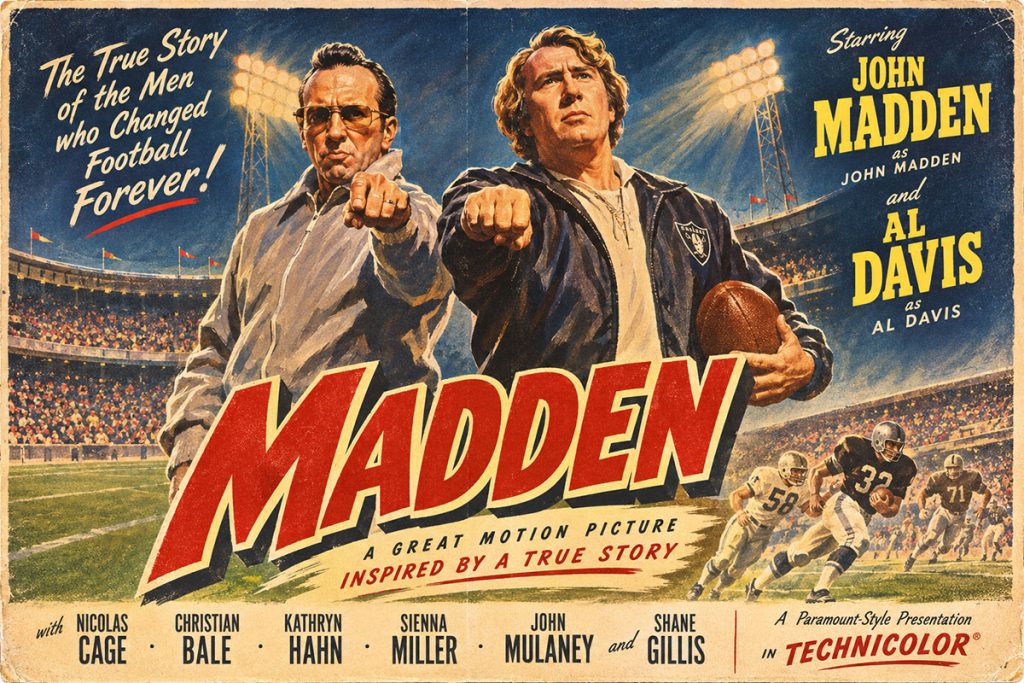
David O. Russell’s John Madden movie is loud, messy and occasionally frustrating. Christian Bale is terrific as Al Davis, Nicolas Cage has the unenviable job of portraying one of football’s most recognizable personalities, and the music is a treat. The movie doesn’t always work, but there’s more to enjoy here than the reviews might suggest.
Madden: The Quick Take
- The movie: An uneven but occasionally entertaining look at John Madden, Al Davis, the Oakland Raiders and the development of the Madden football video game.
- The standout: Christian Bale as Al Davis, bringing intelligence, humor and an appropriately intimidating presence to one of football’s most unusual personalities.
- The toughest role: Nicolas Cage as John Madden, whose distinctive voice, mannerisms and natural enthusiasm make him exceptionally difficult to portray.
- The biggest weakness: Too many competing storylines and a filmmaking style that rarely allows its most interesting characters to settle into a scene.
- The music: A welcome attraction for listeners who appreciate classic rock, Southern rock, psychedelic soul and funk.
- The verdict: Not the biography Madden deserved, but worth watching for Bale, the period atmosphere, the music and the remarkable history behind the story.
The New Madden Movie Has Problems. It Also Has Its Moments.
There was nobody quite like John Madden.
He could spend five minutes explaining why an offensive lineman had moved his left foot six inches in one direction instead of the other, and people would actually listen. He’d circle something on the telestrator, get excited about a block that most viewers hadn’t even noticed, then wander into a story about a restaurant or something that had happened on the road.
Half the time, it seemed as though he’d forgotten there was a football game going on. He hadn’t. He just had a lot to say about it.
Madden knew football inside and out, but his appeal went beyond the game. He was funny without working particularly hard at it. He could be loud, opinionated, easily distracted and completely absorbed in whatever happened to interest him at that moment.
He talked to millions of people every Sunday without ever sounding like somebody delivering a carefully rehearsed television performance.
Trying to recreate all that in a movie was always going to be difficult.
Nicolas Cage certainly doesn’t make the job look easy.
David O. Russell’s Madden stars Cage as the legendary coach and broadcaster, with Christian Bale playing Raiders owner Al Davis. Kathryn Hahn portrays Virginia Madden, and John Mulaney plays Electronic Arts founder Trip Hawkins.
The film covers Madden’s years with the Raiders, his complicated relationship with Davis and his involvement in developing the football video game that eventually became a franchise of its own.
There’s enough material for a very good movie. Several, actually. And that may be part of the problem.
Russell keeps changing the subject. The film begins exploring one part of Madden’s life, then turns toward something else just as the story starts getting interesting. The Raiders, Davis, the video game developers and Madden’s personal life all compete for attention.
Madden isn’t boring, exactly. It just doesn’t know when to settle down.
People argue, scenes get louder, somebody makes a joke, and suddenly the action moves somewhere else. By the time a relationship begins to develop, another piece of Madden’s history has arrived to take its place.
Russell has directed this sort of organized chaos before, and sometimes it works beautifully. Here, it’s a little too much. A movie about John Madden doesn’t need to be quiet, but it should occasionally allow its characters to finish a thought.
The reviews have been disappointing, and many of the complaints are understandable.
But here’s where Madden deserves a little credit.
Christian Bale is excellent. Cage has some good moments, even if his interpretation doesn’t always convince. The music is terrific, particularly for anyone with an affection for classic rock, Southern rock, soul and funk.
And buried beneath the exaggerated personalities and busy filmmaking is a fascinating piece of American sports history.
Madden never quite gets its arms around all of it. That doesn’t mean there’s nothing worth watching.
Christian Bale Almost Makes Madden an Al Davis Movie
Christian Bale has played enough difficult, obsessive men to know that the most interesting one in the room isn’t necessarily the loudest.
His Al Davis is a good example.
Davis was a demanding man with a very particular idea of how a football team should operate. He didn’t especially enjoy being challenged, and he certainly wasn’t interested in running the Raiders the way everybody else thought they should be run.
He wanted talented players. He wanted speed. He wanted to win. And he was perfectly willing to make enemies along the way.
There was more to Davis than the famous silver-and-black image, though. Before becoming the Raiders’ principal owner, he had worked as a coach and executive. He understood the game, the people who played it and the business surrounding it.
Bale makes that knowledge believable.
His Davis watches people closely. He seems to be weighing every answer, trying to work out what somebody really wants and whether they’re being straight with him. He can be intimidating without raising his voice, which is a welcome change in a movie where almost everybody eventually starts shouting.
Some of Bale’s funniest moments come when Davis isn’t saying much at all. A pause, an irritated look or the slightest change in his expression tells the audience exactly what he thinks.
And he’s not always impressed.
Bale also understands that Davis took himself seriously enough to be funny. The actor doesn’t have to turn him into a cartoon to get a laugh.
That’s why the performance works so well.
While the movie is busy demonstrating how eccentric everybody was, Bale seems more interested in what made Davis tick. He plays a man who knows exactly what he wants and has very little patience for anyone standing in his way.
That stubbornness helped make the Raiders what they were.
Davis built an organization with a reputation for doing things differently. He was prepared to take chances on players other teams had dismissed, and the Raiders developed a personality that extended well beyond the football field.
The uniforms helped. So did the attitude. But the team’s success wasn’t just a matter of looking intimidating.
Davis knew how to find talent, and Madden knew how to coach it.
The relationship between the two men is one of the best things about the film. It also leaves the impression that Bale could carry an entire movie about Davis.
There would be plenty to cover: his early coaching career, his role in building the Raiders, his confrontations with the NFL and his determination to make the franchise successful on his own terms.
Bale has the right combination of menace, intelligence and dry humor for the part.
The screenplay occasionally gives him too little to do. Then he gets another scene and reminds everybody why he’s so good.
In Playing Madden – Nicolas Cage Faces a Much Harder Job
There’s a problem with playing John Madden that doesn’t exist with most historical figures.
People already know exactly what he sounded like.
They remember the broad face, the excited delivery, the occasional burst of laughter and the way he’d become fascinated by something that seemed completely ordinary.
Even people who weren’t particularly interested in football knew Madden.
He was on television for decades. He appeared in commercials. His name was on one of the most successful sports video game franchises ever created.
He was familiar in a way that few coaches or broadcasters ever become.
Nicolas Cage has to compete with all those memories.
And there are times when the effort shows.
Cage throws himself into the performance, adopting Madden’s expressions, enthusiasm and familiar way of speaking. The physical transformation is substantial, although the makeup doesn’t always help.
At some angles, the resemblance is impressive. At others, it becomes difficult to stop noticing that Cage is wearing a considerable amount of makeup.
The voice presents another challenge.
The harder Cage pushes Madden’s familiar delivery, the more the performance begins to sound like an imitation.
That’s unfortunate because the real Madden was interesting for reasons that had little to do with the way he looked or sounded.
He was curious about almost everything. He could explain a difficult football play to somebody who barely understood the rules. He noticed small things, asked questions and had a knack for turning ordinary conversations into something entertaining.
Cage is better when he concentrates on that side of Madden.
There are moments when the actor relaxes, lets the character become genuinely interested in something and stops trying quite so hard to reproduce the familiar mannerisms.
For a moment, it’s easier to forget about the makeup and the voice.
Then another exaggerated scene comes along.
The difficulty is understandable. Play Madden without the recognizable voice, and the audience might wonder where the real character went. Reproduce every expression too carefully, and the performance starts resembling somebody doing an impression at a party.
Cage doesn’t consistently find a comfortable middle ground.
Still, it’s difficult to fault him for taking on the role. John Madden was an enormous personality, and Cage isn’t exactly known for playing small, restrained characters.
There was always the possibility that the combination would be too much. Sometimes it is.
But when Cage manages to capture Madden’s genuine affection for football, the performance becomes considerably more convincing.
The movie could have used more of those moments.
Madden and Davis Are More Interesting Together
Bale and Cage work best when the movie puts them in the same room and lets their different personalities take over.
Davis is calculating. Madden is more emotional.
Davis wants control of the organization. Madden wants to do his job and win football games.
They have strong opinions about how things should be done, and neither seems particularly interested in changing his mind simply to make a conversation more pleasant.
The two men also needed each other.
Davis assembled the talent and established the Raiders’ identity. Madden turned that talent into one of the NFL’s most consistently successful teams.
Their partnership produced tremendous results, but success doesn’t automatically make two stubborn people easy company.
There’s plenty of tension in that relationship without needing to manufacture more.
Unfortunately, Russell often pushes their disagreements further than necessary. A disagreement that might have been entertaining at normal volume becomes another scene filled with shouting.
Bale and Cage are capable of much more than that.
Their quieter exchanges are often the better ones, particularly when Davis is studying Madden and Madden is trying to work out whether he’s being challenged, threatened or simply tested.
The film gets glimpses of what made the relationship work.
It could have spent more time there.
The Music Gives the Madden a Much-Needed Lift
There are times when Madden is considerably more enjoyable to listen to than it is to watch.
The music suits the period, and it has some of the personality the movie keeps trying to manufacture through noisy dialogue and exaggerated behavior.
That’s especially true of the classic-rock material.
The Raiders of the 1970s belonged to an era of long guitar solos, enormous amplifiers, great rhythm sections and bands that weren’t particularly interested in sounding respectable.
It was also a period when rock, soul, funk and blues were constantly borrowing from one another. A great deal of that music has aged remarkably well.
The attraction isn’t simply nostalgia. Those records were made by musicians who could play, and there’s a looseness to many of the performances that’s increasingly difficult to find in modern productions.
The guitars aren’t always perfectly polished. The drummers don’t sound as though every note has been corrected by a computer. Sometimes a song takes its time getting where it’s going.
That’s part of the pleasure.
It’s worth separating the movie’s actual soundtrack from a wider collection of recordings associated with the era. The artists and albums discussed here make excellent companion listening, but they shouldn’t all be presented as confirmed film credits without checking the closing titles.
For anyone who enjoys classic rock and the music of the late 1960s and 1970s, there’s quite a bit worth revisiting.
The Outlaws and the Lost Art of the Long Guitar Solo
The Outlaws’ “Green Grass & High Tides” is one of the great Southern-rock guitar performances.
That might sound like a fairly generous description for a song that runs close to ten minutes on its original studio recording. But the length isn’t the attraction by itself.
The playing is.
Hughie Thomasson and Billy Jones were wonderful guitarists, and the way they worked together remains the recording’s greatest pleasure.
The song begins with a strong melody and develops gradually. By the time the extended instrumental section arrives, the band has established enough momentum to carry the listener through several more minutes of guitar playing.
There’s no sense that the musicians are simply taking turns showing off.
One guitarist introduces an idea, the other responds, and the music keeps moving. The rhythm section provides a solid foundation without turning the whole thing into an exercise in speed.
It’s the kind of recording that makes a long solo seem perfectly reasonable.
The Outlaws never received quite the same recognition as Lynyrd Skynyrd or the Allman Brothers Band, although they were certainly capable of standing alongside either group when the guitars took over.
Their self-titled 1975 debut is worth hearing in its entirety, particularly for listeners discovering Southern rock beyond the most familiar radio songs.
“Green Grass & High Tides” is the obvious attraction, but the album offers much more than one extended performance.
Early Aerosmith Still Sounds Better a Little Rough Around the Edges
The first several Aerosmith albums have a sound that later recordings never quite reproduced.
There’s a roughness to the guitars, a little looseness in the playing and the unmistakable impression of a band that was having a very good time making a considerable amount of noise.
Steven Tyler’s voice carried plenty of attitude, but Joe Perry and Brad Whitford were every bit as important.
Their guitar work drew heavily from the blues, with riffs that could be dirty, catchy and surprisingly economical.
Not everything needed to turn into a complicated solo. Sometimes the riff did the job.
Toys in the Attic remains an excellent place to hear that version of Aerosmith.
The album is confident without sounding overly rehearsed. The band knows what it does well and doesn’t spend much time pretending to be anything else.
There’s an obvious connection between that attitude and the Raiders of the same period.
Both had reputations for doing things their own way, although the comparison shouldn’t be pushed too far. A football organization and a rock band have rather different responsibilities.
Still, the music fits.
Hendrix, Santana and Two Very Different Approaches to Guitar Playing
Jimi Hendrix is so routinely described as a revolutionary guitarist that the word has almost stopped meaning anything.
His recordings explain the reputation better than another tribute ever could.
The famous solos are only part of it. Listen to the way Hendrix plays rhythm guitar, moving between chords, short melodic phrases and little bursts of improvisation without losing track of the song.
There’s an extraordinary amount happening beneath the obvious fireworks.
He could make an electric guitar sound almost conversational, then suddenly produce something that seemed completely outside the instrument’s usual vocabulary.
Carlos Santana worked in a different way.
Santana could hold a single note and make it more interesting than somebody else’s entire solo. His tone was recognizable almost immediately, but the guitar wasn’t the only reason his best recordings worked.
The percussion mattered enormously.
On an album such as Abraxas, the congas, drums, bass and keyboards create rhythms that give the guitar room to move. The music has a warmth and patience that separates it from a lot of harder rock recordings.
Hendrix could make a performance sound unpredictable. Santana could make a melody feel as though it had all the time in the world.
Both approaches are worth hearing, and both are reminders of just how much variety existed within rock music during the period.
The Chambers Brothers Deserve More Attention
The Chambers Brothers made some remarkable records, although they’re rarely mentioned as often as other artists from the late 1960s.
Their combination of gospel, soul, rock and psychedelia was unusually adventurous.
“Time Has Come Today” is the song most people know, and for good reason.
It’s rhythmic, strange, restless and occasionally unsettling. The recording stretches the familiar boundaries of rock and soul without losing the energy that makes it entertaining.
It also sounds unmistakably like the late 1960s.
This was a period when musicians were experimenting freely with arrangements, recording techniques and combinations of musical styles.
The Chambers Brothers were right in the middle of it.
Anyone who knows only the single should spend some time with the group’s other recordings. There’s much more to the band than its best-known song.
Kool & the Gang Know How to Make a Rhythm Section Work
Kool & the Gang offer a completely different kind of musical pleasure.
The group’s earlier recordings are built around extraordinary rhythm playing, with the bass, drums and horns working together so closely that it’s difficult to separate one part from the others.
The groove is the main attraction.
That sounds simple until it’s attempted.
A great funk recording needs precise musicianship, but it can’t feel stiff. Everybody has to know when to play, when to leave space and when to let somebody else take over.
Kool & the Gang understood that balance.
Wild and Peaceful is a particularly enjoyable introduction to the group’s earlier sound.
It’s worth hearing for the arrangements and musicianship, even for listeners who normally spend most of their time with guitar-driven rock.
Link Wray Could Do More With a Few Notes Than Most Guitarists
Link Wray’s “Rumble” doesn’t waste much time.
The riff arrives, the guitar sounds threatening, and the record makes its point.
It doesn’t need an extended solo or an elaborate arrangement.
Wray’s distorted guitar sound influenced generations of musicians, including plenty who would eventually play much louder and faster.
There’s something satisfying about going back to the source and hearing how little he needed to make an impression.
For fans of hard rock, garage rock and early punk, his recordings are essential listening.
And they provide an interesting contrast with extended performances such as “Green Grass & High Tides.”
One song takes its time. The other barely needs to explain itself.
Both work.
Talking Heads, The Hollies and a Few Unexpected Choices
Talking Heads seem like an unusual fit for a discussion about John Madden and the Raiders.
But the band’s nervous energy, unusual rhythms and inventive arrangements make an interesting change from the more conventional rock material.
David Byrne’s approach to singing and songwriting could be funny, anxious and slightly strange, sometimes within the same song.
The band was also far more rhythmically adventurous than the term new wave might suggest.
Remain in Light remains a remarkable recording, particularly for listeners willing to follow arrangements that don’t behave like ordinary rock songs.
The Hollies offer something entirely different.
Their best records are wonderfully melodic, with vocal harmonies that deserve more attention than they sometimes receive.
“Long Cool Woman (In a Black Dress)” has a tougher guitar sound than many people associate with the band, and it fits comfortably beside the harder-edged material of the early 1970s.
It’s also an excellent example of how effective a simple riff can be when the song around it is strong.
Ted Nugent’s 1970s recordings take that harder approach much further. The guitars are louder, the riffs more aggressive and the overall effect deliberately confrontational.
Whatever listeners think of Nugent’s public persona, his early hard-rock recordings are part of the musical history of the period.
Steve Miller, meanwhile, provides a welcome change of pace.
His familiar 1970s recordings sound as though they belong on a car radio during a long drive. They’re melodic, relaxed and immediately recognizable.
That makes them especially appropriate company for a story involving John Madden, whose years traveling across America aboard the Madden Cruiser became such a familiar part of his public image.
A Good Soundtrack Can Only Do So Much
The music makes several parts of Madden more enjoyable.
Sometimes an old recording establishes the period better than another elaborate scene. A familiar song can make the setting feel believable without anybody having to explain what year it is or how rebellious the Raiders were supposed to be.
But Madden still needs a story.
The music can’t supply the missing character development or make the screenplay more focused.
What it can do is make the experience more entertaining.
And it might introduce some viewers to a few excellent records they otherwise wouldn’t have heard.
That’s certainly something.
John Madden’s Coaching Record Deserves More Attention
John Madden became so famous as a broadcaster that his coaching career sometimes feels like the first chapter of a much longer story.
It was considerably more than that.
He became head coach of the Oakland Raiders in 1969 at just 32 years old.
That would have been a demanding job for an experienced coach. The Raiders had talented players, strong personalities and an owner with definite opinions about practically everything.
Madden had to establish himself quickly.
He did.
Over ten seasons, his teams won 103 regular-season games, lost 32 and tied seven. He never had a losing season. His .759 winning percentage remains one of the best in NFL history among coaches with lengthy careers.
And in January 1977, the Raiders won Super Bowl XI, beating the Minnesota Vikings 32–14.
There’s no need to exaggerate those achievements. The numbers are impressive enough.
What’s particularly interesting is the way Madden managed his teams.
The Raiders were filled with players who didn’t necessarily fit the conventional image of disciplined professional athletes.
Ken Stabler was a remarkable quarterback with a personality that suited the organization’s image. Fred Biletnikoff, Cliff Branch, Gene Upshaw, Art Shell, Willie Brown, Jack Tatum and Ted Hendricks were among the notable players who helped make the Raiders formidable.
There was a lot of talent.
There were also plenty of strong opinions.
Madden understood that he couldn’t treat every player the same way. Some needed encouragement. Others responded better to a challenge. A few probably played their best football when the coaching staff didn’t interfere too much.
He expected them to prepare and perform, but he wasn’t obsessed with making everybody behave identically.
That’s a difficult balance for a coach to maintain.
It requires confidence, a good understanding of people and enough football knowledge to earn the players’ respect.
Madden had all three.
The Raiders also had to survive an extremely competitive period in the AFC.
The Pittsburgh Steelers and Miami Dolphins were formidable opponents, and Oakland experienced several disappointing playoff defeats before finally winning the championship.
By the time the Raiders reached Super Bowl XI, Madden had already established himself as one of football’s best coaches.
The championship confirmed it.
He wasn’t a television personality who happened to have spent a few years coaching football. He was a great coach who later became an even bigger celebrity.
The movie occasionally loses sight of that distinction.
There’s fascinating material in the way Madden handled players, prepared for opponents and worked with Davis. Some of it would have made for better scenes than another argument about who was in charge.
The Broadcasting Years Made Madden a Household Name
For years, the sound of Pat Summerall’s voice meant an important football game was about to begin.
Then John Madden would start talking, and things got much more interesting.
Summerall was calm and economical. He didn’t use ten words when three would do.
Madden was almost the exact opposite.
He could get excited about the smallest detail of a play, especially something happening along the offensive line.
An ordinary block might send him into a long explanation involving several circles on the telestrator, an arrow pointing in an unexpected direction and a story that seemed to have very little to do with the original play.
Somehow, he’d bring it back to football. And the audience usually learned something along the way. The partnership worked because the two men didn’t compete for attention.
Summerall gave the broadcast structure. Madden filled in the details.
There was no need for both of them to become excited at the same time.
The Telestrator Became Part of the Entertainment
Madden didn’t invent the telestrator.
He did, however, make it one of the most entertaining parts of a football broadcast. He’d freeze the picture and start drawing. An arrow here. A circle around a player’s feet. Another line showing the direction of a block.
Sometimes the screen became so crowded that it was difficult to remember what the original play had looked like. But his explanations usually made sense.
He could take a complicated blocking assignment and make it understandable to somebody who’d never played organized football.
That helped change what audiences expected from television analysis.
Viewers didn’t just want to know who caught the pass. They wanted to know why the play worked.
Madden was particularly good at explaining that without making the audience feel foolish for asking.
The Madden Cruiser Became Famous in Its Own Right
Madden’s preference for traveling by bus was another part of his personality that audiences came to know. He avoided flying and traveled to his broadcasting assignments aboard the specially equipped Madden Cruiser.
There was plenty of opportunity for eccentricity in that arrangement, but Madden seemed to genuinely enjoy being on the road.
He liked restaurants, small towns, roadside discoveries and meeting people. He could become just as enthusiastic about an interesting place to eat as he did about a successful football play.
That made him appealing to people who weren’t necessarily serious football fans.
He was famous, but he didn’t seem terribly interested in acting like an important celebrity. He could sound like somebody talking to a friend over lunch.
Those everyday qualities are exactly what a good Madden biography should find time to explore.
The film works so hard to recreate his larger-than-life personality that it sometimes overlooks how enjoyable he could be when nothing particularly dramatic was happening.
A conversation on the bus could have told quite a bit about the man.
It wouldn’t even have needed an argument.
The Video Game Story Could Have Been a Movie of Its Own
The development of John Madden Football may be the most unusual part of Madden’s career. By the 1980s, he had already won a Super Bowl and become a successful broadcaster.
Then he became involved in developing a computer game.
Football fans who grew up with modern gaming systems might not appreciate just how ambitious that idea was at the time.
Early home computers had limited memory, limited processing power and graphics that look primitive by today’s standards. Creating a realistic football game presented technical problems that weren’t easily solved.
Madden, naturally, wanted the game to resemble actual football. That included eleven players on each side.
It sounds like a perfectly reasonable expectation. A football game should have twenty-two players on the field.
But making all those players move around a computer screen while following the rules of football was an enormous challenge for the technology available at the time.
The developers understood the limitations. Madden understood the game.
Somewhere between those two positions, they had to find a solution.
That’s a fascinating story, and it doesn’t require much Hollywood exaggeration.
The programmers had to build something that worked. Madden had to decide whether the results were good enough to carry his name. His reputation mattered to him.
He wasn’t interested in endorsing something that treated football as a collection of cartoon figures running randomly around a screen.
He wanted the strategy to matter. He wanted the formations to make sense. And he wanted players to recognize the sport.
The original John Madden Football appeared for the Apple II in 1988. It was a long way from the elaborate simulations available today, but it helped establish the foundation for a remarkable franchise.
As computers and consoles improved, so did the games.
Graphics became more sophisticated, playbooks expanded and players gained greater control over team management and strategy. Eventually, the annual Madden release became an event of its own.
For some football fans, buying the newest edition was as much a part of the season as watching the opening weekend of NFL games. The game also became an unexpected teaching tool.
People learned formations, defensive coverages, passing routes and football terminology while sitting in front of a television with a controller in their hands.
Some probably learned more about the sport that way than they did from watching the actual games. Madden would have understood the appeal.
After all, he’d spent years explaining football to people who weren’t professional players or coaches. The video game simply gave them another way to learn.
Madden Has the Ingredients for a Great Story Right Here
There’s something appealing about imagining Madden sitting with a group of computer programmers and trying to explain why their proposed football game isn’t good enough.
They tell him the computer can’t do something. He tells them football doesn’t work without it.
Nobody has to be the villain.
The people building the game understand technology. Madden understands football. Both sides have legitimate concerns, and the project can’t succeed unless they find a way to work together.
There’s room for comedy in that situation, especially with Madden’s personality. There’s also a clear story to tell.
The programmers encounter problems, Madden makes demands, and the team has to keep working until it produces something everyone can accept.
Along the way, the film could reveal plenty about Madden’s coaching career, his relationship with Davis and his unusually detailed understanding of the sport.
Instead, Russell’s movie keeps moving between different parts of Madden’s life.
The video game development is interesting, but it never quite becomes the central story it could have been.
That’s a missed opportunity.
Kathryn Hahn Gives Madden Some Welcome Breathing Room
Kathryn Hahn plays Virginia Madden, John’s wife, and her scenes provide a change from the film’s louder personalities.
John and Virginia married in 1959 and remained together for more than sixty years, until his death in 2021.
That’s a huge amount of shared history. It also means Virginia knew a version of John Madden that most of the public never saw.
She knew him before the Super Bowl championship, before the television fame and long before the video game became an annual fixture in millions of homes.
Hahn plays her without trying to compete with Cage’s larger performance.
It works.
Madden occasionally becomes so occupied with Madden’s public personality that the private man almost disappears. Virginia’s presence provides a reminder that there was a family and an ordinary life beyond the football field.
The movie touches on this part of Madden’s life, but never really explores it.
The demands of professional coaching can be enormous, and Madden’s broadcasting career involved years of travel. His professional life was hardly conventional.
Madden could have spent more time showing how Madden’s demanding career affected life at home. Madden touches on it, but rarely stays with it.
Hahn makes the most of what she’s given.
The Real History Is Better Than Some of the Exaggeration
Movies about famous people almost always take liberties.
Conversations get shortened. Events are combined. Personalities become a little larger because a filmmaker wants the audience to understand them quickly. That’s part of dramatizing a life.
But Madden often pushes its characters so far that their actual accomplishments become less interesting than the exaggerated behavior surrounding them.
Al Davis was a difficult and controversial executive, certainly. He was also a knowledgeable football man who helped build one of the sport’s most recognizable organizations.
John Madden was loud and eccentric. He was also an outstanding coach and a gifted broadcaster who knew how to explain football to almost anyone.
Neither man needs much embellishment to be worth watching. The movie’s approach occasionally reduces them to collections of recognizable traits.
Davis becomes the suspicious, intimidating owner. Madden becomes the excitable coach with the big voice.
Madden gets their personalities right in some ways, but never quite shows what made them so interesting. Watching old interviews and game footage gives a much better sense of who they really were.
Listen to Madden and Summerall call a game. Watch Madden explain a play. Find an interview with Davis discussing the Raiders or his disagreements with the league.
Madden and Davis were entertaining enough on their own. The movie didn’t need to exaggerate their personalities or make every conversation funny.
What Made John Madden So Different?
Madden could be funny, and he certainly knew how to entertain a television audience. His real gift was explaining football.
John Madden understood the details that casual viewers missed, and he had the patience to show people why they mattered. He wasn’t particularly concerned about sounding sophisticated.
Madden would draw circles on the screen, make a few of his famous noises and somehow explain exactly what had happened. Even people who knew very little about football could follow along.
Plenty of people understand a subject thoroughly but have no idea how to explain it. Madden could do both.
The same curiosity followed him away from football. He enjoyed talking about food, travel, people and whatever else happened to catch his attention.
He had a habit of treating ordinary discoveries as though they were worth sharing. People responded to that.
They didn’t need to be Raiders fans. They didn’t even need to know much about football. Madden was simply enjoyable company.
The movie captures some of his excitement, but it’s less successful at showing why people were so comfortable listening to him.
The recognizable voice is there. So are the expressions and the occasional odd behavior. The warmth is harder to find.
And without it, something important is missing.
Is Madden Worth Watching?
Madden isn’t a great biographical movie.
It tries to do too much, some of the performances are pushed beyond what the material needs, and Russell’s frantic style occasionally gets in the way of the story.
The disappointing reviews have a point. But there’s no reason to dismiss the film entirely.
Christian Bale alone makes it worth considering. His Al Davis is funny, intimidating and much more believable than some of the movie’s other characters.
Nicolas Cage doesn’t always succeed as Madden, although the assignment was never going to be easy. There are moments when his enthusiasm feels genuine, and those scenes suggest what the performance might have been with a little less exaggeration.
Kathryn Hahn brings some welcome calm to the proceedings.
The music is another attraction, especially for listeners who enjoy classic rock, Southern rock, soul and funk. And the history behind the movie is genuinely fascinating.
John Madden was a championship-winning coach who became one of America’s most popular sports broadcasters. Then his name became attached to a video game that introduced football to another generation.
That’s a great career by any standard.
For those expecting a straightforward, carefully researched biography, the movie may be disappointing. For those willing to enjoy the performances, the music and a colorful version of football history, there’s enough here to make it worth watching.
Just don’t expect the movie to explain everything that made John Madden special.
It doesn’t.
John Madden Left Behind a Better Story Than Hollywood Could Tell
John Madden died on December 28, 2021, at the age of 85. By then, he’d done just about everything a person could hope to accomplish in professional football.
He’d won a Super Bowl. He’d become one of the most recognizable broadcasters in the country. His name was known to millions of people who had never watched him coach a game.
And through the Madden video game franchise, he helped introduce the sport to younger fans who knew him first as a name on a box or a screen.
Not many people get one career that successful. Madden managed three.
The new movie doesn’t completely capture the man behind those achievements. It does, however, offer a reminder of just how unusual his life was.
And it may encourage younger viewers born after the 90’s to discover the real John Madden. That’s worth something.
Find an old broadcast with Pat Summerall. Watch Madden explain why a lineman made a good block, or listen to him wander into a story that nobody else would have thought to tell.
A few minutes of that footage will explain more about his appeal than any Hollywood impression ever could.
Frequently Asked Questions About Madden
What is the new Madden movie about?
David O. Russell’s Madden tells the story of John Madden, concentrating on his relationship with Raiders owner Al Davis and the development of the football video game that carries his name. It also covers parts of his coaching career, his family life and his years as a broadcaster.
Who plays John Madden?
Nicolas Cage plays Madden, complete with a substantial physical transformation and an attempt to reproduce his distinctive voice and mannerisms.
Who plays Al Davis?
Christian Bale portrays Al Davis. His performance is one of the best things about the movie.
Who plays Virginia Madden?
Kathryn Hahn plays Virginia Madden, John’s wife of more than sixty years.
Who plays Electronic Arts founder Trip Hawkins?
John Mulaney portrays Trip Hawkins, who founded Electronic Arts and helped bring the Madden video game project to life.
Who directed Madden?
David O. Russell directed the film.
Is Madden based on a true story?
Yes, although the film takes considerable dramatic liberties. The important career events are real, but conversations, conflicts and character behavior have been shaped for the screenplay.
Was John Madden really the Raiders’ coach?
Yes. Madden coached the Oakland Raiders from 1969 through the 1978 season.
Did Madden win a Super Bowl?
He did. His Raiders defeated the Minnesota Vikings 32–14 in Super Bowl XI, played in January 1977.
What was John Madden’s coaching record?
Madden finished with 103 regular-season wins, 32 losses and seven ties. He never had a losing season.
Why did Madden leave coaching?
He retired following the 1978 season, citing health concerns and the demanding nature of the job.
Was Al Davis as difficult as the movie suggests?
Davis was famously stubborn, demanding and willing to challenge the NFL. He was also a highly knowledgeable football executive. The movie emphasizes the more theatrical parts of his personality.
Did Madden and Davis get along?
Their relationship was complicated, but productive. They shared a determination to win, although they didn’t always agree about how things should be done.
Did Madden really help develop the video game?
Yes. Madden contributed his football knowledge to the project and insisted that the developers take the sport’s strategy and rules seriously.
When was the first Madden football game released?
John Madden Football debuted for the Apple II computer in 1988.
Why was Madden so insistent on having eleven players per team?
Because that’s how football is played. The requirement created a serious technical problem for early computer game developers, who were working with limited hardware.
Is the Madden NFL video game franchise still active?
Yes. Electronic Arts continues to release Madden NFL games.
Who was Madden’s most famous broadcasting partner?
Pat Summerall. The two became one of the most beloved commentary teams in professional football.
Did Madden invent the telestrator?
No, but he helped make it famous. His enthusiastic drawings became a familiar and entertaining part of football broadcasts.
What was the Madden Cruiser?
It was the specially equipped bus Madden used to travel between broadcasting assignments.
Why didn’t John Madden fly?
Madden avoided air travel, and several factors have been discussed in accounts of that decision. The movie shouldn’t be treated as the final word on his reasons.
Is Nicolas Cage good as John Madden?
Cage has some entertaining moments, but the performance is uneven. His portrayal works best when he captures Madden’s curiosity and enthusiasm rather than concentrating on imitating his familiar mannerisms.
Is Christian Bale good as Al Davis?
Very good. Bale gives Davis a strong personality without turning every scene into an argument. His performance is probably the best reason to watch the movie.
Why are the reviews so negative?
Much of the criticism concerns the film’s exaggerated performances, inconsistent tone and screenplay that moves between too many stories without giving any one of them enough attention.
Is the movie mostly about football?
Football is central to the story, but a substantial part of the movie concerns Madden’s relationship with Davis and the creation of the video game.
What kind of music is in Madden?
The film draws on the sounds of the late 1960s and 1970s, including classic rock, soul and funk. The finished film’s end credits should be consulted for an exact list of licensed recordings.
Is “Green Grass & High Tides” by The Outlaws worth hearing?
Definitely. It’s a Southern-rock classic with exceptional guitar playing from Hughie Thomasson and Billy Jones. Anyone who enjoys the Allman Brothers or Lynyrd Skynyrd should give it a listen.
Do viewers need to understand football to enjoy the movie?
Not necessarily. The performances and broader story are accessible without knowing the details of the sport. Familiarity with the Raiders and Madden’s career will make the historical references more enjoyable.
Is Madden a documentary?
No. It’s a scripted biography featuring actors portraying real people.
Where can Madden be watched?
The film premiered on Prime Video in November 2026. Check Prime Video for current availability.
Did John Madden live long enough to see the movie?
No. He died in December 2021, several years before its release.
What should viewers watch after Madden?
Old Madden and Summerall broadcasts are an excellent place to start. Footage of the Raiders’ Super Bowl XI victory is also worth seeking out, along with interviews featuring Madden and Al Davis.
For readers, Madden’s own books and well-researched histories of the Raiders provide considerably more detail than the film has time to cover.
Books, Music, Video Games and Raiders Gifts Worth Considering
The movie may leave viewers wanting to know more about Madden, the Raiders and the music of the period. Fortunately, there are plenty of worthwhile books, recordings and collectibles to explore.
A few are particularly good gifts for longtime football fans.
Books About Madden and the Raiders
**John Madden — Hey, Wait a Minute! (I Wrote a Book!)
Madden was a terrific storyteller, and his own writing is a good way to experience his personality without an actor trying to recreate it.
The book is especially appealing to people who grew up watching him on television.
John Madden — One Knee Equals Two Feet
Another entertaining collection of Madden’s thoughts about football and the people involved in it.
His ability to explain the game without becoming overly technical is a large part of the appeal.
John Madden — All Madden
A worthwhile addition for collectors of football books, particularly readers interested in Madden’s observations about the sport and his experiences around the league.
Older copies are generally worth checking through used-book sellers.
Al Davis Biographies
Christian Bale’s performance may leave viewers curious about the real Al Davis.
There’s a lot more to his story than the film can explain. A good biography can provide the background on his football philosophy, his conflicts with the NFL and the long history of the Raiders.
NFL History Books Covering the 1970s
The Raiders’ championship years become even more interesting when placed alongside the great Steelers, Dolphins and other teams of the decade.
Books about that period are ideal for readers who enjoy the history and personalities of professional football.
Browse books about 1970s football
Madden Video Games
Recent Madden NFL Games
For younger football fans, a recent edition of Madden NFL is the obvious place to start.
The modern games bear little resemblance to the early computer version, with detailed graphics, extensive playbooks and numerous ways to manage and play with a team.
Check the platform and edition carefully before purchasing.
Classic Sega Genesis Madden Games
Older Genesis editions offer a look at the period when Madden was becoming one of the most important names in home console sports gaming.
They’re especially good collectibles for people who played them when they first appeared.
Buyers will need compatible hardware, and the condition of used cartridges can vary.
Super Nintendo Madden Games
The Super Nintendo editions have a following among collectors who remember playing football games before online competition and elaborate modern graphics.
They’re a fun reminder of how much the franchise has changed.
Browse Super Nintendo Madden games
PlayStation 2 Madden Games
The PlayStation 2 years introduced many players to increasingly detailed football simulations.
These editions can make good nostalgia gifts, provided the recipient still has a compatible console.
Classic Rock from the Madden Soundtrack
The Outlaws — Outlaws
The band’s 1975 debut is an excellent recommendation for anyone who loves Southern-rock guitars.
“Green Grass & High Tides” is the best-known attraction, but there’s plenty of good playing throughout the record.
Aerosmith — Toys in the Attic
One of Aerosmith’s strongest early albums, with the rough-edged blues-rock sound that made the band so exciting during the 1970s.
Jimi Hendrix — Are You Experienced
An essential record for anybody interested in electric guitar. The playing still sounds remarkably imaginative.
Santana — Abraxas
A beautiful combination of expressive guitar playing, Latin rhythms and excellent arrangements.
The Chambers Brothers — The Time Has Come
A great choice for listeners interested in the adventurous side of late-1960s rock and soul.
Kool & the Gang — Wild and Peaceful
For anybody who appreciates a great rhythm section, this is an excellent introduction to the group’s early funk recordings.
Talking Heads — Remain in Light
Inventive, rhythmically adventurous and still an interesting listen decades after its release.
Link Wray — Rumble Collections
Wray’s recordings are worth exploring for anyone interested in the development of distorted electric-guitar rock.
A good compilation makes a useful introduction.
Steve Miller Band — Greatest Hits 1974–78
Familiar, melodic classic rock that still sounds great on a long drive.
Find Steve Miller’s Greatest Hits
Raiders Memorabilia
Vintage Oakland Raiders Clothing
The silver-and-black Raiders identity remains instantly recognizable.
A vintage-style shirt or sweatshirt is an easy gift for somebody who remembers the Madden and Stabler years.
Raiders Mini Helmets
Miniature helmets make good desk and shelf collectibles. Fans interested in the 1970s should look for designs appropriate to that period.
John Madden Collectibles
Trading cards, photographs and other Madden memorabilia can be worthwhile gifts.
Autographed items require extra caution. Seller reputation and reliable authentication are particularly important.
Browse John Madden memorabilia
For the strongest overall gifts, Madden’s own books are hard to beat. They offer a better sense of the man than most collectibles ever could.
For a music fan, The Outlaws’ debut is an excellent choice. For someone fascinated by the Raiders, a good Al Davis biography may be the most rewarding purchase.
The links above are shopping searches, not individually verified product listings. Editions, availability and pricing should be checked before ordering.
Sources and Further Reading
These references offer additional information about the film, the people it portrays and the music discussed in the article.
Film and Reviews
Rotten Tomatoes — Madden reviews and audience reactionsIMDb — Madden (2026) cast and production informationRogerEbert.com — Film reviewsThe Guardian — Film criticism and coverageAssociated Press — Entertainment coverage
John Madden and Football History
Pro Football Hall of Fame — John MaddenPro Football Hall of Fame — Al DavisPro Football Reference — Madden’s coaching recordLas Vegas Raiders — Franchise historyNFL — Football history
The Madden Video Game
Electronic Arts — Madden NFLMobyGames — Early Madden releases
Music
AllMusic — Artist and album historiesDiscogs — Recordings, releases and creditsRock & Roll Hall of FameThe Outlaws — Official website
Disclaimer: This blog post contains affiliate links. If you click on one of these links and make a purchase, I may earn a small commission at no additional cost to you. As an Amazon Associate I earn from qualifying purchases. Thank you for your support!