Why Independent Musicians Need Content Marketing in 2026
Music Promotion Needs More Than a Stack of Links
Independent musicians have access to more promotional tools than ever.
They can release a song worldwide without a record company. They can film a video on a phone, upload a podcast, sell a signed record, email fans, post tour dates, run an advertisement, and speak directly to listeners.
Access is no longer the main problem.
The problem is getting all of those pieces to work together.
An artist may have a website, several social profiles, Spotify, YouTube, Bandcamp, a podcast, an email list, merchandise, and a calendar full of shows. Yet the campaign can still feel disconnected.
The website has not been updated.
The Spotify profile does not feature the newest release.
The music video was shared once.
The tour dates are buried in social posts.
The email list has not heard from the artist in months.
The merchandise page exists, but nobody has explained why the items are worth buying.
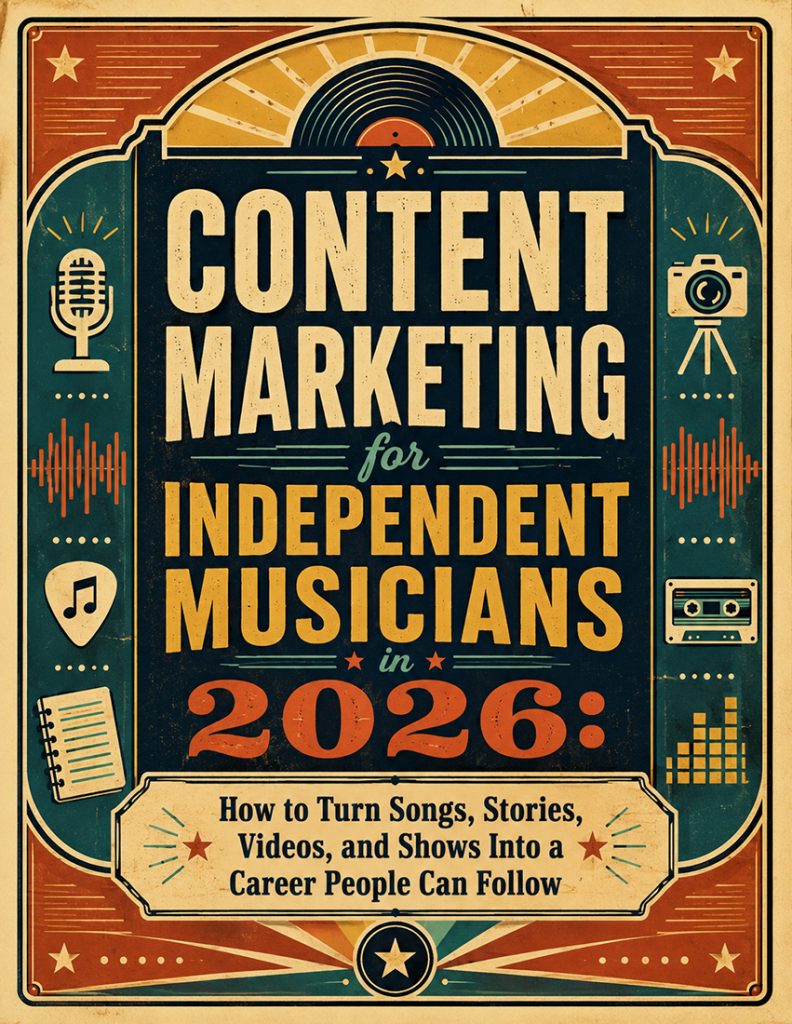
That is the problem addressed by Content Marketing for Independent Musicians in 2026: How to Turn Songs, Stories, Videos, and Shows Into a Career People Can Follow.
It’s available as a FREE download via Gumroad.
The guide is not built around one platform, one release, or one temporary trend.
It is built around a larger idea: every useful piece of artist content should help people find the music, understand the person behind it, and take a reasonable next step.
That next step may be small.
Listen to the full song.
Watch the complete performance.
Follow the artist.
Join the email list.
Buy a download.
Order a record.
Purchase a ticket.
Bring a friend to a show.
None of those actions happens automatically. The guide helps artists create the paths that make them possible.
A Guide for Musicians Who Are Tired of Guessing What to Post
A lot of independent artists do not lack ideas.
They lack a system.
They open Instagram and wonder what to say.
They upload a song and hope people find it.
They receive a show flyer from a venue, post it once, and assume the job is finished.
They hear that they need a podcast, TikTok account, newsletter, YouTube channel, website, electronic press kit, and steady stream of short videos.
Before long, music marketing starts to feel like several unpaid jobs stacked on top of writing, rehearsing, recording, traveling, and performing.
The guide approaches that problem without pretending artists have unlimited time.
It explains how to choose useful channels, create a manageable schedule, reuse strong material, and give every platform a defined role.
The website becomes the permanent home.
Social media helps people recognize the artist.
Video lets listeners see the music in motion.
Spotify supports listening and discovery.
Bandcamp and other direct-sales options give fans a way to buy.
Email keeps the relationship from depending on an algorithm.
Show pages help people find accurate dates and ticket links.
Podcasts and longer articles give the artist room to tell stories that do not fit into short captions.
Once those roles are clear, promotion becomes easier to organize.
The artist no longer needs every platform to do everything.
The Website as the Artist’s Permanent Address
Social platforms are useful, but they are rented space.
An artist does not control how many followers see a post, when a platform changes its design, or whether a feature disappears.
A website is different.
It gives the artist one stable place for music, biography, photographs, videos, merchandise, contact information, press material, and show dates.
The guide treats the artist website as an active part of the career rather than a decorative page that gets updated once every few years.
A useful musician website should quickly answer basic questions:
- Who is the artist?
- What does the music sound like?
- What is the newest release?
- Where can someone listen?
- Where can someone buy the music?
- Where is the artist performing?
- How can a venue, journalist, or fan make contact?
- Where can someone join the email list?
These questions may sound obvious, but many artist sites make the answers difficult to find.
The homepage may lead with an old album.
The biography may mention former members.
The show page may display expired dates.
The newest video may be buried several clicks deep.
The guide encourages artists to make the current priority visible.
When a single is being promoted, the homepage should feature the single.
When a tour is approaching, the tour should be easy to find.
When a limited vinyl edition is available, visitors should not have to search for the store.
The website also gives the artist room to publish material that lasts longer than a social post.
A story about writing an album can remain searchable for years.
A tour diary can help new fans understand the band’s history.
A detailed interview can support future press pitches.
A page about a specific song can collect the lyrics, video, credits, recording story, reviews, and purchase links in one place.
That is how a website becomes more than an online business card.
It becomes the artist’s archive.
Social Media Should Build Recognition, Not Constant Anxiety
Social media is often treated as the center of music marketing.
For many artists, it also becomes the most frustrating part.
Every post seems to require a new concept. Every clip appears to be judged immediately. A quiet day can feel like failure.
The guide offers a more reasonable view.
Not every post needs to go viral.
Not every update needs to sell something.
Not every video needs to attract thousands of strangers.
Social media can succeed by making the artist more recognizable over time.
People begin to remember the name.
They recognize the face.
They understand the humor.
They know what the music sounds like.
They become familiar with the artwork, colors, performance style, and subjects the artist talks about.
That recognition matters.
A listener may need to encounter an artist several times before following, saving a song, joining an email list, or buying a ticket.
The guide recommends a balanced content mix that can include:
- Music clips
- Live performances
- Songwriting stories
- Rehearsal footage
- Studio moments
- Tour photographs
- Older catalog songs
- Influences
- Fan questions
- Merchandise
- Show announcements
- Local music coverage
- Personal observations that fit the artist’s public identity
The key is not to turn every post into a demand.
If each update says “stream this,” “buy this,” or “get tickets,” the audience may stop paying attention.
At the same time, artists should not be so uncomfortable with promotion that fans never receive a clear way to help.
The guide helps artists find the middle ground.
Give people something interesting.
Then offer one natural next step.
Video Is Where Listeners Can See the Music Working
Independent artists already have something most businesses need to manufacture: a soundtrack.
That gives musicians a natural advantage with video.
A strong chorus, guitar part, vocal performance, or live moment can carry a clip without an elaborate concept.
The guide makes an important distinction between video content and an official music video.
An official video can be valuable, but it is only one format.
Artists can also publish:
- Live performances
- Acoustic versions
- Rehearsal clips
- Studio sessions
- Lyric videos
- Visualizers
- Tour diaries
- Song explanations
- Gear demonstrations
- Podcast excerpts
- Fan questions
- Demo-versus-master comparisons
- Short videos built around one lyric or musical moment
YouTube can serve as a long-term music library rather than a place where an artist uploads one official video and disappears.
Eligible artists can request an Official Artist Channel through a label, distributor, or qualifying music service partner. YouTube says an Official Artist Channel can consolidate an artist’s audience and provide artist-focused features such as ticketing, merchandise, and analytics.
The guide helps artists use short and long video for different purposes.
A short clip can catch attention.
A full performance can build confidence in the artist.
A longer interview can reveal personality.
A studio documentary can give serious fans more context.
A tour recap can promote the next show.
The best video strategy does not ask one clip to do everything.
It gives each format a clear job.
Podcasting Can Add Depth to an Artist’s Public Story
Not every musician needs a podcast.
Some artists are better served by performances, photography, written stories, or short video.
For musicians who enjoy conversation, however, a podcast can create room that social captions do not provide.
An artist podcast might focus on:
- Songwriting
- Album stories
- Local music
- Touring
- Production
- Musical influences
- Record collecting
- Interviews with other artists
- Conversations with promoters, journalists, or producers
- Subjects outside music that connect naturally to the artist
The guide does not suggest starting a podcast simply because podcasts are popular.
A useful program needs a clear subject and enough ideas to continue beyond the first few episodes.
Spotify for Creators advises podcasters to define the audience, subject, format, and purpose, then use audience information to refine the show. It also reminds new creators that small audiences are normal at the beginning.
A podcast can also produce material for the rest of the campaign.
One episode can become:
- Several short clips
- A website article
- A newsletter
- Quote graphics
- A YouTube upload
- A guest collaboration
- A playlist
- A series of social posts
This is a recurring idea throughout the guide.
Create one substantial piece.
Then give it several useful forms.
Spotify Is Part of the Campaign, Not the Entire Career
Streaming is an important part of modern music discovery.
It is not the only measure of an artist’s progress.
The guide explains how to use Spotify without allowing the platform to become the artist’s entire marketing plan.
Before a release, artists should review their profile image, biography, Artist Pick, merchandise, Canvas visuals, links, and upcoming shows.
Spotify currently recommends pitching the focus track from an upcoming release at least two weeks before the release date. It also asks artists to provide information about the story, sound, genre, and playlists that may fit the track.
That preparation matters.
A rushed playlist pitch written at the last minute may not explain why the song deserves attention.
The guide encourages artists to build a release story before submitting the pitch.
Why was the song written?
What does it sound like?
Which musical moment matters?
What is the strongest comparison?
Who performed on it?
What makes this release different from the artist’s previous work?
Spotify data can also help with planning.
Artists can review where listeners live, which songs are being saved, how people discover the music, and whether listeners return.
That information can influence content and touring decisions.
However, the guide draws a firm line between genuine promotion and purchased activity.
Spotify defines artificial streams as plays that do not reflect genuine listening intent, including attempts to manipulate the service with bots or automated processes.
A sudden number does not equal an audience.
The guide teaches artists to evaluate promotion companies carefully and avoid anyone promising guaranteed streams or guaranteed playlist placement without explaining the method.
Real listeners are slower to build.
They are also worth building.
Direct Music Sales Still Matter
Streaming makes music easy to hear.
Direct sales give fans a chance to own something and support the artist more directly.
The guide encourages musicians to give listeners several choices.
A fan may want:
- A digital download
- A signed CD
- A vinyl edition
- A cassette
- A shirt
- A poster
- A bundle
- A limited edition
- A ticket
- A membership
- A handwritten note or special insert
Bandcamp remains one useful direct-to-fan option. Its artist guide describes the platform as both a storefront and a community where followers can receive new-release and merchandise updates.
Bandcamp currently states that an average of 82% of a purchase goes to the artist or label after its revenue share and payment-processing costs.
The guide does not argue that every listener must buy.
It makes a more practical point.
Streaming and direct sales do different jobs.
Streaming helps people find and revisit music.
Direct purchases can create a stronger financial and personal connection.
An artist can explain that difference without criticizing fans who only stream.
A simple message may be enough:
“Streaming helps people discover the song. Buying it directly helps us pay for the next one.”
That gives the listener useful information without turning support into a guilt trip.
A New Single Needs More Than Release Day
Many campaigns put almost all their energy into one date.
The single appears at midnight.
The artist posts the cover and streaming link.
Friends share it.
A few days later, attention drops.
The guide treats a single as a campaign rather than a one-day event.
Before release, an artist can introduce:
- The song title
- Cover artwork
- A lyric
- The story behind the song
- A rehearsal clip
- An early demo
- A production detail
- A short video teaser
- A presave or preorder
- The release date
During release week, the artist can update the website, send email, publish the main video, respond to listeners, and make the song easy to find.
After release, the artist can continue with:
- An acoustic version
- A live performance
- A lyric explanation
- A studio story
- A fan question
- Press coverage
- A production breakdown
- A connection to an older catalog song
- A preview of what comes next
This approach gives the single several opportunities to reach people.
It also prevents the artist from repeating the same caption and link every day.
The guide includes campaign prompts and planning structures that help musicians find fresh angles without inventing an entirely new subject for each post.
One Show Date Is Still a Campaign
A show flyer contains important information.
It is rarely enough by itself.
Fans need the date, venue, city, time, ticket link, age policy, and supporting acts.
They also need a reason to care.
The guide asks artists to identify what makes the event worth discussing.
Is it the first hometown show in months?
Will the band perform unreleased music?
Is it a record-release event?
Is there a special guest?
Is the venue meaningful to the artist?
Will limited merchandise be available?
A three-week show campaign can include:
- Initial announcement
- Artist invitation video
- Venue collaboration
- Supporting-act introduction
- Older live footage
- Local press outreach
- Email reminder
- One-week reminder
- Day-before reminder
- Day-of update
- Post-show photographs
- Thank-you message
- Video recap
The same event information can appear more than once.
The angle should change.
That gives the artist several chances to reach people without making every post look identical.
A Tour Is a Group of Local Campaigns
A tour announcement tells the larger story.
A city-specific campaign sells the individual date.
That distinction is one of the most practical ideas in the guide.
A fan in Pittsburgh is not thinking about the entire tour route.
That person wants to know when the artist is coming to Pittsburgh, where the venue is, who else is playing, and why the show is worth attending.
Each date should have current information on the artist website.
City-focused content can include:
- Venue history
- A message to local fans
- Previous footage from that city
- A local playlist
- An introduction to the supporting artist
- Local press or radio outreach
- A ticket reminder
- A post-show recap
Tour content also creates a steady stream of material.
Travel moments, soundchecks, merchandise setups, backstage conversations, road problems, fan photographs, and performance clips can all support the campaign.
The guide helps musicians turn tour activity into a story people can follow instead of a pile of unrelated updates.
AI Can Help With Structure Without Replacing the Artist
The guide does not treat AI as a substitute for experience, judgment, humor, or personality.
It treats AI as a working tool.
Artists can use it to:
- Organize campaign ideas
- Build an outline
- Develop interview questions
- Create a first draft
- Compare headline options
- Turn one article into several formats
- Build a content calendar
- Create a checklist
- Identify missing information
- Improve readability
The final material still needs the artist.
It needs the real song story.
The real venue.
The actual studio problem.
The lyric that almost got removed.
The mistake that changed the arrangement.
The fan question that keeps coming up.
The opinion that belongs to this artist rather than any artist.
Google’s current guidance says generative AI can be useful for research and structure, but publishing large amounts of automated material without adding value can violate its scaled-content policies. Google also advises creators to focus on accuracy, quality, and relevance.
That matches the guide’s approach.
Use AI to reduce unnecessary work.
Do not use it to manufacture a personality.
A Companion Resource for Artists Who Need Practical Starting Points
The guide contains prompts throughout its sections, but some musicians may want a larger collection they can return to during future campaigns.
Prompts for Music Marketing includes hundreds of prompts intended to help independent artists develop ideas for releases, websites, press, social media, touring, fan communication, and other promotional needs.
The prompts are not meant to replace judgment.
They are designed to help artists begin with a clearer question.
➡️ Explore Prompts for Music Marketing
An artist can use a prompt to build the first structure, then add personal stories, facts, opinions, and musical details.
That is usually where the useful material begins.
Writing That Can Be Found Without Sounding Like It Was Written for a Machine
The guide also addresses artist visibility in Google Search and newer AI-assisted search experiences.
Artists may be discovered through searches such as:
- Bands playing in a particular city
- New albums in a specific genre
- Artists similar to another band
- Local musicians with upcoming shows
- Independent artists with new releases
- Podcasts featuring musicians
- Album reviews
- Songwriting interviews
Clear information helps.
The artist’s name should be written consistently.
Song, album, and venue names should be accurate.
Show dates should be current.
Biographies should contain specific information.
Pages should use descriptive titles.
Videos should have useful descriptions.
Google’s current guidance says traditional SEO principles remain relevant to its generative search features. It emphasizes unique, useful content, clear technical structure, high-quality images and video, and first-hand experience rather than special “AI search” tricks.
Google also says its systems are intended to prioritize helpful, reliable information created to benefit people, including content that provides original information, complete explanations, and value beyond what is already obvious.
That gives independent artists a practical direction.
Write clearly.
Publish real information.
Keep it current.
Add first-hand detail.
Make the website useful to people first.
What Makes This Guide Different
There are plenty of music marketing articles online.
Many focus on one platform.
Others offer quick lists of tips without explaining how the pieces connect.
This guide takes a wider view.
It brings together:
- Artist websites
- Social media
- Video
- YouTube
- Podcasting
- Spotify
- Direct sales
- Bandcamp
- New single campaigns
- Individual shows
- Tours
- Merchandise
- Search visibility
- AI-assisted workflows
- Content repurposing
- Measurement
- Artist voice
It also acknowledges that musicians have limited time.
The answer is not to turn every waking hour into promotional content.
The answer is to create a repeatable system.
One interview can become several clips.
One live performance can support a tour announcement, email, website article, and social post.
One song story can become a podcast topic, video, newsletter, and press pitch.
One tour can produce photographs and stories that continue working after the final date.
The guide helps artists recognize the material they already have.
That may be its most useful quality.
Who the Guide Is For
The guide is written for independent musicians at several stages.
It can help:
- Solo artists releasing their first serious single
- Bands rebuilding after a lineup change
- Musicians preparing an album
- Artists planning a regional tour
- Performers trying to improve ticket sales
- Songwriters building a website
- Artists selling physical music
- Musicians starting a podcast
- Bands trying to organize several social platforms
- Artists who want to use AI without losing their voice
- Managers helping a small roster
- Publicists and content creators working with musicians
The reader does not need to use every section immediately.
An artist promoting one show can begin with the live-event chapters.
A band preparing a single can focus on the release campaign.
A musician rebuilding a website can begin with the home-base, SEO, and content-library sections.
The guide is designed to be used, not simply read once.
How to Get the Most From the Guide
The best approach is to choose one current priority.
Do not attempt to rebuild the entire career in a weekend.
Start with a specific need:
- Update the website
- Promote the next single
- Prepare for a tour
- Improve the Spotify profile
- Build the email list
- Create a video plan
- Sell more physical music
- Organize a podcast
- Improve the merchandise table
- Build a press kit
Read the relevant section.
Complete the audit or prompt.
Choose the next three actions.
Add them to a calendar.
Then review what happened.
A practical guide should help an artist make decisions.
It should not become another source of pressure.
🛍️ 15 Amazon Tools That Can Help Musicians Promote Their Brand
Product availability, compatibility, and prices can change. Check the current listing and confirm that microphones, cables, mounts, and accessories work with your phone, camera, or computer.
1. The Clearer Artist Interview Microphone
The Shure MV7+ can support video interviews, podcasts, livestreams, voiceovers, and remote press appearances. Its USB and XLR options give artists room to expand their setup later.
Amazon link: Shure MV7+ microphone
2. The Quick Live-Performance Camera
The Zoom Q2n-4K is designed with musicians and live performance in mind. It can help capture rehearsals, concerts, livestreams, and performance clips without building a large camera rig.
Amazon link: Zoom Q2n-4K video recorder
3. The Two-Person Backstage Interview Kit
The RØDE Wireless GO II can help record conversations between two people during tours, festivals, rehearsals, or behind-the-scenes sessions.
Amazon link: RØDE Wireless GO II
4. The Independent Artist Video Camera
The Sony ZV-E10 is a creator-focused camera that can be used for music videos, live sessions, promotional photographs, interviews, and studio footage.
Amazon link: Sony ZV-E10 creator camera
5. The Smoother Tour-Video Gimbal
A DJI Osmo Mobile gimbal can help stabilize walking shots, venue tours, backstage clips, travel updates, and moving performance footage recorded on a phone.
Amazon link: DJI Osmo Mobile 7P
6. The Flexible Rehearsal-Room Tripod
A JOBY GorillaPod can wrap around rails, stands, and other stable objects, making it useful for rehearsals, dressing rooms, small stages, and quick direct-to-camera messages.
Amazon link: JOBY GorillaPod phone tripod
7. The Simple Home-Video Light
A NEEWER ring light can improve direct-to-camera clips, livestreams, merchandise videos, interviews, and acoustic performances recorded in a small room.
Amazon link: NEEWER ring light kit
The Portable Campaign Archive
The Samsung T7 portable solid-state drive gives artists a place to store photographs, artwork, videos, show documents, podcast recordings, and press assets.
Amazon link: Samsung T7 portable SSD
The Pocket Tour Recorder
The Zoom H1essential can help capture interviews, rehearsals, crowd ambience, song ideas, spoken tour notes, and audio for future videos.
Amazon link: Zoom H1essential recorder
The Reliable Editing Headphones
Sony MDR-7506 headphones are widely used for monitoring and can help with podcast editing, video sound checks, rough mixes, and spoken-content production.
Amazon link: Sony MDR-7506 headphones
The Straightforward USB Podcast Microphone
The Blue Yeti can support podcasting, livestreaming, voiceovers, fan conversations, and spoken introductions to artist videos.
Amazon link: Blue Yeti USB microphone
The Direct-to-Fan Shipping Printer
A Rollo thermal label printer can simplify shipping for CDs, vinyl records, shirts, posters, and other merchandise sold through an artist store.
Amazon link: Rollo thermal label printer
The Merchandise Package Scale
A digital shipping scale helps artists weigh merchandise orders before purchasing postage and can reduce guesswork during fulfillment.
Amazon link: MUNBYN shipping scale
The Branded Merchandise-Table Banner
A custom retractable banner can display the artist name, logo, website, tour design, or scannable link near the merchandise area.
Amazon link: Custom retractable artist banner
The QR Code Display Set
Acrylic tabletop sign holders can display codes linking to music, merchandise, email signup, tipping, tickets, or social profiles.
Amazon link: Acrylic QR code sign holders
❓ Detailed FAQ About the Guide
What is Content Marketing for Independent Musicians in 2026?
It is a detailed guide to helping independent artists connect their websites, social media, video, podcasts, Spotify profiles, direct music sales, single campaigns, merchandise, show dates, and tours.
Is the guide only for new musicians?
No. New artists can use it to build a foundation, while established independent musicians can use it to audit and improve systems they already have.
Does the guide focus only on social media?
No. Social media is one part of the plan. The guide also covers websites, email, video, Spotify, Bandcamp, direct sales, podcasts, search visibility, live events, and content organization.
Does an artist need to use every platform in the guide?
No. One of the guide’s main arguments is that artists should choose channels that fit their audience, goals, personality, and available time.
Can the guide help promote a new single?
Yes. It includes ideas for building a multiweek campaign before, during, and after release day.
Does the guide cover album promotion?
Yes. Its release, cornerstone-content, video, direct-sales, website, and repurposing strategies can be applied to albums and EPs as well as singles.
Does it include Spotify advice?
Yes. It discusses profile preparation, playlist pitching, listener information, release promotion, and the risks connected with artificial streaming.
Does it guarantee Spotify playlist placement?
No. No responsible guide can guarantee editorial playlist placement. It explains how to prepare a clearer pitch and use Spotify’s legitimate artist tools.
Does the guide discuss direct music sales?
Yes. It covers downloads, physical releases, merchandise, bundles, Bandcamp, and ways to explain direct support without criticizing people who stream.
Can it help an artist sell more show tickets?
It provides a structure for promoting individual dates and tours, including website listings, local angles, email reminders, video, venue collaboration, and post-show material.
Does it include podcasting?
Yes. It explains when a podcast may make sense, how to choose a sustainable subject, and how to reuse each episode across several channels.
Is the guide useful for musicians who dislike being on camera?
Yes. It includes written stories, photography, audio, performance clips, voiceovers, interviews, newsletters, and other options that do not require constant direct-to-camera appearances.
Does it explain how to build an artist website?
It covers the role of the website, recommended pages, current priorities, biographies, press material, music, video, merchandise, email signup, and show dates.
Can the guide help with SEO?
Yes. It explains how clear page titles, accurate information, useful artist pages, current show listings, original stories, images, and video can improve discoverability.
Is the guide written for AI search visibility?
It is structured clearly enough to be understood by readers, search engines, and AI-assisted discovery platforms. It does not recommend sacrificing natural writing or creating pages only for machines.
Does it include AI prompts?
Yes. Prompts appear throughout the guide to help artists plan campaigns, generate questions, audit platforms, repurpose material, evaluate marketing companies, and improve content.
Will AI write the campaign for the artist?
AI can help with structure and drafts, but the guide stresses that the artist must add real stories, facts, personality, opinions, and music-specific details.
What is the difference between this guide and Prompts for Music Marketing?
The content marketing guide explains the full system and how the pieces connect. Prompts for Music Marketing offers a larger collection of working prompts artists can use across future campaigns.
Can a manager, publicist, or record label use the guide?
Yes. The systems can be adapted for managers, publicists, small labels, artist-development teams, and anyone helping musicians organize promotion.
How should someone begin using the guide?
Choose one immediate need, such as updating the website or promoting a single. Read that section, complete the prompts, select three actions, and place them on a calendar.
Conclusion: A Music Career Should Be Easier to Follow
Independent musicians do not need more disconnected tasks.
They need a clearer path between the music and the people most likely to care about it.
That is what this guide is built to provide.
It treats the website, social profiles, videos, podcast, Spotify page, store, email list, and tour calendar as parts of the same artist story.
Each platform has a role.
Each piece of content has a purpose.
Each campaign gives listeners a sensible next step.
The guide does not ask musicians to turn every private moment into a promotional opportunity.
It asks them to recognize the useful material already around them.
A lyric has a story.
A rehearsal has a moment worth filming.
A show has a local reason to attend.
A record has artwork, credits, and physical details worth discussing.
A tour has places, people, problems, and memories.
A catalog song can find a new audience.
The artist does not need to become a full-time influencer.
The artist needs to make the music easier to discover, understand, buy, and experience.
That is a much more useful goal.
Download Content Marketing for Independent Musicians in 2026: https://rickmulholland.gumroad.com/l/free-music-marketing-guide
Explore the companion resource: Prompts for Music Marketing
📚 Bibliography and Source List
Spotify for Artists — “New Releases”
Official Spotify guidance covering playlist pitching, release preparation, Canvas, Artist Pick, merchandise, profile updates, social sharing, and post-release measurement.
Read the source
Spotify for Artists — “Artificial Streaming”
Spotify’s explanation of artificial streaming, automated plays, manipulation, royalty-pool concerns, and the risks connected with illegitimate promotional services.
Read the source
YouTube Help — “Introduction to Official Artist Channels”
Official information about Official Artist Channel eligibility, audience consolidation, artist analytics, ticketing, merchandise, and the application process.
Read the source
Bandcamp — “Artist Guide”
Bandcamp’s official recommendations for building followers, communicating with fans, selling music and merchandise, and participating in its direct-to-fan community.
Read the source
Bandcamp — “About Bandcamp”
Official information about Bandcamp’s artist-first marketplace, revenue share, direct fan purchases, and the types of music and merchandise sold through the platform.
Read the source
Spotify for Creators — “How to Start a Podcast: The Creator’s Step-by-Step Guide”
Current Spotify guidance on choosing a podcast concept, identifying an audience, developing the format, using analytics, and adjusting as the program grows.
Read the source
Google Search Central — “Creating Helpful, Reliable, People-First Content”
Google’s guidance on original information, complete explanations, useful page experiences, firsthand expertise, and creating material for people rather than manipulating rankings.
Read the source
Google Search Central — “Google Search’s Guidance on Using Generative AI Content on Your Website”
Official guidance explaining where generative AI can help, why accuracy and relevance matter, and how scaled low-value content can violate spam policies.
Read the source
Google Search Central — “Optimizing Your Website for Generative AI Features on Google Search”
Google’s current recommendations for visibility in AI Overviews, AI Mode, and standard Search, including unique content, clear site structure, useful media, and established SEO practices.
Read the source
Rick Mulholland — “Prompts for Music Marketing”
A companion collection of prompts created to help independent musicians develop campaigns, website material, social posts, press outreach, release plans, touring ideas, and fan communication.
View the guide
Disclaimer: This blog post contains affiliate links. If you click on one of these links and make a purchase, I may earn a small commission at no additional cost to you. Thank you for your support!