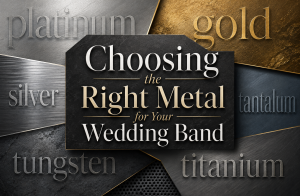

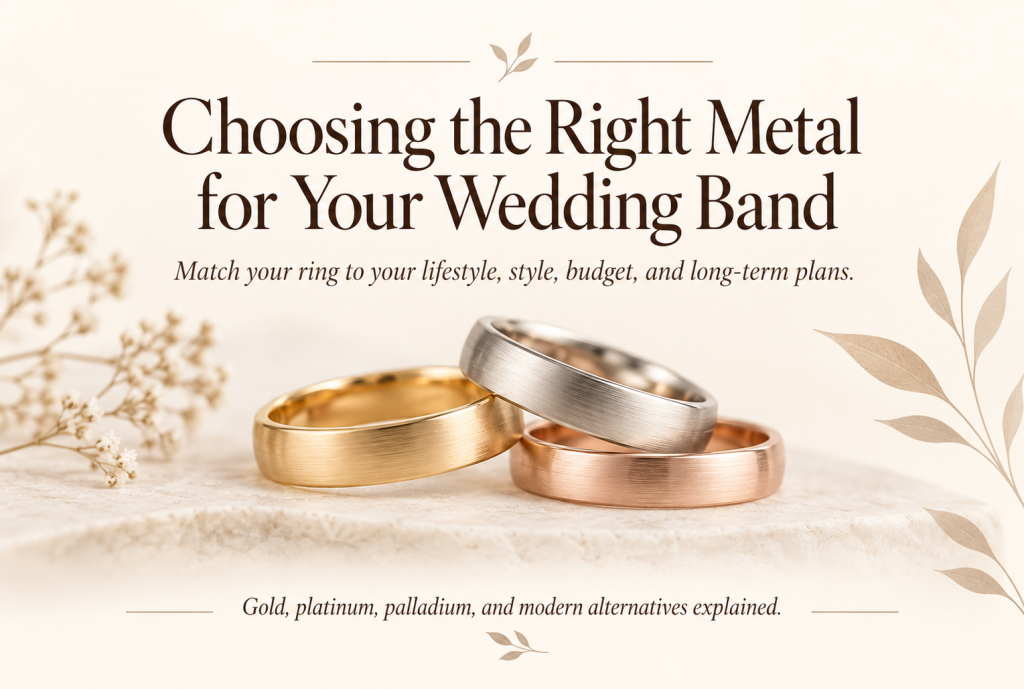
Choosing the Right Metal for Your Wedding Band
💍 A Comprehensive Guide for the Modern Couple
Getting married is a whirlwind of planning, but once the I do’s are over, your focus shifts to keeping those symbols of your commitment looking as sharp as the day you first put them on.
Whether you’ve gone with a classic gold band, a vintage diamond setting, or a modern alternative like tungsten, your rings are going to face a lot of wear and tear. This guide is designed to help you navigate the practical side of ring ownership without the stress.
🔍 What This Guide Covers
Here is a rundown of the main takeaways from Choosing the Right Metal For Your Wedding Band:
Match Your Ring to Your Routine:
A reality check on choosing a metal that fits your actual life—think manual labor vs. keyboard work—and how your specific body chemistry might react to certain materials, rather than just picking what looks best in the case.
The Classics — Gold, Platinum & Palladium:
Gold Explained: Breaks down the trade-off between strength and luxury, comparing the tank-like durability of 10kt against the softer, premium feel of 18kt, plus the style differences between Yellow, White, and Rose options.
Why Platinum: Details why this metal feels heavier on the hand, is a strong option for people concerned about common metal sensitivities, and develops a cool “lived-in” matte finish over time without needing the maintenance dipping that White Gold requires.
Understanding Palladium: Takes a closer look at another precious metal from the platinum family. Palladium offers a naturally white appearance like platinum but feels considerably lighter on the hand. It also gives buyers many of the traditional repair and resizing advantages associated with precious-metal jewelry.
Future-Proofing: Points out that these metals have intrinsic precious-metal value and, unlike many industrial alternatives, can generally be repaired or resized when the design permits if your finger changes size down the road.
Industrial & Alternative Metals:
The Lineup: Walks through the pros and cons of modern options, including Tungsten for extreme scratch resistance, Titanium for an exceptionally lightweight feel, Black Zirconium for a permanent dark surface, Tantalum for substantial weight and a distinctive grey color, and Cobalt Chrome for a bright white alternative-metal appearance.
The Sizing Trap: A crucial warning that many of these performance metals cannot be resized using conventional jewelry techniques, so if your finger size changes, you may need to replace or exchange the ring.
How to Shop Smart:
The Interrogation List: A cheat sheet of questions to ask the jeweler, specifically regarding warranty fine print, resizing rules, and how to handle scuffs or fading finishes.
In-Store Strategy: Practical advice for the appointment, such as insisting on a “comfort fit” interior and making sure any verbal promises about repairs actually make it onto the receipt.
🌟 Why It Matters
Your wedding rings aren’t just jewelry; they’re daily companions. By following a few simple habits, you can ensure they survive the decades right along with your marriage.
This handbook takes the guesswork out of maintenance, giving you the confidence to wear your rings through every adventure life throws your way.
🏛️ Choosing Your Metal
When you’re picking out a wedding band, it’s easy to get caught up in how it looks under the jewelry store lights. But the reality is that the metal you choose is what actually does the heavy lifting.
It’s the foundation that has to stand up to your job, your hobbies, and your skin chemistry for the next fifty years.
Think of this part of the guide as a roadmap for matching a metal to your actual life, not just your style.
📋 Key Factors to Consider
Durability vs. Weight: Some metals are extremely durable but heavy, while others are feather-light but might show more surface wear over time.
The Skin Test: If you have sensitive skin or known metal allergies, ask about the exact alloy used in the ring rather than relying only on the name of the primary metal.
Maintenance Levels: Some metals retain their basic color without plating, while others—like traditional white gold—may periodically need rhodium plating to maintain that bright white finish.
Resizing Reality: This is a big one. Traditional precious metals like gold, platinum and palladium can generally be resized when the ring design permits. Modern alternative metals like tungsten or cobalt chrome usually have much greater resizing limitations.
⏳ Why Your Choice Matters
At the end of the day, your ring should fit your lifestyle. If you work with your hands or hit the gym daily, you need a metal that can handle your routine. If you’re looking for a family heirloom to pass down, you might lean toward the classics.
Let’s break down the pros and cons of each material so you don’t end up with a ring that’s beautiful but impractical.
📜 The Heritage Metals — Precious, Resizable & Timeless
Think of them as forever metals.
Choosing a classic precious material like gold, platinum or palladium isn’t just about the look; it’s also about buying a material with a long history in fine jewelry and intrinsic precious-metal value.
The biggest perk here is flexibility.
Life happens—your style might evolve, or more likely, your finger size might change over the years. Because these metals are workable, a qualified jeweler can generally resize them, repair them, solder them, refinish them or restore the inevitable scratches that come with daily wear when the particular design allows it.
💰 Why They’re Worth the Investment
Total Restorability: Precious-metal rings can generally be professionally refinished when they start looking worn.
Size Adjustments: If the ring gets too tight or too loose down the road, many traditional designs can be resized rather than replaced.
Widespread Service: Gold and platinum are widely serviced throughout the jewelry industry. Palladium may require a jeweler with more specialized experience, but it remains a workable precious metal.
Essentially, these metals are built to age with you. They might take a few hits along the way, but they can usually be restored.
Here are the general benefits:
Platinum: A naturally white, exceptionally dense precious metal that is commonly used at high purity in jewelry. Scratches tend to displace metal rather than removing as much material as may occur with repeated abrasion and polishing of some gold alloys. Platinum develops a distinctive surface patina with wear.
Palladium: Another naturally white member of the platinum group of metals. It provides a precious-metal option that is significantly lighter than platinum and generally does not need rhodium plating simply to remain white.
Gold: The traditional choice. Yellow gold offers a warm, iconic glow. White gold provides a cooler appearance and is commonly rhodium plated to create a brighter white surface. Rose gold gets its characteristic color largely from copper in the alloy.
If you’re deciding between 10kt, 14kt, and 18kt gold, you’re essentially choosing between purity and practicality. Pure gold is very soft, so it’s mixed with other metals to make it better suited for everyday jewelry.
Here is how those different levels of gold stack up when you look at the purity, the price, and how well they handle a busy lifestyle.
🛠️ The Differences Between 10kt, 14kt and 18kt Gold
⛓️ 10kt Gold: The Tough Overachiever
10kt gold is roughly 41.7% pure gold. Because it contains a greater proportion of other alloying metals than 14kt or 18kt gold, it can offer very good durability for everyday wear.
Durability: A practical option for anyone who expects the ring to see plenty of daily activity.
Price: This is generally your most budget-friendly entry point into karat gold.
The Trade-off: The color is often a bit paler compared with higher karats. Because more of the ring consists of alloying metals, anyone with a known metal sensitivity should ask exactly what is used in the alloy.
⚖️ 14kt Gold: The Goldilocks Standard
At 58.3% pure gold, 14kt is an extremely popular choice for wedding bands in the U.S. It strikes an attractive balance between gold content, durability and price.
Durability: Very suitable for everyday jewelry.
Price: You’re paying a middle-ground premium. It’s more expensive than 10kt because of the higher gold content, but generally more affordable than an equivalent 18kt design.
The Trade-off: There aren’t many for the average buyer. It offers a classic gold appearance with excellent everyday practicality.
👑 18kt Gold: The Premium Heirloom
18kt gold is 75% pure gold, giving it a richer gold content and deeper color, particularly in yellow gold.
Durability: It is generally softer than comparable 10kt and 14kt alloys and can develop signs of wear more readily.
Price: You are paying for considerably more gold content.
The Trade-off: You’ll generally want to be more conscious about activities that might dent or heavily scratch the band.
🎨 Comparison: White, Rose, and Yellow Tones
The color you choose also changes slightly depending on the karat:
Yellow Gold: 18kt often has a deeper, richer yellow appearance. 14kt provides the classic yellow-gold look many American buyers recognize. 10kt can appear somewhat lighter.
White Gold: Different karats can look similar after rhodium plating because the plating creates the bright outer surface. The underlying shade varies according to the alloy.
Rose Gold: Lower-karat rose gold can contain proportionally more copper and therefore appear more distinctly pink or reddish. Higher-karat rose gold may have a softer or warmer tone.
🏁 The Final Verdict on Gold: Price vs. Durability
When it comes down to it, choosing the right gold is a balancing act between your wallet, your taste and your lifestyle.
For the Budget-Conscious & Active: Consider 10kt. It offers the lowest gold content of the three, usually carries the lowest price, and is well suited to everyday wear.
For the Perfect All-Rounder: 14kt is an industry favorite for a reason. It provides substantial gold content while remaining practical for daily use.
For Higher Gold Content: If you prefer the richer color and higher precious-metal content of 18kt, it can make an excellent heirloom-quality ring. Just remember that it generally shows wear somewhat more readily than lower-karat alternatives.
🪙 Let’s Talk About Platinum
If you’re looking for a substantial naturally white precious metal, platinum is usually one of the first materials worth considering.
It isn’t simply a silver-colored version of gold. It is an entirely different metal with its own weight, working characteristics and maintenance profile.
Here is the breakdown of why platinum occupies such an important position in fine jewelry—and a few things you should know before you commit.
💎 The Platinum Difference
Metal Displacement: One of platinum’s interesting characteristics is how it handles wear. A scratch can move or displace some of the metal rather than simply removing it. Over time, countless tiny surface marks create the soft finish generally referred to as platinum patina.
Serious Weight: Platinum is much denser than gold. When you pick it up, you’ll immediately notice it feels heavier and more substantial. For many people, that heft contributes to the feeling of quality.
Naturally White: Unlike conventional rhodium-plated white gold, platinum is naturally white throughout the metal. It doesn’t need rhodium plating simply to maintain its basic color.
High Purity: Platinum jewelry is commonly made using high-purity alloys such as 950 platinum. Because individual alloy formulations vary, people with known metal sensitivities should still ask what is contained in the finished ring.
⚖️ The Pros & Cons of Platinum
When you step into the world of high-end jewelry, platinum is usually one of the first names mentioned for couples who want a naturally white precious metal.
It’s dense, heavy, and naturally white, but it behaves differently than gold.
While platinum carries plenty of prestige, it also has a very specific personality you need to understand before you commit.
The Perks
Security: Platinum is widely used for diamond settings and prongs because of its working characteristics and ability to securely hold gemstones when properly designed and maintained.
Rarity: Platinum is a scarce precious metal with important jewelry and industrial uses.
Low Color Maintenance: You never have to worry about rhodium dipping simply to keep platinum white.
The Reality Checks
The Price Tag: Because platinum is dense, a ring of the same dimensions can require considerably more metal by weight than a similar gold ring. Metal markets, manufacturing costs and design all affect the final price.
The Patina Factor: If you love a mirror-like, high-polish finish, understand that platinum develops visible surface wear and patina. Many people love this appearance, while others prefer periodic professional refinishing.
Labor Costs: Platinum requires specialized bench-jewelry skills and equipment. Repairs and resizing can therefore cost more than comparable work in some gold alloys.
💡 Tips for Platinum Buyers
Feel the Weight: Before you buy, try on a 14kt white gold band and a platinum band of the same width. The weight difference is one of the first things you’ll notice.
Embrace the Scuffs: If you go with platinum, understand that the metal will develop its own surface character. That lived-in appearance is part of the material’s personality.
Choosing platinum is a trade-off between substantial weight, naturally white color and its distinctive way of aging.
It’s a metal for someone who values the intrinsic feel and lifelong color of a material that does not rely on plating to remain white.
🎨 The Color Secret: Natural vs. Plated
When you’re looking at white gold and platinum side-by-side in a display case, they can look remarkably similar.
Under the surface, however, they are very different materials.
The biggest thing some buyers don’t realize is that white gold is created by combining gold with whitening alloying metals. Depending on the alloy, the natural color can still retain a warmer undertone.
To create the very bright white surface many shoppers associate with white gold, jewelers commonly use rhodium plating.
The White Gold Tune-up: Rhodium is a very bright platinum-group metal. Electroplating bonds a thin layer of rhodium onto the surface of the ring.
The Catch: Eventually, plating can wear—particularly on areas of the ring receiving constant friction. When that happens, the warmer shade of the underlying white-gold alloy may become more noticeable.
The Platinum Advantage: Platinum is naturally grey-white throughout. Its basic color does not depend on a rhodium layer.
🧪 Purity & Your Skin
If you have skin sensitivity, the alloy matters.
White Gold: Some white-gold alloys contain nickel, while others use different whitening metals. If you have a nickel sensitivity, ask for the actual alloy composition rather than assuming all white gold is the same.
Platinum: Platinum jewelry is commonly produced at high purity and is often chosen by people concerned about common jewelry-metal sensitivities. Again, the finished alloy—not simply the primary metal—is what ultimately touches your skin.
⚙️ Weight, Durability, and the Patina
Beyond the color, the way these metals feel and age is different:
Weight: Platinum is much denser than gold. A comparable platinum ring will generally feel noticeably heavier.
Aging: Gold and platinum both accumulate surface wear. Platinum develops its characteristic patina as the surface becomes covered with small marks and displaced metal.
Both materials require reasonable care, particularly when diamonds or other gemstones are involved.
🏆 The Verdict: Is the Extra Cost Worth It?
White gold is your best bet if:
- You want a traditional precious-metal ring at a generally lower initial price than an equivalent platinum design.
- You prefer a ring that feels lighter on your finger.
- You don’t mind periodic maintenance if your ring uses rhodium plating.
Platinum is your best bet if:
- You want a naturally white precious metal that doesn’t rely on rhodium plating.
- You enjoy the feeling of a heavier, more substantial ring.
- You like the distinctive patina platinum develops over years of wear.
- You want a material with a long history in fine jewelry and diamond settings.
- Ultimately, the choice comes down to which combination of appearance, weight, maintenance and cost feels right to you.
- White gold is a versatile choice for those who want a classic white-metal look, provided you’re comfortable with the possibility of periodic rhodium maintenance.
- Platinum offers a naturally white alternative with considerably more heft and its own distinctive aging characteristics.
🩶 Palladium: The Naturally White Precious Metal
Palladium tends to get overlooked in conversations about wedding bands, but it deserves a place alongside gold and platinum.
It is a genuine precious metal and part of the platinum group of metals, which also includes platinum and rhodium.
Its natural color is white, so unlike conventional rhodium-plated white gold, palladium does not depend on a rhodium coating to create its basic white appearance.
One of the first things you’ll notice is the weight.
Palladium is considerably less dense than platinum. That means a palladium ring can provide the look and precious-metal character of a platinum-family metal without feeling nearly as heavy on your finger.
For someone who loves the idea of platinum but doesn’t love a heavy ring, that difference alone can make palladium worth considering.
Palladium is also an interesting middle ground between traditional precious metals and some of the newer alternative choices.
It has genuine precious-metal value, can generally be refinished and repaired, and in many cases can be resized when the design allows.
At the same time, it has a clean contemporary appearance that works particularly well with modern wedding-band designs.
There is one catch: palladium isn’t stocked or serviced everywhere.
Gold and platinum remain more familiar to many jewelry stores. If you choose palladium, it is worth making sure you have access to a jeweler who actually knows how to work with it.
Here’s a version that should fit naturally into the guide:
🩶 Could Palladium Make a Comeback?
Palladium was once a more familiar choice for wedding bands, particularly for couples looking for a naturally white precious metal without the weight of platinum.
Over time, however, it became much less common in mainstream bridal showcases as gold, platinum and newer alternative metals took more of the spotlight. That may be worth watching again.
With gold and platinum trading at premium market prices, palladium could regain attention from couples and manufacturers looking for another genuine precious-metal option.
Recent market data has placed palladium below both gold and platinum on a per-ounce basis, although finished jewelry prices depend on far more than the commodity price alone.
Specialized online retailers, made-to-order custom designers and alternative band manufacturers still offer 950 Palladium, meaning the alloy contains 95% palladium.
For buyers who want a naturally white precious metal, lighter weight than platinum and more traditional repair and resizing possibilities than most industrial alternatives, palladium may deserve another look.
💎 The Palladium Difference
Naturally White: Palladium is white throughout the metal. It doesn’t have the underlying yellow tone associated with traditional yellow-gold-based white alloys, so rhodium plating isn’t necessary simply to keep the ring looking white.
Part of the Platinum Family: Palladium belongs to the platinum group of metals. It is not an imitation of platinum or a coated base metal. It is a precious metal in its own right.
Lighter on the Hand: Palladium is considerably less dense than platinum. A ring made to the same general dimensions will normally feel much lighter in palladium.
High-Purity Jewelry Options: Palladium jewelry is available in different alloys and purity levels. Palladium 950, for example, indicates an alloy containing 95% palladium. Always check the actual hallmark or manufacturer specifications because not every palladium ring uses the same alloy.
No Yellowing: Because palladium is naturally white, normal surface wear does not reveal a yellow-colored metal underneath.
Corrosion and Tarnish Resistance: Palladium handles normal exposure to air and moisture very well and does not require the same type of routine replating associated with rhodium-plated white gold.
Repairability: Unlike many alternative metals, palladium can generally be repaired, polished and resized when the construction of the ring allows it. The important part is finding a jeweler familiar with palladium and equipped to work with it properly.
⚖️ The Pros & Cons of Palladium
The Perks
Natural White Color: If you want a cool white ring without depending on a surface coating for the color, palladium checks that box.
Comfortable Weight: People who find platinum too heavy may prefer the noticeably lighter feel of palladium.
Precious-Metal Status: Palladium has intrinsic precious-metal value. It belongs in a different category from industrial alternatives such as tungsten, titanium or cobalt chrome.
Good Option for Metal-Sensitive Buyers: High-purity palladium alloys are frequently considered by people concerned about common jewelry-metal sensitivities. As with any ring, ask what other metals are included in the specific alloy before assuming every palladium ring is identical.
Resizable and Repairable: Many traditional palladium rings can be sized, repaired and refinished rather than automatically replaced when something changes.
Low Color Maintenance: There is no routine rhodium dipping required simply to keep the basic metal white.
The Reality Checks
Availability: Palladium wedding bands aren’t as common in jewelry showcases as gold or platinum. Your selection may be smaller depending on where you shop.
Finding the Right Jeweler: Not every bench jeweler regularly works with palladium. Repairs and resizing may require a jeweler with experience in platinum-group metals.
It Still Scratches: Palladium is durable, but don’t confuse durable with scratch-proof. Everyday wear will eventually leave marks on a polished palladium ring just as it does on other precious metals.
Price Can Move Around: Don’t assume palladium will automatically cost less than platinum or gold. Palladium is a globally traded precious metal, and its market price can move considerably. The finished cost of the ring also depends on its weight, purity, design, manufacturer and availability.
Limited Selection: Certain intricate designs, specialized finishes or matching bridal sets may simply be easier to find in gold or platinum.
💡 Tips for Palladium Buyers
Check the Stamp: Ask whether the ring is Palladium 950, Palladium 500 or another alloy. The word palladium by itself doesn’t tell you everything about the composition.
Ask About Resizing Before You Buy: Palladium itself can be worked, but that doesn’t mean every palladium ring can be resized. Eternity bands, continuous patterns, complicated stone settings and mixed-material designs may still be difficult or impossible to alter.
Find Out Who Does the Repairs: Ask whether the store handles palladium work in-house or sends the ring to a specialist. You don’t want to discover years from now that your jeweler doesn’t service the metal they sold you.
Try Palladium Against Platinum: If both are available, put similarly sized rings on your hand. The difference in weight is noticeable. Some people love platinum’s heft while others immediately prefer the lighter palladium feel.
Don’t Buy Based on Spot Price Alone: A finished wedding band includes manufacturing, labor, design, finishing, distribution and retailer costs. The daily market price of palladium is only one part of what determines the price you see in the showcase.
🏆 The Verdict: Where Palladium Fits
Palladium makes the most sense for someone who wants a real precious metal, prefers a naturally white appearance and likes the idea of something lighter than platinum.
It also gives you something most industrial alternative metals cannot: the possibility of traditional jewelry repair and resizing.
That makes palladium particularly interesting for someone attracted to the modern look of white metals but uncomfortable with the idea of buying a ring that may need to be completely replaced if their finger size changes.
The bigger question is whether you can find the design you want and a jeweler who is comfortable servicing it.
If you can, palladium sits in a useful space between white gold and platinum.
You get natural white color without routine rhodium plating, precious-metal value without platinum’s extreme density, and considerably more long-term flexibility than you get with most alternative metals.
🏙️ The Modern Alternatives — Durable & Edgy
If you’re looking for something that breaks away from tradition, modern alternative metals are likely where you’ll end up.
Metals like tungsten, tantalum, titanium, cobalt chrome and black zirconium have become popular because they provide distinctive looks and physical characteristics you don’t necessarily get from traditional precious metals.
They can be particularly appealing if you have a hands-on job or simply want something different from the traditional shiny gold wedding band.
However, there is a major trade-off you need to know about: resizing.
Many alternative-metal rings cannot be resized using the conventional techniques used for gold, platinum or palladium.
If your finger size changes five or ten years down the road, you may need to exchange or replace the entire band.
⚠️ Things to Keep in Mind
Durability: Many alternative metals provide excellent resistance to scratching, bending, corrosion or everyday wear, although each behaves differently.
Unique Finishes: You can get deep greys, matte blacks, bright whites and brushed textures that give these materials a distinctive personality.
Affordability: Generally speaking, many alternative-metal rings cost less than comparable precious-metal designs, although tantalum and premium custom designs can move significantly higher.
The No-Resize Rule: Since many alternative bands can’t be conventionally resized, getting an accurate finger measurement is extremely important.
These metals are a great choice if you want a modern look, as long as you’re comfortable with the possibility that the original ring may not adjust with your finger size forever.
Here is the real-world breakdown of five major players in the alternative-metal space.
⛰️ Tantalum: The Premium Heavyweight
Tantalum is the luxury choice among many alternative metals. It has a beautiful, natural slate-grey color with a distinct bluish undertone.
The Pros
Heft: Unlike lighter alternative metals, tantalum has a substantial feel on the hand.
Resiliency: It is notably ductile compared with brittle materials such as tungsten carbide and is not known for shattering in the same manner.
Skin Compatibility: Tantalum is widely valued for excellent corrosion resistance and biocompatibility. Anyone with significant metal sensitivities should still discuss the specific ring and alloy with their jeweler or medical professional.
The Secret Perk: Certain tantalum wedding bands can be resized within a limited range by manufacturers or jewelers experienced with the material.
The Cons
Cost: It can be considerably more expensive than many other alternative metals.
Darker Tone: If you want a bright silver-white look, this isn’t it. Tantalum has a distinctive grey appearance.
🔘 Cobalt Chrome: The Bright White Alternative
Cobalt chrome is one of the more interesting alternative metals because it doesn’t necessarily look like an alternative metal.
Instead of the darker grey associated with tantalum or many titanium rings, cobalt chrome has a naturally bright, silvery-white appearance that can resemble polished white gold or platinum from a visual standpoint.
The material is an alloy based primarily on cobalt and chromium, sometimes with additional elements depending on the specific formula used by the manufacturer.
It is considerably harder than traditional gold alloys and stands up very well to everyday wear.
It is also resistant to corrosion and doesn’t depend on rhodium plating to create its white appearance.
For someone who wants the look of a bright white metal but prefers an industrial-style material and generally lower entry price, cobalt chrome deserves a serious look.
The Pros
Bright White Color: Cobalt chrome is one of the whitest-looking alternative metals. If you love the appearance of platinum or freshly rhodium-plated white gold but don’t necessarily want a precious metal, this is one of the closest visual alternatives.
Scratch Resistance: Cobalt chrome is harder and generally more scratch-resistant than traditional gold alloys. It isn’t completely scratch-proof, but it tends to hold its finish well during normal daily wear.
Corrosion Resistance: The chromium in the alloy helps provide excellent corrosion resistance. You don’t have to schedule routine plating just to maintain the basic color.
The Weight: Cobalt chrome occupies a comfortable middle ground. It isn’t feather-light like titanium, but it also doesn’t carry the extreme density of tungsten carbide.
Less Brittle Than Tungsten: Cobalt chrome is hard, but it does not behave like tungsten carbide. It is less prone to brittle fracture from impact.
Price: Cobalt chrome bands are generally more affordable than comparable rings made from gold, platinum or palladium, although design, manufacturer and added materials can move the price considerably.
The Cons
Usually Not Resizable: This is the biggest limitation. Most cobalt chrome wedding bands are not resized using the same conventional techniques used for gold, platinum or palladium. Some manufacturers offer size-exchange or replacement programs instead.
Limited Traditional Repairs: A neighborhood jeweler who can easily solder a gold band may not be able to perform the same type of repair on cobalt chrome. Manufacturer support becomes more important.
Not Scratch-Proof: Cobalt chrome gets described as extremely scratch-resistant, but scratches and scuffs can still happen. Tungsten carbide generally offers greater resistance to ordinary surface scratching.
Emergency Removal Requires the Right Equipment: Cobalt chrome’s hardness can make ring removal more challenging than cutting a conventional gold or silver band. Anyone working in an occupation where emergency ring removal is a concern should discuss that issue with the jeweler and their workplace safety professional.
The Allergy Question: Cobalt chrome jewelry is sometimes marketed as hypoallergenic or biocompatible, and many people wear it without difficulty. However, cobalt is a recognized contact allergen for some individuals. If you already know that you’re sensitive to cobalt, don’t assume every cobalt chrome ring will be suitable for your skin. Ask the jeweler for the exact alloy information.
Cobalt chrome is a strong choice for someone who wants a bright white ring, doesn’t want to deal with rhodium plating and likes the durability of an alternative metal.
Just remember that it comes with the same long-term question that surrounds many modern materials:
What happens if your finger size changes?
For that reason, the warranty and size-exchange policy matter almost as much as the ring itself.
🕶️ Black Zirconium: The Sleek Stealth Choice
Don’t confuse this with a conventional black-plated ring.
Black zirconium begins with zirconium metal that is heat-treated to create a very hard dark zirconium-oxide surface layer.
The Pros
Distinctive Color: The black surface is created through oxidation rather than simply applying conventional black plating.
Lightweight: It is comfortable for daily wear compared with heavier options such as tungsten.
Corrosion Resistance: Zirconium has good resistance to corrosion under normal conditions.
The Cons
The Two-Tone Scratch: While the dark oxide layer is hard, sufficiently deep damage can expose the lighter-colored material beneath.
Non-Resizable: Finished black zirconium wedding bands generally aren’t conventionally resized.
🧱 Tungsten: The Forever Shiny Tank
Tungsten carbide is one of the most popular alternative wedding-band materials because of its exceptional hardness and scratch resistance.
The Pros
Scratch Resistance: Tungsten carbide is extremely resistant to ordinary scratching and can retain a polished appearance remarkably well.
Affordability: Many tungsten rings are relatively easy on the wallet.
Weight: It feels substantial on the hand.
The Cons
The Brittle Factor: Tungsten carbide’s extreme hardness also means it is relatively brittle. A sufficiently hard impact can crack or fracture the ring.
Sizing: Tungsten carbide bands generally cannot be conventionally resized.
Emergency Removal: Tungsten carbide is typically removed in an emergency by applying controlled pressure to fracture the ring rather than cutting it in the same manner as gold.
✈️ Titanium: The Lightweight Workhorse
Titanium is the ultimate “I don’t like wearing heavy rings” metal.
It’s famous for its excellent strength-to-weight ratio.
The Pros
Weight: Titanium is exceptionally light. If you find jewelry annoying or heavy, this is worth considering.
Toughness: Titanium has very good strength and toughness for its weight.
Price: Many titanium wedding bands are affordable compared with precious metals.
The Cons
Surface Wear: Although titanium is strong, polished surfaces can still develop scratches and scuffs with regular wear.
Refinishing and Repair: Titanium requires different tools and techniques than conventional precious-metal jewelry, and not every jeweler works with it.
Sizing: Most titanium wedding bands have limited or no conventional resizing options.
☝️ Jeweler’s Tip: The Knuckle Test
Because many alternative-metal wedding bands cannot be conventionally resized, get your finger professionally measured and pay attention to how the ring passes over your knuckle.
Finger size also changes throughout the day with temperature, activity and fluid retention.
For any metal with limited resizing options, an accurate initial fit becomes especially important.
Cobalt Chrome Sizing Note: Although some manufacturers have programs allowing a cobalt chrome ring to be exchanged or replaced when your finger size changes, that is different from physically resizing the original band.
Tantalum Sizing Note: Certain tantalum bands can be adjusted within a limited range, but this depends on the manufacturer, construction and design.
Precious-Metal Difference: Gold, platinum and palladium generally offer considerably more traditional resizing flexibility when the design permits.
🧭 The Perfect Match
Choosing a ring is a lot like buying a car—it’s not just about how it looks in the driveway, but how it handles on the road.
To help you cut through the noise, we’ve put together a set of discovery questions.
These are designed to help you get honest about your daily habits so you don’t end up with a ring that’s beautiful but totally impractical for your life.
Instead of just looking at price tags, use these questions to figure out what you actually need from your jewelry.
❓ Questions to Keep in Mind
To get the most out of these, don’t just think about them—talk them through.
Be Realistic: If you hit the gym five days a week or work with power tools, don’t ignore that for the sake of a pretty metal.
Think Long-Term: Don’t just think about who you are today; think about whether you want a ring that can be repaired or resized in twenty years.
Compare Notes: If you’re buying as a couple, answer these together to see if your priorities—like low maintenance vs. classic look—align.
Now ask:
The Hands-On Check: Does your daily work or hobby involve heavy lifting, chemicals, or abrasive surfaces?
The Maintenance Reality: Are you the type who will bring your ring in for professional maintenance when needed, or do you want something requiring as little attention as possible?
The Sensitivity Factor: Do you have any history of skin irritation with watches or jewelry?
The Legacy Question: Is it important to you that this specific physical band stays on your finger forever, or are you okay with replacing it if your size changes later?
By answering these, you’ll move past the shiny object phase and find a metal that actually fits your life.
Finding the right ring is really about balancing three things: your lifestyle, your style, and your budget.
It’s easy to get overwhelmed by all the options, so we’ve broken it down into a simple framework to help you spot your perfect match quickly.
🏃 Define Your Daily Wear and Tear
Be honest about what your hands actually do all day. Your ring needs to keep up with you, not hold you back.
The Desk Professional: If you’re mostly at a computer or in meetings, you have considerable flexibility. Gold, platinum or palladium can all work beautifully here.
The Active Professional: If your day involves job sites, heavy gear or plenty of outdoor activity, alternative materials such as tungsten, tantalum, cobalt chrome or titanium may deserve a closer look. Just remember that a wedding band should still be removed whenever machinery, heavy lifting or workplace safety rules make wearing a ring hazardous.
The Sensitive-Skin Buyer: If you deal with known metal allergies, don’t shop solely by metal name. Ask for the actual alloy composition. High-purity platinum and palladium, certain gold alloys, tantalum and titanium may all be worth discussing depending on your specific sensitivity.
The Bright-White Alternative Buyer: If you want something tougher than a traditional gold alloy but don’t like the darker appearance of many alternative metals, look at Cobalt Chrome. It gives you a bright polished appearance with strong scratch resistance, although conventional resizing is usually unavailable.
The Precious-Metal Minimalist: If you like naturally white precious metals but don’t enjoy the heavy feel of Platinum, Palladium may be a better fit. It provides a lighter feel while retaining precious-metal character and significantly more traditional repair flexibility than most industrial alternatives.
👓 Choose Your Visual Vibe
This is the fun part. What color do you want to see on your hand every morning?
Warm & Timeless: If you want that iconic wedding-ring look, Yellow Gold remains the classic choice.
Bright & Crisp: For a clean, white-metal finish, consider Platinum, Palladium or White Gold.
Naturally White & Lighter: Palladium provides a naturally white precious-metal option for someone who wants something substantially lighter than Platinum.
Bright & Industrial: Cobalt Chrome is worth considering if you like the white appearance of Platinum or White Gold but want the characteristics and pricing structure associated with an alternative metal.
Moody & Modern: If you prefer deeper industrial greys, look at Tantalum or certain Titanium designs.
Bold & Edgy: For a total departure from tradition, Black Zirconium offers a sleek black appearance.
💵 Set Your Investment Level
Price isn’t just about the name of the metal. It’s influenced by precious-metal markets, weight, manufacturing, design, retailer margins, diamonds, customization and brand positioning.
Budget-Friendly: Titanium, tungsten, cobalt chrome and black zirconium often occupy the more affordable end of the wedding-band market.
The Middle Ground: 10kt and 14kt gold, premium alternative-metal designs and some tantalum bands can occupy a broad middle range.
The Heirloom Tier: Platinum, 18kt gold and some palladium designs belong in the precious-metal category, although actual retail prices can vary substantially.
A Note About Palladium: Palladium doesn’t fit neatly into a permanent price category because its commodity price and availability can change considerably. Treat it as a precious-metal purchase and compare the actual finished-ring price with equivalent Gold and Platinum designs.
A Note About Cobalt Chrome: Cobalt Chrome is generally positioned on the more affordable side of the wedding-band market. Elaborate designs, inlays, diamonds, custom work and premium manufacturing can push the price higher.
At the end of the day, the perfect metal is the one that disappears into your life—you shouldn’t have to constantly worry about it.
By balancing your visual style with the investment level that makes sense for your budget, you’re not just buying a piece of jewelry; you’re choosing something you may wear for decades.
✅ Tips for Choosing the Right Metal
When you finally sit down to pick out your wedding band, the sheer number of specs and metal types can make your head spin.
The perfect choice isn’t always found on a spec sheet—it’s found in how the ring actually fits into your life.
Before you get bogged down in technical details, keep these practical filters in mind.
Don’t Overthink the Style: Usually, your first instinct about what you enjoy looking at is worth listening to.
The Weight Test: If you can, try on a light metal such as Titanium and a heavy metal such as Platinum back-to-back. Then compare Palladium, Gold, Tantalum, Cobalt Chrome and Tungsten if the store has them available. The feel on your finger is just as important as the look.
Think About the Future You: If you’re choosing between a precious-metal ring and a non-resizable alternative, remember that gold, platinum and palladium generally offer more traditional resizing possibilities.
The Service Test: Ask yourself what happens if the ring needs work fifteen years from now. Gold, Platinum and Palladium provide considerably more traditional repair flexibility than most industrial alternatives. With Cobalt Chrome, Tungsten, Titanium and Black Zirconium, the manufacturer’s replacement and sizing policies may matter more than the ability of your local jeweler to alter the original ring.
The secret to a successful ring purchase is acknowledging that you aren’t just buying a piece of jewelry for a ceremony; you’re buying something you may wear during everyday life for decades.
Trust your gut on the style, but let practicality guide the material.
💎 The Jeweler’s Checklist
Before you swipe your card and walk out of the jewelry store, you need to be your own best advocate.
Even the most beautiful ring can become a headache if you don’t understand the fine print of the metal and the shop’s policies.
Think of this checklist as your filter.
A good jeweler should have no problem answering these questions clearly.
🙋 Questions to Ask Before You Buy
When you’re standing at the jeweler’s counter with a ring you love, it’s easy to get swept up in the aesthetic and the emotion of the moment.
However, some of the most important parts of the purchase happen during the conversation.
You need to look past the showroom lights and ask how that ring will actually live on your hand.
The Resizing Reality Check
Ask: If my finger size changes down the road, can this specific design be resized, or will the entire ring need to be replaced?
Why it matters: Many modern metals are one-size-only or have very restricted adjustment possibilities.
The Fresh Look Maintenance Question
Ask: For this specific finish—matte, polished, brushed, hammered or another texture—how easily can it be restored once it starts to wear?
Why it matters: Every ring changes with wear. Matte surfaces can become shinier in contact areas, while polished surfaces accumulate scratches.
The Allergy Audit
Ask: What is the exact alloy used in this ring?
If you’re shopping for White Gold, ask whether the alloy contains nickel or uses another whitening system.
If you’re considering Palladium, ask about the palladium purity and alloy.
If you’re considering Cobalt Chrome, disclose any known cobalt sensitivity.
Why it matters: The primary metal name doesn’t always tell you every element that will be touching your skin.
The Warranty Question
Ask: What’s your policy if the ring becomes damaged, a stone comes loose, or an alternative-metal band fractures?
Why it matters: Different metals fail in different ways, and warranty coverage can vary dramatically.
The Exact Alloy Question
Ask: If I’m considering Palladium or Cobalt Chrome, exactly what alloy is used in this ring, and can you provide the metal specifications?
Why it matters: Palladium jewelry is available in different purity levels and alloys, while Cobalt Chrome formulations also vary between manufacturers.
The Alternative-Metal Sizing Policy
Ask: If I buy a Cobalt Chrome, Tungsten, Titanium or another difficult-to-resize ring and my finger size changes, do you resize my original ring, replace it with another ring, or offer a discounted size exchange?
Why it matters: The word resizing is sometimes used loosely when discussing alternative metals. There is a major difference between physically altering your original wedding band and receiving a replacement ring in another size.
At the end of the day, a reputable jeweler should be happy to walk you through these details.
By pinning down the how and what if before you leave the store, you aren’t just buying jewelry—you’re figuring out what ownership will look like for years to come.
🛍️ How to Get the Most Out of Your Visit
When you walk into a jewelry store, the lights are bright and everything looks perfect in the jewelry showcase.
Some of the most successful buyers aren’t the ones with the biggest budgets; they’re the ones who take their time.
To get the best experience, shift the dynamic from a sales pitch to a professional consultation.
Don’t Rush the Conversation: Take your time with your questions.
Get it in Writing: If the store promises free resizing, refinishing, replacement coverage or a lifetime size-exchange program, make sure that’s included in your receipt, warranty or other documentation.
Ask Who Actually Services the Metal: If you’re considering Palladium, find out whether the store’s jeweler works with it or whether repairs are sent to a specialist.
If you’re considering Cobalt Chrome, Tungsten, Titanium or another alternative metal, ask what happens if the ring becomes damaged or your size changes.
The Tug Test: When you’re trying on a sample, pay attention to how it feels over the knuckle. Ask the jeweler if the design comes in a comfort fit or standard fit.
Navigating a jewelry purchase is really about managing expectations.
Whether it’s confirming your White Gold alloy, determining who can service Palladium, or finding out what the manufacturer does when a Cobalt Chrome ring no longer fits, getting these details in writing makes the purchase easier to understand.
🛡️ Wedding Day & Long-Term Protection
The big day is finally here, but the work doesn’t stop at the altar.
Between the ceremony photos and the honeymoon adventures, your rings can actually be at relatively high risk of being lost right at the beginning.
Think of this as your insurance policy for peace of mind, covering everything from the morning of the wedding to your first week as a married couple.
🎒 The Wedding Day Ring Security Kit
You’d be surprised how many fingerprints and smudges a ring picks up while getting ready.
Keep a small kit nearby to ensure everything looks good for close-up photographs.
Microfiber Cloth: A quick wipe removes oils and dust.
Jewelry Cleaning Product: If your ring contains stones, use only a cleaner specifically considered safe for those gemstones and metals.
Temporary Sizing Aid: If a ring feels loose, ask your jeweler whether a temporary ring-size adjuster is appropriate. Don’t use anything that could damage the ring or interfere with circulation.
A Dedicated Travel Pouch: Never put a ring in a loose pocket or random cup. Use a small, secure pouch or ring box that stays in one specific location.
📄 Ring Insurance 101
Don’t wait until you’re back from the honeymoon to think about protection.
Get Proper Documentation: Depending on the value and policy requirements, your insurer may request a detailed sales receipt, appraisal or other documentation describing the ring.
Pick Your Policy: You may be able to schedule jewelry through homeowners or renters insurance, or purchase a specialized jewelry policy. Coverage terms vary, so ask specifically about theft, loss, mysterious disappearance, damage, deductibles and replacement procedures.
🌊 The Honeymoon Rule: Beware of the Water
The ocean can be a terrible place to discover your wedding ring isn’t quite as tight as you thought.
Cold water can temporarily change finger size, while sunscreen and water make the skin slippery.
When you’re swimming at the beach or pool, leaving valuable jewelry secured in an appropriate safe location is often far less stressful than trying to recover a ring from the bottom of the ocean.
🏡 Tips for Staying Protected
Take Proof-of-Ownership Photos: Take clear photographs of your rings and their identifying hallmarks.
The Safe Spot Habit: Designate one secure place in your house where the rings go whenever they come off your finger.
Never leave them beside a sink, wrapped in a tissue, or sitting somewhere they can easily be swept away.
The survival of your wedding jewelry depends heavily on proper documentation and smart habits.
Most importantly, establish routines that make it difficult to accidentally lose your ring.
✅ Quick Selection Summary
If you want…
A traditional, warm glow, choose:
☀️ Yellow Gold
A traditional bright-white precious-metal look, choose:
❄️ White Gold
A naturally white, dense precious metal, choose:
👑 Platinum
A naturally white precious metal with a lighter feel, choose:
🩶 Palladium
A slate-grey, substantial alternative metal, choose:
🌑 Tantalum
A bright white alternative metal with strong scratch resistance, choose:
🔘 Cobalt Chrome
A permanent dark surface, choose:
🖤 Black Zirconium
Exceptional scratch resistance, choose:
🛡️ Tungsten Carbide
Maximum strength with very light weight, choose:
🚀 Titanium
🥂 Wishing You a Happy Life Together
Choosing a wedding band is a decision that balances sentimental value with structural reality.
Traditional precious metals like Gold, Platinum and Palladium are strong choices for people who view their rings as lifelong heirlooms.
They are workable metals that generally allow a qualified jeweler to resize, repair and refinish them when the design permits.
Gold remains the familiar classic.
Platinum provides a heavy, naturally white option with its characteristic patina.
Palladium adds another choice for someone who wants a naturally white precious metal but prefers something considerably lighter than Platinum.
On the other side are modern alternatives such as Tungsten Carbide, Titanium, Cobalt Chrome, Black Zirconium and Tantalum.
They offer distinctive colors, weights, durability characteristics and price points that traditional precious metals don’t always provide.
Cobalt Chrome fills an especially interesting position for someone who wants a bright white appearance and strong scratch resistance without moving into a traditional precious metal.
Tantalum provides a darker, more substantial option and, depending on the ring, may offer more sizing flexibility than many competing alternatives.
Tungsten Carbide provides exceptional scratch resistance but sacrifices conventional resizing and is comparatively brittle.
Titanium delivers outstanding lightness.
Black Zirconium creates a dramatically different dark appearance.
Ultimately, your lifestyle should help dictate your choice.
If you have known metal sensitivities, ask about the exact alloy instead of relying on broad labels such as hypoallergenic.
If you work in a rugged environment, consider both durability and workplace ring-safety requirements.
If your priority is keeping the same physical ring throughout your life, precious metals generally provide the greatest flexibility.
If low maintenance, unusual color or specific physical characteristics matter more, alternative metals can be an excellent fit.
Understanding those differences today gives you a much better chance of loving your wedding band years after the ceremony is over.
⚖️ Important Disclaimer & Disclosure
The information provided in Choosing the Right Metal for Your Wedding Band is intended for educational and informational purposes only.
While I strive to provide accurate advice based on jewelry-industry practices and commonly accepted characteristics of these materials, please keep the following in mind:
Individual Results May Vary: Factors such as unique skin chemistry, environmental exposure, alloy formulation, ring design and daily activity levels can affect how a metal reacts or wears over time. Descriptions of durability, scratch resistance and skin compatibility are general guidelines and not guarantees of performance for every individual.
Metal Allergy Note: Terms such as hypoallergenic, biocompatible and skin-safe are frequently used when discussing jewelry metals, but individual reactions can vary.
Cobalt is a recognized contact allergen for some people, so anyone with a known or suspected cobalt sensitivity should consult an appropriate medical professional and confirm the exact alloy before purchasing a Cobalt Chrome ring.
Likewise, buyers with metal sensitivities should ask for the full alloy composition of Palladium, Gold and other jewelry metals rather than relying solely on the name of the primary metal.
Professional Consultation: This guide is not a substitute for professional advice from a qualified jeweler or medical professional in the case of suspected metal allergies.
I strongly recommend consulting with your local jeweler to confirm the specific alloy, construction, finish, sizing limitations and care requirements of a piece before purchase.
Alternative-Metal Sizing: Statements regarding whether a ring can be resized are general guidelines.
Manufacturing methods, inlays, stones, patterns, coatings and individual designs may make an otherwise workable metal difficult or impossible to resize.
Some manufacturers also use the term resizing to describe a replacement or exchange program rather than physically altering the original ring.
Always confirm the policy for the specific ring before purchase.
No Liability: By using this guide, you acknowledge that I am not responsible for damage to jewelry, loss of stones, loss of a ring or physical irritation that may result from following these general suggestions. Care and maintenance should always follow the specific manufacturer’s instructions.
Investment & Value: Discussions regarding intrinsic or precious-metal value are not intended as financial or investment advice. Market prices for Gold, Platinum, Palladium and other commodities fluctuate.
✅ Prompts You Can Use to Help Choose the Right Metal
Let’s be real about the rings: they are one of the few items in your wedding budget you may still be using every day decades from now.
The cake gets eaten, the flowers fade, and most of the decorations disappear after the reception—but the rings stay on your hands.
Because you may be wearing this metal through gym sessions, grocery runs, careers, vacations and decades of everyday life, you need to treat the decision as both an aesthetic and practical one.
You need a ring that can survive your actual life, fits your budget, and works properly with your engagement setting.
Just cut and paste the following prompts in ChatGPT, Google Gemini or Claude. Be sure to fill in the details between the brackets.
💎 Choosing Your Ring Style Prompts
The wedding bands you choose are a beautiful and lasting symbol of your commitment. You’ll want to allow plenty of time to find rings that you’ll both love wearing every day. For a ring without a matching band, there are wonderful custom options or complementary designs that may work beautifully. Just cut-and-paste into your favorite AI platform.
“We are ___ months out. We must order our wedding bands. My engagement ring is a [diamond type and style type – e.g., pear-shaped solitaire], and it [e.g., doesn’t have a matching band]. My partner wants a simple [metal type – e.g., gold band]. What are some options for me, and what questions should we ask the jeweler?”
“We’re looking for unique and personal wedding bands. What are some alternatives to traditional gold or platinum rings? We’re a couple that loves the outdoors; are there any rings that would reflect that?”
“Our engagement ring is a very unique shape, and finding a wedding band that fits is proving difficult. We are thinking about getting a custom-made band. What are the key steps in the custom ring design process, and what should we expect in terms of cost and timeline?”
“My engagement ring is a [diamond type and style type – e.g., pear-shaped solitaire] that doesn’t have a matching band. We want to find a simple wedding band that complements it. What are some design principles we should follow, and what should we look for in a jeweler to help us find the perfect match?”
“We’re trying to figure out the right style of wedding bands that are both durable and comfortable for everyday wear. What are some things to consider when choosing a band, such as material, width, and shape?”
“We’re on a tight budget for our wedding bands. What are some affordable and stylish alternatives to traditional diamond or gold rings? Are there any jewelers that offer a good selection of unique, budget-friendly bands?”
“We’re looking for an ethical and sustainable wedding band. What are some things we should look for in a jeweler or brand? What are some alternatives to traditional mined diamonds and gold?”
“We want our wedding bands engraved. What are some creative and romantic ideas for a message or a date to include? What is the best way to get our rings engraved and how long does it typically take?”
“My partner and I have very different styles. How can we choose wedding bands that are cohesive but still reflect our individual personalities? What are some ways to tie our rings together, even if they are different styles?”
“We’re looking for a jeweler who can help us with our wedding bands. What are some questions we should ask them during our appointment to ensure they are reputable and experienced? What should we look for in their portfolio and reviews?”
“Provide a guide on how to clean and care for wedding rings, especially for different [metal type]s. What are some do’s and don’ts to ensure the rings last a lifetime?”
“What are the most common wedding ring materials, and what are the pros and cons of each? This should help a couple decide between options like platinum, palladium, white gold, yellow gold, tantalum, cobalt chrome, titanium or tungsten.”
“Brainstorm ways to incorporate a meaningful date or a symbol of our [my wedding style] into the design of our rings, beyond just engraving.”
“We have a large [my guest count] at our wedding. How can we include our rings in the ceremony in a special way, like with a ring bearer or a special box?”
“What are some questions we should ask a jeweler about a ring’s warranty or insurance policy? This will help us understand the long-term protection of our [engagement ring style] and [wedding band style].”
“Detail a plan for a couple to try on rings together. What should they look for in terms of comfort, fit, and how the ring looks with the [engagement ring style]?”
“What are the pros and cons of having a wedding band that is the same [metal type] as the [engagement ring style]? What are some modern trends for mixing metals?”
“Create a guide on how to budget wedding bands. What is a realistic price range, and how can a couple find rings that fit within their budget without compromising on quality?”
“Suggest a method for a couple to choose a jeweler who is known for their high-quality craftsmanship, especially for custom designs or intricate [engagement ring style].”
“What are some tips for a couple to surprise each other with an engraved message in their ring without spoiling the surprise?”
“Develop a prompt to help a couple consider the practicalities of wearing a wedding band every day. For example, ‘How will this ring hold up to my job or hobbies?’”
“How can a couple’s [my color palette] or [my wedding style] inspire the design of their wedding rings? What are some subtle ways to incorporate these elements?”
“What are the key differences between a traditional wedding band and a modern one, and how can a couple choose the style that best suits their personalities?”
“Provide a list of questions to ask a jeweler about sizing and resizing, especially for a band that might be difficult to alter due to its design or material.”
“How can a couple ensure their wedding rings are safe on the wedding day and during their honeymoon? What is the best way to transport and store them?”
🔗 Choosing the Perfect Metal Prompts
Choosing the right metal for your wedding band is a decision that lasts a lifetime.
The material you select impacts not only the ring’s appearance and durability but also its comfort, maintenance, potential repairability and resizing options.
It’s a choice that combines personal style with practicality, so taking the time to understand the pros and cons of each option is key to finding the perfect fit. Just cut-and-paste into your favorite AI platform.
“I’m trying to decide the best metal for my wedding band. I’m currently considering [METAL_CHOICE_1] and [METAL_CHOICE_2]. Could you please provide a comprehensive breakdown of the pros and cons for each of these metals? Please cover aspects such as:
- Durability and Scratch Resistance
- Appearance and Luster
- Maintenance Requirements
- Comfort and Weight
- Typical Cost Considerations
- Alloy and Skin-Sensitivity Considerations
- Resizing/Repairability “
“We’re trying to decide between two metals for our wedding bands. We want something that is both durable and stylish, but we’re not sure which one is the right choice for us. Our wedding style is [my wedding style]. What are some things we should consider when choosing between a traditional gold band and a modern titanium band?”
“We’re on a tight budget and need to find an affordable wedding band. What are some budget-friendly metal options, such as tungsten, cobalt chrome or stainless steel? What are the pros and cons of these materials, and what should we look for in a quality ring?”
“My partner works in a job that requires them to be very hands-on, so they need a wedding band appropriate for an active lifestyle. What are some metal options worth considering, and when should a wedding band be removed completely for workplace or gym safety?”
‘We have sensitive skin and are worried about a metal allergy. What are some wedding-band alloys we should discuss with a jeweler? What common alloying metals can cause reactions, and why is knowing the exact composition more useful than simply looking for the word “hypoallergenic”?’
‘We’re looking for a unique and personal wedding band. What are some alternative material options, such as ceramic or wood inlays? What are the pros and cons of these materials, and what should we look for in a quality ring?’
‘We’re trying to decide between a classic gold wedding band and a platinum band. What are the key differences in their appearance, weight, maintenance requirements, resizing, durability and cost?’
‘We’ve already purchased our engagement ring and now need to find a wedding band that complements it. The metal of my engagement ring is [metal type]. What are some things to consider when choosing a wedding band that will match or complement it, such as a mixed-metal band or a band with a different texture?’
“We’re looking for a wedding band that is classic and timeless. Compare Gold, Platinum and Palladium for long-term wear, resizing, repairability, refinishing, intrinsic metal value and heirloom potential.”
“We’re trying to decide on the best metal for a groom’s wedding band. What are some popular and durable options for men’s rings? What are some things to consider when choosing a metal, like comfort, weight, resizing and maintenance?”
“My [engagement ring style] is a very specific shape. What are some options for a wedding band that will sit flush against it without leaving a gap?”
“We’re considering a ring with a stone for my wedding band, but my partner wants a simple [metal type] band. How can we make our rings feel cohesive while reflecting our individual tastes?”
“We love the look of vintage [metal type] bands, but we’re worried about finding one that is durable enough for everyday wear. What are some things we should look for in a vintage ring, and what are some modern alternatives that have a similar look?”
“We’re planning to engrave our rings. Are there any metals that are better for engraving than others? How does the [metal type] affect the look, method and durability of the engraving?”
“What are the pros and cons of having a wedding band that is a different [metal type] than my [engagement ring style]? What are some modern and stylish ways to mix and match different metals?”
“We’re trying to decide on a finish for our rings, such as polished, brushed or hammered. What are the key differences in these finishes, and how do they affect the appearance and maintenance of the [metal type]?”
“We’re considering Palladium and Platinum wedding bands. We like the naturally white appearance of both metals but aren’t sure how their weight, durability, maintenance, repairability, resizing options and current pricing compare. Explain the practical differences for everyday wear and tell us what questions we should ask the jeweler before buying.”
“I’m considering a Palladium wedding band because I want a naturally white precious metal but don’t necessarily want the weight of Platinum. What should I know about Palladium purity, common jewelry alloys, scratching, refinishing, resizing, repairs, skin sensitivity and long-term maintenance before purchasing?”
“We’re deciding between Platiunum and White Gold. We want a bright white wedding band but would prefer to avoid unnecessary maintenance. Compare the natural color, rhodium-plating requirements, weight, durability, repairability, resizing, possible metal sensitivities and long-term ownership considerations.”
“I’m considering a Cobalt Chrome wedding band. Explain how Cobalt Chrome compares with Tungsten, Titanium, Tantalum, White Gold and Platinum in terms of color, weight, scratch resistance, impact resistance, corrosion resistance, resizing, emergency removal, maintenance and price.”
“I like the bright white appearance of Platinum but want a more affordable alternative metal. Would Cobalt Chrome be worth considering? Explain what I gain and what I give up by choosing Cobalt Chrome instead of Platinum, including resizing, repairability, precious-metal value and long-term service.”
“I have sensitive skin and I’m considering Cobalt Chrome. Explain what I should know about cobalt contact sensitivity, why some Cobalt Chrome rings are marketed as hypoallergenic or biocompatible, and what information I should request from the jeweler about the exact alloy before purchasing.”
“We’re comparing Cobalt Chrome and Tungsten wedding bands. We work with our hands and want something durable. Compare their scratch resistance, brittleness, weight, color, comfort, resizing limitations, emergency removal and manufacturer replacement policies.”
“I’m trying to decide whether I should buy a precious-metal wedding band or an alternative-metal wedding band. Compare Gold, Platinum and Palladium with Tantalum, Cobalt Chrome, Tungsten, Titanium and Black Zirconium. Focus on what happens after ten, twenty or thirty years of wear, including resizing, repair, refinishing, replacement and changes in finger size.”

✅ Resources to Help with Your Wedding Planning
This collection highlights that Amazon is actually a solid option for tackling the massive to-do list a wedding creates, often saving you a trip to a specialty store.
We’ve grouped these items to cover the entire timeline: the books and binders help you handle the early logic and budgeting, while the day-of tools—like steamers, emergency kits, and clear umbrellas—handle the inevitable hiccups.
It’s a mix of the “boring but necessary” logistics—like locking card boxes—and the fun details that keep the energy up—like dance floor props.
Basically, this list is designed to help you stay organized on paper and prepared in person, so you can actually enjoy the party you spent so long planning.
💒 Planning Books & Organizers
➜ The Knot Ultimate Wedding Planner & Organizer
Widely considered a major wedding-planning resource, this functions as a portable planning binder. It includes timelines, worksheets for scheduling, and budgeting guidance.
Particularly useful for couples who want a physical place to store vendor contracts and inspiration.
➜ The Wedding Planner & Organizer by Mindy Weiss
Written by celebrity wedding planner Mindy Weiss, this organizer contains detailed planning tools including menu planning, seating guidance and vendor questions.
➜ A Practical Wedding Planner by Meg Keene
Designed for couples looking for a more practical approach to wedding planning and budgeting.
It focuses on priorities, budgeting, checklists and the logistics of creating a wedding without losing sight of what matters to the couple.
➜ The Budget-Savvy Wedding Planner & Organizer
A useful resource for couples working within a defined budget. It covers spending priorities, potential hidden expenses and sample budgeting approaches.
Stationery & Details
➜ Wedding Planning Stickers and Tab Dividers
For the visual planner who loves to color-code, these accessory packs are a great way to customize a standard notebook or calendar.
➜ Custom Self-Inking Address Stamp
A huge time-saver when addressing Save the Dates, Invitations and Thank You cards.
A popular way to elevate DIY invitations without the cost of fully custom printing.
Ceremony & Morning Prep
➜ Velvet Ring Box — Hexagon or Square
The standard box your jeweler provides is often bulky and branded.
These photogenic velvet boxes come in many colors and can look beautiful in detailed photographs of the rings, invitation suite and accessories.
Small notebooks provide a cleaner-looking alternative to reading personal vows from a phone screen or loose piece of paper.
They also become a sentimental keepsake after the ceremony.
A favorite for DIY couples looking to dress up a simple wooden arch or gazebo.
➜ Biodegradable Confetti & Cannons
Some venues restrict rice, glitter, plastic confetti or other difficult-to-clean materials.
Always check venue rules before purchasing.
Helpful for ceremonies or cocktail hours held on grass or other soft surfaces.
Travel-sized steamers are useful for dresses, veils, shirts and other clothing that becomes wrinkled in transit.
Always follow the garment manufacturer’s care instructions before applying steam.
💒 Reception Decor & Logistics
A locking card box can help keep envelopes and monetary gifts contained in one designated location.
➜ Acrylic Wedding Table Numbers
Blank acrylic signs can be customized to create table numbers, bar menus or other reception signage.
➜ Realistic Flameless LED Candles
Useful for venues that prohibit open flames.
An easy-to-forget item when planning how to display a welcome sign or seating chart.
Guest Experience & Party
➜ Polaroid/Instax Guest Book Station
Turns the guest book into an interactive activity by allowing guests to add instant photographs beside their messages.
An optional reception amenity for guests who want to change out of formal shoes later in the evening.
Popular as dance-floor props and as alternatives to open-flame sparklers at venues that prohibit them.
Can be stocked with items such as mints, hair products, safety pins and stain remover.
💒 Emergency & Weather
These kits commonly include fashion tape, safety pins, stain remover, sewing supplies and blotting paper.
Useful when rain is in the forecast and often preferable to dark umbrellas for photography because they allow more light through.
🎁 Great Gifts Bridesmaids Will Enjoy After the Wedding
Wedding gifts don’t have to be overly sentimental to feel personal.
Sometimes the best choice is something useful, well made, and easy to enjoy long after the dresses are packed away and the last photos are posted.
This collection mixes travel essentials, beauty and self-care favorites, practical everyday upgrades, jewelry accessories, kitchen finds, and a few fun extras for the wedding weekend itself.
They work well for bridesmaids, the maid of honor, sisters, friends, mothers, or anyone else you want to thank with something that feels thoughtful without becoming another piece of wedding clutter.
Perfect for keeping delicate necklaces untangled and protecting fine metals like gold, platinum, or even modern tantalum bands while traveling to the bachelorette party or wedding venue. A compact, elegant way to secure her favorite pieces.
Give them the gift of perpetual sparkle. This compact sonic bath vibrates makeup, lotion, and dirt out of intricate diamond settings and polishes up 14kt and 18kt gold rings to a showroom shine right on their bathroom counter.
➜ Pure Mulberry Silk Pillowcase
A luxurious beauty sleep essential that protects hair from breakage and keeps skin cool and crease-free. It feels incredibly high-end and is a massive upgrade from standard cotton cases.
➜ Aesthetic Glass Iced Coffee Tumblers
Complete with a bamboo lid and glass straw, these minimalist tumblers are perfect for the bridal suite. They make morning iced coffees or matcha lattes feel like a curated café experience.
➜ Portable Handheld Garment Steamer
A true lifesaver for the wedding day and beyond. This travel-sized steamer heats up in seconds to effortlessly erase wrinkles from delicate bridesmaid dresses, silk robes, and everyday workwear.
A vintage-inspired, compact speaker with surprisingly rich sound. Perfect for blasting some classic rock, power pop, or their favorite getting-ready playlists in the bridal suite before walking down the aisle.
➜ Aromatherapy Shower Steamers
For the bridesmaid who doesn’t have time for a bath but desperately needs to relax. These tablets dissolve in the shower, releasing eucalyptus, lavender, and citrus essential oils to turn a standard wash into a spa experience.
➜ Monogrammed Canvas Boat Tote
A heavy-duty, preppy canvas tote bag with contrast stitching. It is spacious enough to hold all her wedding day essentials, overnight gear, or beach supplies, making it a highly practical and stylish gift.
➜ Heated Neck and Shoulder Wrap
Filled with clay beads and flaxseed, this soft wrap can be microwaved to provide deep, soothing heat. It is the ultimate recovery tool for melting away pre-wedding stress or relieving tension after a long day at a desk.
➜ Fujifilm Instax Mini 12 Camera
Bring back the magic of physical photos. Hand these out at the rehearsal dinner or bachelorette trip so the bridesmaids can capture instant, candid, and wildly fun vintage-style polaroids of the celebration.
➜ Vegan Leather Tech Organizer
A sleek, zippered pouch designed to corral charging bricks, stray cables, and earbuds. It keeps her tote bag perfectly organized and ensures her devices stay powered up during all the wedding weekend travel.
➜ Jade Roller and Gua Sha Facial Set
A soothing, cooling skincare tool duo that helps reduce morning puffiness and promotes lymphatic drainage. It is exactly what everyone needs to look fresh-faced and glowing for wedding day photography.
The ultimate morning-after recovery secret. Packed with collagen and hyaluronic acid, these cooling gel patches hydrate and depuff tired eyes after late nights of celebrating or long bachelorette weekends.
➜ Insulated Champagne Flute Tumblers
Stemless, double-walled stainless steel flutes that keep mimosas and prosecco ice-cold for hours without sweating. Perfect for sipping while getting hair and makeup done.
➜ Plush Faux Fur Crossband Slippers
Incredibly soft, supportive, and chic. These open-toe slippers are perfect for lounging around the bridal suite and give their feet a much-needed break before slipping into uncomfortable heels.
A folding, ultra-slim mirror lined with dimmable daylight LEDs. It guarantees she will always have the perfect lighting for makeup touch-ups, whether she is in a dimly lit hotel room or the back of a car.
➜ Custom Birth Month Flower Necklace
A delicate, personalized piece of jewelry featuring the engraved floral symbol of her birth month. It is a thoughtful, custom touch that she can actually wear layered with her everyday pieces long after the wedding.
Rich, non-greasy moisturizers packed with shea butter and botanical extracts. A high-end hand cream is a small luxury that feels incredibly pampering, especially during dry winter months or after rigorous hand-washing.
➜ Bluetooth Sleep Mask with Built-in Headphones
A blackout eye mask with integrated, ultra-thin speakers. She can block out the world and fall asleep to her favorite podcasts, white noise, or audiobooks on flights and in shared hotel rooms.
A game-changer for the organized traveler. These lightweight, zippered fabric cubes compress clothing and keep suitcases impeccably tidy, making unpacking at the bachelorette destination an absolute breeze.
➜ Chunky Waffle Knit Lounge Set
Ditch the typical matching robes for something they will actually wear again. A cozy, oversized waffle knit shorts-and-top set is highly photogenic for getting-ready pictures and perfect for lazy Sunday mornings.
An aesthetic, eco-friendly alternative to disposable cameras. It features a built-in flash and retro styling, allowing her to shoot real 35mm film at the wedding and reload it for her own future vacations.
➜ Stanley Quencher H2.0 FlowState Tumbler
The hydration holy grail. The 40oz stainless steel tumbler fits into a standard car cup holder, features an ergonomic handle, and will legitimately encourage her to drink more water every single day.
A stylish, highly functional hair accessory that never goes out of style. These strong-hold, neutral-toned claw clips are perfect for securing her hair while applying makeup or for casual, everyday updos.
➜ Refillable Mini Perfume Atomizers
These genius little aluminum tubes pump directly from the nozzle of her favorite full-sized fragrance bottle, allowing her to carry her signature scent in a tiny clutch without risking a glass bottle breaking.
➜ Matcha Whisk and Bowl Ritual Set
For the tea enthusiast. A traditional bamboo whisk, ceramic bowl, and measuring scoop that turns a rushed morning caffeine habit into a calming, intentional, and highly aesthetic daily ritual.
➜ Gel Manicure Kit with UV Lamp
Give the gift of infinite flawless manicures. This comprehensive starter kit includes the LED curing lamp, base coats, and popular gel polish shades, saving her time and money at the salon.
➜ Aesthetic Weekly Desktop Planner
An undated, tear-off paper pad for the chronically busy bridesmaid. It sits cleanly on a desk and allows her to visually map out her week, track habits, and check off to-do lists in style.
✨ Dainty 14k Gold Plated Huggie Hoops
Minimalist, lightweight earrings that securely click into place. They are comfortable enough to sleep in, won’t snag on clothing, and add a subtle flash of style to literally any outfit.
A trendy, highly addictive culinary gift. Real honey infused with chili peppers to drizzle on pizza, fried chicken, or charcuterie boards. It’s a fantastic, flavorful surprise for the foodie of the friend group.
🎁 Thoughtful Gifts For The Guys They’ll Actually Use
Finding a great gift doesn’t have to mean buying something flashy, expensive, or destined to sit untouched in a drawer.
The best gifts are usually the ones that fit naturally into someone’s everyday life. They make travel easier, improve a hobby, upgrade something he already uses, or simply give him an excuse to enjoy a little downtime.
This collection includes practical gear, travel essentials, bar and kitchen accessories, outdoor favorites, everyday-carry items, and a few things that are simply fun to own.
Some are perfect for the groom. Others work just as well for groomsmen, the best man, fathers, brothers, friends, or anyone else you want to thank during the wedding weekend.
The goal is simple: useful gifts with enough personality to feel thoughtful, without falling back on the same predictable choices everyone has seen before.
Instead of tossing his daily wearers onto the nightstand, this gallery-style display stand organizes watches upright. It turns his timepiece collection into a piece of room decor while keeping the glass scratch-free.
🥃 Cocktail Smoker Kit with Wood Chips
For the amateur mixologist, this wooden chimney sits over a rocks glass to infuse bourbons and old fashioneds with rich, smoldering oak and cherry smoke. It completely changes the home bar experience.
💳 Minimalist RFID-Blocking Metal Wallet
A massive upgrade from the bulging leather bifold. These sleek, front-pocket metal wallets force him to carry only the essentials, blocking digital theft while surviving drops, scratches, and everyday abuse.
🥩 Wireless Smart Meat Thermometer
Grill masters can finally stop guessing. This wire-free probe connects directly to his phone, monitoring the internal temperature of a steak or brisket in real-time to guarantee a perfect medium-rare without him having to hover over the hot coals.
🧳 Heavy-Duty Waxed Canvas Weekender
A rugged, stylish overnight duffel that actually looks like it belongs to an adult. The waxed canvas repels water, the leather straps break in beautifully over time, and it’s the exact right size for a two-day road trip.
🚬 Desktop Glass and Wood Cigar Humidor
An aesthetically pleasing upgrade for the guy who loves a celebratory smoke. Instead of a hidden wooden box, the glass top lets him display his favorite cigars while an internal hygrometer keeps the humidity perfectly dialed in.
☕ Portable Hand-Pumped Espresso Maker
For the coffee snob who refuses to drink hotel drip. This heavy-duty, battery-free cylinder uses hand pressure to pull a genuinely rich, crema-topped shot of espresso whether he is at a campsite or in an office cubicle.
Travel, stress, and hangovers stand no chance. The gentle pressure of a weighted eye mask triggers deep relaxation while blocking out 100% of ambient light, making it a lifesaver for flights or catching up on sleep after the wedding weekend.
🛠️ Victorinox Swiss Army Multi-Tool
A genuine buy-it-for-life pocket tool. It is the gift that gets pulled out on camping trips, at the workbench, and every time a loose screw needs tightening around the house.
📱 Aesthetic Wireless Charging Valet Tray
This sleek leather or matte-plastic drop zone sits by the front door to corral his keys, rings, and wallet, while simultaneously fast-charging his phone and wireless earbuds on contact.
A razor-sharp kitchen workhorse featuring the striking, wavy grain pattern of folded Damascus steel. It makes chopping vegetables feel like a culinary event and instantly becomes the best blade in his kitchen block.
A heavy-duty stainless steel sleeve that locks around standard cans and glass bottles, keeping craft beers and sodas ice-cold for hours—even in direct summer sunlight during a bachelor party or tailgate.
🚗 Compact Car Jump Starter & Power Bank
A literal lifesaver that sits in the glovebox. These compact lithium bricks are powerful enough to jump-start a dead V8 engine on a deserted road without needing a second car, and they double as a fast-charger for dead phones.
🪒 Old-School Safety Razor Shaving Kit
Ditch the cheap plastic cartridges. A weighty, single-blade safety razor paired with a badger-hair brush and artisan shaving soap transforms a daily chore into a luxurious, barbershop-quality ritual.
Every guy eventually outgrows throwing his toothbrush into a plastic grocery bag. A structured, water-resistant leather toiletry bag keeps his cologne, razor, and shaving cream secure and stylish during travel.
🍔 Cast Iron Smash Burger Press
The ultimate backyard griddle tool. This heavy, flat-bottomed iron weight is the secret to achieving those crispy, lacy, restaurant-quality caramelized edges on homemade burgers.
⛳ Insulated Golf Bag Cooler Sleeve
Designed to slide discreetly right into the side pocket of a standard golf bag, this insulated tube holds up to a six-pack of cans and keeps them ice cold from the first tee box to the eighteenth green.
🌶️ DIY Artisanal Hot Sauce Making Kit
For the buddy who dumps hot sauce on absolutely everything. This kit provides the dried heirloom peppers, gourmet spice blends, vinegar, and glass bottles needed to cook up and name his own signature fiery condiment.
🧰 Heavy-Duty Waxed Canvas Work Apron
Whether he spends his weekends woodworking, restoring motorcycles, or managing a massive barbecue smoker, this rugged apron protects his clothes and keeps his essential tools right at hip level.
🥞 Bourbon Barrel-Aged Maple Syrup
A highly elevated breakfast staple. Real Vermont maple syrup aged in recently emptied bourbon casks takes on deep, smoky notes of oak and vanilla, completely ruining standard supermarket syrup for him forever.
🖊️ Tactical Pen with Glass Breaker
An ultra-durable everyday carry pen machined from aircraft-grade aluminum. It writes flawlessly in the rain but also features a tungsten-carbide tip designed to shatter safety glass in an emergency.
💆 Shiatsu Heated Neck and Back Massager
A portable, heated massage node pillow that loops over his favorite chair. It digs deep into tense shoulder and back muscles, offering instant relief after a brutal gym session or a long day staring at spreadsheets.
🔌 Travel Cord and Tech Organizer Roll
A godsend for the disorganized traveler. This canvas or leather roll-up pouch features elastic loops and zippered mesh pockets to keep charging bricks, stray cables, and SD cards totally untangled in his backpack.
🏞️ National Parks Scratch-Off Poster
A visually striking piece of interactive wall art for the avid outdoorsman. Beneath the foil of each tree icon is a full-color illustration, allowing him to scratch off and track every U.S. National Park he successfully visits.
🍺 Hand-Forged Iron Bottle Opener
Skip the flimsy keychain openers. A heavy, rustic piece of hand-hammered blacksmith metal cracks open beers with serious authority, never bends, and looks incredible sitting out on the kitchen counter.
🔊 Rugged Waterproof Bluetooth Speaker
A compact, drop-proof, completely waterproof speaker that clips to a backpack or sits in a cup holder. It delivers surprisingly loud, bass-heavy audio at the beach, on the golf course, or right in the shower.
☕ AeroPress Go Travel Coffee Maker
An indestructible, highly portable coffee press that packs up into its own drinking cup. It utilizes rapid, full-immersion brewing to produce a smooth, grit-free, highly caffeinated cup anywhere in the world.
A high-quality resin bocce set housed in a durable canvas carrying case. It requires a drink in one hand to play properly, practically guaranteeing it will be the centerpiece of his next backyard barbecue.
🥃 Whiskey Decanter and Sphere Ice Mold Set
A heavy-bottomed, geometric glass decanter paired with silicone molds that freeze perfectly round, slow-melting ice spheres. It elevates a standard pour of whiskey into a high-end lounge experience.
🔧 Magnetic Wristband for DIY and Mechanics
A simple, brilliant wearable tool. Lined with ultra-strong neodymium magnets, it straps to his wrist to securely hold screws, nails, drill bits, and washers so he doesn’t have to hold hardware in his teeth while on a ladder.
✅ Top Wedding Blogs and Websites
Here are some useful wedding blogs and websites for couples looking for planning information and inspiration.
➜ The Planning Powerhouses
Engagement 101 — A lifestyle platform dedicated to the engagement journey, offering guidance on proposals, relationships, diamonds and jewelry design.
The Knot — Offers planning tools, vendor listings, wedding websites, registries and editorial content.
WeddingWire — Known for its vendor directory, reviews and planning resources.
Zola — Combines registry services, planning tools, wedding websites and editorial content.
➜ High-End & Aesthetic Inspiration
Style Me Pretty — Known for carefully photographed weddings, elegant styling and detailed inspiration.
Brides — A long-established wedding publication covering etiquette, fashion, planning, celebrity weddings and practical advice.
Martha Stewart Weddings — Known for detailed inspiration involving stationery, décor, food, flowers and other wedding details.
Junebug Weddings — Features distinctive wedding photography and destination inspiration.
Over The Moon — Focuses heavily on fashion, weddings and luxury lifestyle content.
Carats & Cake — Connects real-wedding inspiration with the vendors involved.
Wedding Sparrow — Known for fine-art and film-inspired wedding photography.
Magnolia Rouge — Focuses on fine-art styling and nature-inspired wedding imagery.
Inside Weddings — Features luxury weddings, décor and large-scale event design.
Grace Ormonde Wedding Style — Focuses on the luxury wedding market.
➜ Alternative & Unique Styles
Green Wedding Shoes — Known for creative, colorful and nontraditional wedding inspiration.
Offbeat Wed — Focuses on inclusive and nontraditional weddings.
Rock n Roll Bride — Built around alternative wedding style and couples who want to move away from conventional bridal traditions.
Ruffled — Combines vintage inspiration, modern creativity and DIY content.
100 Layer Cake — Covers weddings, parties and lifestyle inspiration.
Whimsical Wonderland Weddings — Features colorful, personal and unconventional celebrations.
Bespoke Bride — Bright, DIY-focused wedding inspiration.
The Wedding Playbook — Focuses on real weddings and the personal stories behind them.
➜ Budget-Friendly & Practical
The Budget Savvy Bride — Strong emphasis on realistic wedding budgets and cost-conscious planning.
A Practical Wedding — Known for practical discussions about wedding planning, relationships and budgeting.
Woman Getting Married — Offers venue information and practical guidance.
Intimate Weddings — Focuses on smaller weddings and elopements.
Emmaline Bride — Focuses on handmade wedding ideas and products.
Something Turquoise — Known for DIY wedding tutorials and projects.
➜ Niche & Inclusive Blogs
Equally Wed — LGBTQ+ wedding resource focused on inspiration and inclusive vendors.
Black Bride — Wedding and lifestyle publication with cultural, bridal and fashion content.
Smashing the Glass — Focused on Jewish weddings and wedding planning.
Maharani Weddings — Features South Asian weddings and related inspiration.
Love Inc. Mag — Inclusive wedding publication emphasizing diverse couples.
Indian Wedding Site — Planning and inspiration resource for Indian weddings.
The Gay Wedding Guide — Wedding guidance and resources for LGBTQ+ couples.
The Crimson Bride — Focuses on South Asian weddings and contemporary planning.
➜ Regional & Destination Specialists
Rocky Mountain Bride — Wedding inspiration centered on the Rocky Mountain region.
California Wedding Day — California-focused weddings, vendors and venues.
United with Love — Washington, DC, Maryland and Virginia wedding content.
Burgh Brides — Pittsburgh-area wedding planning and inspiration.
Tidewater & Tulle — Coastal Virginia wedding resource.
Destination I Do — Destination-wedding and travel planning.
Rustic Wedding Chic — Rustic, barn and countryside wedding inspiration.
Mountainside Bride — Mountain wedding inspiration.
Bajan Wed — Tropical and island-inspired weddings.
New Jersey Bride — New Jersey wedding planning, venues and inspiration.
Texas Weddings — Texas wedding resources.
Chicago Style Weddings — Chicago-area weddings, venues and vendors.
South Asian Bride Magazine — South Asian bridal and wedding inspiration.
Brooklyn Bride — Modern urban wedding style.
➜ Specific Categories — Photography, Paper, Fashion & More
Once Wed — Fine-art and minimalist wedding inspiration.
Oh So Beautiful Paper — Invitations, stationery and calligraphy.
Dress for the Wedding — Clothing and style ideas for brides, grooms, wedding parties and guests.
The Cake Blog — Wedding and celebration cake inspiration.
Flowerona — Floral design content, including wedding flowers.
How They Asked — Proposal stories and engagement inspiration.
Weddingbee — Community-oriented wedding planning and personal experiences.
Inspired by This — Weddings, lifestyle, home and family.
Hey Wedding Lady — Mood boards and visual wedding inspiration.
Storyboard Wedding — Wedding themes and visual storytelling.
Elizabeth Anne Designs — Timeless wedding inspiration.
The Wedding Row — Wedding vendors and inspiration with strong coverage in the Southeast.
Wedding Chicks — Wedding inspiration and printable resources.
Every Last Detail — Planning-oriented wedding content.
Bridal Musings — Wedding inspiration combined with practical guidance.
Chic Vintage Brides — Vintage-inspired bridal style.
Wedding Gallery — Wedding fashion and visual inspiration.
Modern Weddings — Contemporary wedding style.
Polka Dot Wedding — Inclusive wedding stories and planning content.
Burnett’s Boards — Wedding mood boards and color inspiration.
Glamour & Grace — Vintage and heirloom-inspired wedding aesthetics.
The Overwhelmed Bride — Practical content for couples dealing with wedding-planning stress.
Honeymoon Goals — Honeymoon and destination planning.
Wedding Salon — Luxury wedding showcases and vendor events.
Loverly — Searchable wedding inspiration and planning content.
Cake & Lace — Real weddings and photography.
Aisle Society — Wedding inspiration from multiple editorial sources.
Lakeshore Lady — Lifestyle content with wedding coverage.
➜ Precious Metal Wedding Band Retailer Directory
Independent and family-owned jewelry stores organized by state
About this directory.: This guide reformats every retailer in the supplied list into a consistent, easy-to-scan entry. Each listing includes the store address, direct links to the website and contact page, a fresh summary based on the retailer’s About, history or service information, and a Google Maps directions link created from the displayed address.
Shopping note: Wedding-band inventory, metal options, showroom access and hours can change. Contact the store before traveling, especially where an appointment is noted. Descriptions are independent summaries and are not endorsements.
➜ How to Use This Directory
Confirm metal availability. Many stores carry gold and platinum wedding bands, but specific widths, finishes, alloys and sizes may need to be ordered or custom made.
Ask about sizing and future service. Before buying, find out whether the ring can be resized and whether refinishing, polishing, engraving or inspection services are available.
Bring the engagement ring. When selecting a coordinating band, an in-person comparison can reveal spacing, height and contour issues that are difficult to judge from photographs.
Call before visiting. Several businesses work by appointment, and even walk-in stores may have special showroom hours or limited bridal staff on certain days.
Prepared from the retailer list supplied by the user and public information presented on each store’s own website.
Directory reviewed: August 6, 2026 | 62 retailer listings | 22 states
Alabama
Levy’s Fine Jewelry (Levy’s Jewelry & Loan)
Address: 2116 2ND AVE N, Birmingham, AL 35203
Website | Contact | Directions | About / Store Story
A Birmingham institution with roots reaching back to 1922, Levy’s has evolved from a family pawn and jewelry business into a destination for fine jewelry, diamonds and bridal pieces. The store’s story centers on several generations of family involvement, personal service and a long connection to downtown Birmingham.
California
Cabochon Fine Jewelry
Address: 1426 MONTANA AVE #4, Santa Monica, CA 90403-1712
Website | Contact | Directions | About / Store Story
Cabochon was founded in 1989 by GIA Graduate Gemologist Sheila Mashian. The Santa Monica boutique combines fine jewelry knowledge with a carefully edited, fashion-aware selection. Its smaller setting is designed for personal help, making it a useful stop for couples who prefer thoughtful guidance over a large, high-pressure showroom.
Dell Williams Jewelers
Address: 1320 PACIFIC AVE, Santa Cruz, CA 95060
Website | Contact | Directions | About / Store Story
Dell Williams is a longtime downtown Santa Cruz jeweler with a broad mix of bridal jewelry, designer collections, watches, gifts and repair services. Its workshop employs experienced jewelers who can handle restoration and custom projects, giving couples options beyond selecting a ring directly from a display case.
Larson Jewelers (Online Retailer)
Address: Signal Hill, CA 90755
Online retailer; no public showroom directions are listed.
Website | Contact | About / Store Story
Larson Jewelers is an online retailer built largely around wedding bands. Its catalog covers classic and contemporary styles in gold and platinum, along with alternative-metal choices. The online format is supported by sizing guidance, customer service and warranty information, making it convenient for shoppers who already know the general style and metal they prefer.
Spitz Jewelers
Address: 1333 N. MAIN STREET, Walnut Creek, CA 94596
Website | Contact | Directions | About / Store Story
Family-owned since 1946, Spitz Jewelers has served the East Bay through three generations. The Walnut Creek store offers bridal jewelry, custom design, repairs, appraisals and luxury watches. Its history reflects the kind of full-service neighborhood jeweler that can help with the original purchase and continue caring for the ring afterward.
Peter Norman Jewelers
Address: 11640 SAN VICENTE BLVD #110, Los Angeles, CA 90049
Website | Contact | Directions | About / Store Story
Peter Norman Jewelers has created fine jewelry in Brentwood since 1980. The team includes GIA-trained gemologists and craftspeople known for custom engagement rings, wedding bands, heirloom resets and rare gemstones. Platinum and high-karat gold work are central to the store’s handcrafted approach, with an emphasis on personal design rather than mass-produced choices.
Trabert Goldsmiths
Address: 2420 FILLMORE STREET, San Francisco, CA 94115-1815
Website | Contact | Directions | About / Store Story
Kristy and Eric Trabert founded Trabert Goldsmiths in 2002. Eric’s metalsmithing background shapes a studio-centered approach to custom jewelry, restoration and repair. The San Francisco shop blends contemporary design with an appreciation for vintage details, making it a strong resource for couples who want a wedding band with an individual, handcrafted feel.
Colorado
J.F. Options Jewelers
Address: 3575 RINGSBY CT, STE 304, Denver, CO 80216-5029
Website | Contact | Directions | About / Store Story
J.F. Options has served Denver-area clients since 1992. Owner Becky Baxman and her team emphasize one-on-one attention, whether the customer is buying a first piece of jewelry, choosing bridal rings, replacing an insured item or redesigning an heirloom. The store’s relaxed, relationship-driven approach is a good fit for shoppers seeking practical guidance.
Connecticut
Addessi Jewelers
Address: 387 MAIN STREET, Ridgefield, CT 06877
Website | Contact | Directions | About / Store Story
Addessi Jewelers is a third-generation Ridgefield business with jewelry design and bench work handled on the premises. The family-run store offers bridal jewelry, custom projects, repairs and other services while maintaining a close connection to its Main Street community. It is especially well suited to couples who value direct access to the people working on their rings.
David Harvey Jewelers
Address: 995 POST ROAD, Darien, CT 06820
Website | Contact | Directions | About / Store Story
David Harvey Jewelers brings more than a century and four generations of family experience to its Darien showroom. The store combines traditional service with modern custom-design tools, including CAD/CAM capabilities. Its staff works with diamonds, bridal jewelry and fine jewelry while also providing repair and appraisal support for pieces meant to be worn for decades.
NAGI Jewelers
Address: 828 HIGH RIDGE RD, Stamford, CT 06905
Website | Contact | Directions | About / Store Story
Founded in 1980 by Nagi and Liz, NAGI Jewelers is now a second-generation family business. Its two-story Stamford showroom carries diamonds, engagement rings, wedding bands, designer jewelry and luxury watches. The company places equal weight on craftsmanship, education and long-term client relationships, with a strong record of involvement in the Fairfield County community.
Rumanoff’s Jewelers
Address: 4130 Whitney Ave., Hamden, CT 06518
Website | Contact | Directions | About / Store Story
Rumanoff’s has been family-owned since 1938 and is now in its fourth generation. The Hamden store offers bridal jewelry, fine jewelry, timepieces and a full range of services. Its history is built around trust, value and personal attention, making it a traditional local option for couples who want an established jeweler they can return to after the wedding.
Florida
Jae’s Jewelers
Address: 237 MIRACLE MILE, CORAL GABLES, FL 33134
Website | Contact | Directions | About / Store Story
Jae’s Jewelers began in 1945 when watchmaker George Hornik opened the business. Now operated by the third generation, the Coral Gables store combines bridal jewelry and fine jewelry with gemological training and a longstanding commitment to the local community. The family history and professional credentials give shoppers a balance of warmth and technical expertise.
Gause & Son Jewelers
Address: 14 SE BROADWAY, Ocala, FL 34471
Website | Contact | Directions | About / Store Story
Gause & Son Jewelers was founded in 1950 by Otha Gause and remains a third-generation family business in downtown Ocala. The store has grown by pairing personal service with fine jewelry, bridal selections and custom work. Its history reflects a jeweler that has marked local engagements, weddings and family occasions for more than seven decades.
Georgia
Universal Diamonds
Address: 3344 PEACHTREE ROAD NE, SUITE 1750, Atlanta, GA 30326
Website | Contact | Directions | About / Store Story
Universal Diamonds was founded in 1980 by Amos Agami and is now led with the involvement of his sons, Ronnie and Jonathan. The Atlanta showroom focuses on diamonds, bridal jewelry and personalized service. Family continuity, GIA training and a consultative approach make it a strong choice for shoppers who want to understand their options before making a major purchase.
Van Adams Jewelers
Address: 1870 Highway 124 North, Snellville, GA 30078
Website | Contact | Directions | About / Store Story
Van Adams Jewelers is a full-service Snellville store offering bridal jewelry alongside custom design, on-site repair, appraisals and routine jewelry care. Its service pages stress clear communication and practical help throughout a project’s life, from creating a new ring to maintaining or restoring an existing piece. The current showroom address is on Highway 124 North.
Illinois
Dalzell Jewelers
Address: 41 N WILLIAMS ST, Crystal Lake, IL 60014
Website | Contact | Directions | About / Store Story
Steve Dalzell began the business by appointment in 1996 and opened the first showroom in 1998. A GIA-trained jeweler and Certified Gemologist, he personally sources diamonds and works with an in-house team on custom design and repair. The Crystal Lake store combines designer selections with hands-on craftsmanship and a strong record of community involvement.
Fuenfer Jewelers
Address: 124 SKOKIE BLVD., Wilmette, IL 60091-3050
Website | Contact | Directions | About / Store Story
Fuenfer Jewelers presents itself as a service-focused Wilmette jeweler with capabilities that include custom and CAD design, repairs, appraisals, pearl restringing and watch-battery replacement. That practical range is useful for couples who may need a wedding band altered, matched to an engagement ring or created from scratch rather than purchased exactly as shown.
Lambrecht’s Jewelers
Address: 1131 CENTRAL AVE, FRONT #17, Wilmette, IL 60091-2600
Website | Contact | Directions | About / Store Story
Lambrecht’s is a traditional Wilmette jeweler offering bridal jewelry, diamonds, watches, gifts and repair services. Its history and virtual-store materials reflect a neighborhood business built around personal assistance and a wide-ranging showroom. Couples can explore wedding bands while also having access to the follow-up services that keep fine jewelry in wearable condition.
Reuven Gitter Jewelers
Address: 5 S. WABASH AVE, STE. 1708, Chicago, IL 60603-3059
Website | Contact | Directions | About / Store Story
Reuven Gitter has worked on Chicago’s Jewelers Row since 1986. A GIA-trained gemologist and direct diamond importer, he combines stone expertise with custom jewelry design and craftsmanship. The private downtown setting is well suited to clients who want close involvement in selecting a diamond, choosing precious metal and developing a ring around a specific idea.
Steve Quick Jeweler
Address: 2471 N. CLARK ST., Chicago, IL 60614-2706
Showroom visits are by appointment.
Website | Contact | Directions | About / Store Story
Steve Quick has created and curated one-of-a-kind jewelry for Chicago clients since 1986. The Lincoln Park showroom mixes original work, unusual gems and established designers, with an emphasis on relationships and responsible sourcing. Visits are by appointment, allowing the team to give focused attention to bridal jewelry, wedding bands and custom requests.
Massachusetts
ADCO Diamond
Address: 333 WASHINGTON STREET, SUITE 707, Boston, MA 02108
Website | Contact | Directions | About / Store Story
ADCO Diamond draws on more than four decades of family diamond experience. Sisters Aline and Rina combine gemological education with an interest in both the technical and artistic sides of jewelry. Their Boston office focuses on diamonds, custom design and personal consultations, offering a quieter alternative to a conventional retail showroom.
Barmakian Jewelers – Boston
Address: 333 Washington St,, Boston, MA 02108
Website | Contact | Directions | About / Store Story
Barmakian’s original Boston location traces its history to 1910 in the Jewelers Exchange Building. The store offers private showrooms, a large bridal selection and access to on-site designers for custom work. Its long family history and downtown setting make it a well-established option for gold, platinum and diamond wedding jewelry.
E.B. Horn Company
Address: 429 WASHINGTON STREET, Boston, MA 02108-5278
Website | Contact | Directions | About / Store Story
E.B. Horn has served Boston since 1839, making it one of the country’s oldest continuously recognized jewelry names. The Washington Street store offers diamonds, bridal jewelry, fine jewelry and custom services. Its unusually long history gives customers access to a traditional jeweler with generations of experience in precious metals, gemstones and milestone purchases.
Freedman Jewelers
Address: 333 WASHINGTON ST., ROOM 408-411, Boston, MA 02108-5111
Website | Contact | Directions | About / Store Story
Freedman Jewelers was founded in 1945 and is now a third-generation family business in Boston’s Jewelers Building. The store specializes in diamonds, engagement rings, wedding jewelry and custom design. Its family-oriented approach and GIA knowledge create a personal setting for couples who want help comparing stones, settings and precious-metal options.
Barmakian Jewelers – Framingham
Address: 496 Cochituate Rd., Framingham, MA 01701
Website | Contact | Directions | About / Store Story
Barmakian’s Framingham showroom pairs the company’s family history with a large, modern retail space. Customers can browse extensive selections of loose diamonds, engagement rings, wedding bands and fine jewelry, while on-site experts handle custom design and repair work. The location works well for shoppers who want variety without giving up access to experienced guidance.
New England Jewelry
Address: 43 WHITING STREET, Hingham, MA 02043
Website | Contact | Directions | About / Store Story
New England Jewelry is a full-service Hingham jeweler with a graduate gemologist and custom jeweler on staff. The store highlights weddings, custom design, repairs, appraisals, engraving and gem recutting. Its bridal selection includes women’s diamond bands and men’s wedding bands in a range of metals, with the option to create a completely original piece.
Maryland
Boone & Sons Jewelers – Chevy Chase
Address: 5550 THE HILLS PLAZA, Chevy Chase, MD 20815
Website | Contact | Directions | About / Store Story
Boone & Sons is a multigenerational family jeweler known for a personal, local style of service. The Chevy Chase location offers bridal jewelry, custom design and appointments, backed by the resources of a company with several Washington-area stores. Its history is built around long client relationships, careful workmanship and a willingness to handle one-of-a-kind requests.
Maine
D. Cole Jewelers
Address: 10 EXCHANGE ST, Portland, ME 04101
Website | Contact | Directions | About / Store Story
Dean and Denise Cole founded D. Cole Jewelers after building an audience at craft shows, opening the Portland business in 1981. The family studio creates jewelry in platinum, gold and silver and remains closely involved in the making process. Its Old Port location is a strong choice for couples drawn to original, handcrafted wedding bands.
New Hampshire
Barmakian Jewelers – Nashua
Address: 300 Daniel Webster Hwy, Nashua, NH 03060
Website | Contact | Directions | About / Store Story
Barmakian’s Nashua location offers the selection and services of a large family-owned jeweler in a spacious New Hampshire showroom. Couples can compare diamonds, engagement rings and wedding bands, then work with on-site professionals on custom design, repair or adjustments. The store is designed for shoppers who want many options in one visit.
Michigan
Kramar Jewelry
Address: 25766 WOODWARD AVE, Royal Oak, MI 48067
Website | Contact | Directions | About / Store Story
Kramar Jewelry has served the Royal Oak area for more than six decades. The family business is known for custom work, bridal jewelry, repair and routine care, with an emphasis on making the design process personal. It is a practical option for couples who want a wedding band tailored around an existing engagement ring or a specific metal preference.
Missouri
Meierotto Jewelers
Address: 1900 DIAMOND PARKWAY, Kansas City, MO 64116
Website | Contact | Directions | About / Store Story
Dennis and Carol Meierotto opened their first 800-square-foot store in 1979. The family business grew with the involvement of their children and moved to its current North Kansas City showroom in 2017. Today, it offers a very large selection of diamonds, wedding jewelry, fine jewelry and watches while retaining its local, family-run identity.
TIVOL – Country Club Plaza
Address: 220 NICHOLS ROAD, Kansas City, MO 64112-1523
Website | Contact | Directions | About / Store Story
TIVOL was founded in 1910 and is now led by the fourth generation of the Tivol family. The Country Club Plaza store combines luxury designers and timepieces with bridal jewelry and a long tradition of service. Its history in Kansas City makes it a destination for couples seeking an established jeweler with both classic and contemporary precious-metal options.
Elleard B. Heffern Fine Jewelers
Address: 101 S HANLEY RD., STE 110, Saint Louis, MO 63105
Website | Contact | Directions | About / Store Story
Elleard B. Heffern Fine Jewelers traces its St. Louis history to 1913. The family business is known for craftsmanship, attentive service and a selection influenced by distinctive jewelry found around the world. Its Clayton showroom offers bridal and fine jewelry in a setting aimed at clients who appreciate refined design and a long-standing local reputation.
North Carolina
Ascot Diamonds – Charlotte
Address: 215 S. Main St., Suite 205, Davidson, NC 28036
Website | Contact | Directions | About / Store Story
Ascot Diamonds has built its business around diamond education, carefully selected stones and custom design since 1978. The Charlotte-area showroom in Davidson provides a private, consultative experience where couples can compare diamonds and develop engagement rings or wedding bands with an experienced team. The focus is on clear guidance rather than a hurried retail transaction.
New Jersey
AM Jewelers
Address: 11 WESTFIELD AVE, Clark, NJ 07066-3224
Website | Contact | Directions | About / Store Story
AM Jewelers is a family-owned Clark business with nearly 45 years of experience. Its services include custom design, repairs, appraisals and bridal jewelry, supported by GIA diamond knowledge. The store also emphasizes community involvement and heirloom work, making it a useful choice for couples who want to incorporate family stones or redesign an older ring.
Freehold Jewelers
Address: 33 West Main Street, Freehold, NJ 07728
Address updated from the retailer website.
Website | Contact | Directions | About / Store Story
Freehold Jewelers was founded in 1995 by Charles Altiero after decades in the jewelry trade. The downtown store offers engagement rings, wedding bands, repairs and personal service while maintaining close ties to the community. Its smaller, independent setting is a good fit for couples who prefer straightforward help from an experienced local jeweler.
Linwood Custom Jewelers
Address: 199 New Road, Suite 1, Linwood, NJ 08221
Address updated from the retailer website.
Website | Contact | Directions | About / Store Story
Linwood Custom Jewelers combines bridal jewelry with diamond sourcing and custom work. The store notes that its team travels to Antwerp to select diamonds, giving clients access to stones chosen directly by the jeweler. Couples can browse wedding bands or develop a more individualized design at the current New Road showroom.
Mazzo Jewelers
Address: 384 TOTOWA ROAD, Totowa, NJ 07512-2020
Website | Contact | Directions | About / Store Story
Mazzo Jewelers has served Totowa and nearby communities since 2005. John Mazzo is a master jeweler and certified GIA diamond setter who creates custom settings and handles repairs on site. The store carries engagement rings, wedding bands, gemstone jewelry and watches, with an emphasis on detail, reliability and long-term customer relationships.
Pavé Goldsmith & Diamonds
Address: 4481 S. BROAD STREET, Trenton, NJ 08620
Website | Contact | Directions | About / Store Story
Pavé Goldsmith & Diamonds is a full-service Hamilton-area jeweler offering diamonds, colored gemstones, gold jewelry and watches. Its on-site service department handles repairs, watch work and appraisals. For wedding-band shoppers, the combination of finished jewelry and bench services can be especially useful when a ring needs customization, refinishing or future maintenance.
Schroth & Lorenson Jewelers
Address: 446 SPRINGFIELD AVE., Summit, NJ 07901-2680
Website | Contact | Directions | About / Store Story
Schroth & Lorenson was founded in 1974 and moved to its current Summit location in 1979. Rich Foley took ownership in 2016 while continuing the store’s established service model. The jeweler offers bridal jewelry, custom design, repairs and access to independently sourced diamonds, including buying opportunities through its industry affiliations.
Venus Jewelers
Address: 940 EASTON AVE, STE 11B, Somerset, NJ 08873
Website | Contact | Directions | About / Store Story
Venus Jewelers is a family-run Somerset store with strong gemological credentials. Owner Dr. Peter Stavrianidis is a GIA Graduate Gemologist and holds additional professional designations, while the team offers diamonds, wedding bands, custom design and appraisal expertise. The store is a good match for shoppers who want detailed education and technical guidance.
New York
Buono Jewelers
Address: 1250 HYLAN BLVD., Staten Island, NY 10305
Website | Contact | Directions | About / Store Story
Buono Jewelers was established in 1995 and remains a family-owned Staten Island business. Owner John Buonocore entered the trade as a repairman before moving into design and manufacturing. The full-service store works with 14-karat and 18-karat gold, platinum, diamonds and gemstones, with design, setting and repair work performed on the premises.
Firth Jewelers
Address: 2435 MILITARY RD, Niagara Falls, NY 14304
Website | Contact | Directions | About / Store Story
Firth Jewelers has served Western New York since 1946 and is now a fourth-generation family business. From a one-room store, it grew into a full-service Niagara Falls jeweler with bridal selections, a graduate gemologist and custom-design capabilities. The store’s long history is paired with repair, cleaning and other practical services.
Her-Rock.com
Address: 50 West 47th St, Suite 1720, New York, NY 10036
NYC showroom visits are by appointment.
Website | Contact | Directions | About / Store Story
Her Rock was founded by Brianna Chiarello after more than 15 years in the jewelry field. The company focuses on made-to-order, one-of-one rings shaped around each client’s style, story and budget. Designs are produced in New York City, and the process emphasizes education, careful communication and direct collaboration. NYC showroom visits are by appointment.
Mann’s Jewelers
Address: 2945 MONROE AVE, Rochester, NY 14618
Website | Contact | Directions | About / Store Story
Mann’s Jewelers describes a family jewelry tradition spanning nine generations, with Rochester operations established by Irving and Gertrude Mann in 1947. Today, the store combines GIA-trained staff, in-house goldsmiths and watch specialists with major jewelry and timepiece collections. Its depth of expertise supports both traditional wedding bands and highly customized bridal projects.
Zoland Jewelers
Address: 75 W. 47TH STREET, New York, NY 10036-2823
Website | Contact | Directions | About / Store Story
The Zoland family’s jewelry history began in New York in the early 1920s. Now based on West 47th Street, the business serves multiple generations of clients and specializes in diamonds, fine jewelry, bridal pieces and custom work. Its approach centers on relationships, value and creating jewelry that connects to a family’s own history.
Ohio
Alson Jewelers
Address: 28149 CHAGRIN BLVD, Beachwood, OH 44122-4521
Website | Contact | Directions | About / Store Story
Alson Jewelers’ family story reaches back to a jewelry-making business established in Poland in 1890. The Cleveland retail operation began in 1931 and is now carried forward by the fourth generation. The Beachwood store offers fine jewelry, bridal collections and timepieces while preserving a family emphasis on craftsmanship, service and long-term client relationships.
Chas. S. Rivchun & Sons, Jewelers
Address: 1350 EUCLID AVE SUITE 200, Cleveland, OH 44115
Website | Contact | Directions | About / Store Story
Charles S. Rivchun founded the Cleveland business in 1917 and helped establish the city’s historic jewelry center. After decades under the Rivchun family, longtime employees continued the company in 2001. The store remains focused on diamonds, precious gemstones and metals, estate jewelry and custom work, guided by its longstanding principles of service, quality and value.
Oklahoma
Brockhaus Jewelry
Address: 1905 24th Avenue NW, Norman, OK 73069
Physical showroom address updated from the retailer website.
Website | Contact | Directions | About / Store Story
Brockhaus Jewelry began in 1952 when Tom Brockhaus opened a watch-repair shop with $300. The Norman business grew into a multigenerational jewelry store now led by his son and grandson. Its current showroom offers designer jewelry, bridal pieces, engraving and service work while retaining the approachable character of the original family shop.
Pennsylvania
Safian & Rudolph Jewelers
Address: 701 Sansom Street, Philadelphia, PA 19106
Website | Contact | Directions | About / Store Story
Safian & Rudolph has served Philadelphia’s Jewelers’ Row for about 70 years and is operated by the third generation of the family. The store carries diamonds, gemstones, bridal jewelry and fashion pieces, and it creates custom designs with CAD and 3D-printing technology. Its central location and broad expertise make it a convenient full-service bridal destination.
The Jewelers Bench
Address: 428 HOCKERSVILLE ROAD, Hershey, PA 17033-2078
Website | Contact | Directions | About / Store Story
The Jewelers Bench is a family-owned Hershey business established in 1979. Its specialties include custom jewelry design, fine jewelry, repair and restoration. The store’s bench-focused identity is especially useful for couples looking to modify a band, restore a family ring or create something original rather than choosing only from standard inventory.
Texas
Ascot Diamonds – Dallas
Address: 15851 DALLAS PARKWAY, SUITE 170, ADDISON, TX 75001
Website | Contact | Directions | About / Store Story
Ascot Diamonds’ Dallas-area showroom offers a private, educational buying experience backed by the company’s expertise since 1978. The team helps clients compare carefully selected diamonds and creates custom engagement rings, wedding rings and fine jewelry. Appointments are recommended, allowing couples to work through cut, design, budget and precious-metal choices at a comfortable pace.
Bachendorf’s Jewelers – Galleria Dallas
Address: 13350 Dallas Parkway, Suite 1415, Dallas, TX 75240
Website | Contact | Directions | About / Store Story
Bachendorf’s carries forward a four-generation Bock family jewelry tradition that began in Europe and took root in Dallas in 1948. The first Bachendorf’s retail store opened in 1977. The Galleria location offers designer jewelry, hand-selected diamonds, bridal collections and luxury watches, supported by experienced gemologists, sales professionals and watchmakers.
CALVIN’S Fine Jewelry
Address: 3818 FAR WEST BLVD, SUITE 102, Austin, TX 78731-3050
Website | Contact | Directions | About / Store Story
CALVIN’S Fine Jewelry was founded in Austin in 1997 by bench jeweler Calvin Smith III. What began as a small family operation grew around custom work, distinctive designers and close customer relationships. The Far West Boulevard showroom remains family-owned and is particularly known for custom engagement rings, wedding bands and hands-on craftsmanship.
David Gardner’s Jewelers
Address: 911 UNIVERSITY DR EAST, College Station, TX 77840-9690
Website | Contact | Directions | About / Store Story
David and Julia Gardner opened their College Station store in 1983 with the goal of becoming the community’s jeweler. Now in its fifth decade, the family business is known for award-winning custom design, an in-house studio and strong ties to Texas A&M. Bridal clients can choose finished designs or collaborate on a personal wedding band.
Lyles DeGrazier Jewelers
Address: 2050 N. STEMMONS FWY, STE 7943, Dallas, TX 75207-3213
Call ahead to arrange an appointment.
Website | Contact | Directions | About / Store Story
Lyles DeGrazier has served Dallas clients for more than 70 years, with a focus on trust, value and custom craftsmanship. The showroom handles custom design, repairs, restoration and appraisals, including work intended to become a future family heirloom. Calling ahead is recommended because the business operates from a suite in the Dallas Market Center complex.
Zadok Jewelers
Address: 1801 POST OAK BLVD #100, Houston, TX 77056-3801
Website | Contact | Directions | About / Store Story
The Zadok family’s jewelry and watchmaking tradition spans seven generations. Dror and Helene Zadok opened their Houston business in 1976, and the family now operates a large Post Oak flagship led by the next generation. The store combines major luxury brands with bridal jewelry, in-house custom design, repair services and the family’s own jewelry collection.
Virginia
Ascot Diamonds – Washington, D.C.
Address: 4301 N FAIRFAX DR., STE 107, Arlington, VA 22203
Website | Contact | Directions | About / Store Story
Ascot Diamonds’ Washington, D.C. showroom is located in Arlington and operates by appointment. The team offers a guided diamond education, hand-selected inventory and custom manufacturing for engagement rings and wedding bands. Its private setting is designed for clients who want to compare quality, value and design choices with an experienced professional rather than shop anonymously.
Boone & Sons Jewelers – McLean
Address: 1320 OLD CHAIN BRIDGE ROAD, Mc Lean, VA 22101
Website | Contact | Directions | About / Store Story
Boone & Sons’ McLean location brings the company’s multigenerational family service to Northern Virginia. The showroom offers engagement rings, wedding bands, custom and one-of-a-kind jewelry, repairs, appraisals, watch work and insurance replacement. It is a practical choice for couples who want both a bridal selection and ongoing technical support from the same jeweler.
Washington Diamond
Address: 1245 WEST BROAD ST., Falls Church, VA 22046-2117
Website | Contact | Directions | About / Store Story
Washington Diamond has served the greater Washington area since 1969. Its history began with founder Tom Daube working as a diamond dealer and jewelry expert throughout Bethesda, Georgetown and Falls Church. The appointment-based studio now combines diamond guidance, master-jeweler craftsmanship, custom design and a stated commitment to ethically sourced materials.
Washington
Seattle Diamonds
Address: 900 LENORA STREET SUITE W100, Seattle, WA 98121
Private consultations are scheduled by appointment.
Website | Contact | Directions | About / Store Story
Seattle Diamonds has been a South Lake Union fine-jewelry destination since 1985. The boutique-style business is staffed by gemologists and accredited jewelry professionals who guide clients through diamonds, designer wedding bands and custom heirloom work. Private appointments give couples time to compare options and develop a ring without the distractions of a crowded showroom.
Choosing the Right Metal for Your Wedding Band
Compiled by Gadgets Food and Travel— original concept by Bruce Pucciarello in cooperation with Platinum Guild and assisted by Richard Mulholland
With creative development assistance from ChatGPT and Google Gemini AI
Published by Gadgets Food and Travel
2025/2026 Edition
© 2026 Gadgets Food and Travel. All rights reserved.
No part of this book may be reproduced, distributed, or transmitted in any form or by any means without prior written permission from the publisher, except brief quotations used in reviews or educational purposes.
Disclaimer: This guide contains affiliate links. If you click on one of these links and make a purchase, I may earn a small commission at no additional cost to you. As an Amazon Associate I earn from qualifying purchases. Thank you for your support!
📚 Sources, References & Further Reading
The following sources were consulted or are recommended for further research related to the metals, alloys, ring sizing, jewelry care, skin sensitivity, safety, insurance and purchasing considerations discussed in Choosing the Right Metal for Your Wedding Band.
Whenever possible, primary government sources, respected gemological organizations, medical research, professional jewelry organizations and established jewelry-industry technical resources have been used.
Because metal alloys, manufacturing processes, warranty policies and jewelry designs vary from one manufacturer to another, readers should always confirm the specifications of an individual ring with the jeweler or manufacturer before making a purchase.
💎 Gold, Platinum, Palladium & Precious-Metal Standards
Federal Trade Commission — Jewelry Guides
The FTC Jewelry Guides are one of the most important U.S. references for understanding how jewelers and manufacturers should represent precious metals, metal content, quality, durability and other jewelry characteristics.
They are particularly useful for understanding terminology involving gold, platinum, silver, alloys and precious-metal markings.
Federal Trade Commission — Buying Platinum, Gold, and Silver Jewelry
This consumer guide explains karat markings, gold purity, platinum markings and the terminology shoppers may encounter when buying precious-metal jewelry.
It also explains that pure 24-karat gold is soft and is normally alloyed with other metals for greater hardness and durability.
FTC: Buying Platinum, Gold, and Silver Jewelry
Gemological Institute of America — Guide to White, Yellow and Rose Gold
A particularly useful reference for the sections of this guide covering 10kt, 14kt and 18kt gold, differences among gold colors, common alloying metals and rhodium-plated white gold.
GIA notes that 14kt gold contains approximately 58.3% gold and that 18kt contains 75% gold. It also discusses the use of nickel, palladium, copper and zinc in different gold alloys.
GIA: Guide to White, Yellow and Rose Gold
Gemological Institute of America — Choosing Between White Gold, Platinum, Palladium and Silver
One of the most directly relevant sources for this guide.
GIA compares four major white jewelry metals and discusses palladium as a member of the platinum group, its naturally white appearance, relatively light weight, resistance to tarnish and jewelry purity markings.
The article also discusses platinum, white gold and rhodium plating.
GIA: White Metal Options for Engagement and Wedding Rings
Gemological Institute of America — White Gold vs. Silver
Although primarily a white-gold-versus-silver comparison, this GIA guide provides useful information on white-gold alloys, rhodium plating, maintenance and the differences between 14kt and 18kt white gold.
It confirms that rhodium plating can wear and may eventually require renewal.
U.S. Geological Survey — Platinum-Group Metals Statistics and Information
The USGS is an excellent independent source for information concerning platinum-group metals.
It identifies platinum, palladium, rhodium, ruthenium, iridium and osmium as the six platinum-group metals and provides extensive information regarding worldwide production, supply, demand and industrial use.
USGS also discusses platinum’s resistance to wear, tarnishing and chemical attack.
USGS: Platinum-Group Metals Statistics and Information
U.S. Geological Survey — Platinum-Group Elements: So Many Excellent Properties
This USGS fact sheet provides additional scientific background on platinum, palladium and the other platinum-group elements.
It discusses their physical and chemical similarities, corrosion resistance, high melting points, limited sources and industrial importance.
USGS: Platinum-Group Elements — So Many Excellent Properties
U.S. Geological Survey — Platinum-Group Elements
This USGS resource provides additional background regarding platinum-group metals and their use in jewelry and industry.
It specifically notes platinum’s white color, strength and resistance to tarnish as qualities that make platinum alloys well suited for jewelry.
🩶 Palladium Repair, Resizing & Bench Work
Ganoksin / MJSA — Palladium Sizing, Welding and Engraving
This professional jewelry-manufacturing reference is useful for understanding why palladium belongs with workable precious metals rather than with non-resizable alternative metals.
It discusses traditional methods used by professional jewelers to resize palladium rings.
Ganoksin: Palladium Sizing, Welding and Engraving
Ganoksin — 950 Palladium Selling Points and Manufacturing Basics
A detailed jewelry-industry reference covering 950 palladium, its weight, white color and jewelry-manufacturing characteristics.
The technical portion includes an illustrated overview of resizing 950 palladium wedding bands.
Ganoksin: 950 Palladium Selling Points
Ganoksin — 950 Palladium Bench Guide
A technical resource for professional jewelers covering soldering, sizing, finishing, polishing, gemstone setting and servicing 950 palladium jewelry.
This is particularly useful for supporting the guide’s distinction between palladium and difficult-to-resize industrial alternative metals.
Ganoksin: 950 Palladium Bench Guide
Ganoksin / Platinum Guild Technical Material — Resizing Platinum Rings
A professional bench-jewelry reference explaining the specialized procedures involved in resizing platinum rings.
It helps support the guide’s point that platinum is workable and resizable but requires appropriate tools, temperatures and professional expertise.
Ganoksin: How to Resize Platinum Rings
🏙️ Alternative Wedding-Band Metals
Royal Society of Chemistry — Tantalum: Properties and Uses
The Royal Society of Chemistry provides an independent scientific overview of tantalum and its physical properties.
It describes tantalum as a dense, highly corrosion-resistant metal and discusses its ductility and ability to be fabricated into useful forms.
The source also discusses tantalum’s use in medical applications, helping explain why the metal is valued in situations where corrosion resistance and material compatibility are important.
This is a strong independent source for the guide’s discussion of tantalum’s substantial weight, durability, corrosion resistance and distinctive place among alternative wedding-band metals.
🔗 Royal Society of Chemistry: Tantalum — Properties and Uses
U.S. Geological Survey — Niobium and Tantalum Statistics and Information
The U.S. Geological Survey provides additional independent information about tantalum, its physical characteristics and its industrial uses.
USGS describes tantalum as ductile, easy to fabricate and highly resistant to corrosion.
It also discusses tantalum’s use in specialized industrial and medical applications.
This source is particularly useful because it comes from a U.S. government scientific agency rather than a company that manufactures or sells wedding bands.
🔗 USGS: Niobium and Tantalum Statistics and Information
Important Note About Tantalum Resizing
Scientific sources can confirm tantalum’s underlying physical properties, but whether a particular tantalum wedding band can be resized depends on the construction and design of the finished ring.
A plain tantalum band may offer different resizing possibilities than a ring containing diamonds, inlays, multiple metals or continuous decorative patterns.
Always confirm the resizing policy for the exact ring being purchased.
Springer Nature / High Temperature Corrosion of Materials — Black Zirconium Oxide Research
This peer-reviewed materials-science study examines how heat treatment changes the surface characteristics and color of zirconium alloys.
Researchers found that zirconium can develop different oxide colors, including grey and black, depending on the oxidation process.
The research also examines the hardness, abrasion resistance and corrosion resistance of oxidized zirconium surfaces.
This provides independent scientific support for explaining why Black Zirconium is different from a conventionally black-plated ring.
Rather than relying solely on an applied decorative coating, zirconium can develop a dark zirconium-oxide layer through controlled oxidation of the metal’s surface.
🔗 Springer Nature: The Influence of Oxide Color on the Surface Characteristics of Zirconium Alloy
Journal of Nuclear Materials — On the Black Oxide Colour of Zirconium Alloys
This peer-reviewed scientific study provides additional information about the dark appearance that can develop when zirconium alloys are oxidized.
The research examines the characteristics of the oxide responsible for the material’s black coloration.
Although this study is not specifically about wedding rings, it provides independent materials-science support for understanding the basic process behind Black Zirconium.
It reinforces the important distinction between a zirconium surface that has been altered through oxidation and a conventional decorative black plating applied over another metal.
🔗 Chalmers University of Technology: On the Black Oxide Colour of Zirconium Alloys
🔗 DOI: 10.1016/j.jnucmat.2010.02.013
Important Note About Black Zirconium
The appearance and durability of a Black Zirconium wedding band can depend on the exact manufacturing and oxidation process used to produce it.
A sufficiently deep scratch or gouge may damage the dark surface and expose lighter-colored material underneath.
Resizing may also be difficult or unavailable depending on the construction of the ring.
Always ask the jeweler about the specific sizing, refinishing and replacement policies associated with the ring before buying.
Gemological Institute of America — The Best Ring Material for Everyday Wear
The Gemological Institute of America provides a jewelry-specific comparison of several common materials used for rings.
The guide discusses Gold, Platinum, Titanium, Tungsten and other materials from the standpoint of everyday wear.
It covers considerations including durability, weight, maintenance, affordability, skin sensitivity and resizing.
GIA discusses Titanium as a strong and exceptionally lightweight material with good resistance to corrosion.
These characteristics make Titanium particularly interesting for someone who wants a wedding band that feels considerably lighter on the finger than Platinum, Tungsten and many traditional precious-metal designs.
The source also discusses the more limited resizing possibilities associated with Titanium compared with traditional precious metals.
🔗 GIA: The Best Ring Material for Everyday Wear
Royal Society of Chemistry — Titanium: Properties and Uses
The Royal Society of Chemistry provides independent scientific information about Titanium and its physical characteristics.
It lists Titanium’s density at approximately 4.5 grams per cubic centimeter and discusses the metal’s combination of strength and relatively low weight.
The source also notes Titanium’s resistance to corrosion.
These properties help explain why Titanium wedding bands can feel dramatically lighter than Platinum, Tungsten and many traditional precious-metal rings while still offering useful strength for everyday wear.
🔗 Royal Society of Chemistry: Titanium — Properties and Uses
Gemological Institute of America — Men’s Jewelry: Alternative Jewelry Metals
This GIA guide focuses specifically on alternative metals used in men’s jewelry and wedding bands.
It discusses Tungsten Carbide, Cobalt, Titanium, Stainless Steel and Ceramic.
The article covers practical differences involving hardness, scratch resistance, brittleness, weight, affordability and resizing limitations.
This makes it particularly useful for comparing alternative wedding-band materials without relying on information supplied by a company that manufactures the rings.
The source also helps reinforce an important point made throughout this guide: hardness, toughness and scratch resistance are not the same thing.
A material can be extremely resistant to scratching while reacting very differently to impact than a more ductile metal.
This distinction is especially important when comparing Tungsten Carbide with metals such as Titanium, Cobalt Chrome, Gold or Platinum.
🔗 GIA: Men’s Jewelry — Alternative Jewelry Metals
Jewelers Mutual — Understanding Men’s Wedding Band Styles, Shapes and Metals
Jewelers Mutual provides another useful consumer-oriented resource for comparing contemporary wedding-band materials.
Its guide discusses several traditional and alternative metals, including Cobalt and Tantalum.
The information is useful for understanding how different wedding-band materials compare in areas such as appearance, weight, durability and everyday practicality.
Because Jewelers Mutual is an insurance organization rather than a wedding-band manufacturer, it provides an additional consumer-focused perspective that works well alongside GIA, government sources and independent scientific references.
🔗 Jewelers Mutual: Understanding Men’s Wedding Band Styles, Shapes and Metals
📌 A Note About Alternative-Metal Sources
Alternative wedding-band metals require a slightly different approach to research than traditional precious metals such as Gold, Platinum and Palladium.
Independent scientific organizations can provide highly reliable information about the underlying properties of materials such as Tantalum, Titanium and Zirconium.
Gemological and jewelry-industry organizations can then help explain how some of those characteristics translate into everyday jewelry.
However, resizing, refinishing and replacement policies can still vary considerably from one finished ring to another.
The physical metal itself may technically be workable while a particular wedding-band design cannot be altered because of the way it was manufactured.
Diamonds, continuous patterns, inlays, multiple metals, ceramic components and specialized finishes can all affect what a jeweler is able to do.
The same principle applies when comparing Cobalt Chrome, Tungsten Carbide, Titanium, Tantalum, Black Zirconium and other alternative materials.
Before purchasing an alternative-metal wedding band, always ask:
- What exact alloy or material is used?
- Can this particular ring be resized?
- If it cannot be resized, does the company offer a size-exchange or replacement program?
- Can the original finish be professionally restored?
- What happens if the ring becomes scratched, cracked or otherwise damaged?
- Who performs repairs or refinishing?
- Can a local jeweler service the ring, or must it be returned to the original supplier?
- Will servicing, refinishing or altering the ring affect the warranty?
The answers to these questions are often just as important as the basic properties of the metal itself.
🧪 Metal Allergies & Skin Sensitivity
American Academy of Dermatology — Nickel Allergy
The American Academy of Dermatology identifies nickel as one of the most common causes of allergic contact dermatitis.
Its consumer guidance specifically notes that jewelry, watches, rings and other everyday objects can expose the skin to nickel.
American Academy of Dermatology: Nickel Allergy
CDC / ATSDR — Toxicological Information on Nickel
The Agency for Toxic Substances and Disease Registry provides extensive scientific information on nickel exposure.
Its consumer health information notes that allergic skin reactions are among the most common harmful effects of nickel exposure and that prolonged contact with nickel-containing jewelry can contribute to sensitization.
CDC/ATSDR: Toxicological Profile Information for Nickel
Contact Dermatitis — Prevalence of Contact Allergy in the General Population
This systematic review and meta-analysis examined more than 20,000 patch-tested individuals.
Nickel was the most common metal allergen identified, followed by cobalt and chromium among the metals examined. This provides strong medical support for avoiding blanket claims that every cobalt-containing alloy is universally hypoallergenic.
PubMed: Prevalence of Contact Allergy in the General Population
North American Contact Dermatitis Group — Nickel, Cobalt and Chromium Allergy
This large study analyzed more than 43,000 patch-test results.
Positive allergic reactions occurred to nickel, cobalt and chromium, and jewelry was identified as the most common source of both nickel and cobalt exposure in relevant cases.
This is one of the most important sources behind the guide’s caution concerning cobalt sensitivity.
PubMed: Patch Testing With Nickel, Cobalt and Chromium
Cutis — Jewelry Alloy Testing in People Allergic to Cobalt
This study examined a cobalt-containing jewelry alloy in people with documented cobalt allergy.
Some participants reacted to the alloy, reinforcing the point that a person with a known cobalt allergy should not assume that every cobalt-containing jewelry alloy will be suitable for them.
PubMed: Jewelry Alloy Testing in Patients Allergic to Cobalt
Contact Dermatitis — Chromium and Cobalt Release From Jewelry
Researchers examined hundreds of earrings for chromium and cobalt content and release.
The study concluded that jewelry can, on a case-by-case basis, represent a source of chromium and cobalt exposure and sensitization.
PubMed: Chromium and Cobalt Release From Metallic Earrings
☝️ Ring Sizing, Fit & Resizing
Gemological Institute of America — Accurate Determination of Finger and Ring Sizes
A professional GIA quality-assurance guide to measuring ring and finger size correctly.
It explains the differences between sizing narrow and wide bands, how a properly fitted ring should move over the knuckle, and why bridal sets and wide wedding bands require special consideration.
GIA: Accurate Determination of Finger and Ring Sizes
Gemological Institute of America — How to Determine Ring Size
GIA recommends professional finger gauges for accurate sizing and explains why temperature, humidity, altitude, time of day, band width and knuckle size can affect fit.
It also notes that certain ring designs—including eternity rings and some stone-set bands—can be difficult to resize even when the underlying metal itself is normally resizable.
GIA: How to Determine Ring Size
GIA — Men’s Wedding Bands and Ring Sizing
This GIA article discusses professional sizing for men’s wedding bands and the importance of accounting for temperature, humidity, time of day and band width.
It is particularly relevant to wide wedding bands, where sizing can feel different from a narrow engagement-ring shank.
GIA: Men’s Wedding Bands and Ring Sizing
Jewelers Mutual — How to Measure Ring Size
This consumer guide discusses temperature, activity, diet, band width and other factors that can cause finger size to fluctuate.
It also recommends professional measurement when accuracy is particularly important.
Jewelers Mutual: How to Measure Ring Size
Jewelers Mutual — How to Resize a Ring
A useful general resource explaining how conventional rings are made larger or smaller and how jewelers determine whether a ring can safely be altered.
The article also explains how finger size changes with temperature, exercise and other factors.
Jewelers Mutual: How to Resize a Ring
🛡️ Wearing, Cleaning & Protecting Wedding Rings
GIA — How to Wear Your Engagement Ring and Wedding Band
GIA provides practical guidance on ring fit, cleaning, maintenance and protection.
The article recommends professional sizing, periodic inspection and removing rings during heavy physical activities or when handling harsh chemicals.
GIA: How to Wear Your Engagement Ring and Wedding Band
Jewelers Mutual — When Not to Wear Your Wedding Ring
An especially useful source for the honeymoon and everyday-safety sections of the guide.
It discusses removing rings when swimming and explains that colder conditions can make fingers temporarily smaller, increasing the chance that a ring will become loose and slip off.
It also discusses risks from chlorine, salt water, dirt and physical activity.
Jewelers Mutual: When Not to Wear Your Wedding Ring
Jewelers Mutual — Jewelry Safety Tips
This resource offers practical guidance concerning cold water, swimming pools, sunscreen, chemicals, gardening and other situations that may expose jewelry to loss or damage.
It specifically notes that cold water can cause fingers to temporarily shrink, creating an opportunity for a ring to slip off.
Jewelers Mutual: Jewelry Safety Tips to Avoid Damage
⚙️ Workplace & Machinery Safety
CDC / NIOSH — Machine Safety in the Workplace
NIOSH explains the serious risks associated with moving machinery, including caught-in injuries, avulsions, amputations and crushing injuries.
This is relevant to the guide’s recommendation that people working around machinery follow workplace safety requirements rather than relying on the strength or durability of the ring itself.
CDC/NIOSH: Machine Safety in the Workplace
Occupational Safety and Health Administration — Ring Caught in Machinery Accident Investigation
This OSHA investigation documents a real workplace incident in which a finger ring became caught on machinery, causing a severe degloving injury and eventual surgical amputation.
It illustrates why no wedding-band metal—regardless of strength, hardness or price—should be viewed as appropriate protective equipment around machinery.
OSHA: Ring Caught in Machinery Investigation
📄 Ring Insurance, Appraisals & Documentation
Jewelers Mutual — Jewelry Insurance Coverage
This resource explains potential insurance coverage for loss, theft, damage, disappearance, natural disasters and travel.
Actual coverage always depends on the specific policy and state, which is why the guide recommends reading policy terms rather than assuming all homeowners or jewelry policies provide the same protection.
Jewelers Mutual: Jewelry Insurance Coverage
Jewelers Mutual — Jewelry Appraisals
A useful reference explaining what a jewelry appraisal is, what an appraisal normally contains and why replacement value differs from resale value.
It also explains why photographs, detailed descriptions and accurate valuations can be important when insuring jewelry.
Jewelers Mutual: Jewelry Appraisals Explained
Jewelers Mutual — Getting a Jewelry Appraisal for Insurance
This article provides additional guidance on insurance appraisals and replacement-value documentation.
It explains why an inaccurate appraisal can result in either insufficient coverage or unnecessarily high premiums.
Jewelers Mutual: Getting a Jewelry Appraisal for Insurance
Jewelers Mutual — How to Insure Your Engagement Ring
A practical list of questions consumers should ask an insurer.
Topics include accidental loss, mysterious disappearance, worldwide coverage, deductibles, appraisal requirements, replacement procedures and whether the customer can choose the jeweler performing the repair or replacement.
Jewelers Mutual: How to Insure Your Engagement Ring
🔎 Additional Consumer Research
Federal Trade Commission — Jewelry Industry Resources
The FTC maintains additional consumer and business resources concerning jewelry marketing, precious-metal descriptions and advertising requirements.
This is a useful starting point for anyone who wants to investigate how jewelry terminology and metal-content claims are regulated in the United States.
Federal Trade Commission: Jewelry Industry Resources
📌 A Note About Manufacturer Sources
Some technical information about modern wedding-band materials comes directly from companies that manufacture rings from those materials.
Manufacturer resources can be particularly useful for understanding how a specific company machines, finishes, resizes, replaces or services its own rings.
However, a manufacturer’s policy should never be assumed to apply to every ring made from the same material.
For example, one manufacturer may be able to resize a particular tantalum band by a limited amount while another design containing stones, inlays or multiple materials may not be resizable at all.
The same principle applies to Cobalt Chrome, Titanium, Black Zirconium, Tungsten and other alternative materials.
Always ask:
- What exact alloy is used?
- Can this particular design be resized?
- If it cannot be resized, is there a size-exchange program?
- What happens if the ring is damaged?
- Who performs repairs or refinishing?
- Does altering the ring affect the warranty?
📌 A Note About Metal Allergies
Terms such as hypoallergenic, skin-safe and biocompatible are frequently used in jewelry advertising.
They should not be interpreted as guarantees that no person can react to a particular ring.
Medical research documents allergic contact reactions to nickel, cobalt, chromium and, less commonly, other metals.
A person who already knows they have a metal allergy should ask for the complete alloy composition rather than relying solely on the primary metal name.
Anyone experiencing persistent redness, itching, blistering or another skin reaction beneath a ring should stop wearing the ring and consult an appropriate medical professional.
📌 About the Wedding Websites and Amazon Resources in This Guide
The wedding blogs, websites and Amazon products listed elsewhere in Choosing the Right Metal for Your Wedding Band are provided as planning and shopping resources rather than as scientific or technical sources for the metal information contained in this guide.
Their inclusion should not be interpreted as an endorsement of every article, product, seller, vendor or claim appearing on those external websites.
Amazon product availability, prices, sellers, product specifications and reviews can change at any time.
Wedding websites and blogs may also change ownership, editorial policies, content and web addresses.
Readers should independently review current information before making purchasing, medical, financial, insurance or jewelry-care decisions.
❓ Frequently Asked Questions About Choosing the Right Wedding Band Metal
Buying a wedding band sounds simple until you start comparing metals.
Gold comes in several karats and colors. Platinum and Palladium look similar but feel very different. Tantalum, Tungsten Carbide, Titanium, Cobalt Chrome and Black Zirconium each bring their own advantages and limitations.
Then there are questions about resizing, scratching, skin sensitivity, finishes, insurance and what happens if your finger size changes twenty years from now.
The questions below cover some of the most important things to understand before choosing a wedding-band metal.
💍 Is There One Best Metal for a Wedding Band?
No.
The best wedding-band metal depends on how you live, what you like to wear and what you expect from the ring over the years.
Someone who wants a traditional precious-metal band that can generally be resized may prefer Gold, Platinum or Palladium.
Someone who wants exceptional scratch resistance may be more interested in Tungsten Carbide.
A person who dislikes heavy jewelry might prefer Titanium, while someone who wants a substantial grey alternative metal may be drawn to Tantalum.
The goal isn’t finding the metal that wins on a specification sheet.
It is finding the one whose advantages and compromises make sense for your life.
🏛️ What Is the Biggest Difference Between Precious Metals and Alternative Metals?
The biggest long-term difference is often serviceability.
Gold, Platinum and Palladium are workable precious metals. Depending on the construction of the ring, a jeweler can generally resize, repair, refinish or restore them.
Alternative metals such as Tungsten Carbide, Titanium, Cobalt Chrome and Black Zirconium usually have greater limitations.
Some cannot be conventionally resized at all.
That doesn’t automatically make alternative metals a poor choice. They can offer excellent durability, unusual colors, lower prices and distinctive weights.
It simply means you should understand what happens if the ring no longer fits or becomes damaged.
🟡 What Is the Difference Between 10kt, 14kt and 18kt Gold?
The basic difference is the amount of pure gold in the alloy.
10kt Gold contains approximately 41.7% gold.
14kt Gold contains approximately 58.3% gold.
18kt Gold contains 75% gold.
As the gold content increases, you generally get a richer precious-metal content and, particularly with Yellow Gold, a deeper gold color.
The trade-off is that higher-gold-content alloys such as 18kt are generally softer than comparable 10kt and 14kt alloys.
Price also normally rises as gold content increases, although design, weight, manufacturing and the current gold market all contribute to the final retail price.
⚖️ Why Is 14kt Gold So Popular for Wedding Bands?
14kt sits in a useful middle ground.
It contains substantially more gold than 10kt but remains very practical for everyday jewelry.
It is generally less expensive than a similar ring made in 18kt Gold and tends to stand up well to normal daily wear.
For many buyers, that combination of traditional appearance, gold content, durability and price makes 14kt easy to live with.
⛓️ Is 10kt Gold a Good Choice for Everyday Wear?
It can be.
Because 10kt contains a larger proportion of alloying metals than 14kt or 18kt, it can provide very good durability for everyday use.
It is also usually the least expensive way to purchase a karat-gold wedding band.
The color may be somewhat lighter than higher-karat Gold, and anyone with a known sensitivity to jewelry metals should ask exactly which metals are used in the alloy.
👑 Is 18kt Gold Too Soft for a Wedding Band?
Not necessarily.
18kt Gold has been used successfully in fine jewelry for generations.
It simply contains more pure gold than 10kt or 14kt, which generally makes it somewhat softer and more likely to show evidence of everyday wear.
If you like the richer color and higher gold content, 18kt can make a beautiful wedding band.
You may just want to be a little more careful during activities that could heavily scratch, dent or deform the ring.
🎨 Does Gold Karat Affect the Color?
Yes, particularly with Yellow and Rose Gold.
18kt Yellow Gold usually has a deeper, richer yellow color because it contains more pure gold.
14kt Yellow Gold has the familiar appearance many people associate with traditional American wedding jewelry.
10kt can look somewhat lighter.
Rose Gold gets much of its pink or reddish character from copper in the alloy. Because lower-karat versions contain more alloying metal overall, their color can sometimes appear more distinctly pink or red.
White Gold is different because many White Gold rings receive a bright rhodium-plated finish.
❄️ Is White Gold Naturally Bright White?
Not usually in the same way Platinum or Palladium is.
White Gold is created by alloying Gold with metals that reduce the yellow appearance.
Depending on the specific alloy, the underlying metal can still have a warmer or slightly greyish tone.
Many White Gold wedding bands are therefore plated with rhodium, which gives the ring the bright white appearance shoppers commonly see in jewelry showcases.
🎨 Does Rhodium Plating Last Forever?
No.
Rhodium plating is a surface treatment, and surface treatments eventually wear.
How quickly that happens depends on the ring, the wearer and the amount of friction the band receives.
Areas that constantly rub against skin, other rings or everyday objects may begin showing the underlying White Gold sooner.
When that happens, a jeweler can usually replate the ring.
If maintaining a very bright white appearance matters to you, ask the jeweler about expected rhodium maintenance before buying.
🪙 How Is Platinum Different From White Gold?
They can look similar when they are new, but they are very different metals.
Platinum is naturally white throughout.
White Gold is a gold alloy that is commonly rhodium plated to create a brighter white exterior.
Platinum is also considerably denser. A Platinum ring and a White Gold ring with similar dimensions can feel noticeably different in your hand.
Platinum also develops its characteristic patina as it accumulates countless small surface marks through normal wear.
White Gold has its own wear pattern and may periodically require rhodium replating if you want to maintain a freshly plated appearance.
⚙️ What Is Platinum Patina?
Patina is the soft surface appearance Platinum develops through everyday wear.
As the ring collects many tiny scratches and marks, the surface gradually takes on a softer, less mirror-like character.
Some people love it.
They see it as part of the way a Platinum ring naturally ages.
Others prefer a brighter polished appearance and have the ring professionally refinished from time to time.
Neither preference is wrong.
It is simply worth knowing how Platinum changes before you buy it.
⚖️ Is Platinum Really Heavier Than Gold?
Yes.
Platinum is a very dense metal.
If you try on similarly sized Platinum and Gold wedding bands one after the other, the difference can be immediately noticeable.
Some people love that substantial feeling.
Others find it heavier than they want to wear every day.
Trying the actual metals on your hand is far more useful than trying to imagine the difference from a description.
🩶 What Is Palladium?
Palladium is a naturally white precious metal belonging to the Platinum group of metals.
It provides an interesting alternative for someone who likes naturally white precious metals but doesn’t necessarily want the substantial weight of Platinum.
Palladium is considerably less dense than Platinum, so a similarly sized ring normally feels much lighter.
Unlike conventional rhodium-plated White Gold, Palladium does not need rhodium plating simply to remain white.
🔧 Can Palladium Wedding Bands Be Resized?
Many can, but the answer depends on the ring.
Palladium itself is a workable precious metal, so traditional designs can often be resized, repaired and refinished by a jeweler familiar with the material.
The design still matters.
Continuous patterns, intricate stone settings, mixed materials and other construction details can make resizing difficult even when the primary metal is workable.
Before buying, ask whether that specific ring can be resized and who would actually perform the work.
🩶 Why Isn’t Palladium as Common as Gold or Platinum?
Availability is one of Palladium’s biggest practical limitations.
Many jewelry stores carry extensive selections of Gold and Platinum but relatively few Palladium bands.
Not every bench jeweler regularly works with Palladium either.
That means finding the design you want and finding someone qualified to service it later may require more effort.
If you’re considering Palladium, ask the retailer about repair and resizing support before making the purchase.
⛰️ What Makes Tantalum Different?
Tantalum has a distinctive slate-grey appearance with a subtle bluish character.
It also has considerably more heft than lightweight alternatives such as Titanium.
One of Tantalum’s interesting characteristics is that it is relatively ductile compared with brittle materials such as Tungsten Carbide.
Certain Tantalum wedding bands can also be adjusted within a limited size range, although that varies considerably by manufacturer and design.
Never assume a Tantalum ring is resizable simply because another Tantalum ring is.
Ask about the exact model.
🔘 What Is Cobalt Chrome?
Cobalt Chrome is an alternative-metal alloy based primarily on cobalt and chromium.
One of its biggest attractions is its color.
It has a naturally bright, silvery-white appearance that can visually resemble polished Platinum or freshly finished White Gold.
It is also considerably harder than traditional Gold alloys and provides good resistance to everyday scratching and corrosion.
Unlike White Gold, it doesn’t need rhodium plating to create its basic white appearance.
⚠️ Can Cobalt Chrome Be Resized?
Most Cobalt Chrome wedding bands cannot be conventionally resized the way a Gold or Platinum band can.
Some manufacturers offer replacement or size-exchange programs.
That’s an important distinction.
Receiving another ring in a different size is not the same thing as having your original wedding band physically resized.
If keeping the exact same ring matters to you, find out precisely how the manufacturer’s sizing policy works before purchasing.
🧱 Why Is Tungsten Carbide So Popular?
Scratch resistance is a major reason.
Tungsten Carbide is extremely hard and can retain its polished appearance exceptionally well during ordinary wear.
It also feels substantial on the finger and is often relatively affordable compared with precious-metal bands.
The trade-off is that extreme hardness does not mean indestructibility.
Tungsten Carbide is comparatively brittle. A sufficiently hard impact can crack or fracture the ring.
It also generally cannot be conventionally resized.
🛡️ Is Tungsten Carbide Scratch-Proof?
No wedding band should realistically be described as completely scratch-proof.
Tungsten Carbide is exceptionally resistant to ordinary scratching, which is one of the reasons it has become popular for wedding bands.
That doesn’t mean nothing can damage it.
The important distinction is that hardness and toughness are different properties.
A material can resist scratches extremely well while still being vulnerable to fracture from certain impacts.
✈️ Why Would Someone Choose Titanium?
Weight.
Titanium is exceptionally light for its strength.
People who don’t normally enjoy wearing jewelry sometimes find Titanium much easier to forget about once it is on their finger.
It also provides excellent strength and is available in many affordable wedding-band designs.
The compromises are mostly related to long-term service.
Most Titanium wedding bands have limited conventional resizing possibilities, and not every jeweler has the tools or experience required to repair or refinish them.
🕶️ Is Black Zirconium Just a Black-Plated Ring?
No.
Black Zirconium is created by treating Zirconium to produce a hard dark oxide surface.
That is different from simply applying ordinary black plating over another metal.
The dark surface can be very durable, but sufficiently deep damage can expose the lighter-colored material underneath.
Finished Black Zirconium wedding bands also generally cannot be conventionally resized.
🔨 Which Wedding Band Metal Is the Most Durable?
That depends on what you mean by durable.
Scratch resistance, resistance to bending, resistance to fracture, corrosion resistance and repairability are different characteristics.
Tungsten Carbide offers outstanding scratch resistance but is relatively brittle.
Titanium has an excellent strength-to-weight ratio.
Cobalt Chrome is hard and resists everyday wear well.
Tantalum is more ductile than Tungsten Carbide.
Gold, Platinum and Palladium may show scratches more readily than some industrial alternatives, but they usually provide much greater repair and refinishing flexibility.
There isn’t one durability ranking that answers every question.
Think about the kind of wear your own ring is likely to experience.
✨ Will Every Wedding Band Eventually Scratch?
Almost every ring worn regularly will eventually show evidence of use.
Some metals resist ordinary scratching better than others, but everyday life leaves its mark.
A polished finish may develop fine scratches.
A matte or brushed finish can become smoother or shinier in the areas receiving the most contact.
Hammered and textured surfaces can also change gradually.
Instead of asking whether a ring will ever show wear, ask how that particular metal and finish will look as it ages and whether the original finish can be restored.
🔧 Can Every Gold, Platinum or Palladium Ring Be Resized?
No.
The metal may be workable while the design is not.
Plain wedding bands are generally much easier to resize than eternity bands, continuous engraved patterns, rings with stones extending completely around the band or designs combining multiple materials.
Always ask about the specific ring.
Don’t assume that a ring is resizable simply because it is made from Gold, Platinum or Palladium.
📏 Why Does Resizing Matter So Much When Buying a Wedding Band?
Your finger probably won’t remain exactly the same size throughout your entire life.
Weight changes, aging, temperature, activity and other factors can affect fit.
That makes resizing particularly important when you’re buying something you hope to wear for decades.
If you choose a ring that cannot be physically resized, find out what happens when it no longer fits.
Some companies may replace it.
Others may offer an exchange program.
Some may provide no long-term sizing accommodation at all.
☝️ What Is the Knuckle Test?
A good ring fit isn’t only about the measurement around the base of your finger.
The band also has to pass over your knuckle.
Ideally, it should require enough resistance that it won’t easily slide off while still remaining comfortable once it is in place.
Finger size can change during the day because of temperature, activity and fluid retention.
This becomes especially important when purchasing a metal with little or no resizing flexibility.
💍 What Is a Comfort-Fit Wedding Band?
A comfort-fit band has a more rounded interior profile than a traditional flat interior.
Many people find this especially comfortable in wider wedding bands.
Comfort fit can also affect sizing.
A wide comfort-fit ring may feel different from a narrow standard-fit sizing sample.
When possible, get measured using a ring or sizing system that reasonably reflects the width and interior profile of the band you plan to buy.
🧪 Which Wedding Band Metal Is Best for Sensitive Skin?
There isn’t one answer that works for everyone.
The exact alloy matters more than the broad metal name.
Some White Gold alloys contain nickel, while others use different alloying systems.
Platinum and Palladium jewelry are often made at relatively high purity, but the finished alloy still contains additional metals.
Cobalt can cause contact reactions in some individuals.
Anyone with a known metal sensitivity should ask for the complete alloy information rather than relying on broad descriptions such as “hypoallergenic.”
If you have a significant allergy history, discuss the issue with an appropriate medical professional as well as your jeweler.
⚠️ Can Someone With a Cobalt Allergy Wear Cobalt Chrome?
Someone with a known cobalt sensitivity should not assume a Cobalt Chrome ring will be suitable simply because the product is described as biocompatible or hypoallergenic.
Cobalt is a recognized contact allergen for some people.
Ask the jeweler or manufacturer for the exact composition of the ring and discuss any known sensitivity with an appropriate medical professional before purchasing.
💪 What Wedding Band Is Best for Someone Who Works With Their Hands?
Start by thinking about safety before durability.
A stronger ring is not necessarily a safer ring around machinery, heavy equipment or situations where jewelry can become caught.
If your workplace restricts ring wear, follow those rules regardless of the metal.
Outside of those situations, your priorities may include scratch resistance, impact behavior, weight, repairability and cost.
Someone may choose an alternative metal because it handles everyday surface wear well.
Another person may deliberately choose Gold, Platinum or Palladium because they value the ability to repair or resize the original ring later.
Your occupation should help shape the conversation, but it shouldn’t be the only factor.
🏋️ Should I Wear My Wedding Band While Lifting Weights?
Usually, removing valuable jewelry during heavy lifting is the safer approach.
A barbell, dumbbell or piece of gym equipment can scratch, deform or damage a ring.
More importantly, a ring trapped between heavy equipment and your finger can create a safety problem.
A wedding band doesn’t need to accompany you through every activity to remain meaningful.
Developing a consistent safe-storage routine is often the smarter approach.
🛠️ Does a More Scratch-Resistant Metal Require Less Maintenance?
Not necessarily.
Scratch resistance is only one part of ring ownership.
You also need to think about resizing, refinishing, repairs, stone security, surface treatments and replacement policies.
A Tungsten Carbide band may resist scratches extremely well but cannot normally
🪞 Which Finish Hides Wear Best?
There is no finish that permanently hides all signs of use.
High-polish rings make fine scratches easier to notice because those scratches interrupt a reflective surface.
Brushed and matte finishes can disguise some small marks initially, but areas receiving constant contact may gradually become smoother and shinier.
Textured and hammered finishes have their own aging patterns.
Before choosing a finish, ask how easily the manufacturer or jeweler can restore it later.
💎 Should My Wedding Band Be the Same Metal as My Engagement Ring?
It doesn’t have to be, but there are practical reasons to discuss the combination with a jeweler.
Different metals can vary in hardness and wear characteristics.
When two rings sit against each other every day, they can rub together.
The shape of the engagement ring also matters.
Some wedding bands sit flush against the engagement ring, while others require a curved, contoured or custom design.
If the rings will be worn together constantly, try them together before buying whenever possible.
🎨 Do Our Wedding Bands Have to Match?
No.
There is no rule saying both partners need identical wedding bands.
One person might prefer a traditional Yellow Gold ring while the other wants Tantalum, Titanium, Platinum or another material.
You can create a connection through width, engraving, finish, design details or simply the meaning behind the rings.
Choose bands you will each enjoy wearing rather than forcing two very different people into the same material.
💰 Why Can Two Rings Made From the Same Metal Have Very Different Prices?
Metal is only part of the final price.
Width, thickness, ring size, weight, manufacturing method, finish, diamonds, engraving, custom work, brand positioning and retailer costs all contribute.
Precious-metal market prices also move.
That is why comparing the daily Gold, Platinum or Palladium price doesn’t tell you what a finished wedding band should cost.
Compare completed rings with similar dimensions and construction whenever possible.
🩶 Is Palladium Always Cheaper Than Platinum?
No.
Palladium is a globally traded precious metal, and its market price can move substantially.
The finished price also depends on how much metal the ring requires, its design, manufacturing costs, availability and retail positioning.
Choose Palladium because its combination of natural white color, lighter weight and precious-metal characteristics works for you—not simply because you expect it to be cheaper.
⚪ What Is the Best Choice If I Want a Naturally White Wedding Band?
Platinum and Palladium are the primary precious-metal choices discussed in this guide.
Both are naturally white rather than depending on rhodium plating to create their basic color.
Platinum feels considerably heavier.
Palladium offers a much lighter feel.
Cobalt Chrome is another option if you want a bright white appearance but are comfortable moving away from precious metals and accepting greater resizing limitations.
🌑 What If I Want a Dark Grey Wedding Band?
Tantalum is worth considering.
Its natural slate-grey color gives it a noticeably different appearance from traditional Gold, Platinum or Palladium.
Certain Titanium designs also provide darker grey tones.
If you want something even darker, Black Zirconium provides a dramatically different black appearance.
Try these metals in person if possible.
Small differences in color and finish can look much more noticeable on your hand than they do in photographs.
🪶 What Is the Best Wedding Band Metal If I Hate Heavy Jewelry?
Titanium is one of the first materials to consider.
It is exceptionally light.
Palladium is another interesting option if you prefer a precious metal but don’t want the substantial weight of Platinum.
Trying rings side-by-side is helpful because people have very different reactions to weight.
Some barely notice the difference.
Others know immediately which feel they prefer.
⚓ What If I Want My Wedding Band to Feel Heavy?
Platinum, Tungsten Carbide and Tantalum can all provide a more substantial experience than lightweight metals such as Titanium.
They do not feel identical, however.
They also have very different repair, sizing and impact characteristics.
Don’t choose solely by weight.
Use the weight as one part of the larger decision.
🔄 What Happens If an Alternative-Metal Ring No Longer Fits?
That depends on the manufacturer.
Some offer size exchanges or replacement programs.
Others may provide discounted replacement rings.
Certain Tantalum designs may permit a limited adjustment.
Many Tungsten Carbide, Cobalt Chrome, Titanium and Black Zirconium rings cannot be conventionally resized.
Ask about the policy before you buy, and get the answer in writing.
📜 What Should I Look for in a Wedding-Band Warranty?
Read beyond the words “lifetime warranty.”
Find out what the warranty actually covers.
Ask about manufacturing defects, finish restoration, stone loss, accidental damage, resizing, replacement and size exchanges.
For alternative metals, determine what happens if the ring cracks, becomes badly damaged or no longer fits.
If a salesperson makes an important promise, have it included in the paperwork rather than relying on memory years later.
🛍️ What Questions Should I Ask the Jeweler Before Buying?
Start with the questions that affect long-term ownership.
Ask what the exact alloy is.
Ask whether that exact design can be physically resized.
Ask how the finish can be restored.
Ask who performs repairs.
Ask what happens if the ring becomes damaged.
Ask whether the store or manufacturer offers a size-exchange program.
Ask whether the ring is comfort fit or standard fit.
Ask what maintenance is recommended.
Those answers can tell you far more about whether a ring suits you than a five-minute look under showroom lighting.
🧾 Should I Get Resizing or Replacement Promises in Writing?
Yes.
If resizing, refinishing or replacement coverage influences your buying decision, make sure the policy appears in the warranty, receipt or other documentation.
This is particularly important with alternative metals because manufacturers can use different terms for sizing programs.
You don’t want to discover years later that what sounded like “free resizing” actually meant something completely different.
📄 Do I Need Insurance for My Wedding Band?
That depends on the value of the ring and how comfortable you would be paying to repair or replace it yourself.
Coverage may be available through homeowners insurance, renters insurance or a separate jewelry policy.
Don’t assume every policy covers the same situations.
Ask specifically about theft, accidental loss, unexplained disappearance, damage, deductibles and replacement procedures.
🧾 What Documents Should I Keep After Buying the Ring?
Keep the sales receipt, warranty, appraisal if applicable and any documents describing the metal, gemstones or identifying characteristics.
Take clear photographs of the ring as well.
Photograph hallmarks or inscriptions when they are visible.
Store copies of important documentation somewhere other than the jewelry box itself.
If the ring is ever lost, stolen or damaged, good records can make the insurance and replacement process considerably easier.
🌊 Should I Wear My Wedding Ring in the Ocean?
Leaving valuable rings secured elsewhere is usually the less stressful option.
Cold water can temporarily affect finger size.
Sunscreen and water also make skin slippery.
A ring that normally feels secure can suddenly become much easier to lose.
Replacing a wedding band is inconvenient.
Trying to locate one at the bottom of the ocean is considerably worse.
🏊 What About Wearing the Ring in a Pool?
The same basic rule applies.
If there’s a realistic chance the ring could slip off, become damaged or be forgotten beside the pool, securing it beforehand can be the better choice.
Make one safe-storage location part of your travel routine instead of improvising every time the ring comes off.
🧳 How Should I Store My Wedding Band While Traveling?
Use a dedicated ring box, jewelry pouch or other secure container.
Avoid putting the ring loose in a pocket, cup, bathroom counter or random section of your luggage.
The key is consistency.
Choose one secure location and use it every time.
Many jewelry losses happen because someone takes a ring off “for just a minute” and puts it somewhere unusual.
📸 How Can I Keep My Wedding Band Looking Good for Wedding Photos?
Keep a clean microfiber cloth nearby.
Fingerprints, hand lotion and everyday oils can make even a brand-new ring look dull in close-up photographs.
If you use a jewelry cleaner, make sure it is appropriate for the specific metal, finish and any gemstones in the ring.
When in doubt, ask your jeweler before using a cleaning product.
🧼 Can I Use Any Jewelry Cleaner on My Wedding Band?
No.
Cleaning recommendations can vary by metal, finish and gemstone.
A product that works well for one piece of jewelry may not be appropriate for another.
This becomes especially important with rings containing delicate gemstones, unusual finishes, coatings, inlays or mixed materials.
Follow the manufacturer’s instructions or ask a qualified jeweler.
💍 Should I Buy My Wedding Band Based Mostly on How It Looks?
Appearance matters.
You’re going to look at the ring every day, so you should enjoy it.
But don’t stop there.
Think about weight, maintenance, resizing, skin sensitivity, your job, hobbies and what will happen if the ring needs service years from now.
A ring can look perfect under jewelry-store lighting and still be a poor match for the way you actually live.
🕰️ Which Metals Make the Most Sense If I Want to Keep the Same Physical Ring for Life?
Traditional precious metals generally provide the greatest flexibility.
Gold, Platinum and Palladium can usually be repaired, refinished and resized when the design permits.
That gives them an important advantage for someone who feels strongly about preserving the exact band exchanged during the wedding ceremony.
Alternative metals can also last for many years, but resizing limitations may eventually mean replacing the original ring if your finger changes significantly.
🛡️ Which Wedding-Band Metal Requires the Least Worry?
There isn’t a completely worry-free metal.
Tungsten Carbide offers outstanding scratch resistance but limited sizing options.
Titanium is extremely light but may be difficult to resize or service.
Platinum remains naturally white but develops patina.
White Gold can be repaired and resized but may require rhodium maintenance.
Palladium is naturally white and workable but may be harder to find or service locally.
Every material gives you something and asks you to accept something in return.
Choose the compromises you are comfortable living with.
❤️ What Is the Most Important Thing to Remember When Choosing a Wedding Band Metal?
Think beyond the wedding day.
The ring may be with you during workdays, vacations, home projects, workouts, anniversaries and ordinary Tuesday mornings for decades.
Choose something you like looking at.
Then make sure you understand how it wears, how it feels, how it is serviced and what happens if your finger size changes.
The right wedding band isn’t simply the one that looks best when it is brand new.
It is the one that continues to make sense for the life you actually live.
Disclaimer: This blog post contains affiliate links. If you click on one of these links and make a purchase, I may earn a small commission at no additional cost to you. As an Amazon Associate I earn from qualifying purchases. Thank you for your support!