
Real Rock in a Hairspray Era: Great White’s 87–92 Run Kicks Butt
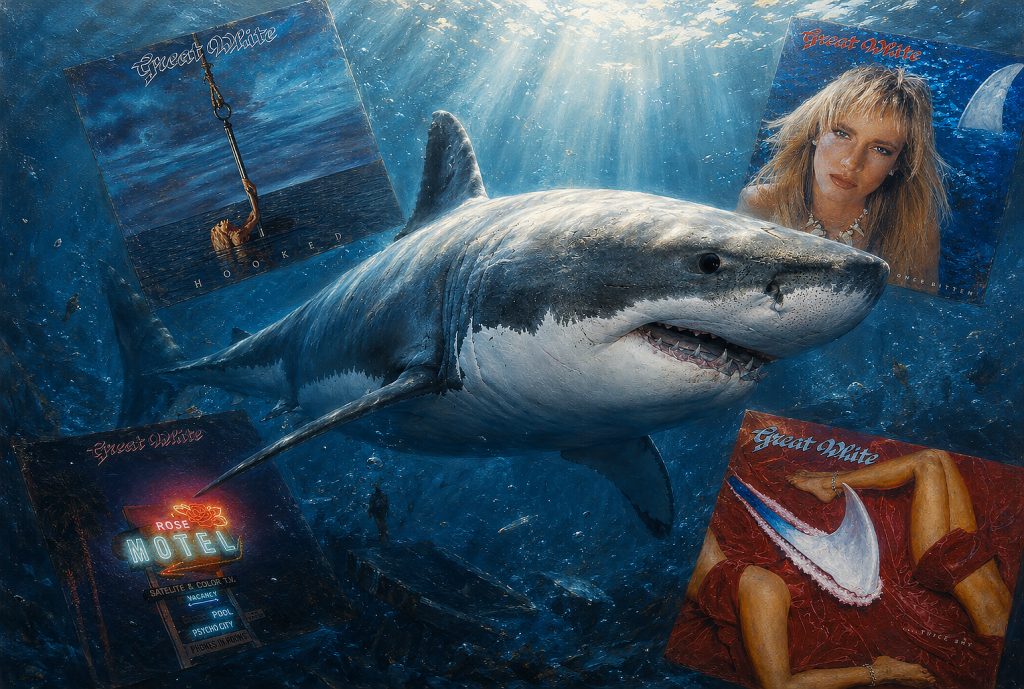
Forget the spandex stereotypes. Throw them out the window. Or bury them in a hole.
Great White is a band that didn’t necessarily fall into the gimmicks of the era.
Here’s why four albums — Once Bitten through Psycho City — represent some of the best blues-rock the era produced
So let’s turn back the clock.
The Sunset Strip in the late 1980s ran on a pretty simple formula. Grab five guys. Or four.
Hand them a wardrobe budget. Tell them to tease their hair to the ceiling. Then hire a producer who knows how to mold a chorus into something radio-friendly.
Need a songwriter to help? Call Desmond Child.
Not available? Call Holly Knight or Diane Warren.
Still not available? Call Jack Ponti.
Repeat until the money stops coming. And look — it worked. For a while, at least.
MTV was the whole ballgame back then. Most of the time the look mattered more than anything happening on the actual record.
The stage show was a selling point. The songs were the party’s soundtrack.
Great White never fit that mold.
It may have made them easy to dismiss at a glance. Yet hard to ignore once you actually sat down with their records.
Sure, flip through a copy of Circus magazine from 1988 and they look the part — leather, denim, big stage presence.
Throw in a pout here and there (if needed). But the second the needle hits the groove – something different comes through.
This wasn’t a manufactured pop-metal act sliding through on charm, bandannas and cheekbones.
These were guys who had clearly spent their teenage years sitting with Zeppelin records and Humble Pie bootlegs and old Muddy Waters stuff.
Some West Coast dudes trying to figure out how the blues actually works underneath all that volume.
What separated them was understanding something a lot of their Sunset Strip peers completely missed: groove is everything.
You don’t need to play a million miles an hour to hold a room. Sometimes a slow, heavy, seven-minute jam is exactly what the crowd needs.
Great White knew when to let a song breathe instead of stuffing it full of tricks.
Between 1987 and 1992, four studio albums came out.
Track the band’s path from Once Bitten through Psycho City. You’re watching a band learning to write radio hits without selling out their sound.
All while surviving label pressure.
When the entire music industry lost its mind over grunge, these California boys responded by making the heaviest record of their career.
Great White Early Days: Sweating It Out in the Clubs
None of what came later makes sense without understanding how the band actually started.
Mark Kendall and Jack Russell started playing together in the late 1970s.
These guys spent years grinding through tiny, crowded clubs all over Southern California before anyone outside of LA had any idea who they were.
That kind of background leaves marks on a band that studio time never can.
When you’ve been playing rough bars long enough, you learn how to read a room. You figure out that cranking your amp to ten means nothing if the rhythm section isn’t totally locked in.
You learn what makes people move.
Kendall is, without question, one of the most underrated guitar players that whole decade produced.
While everyone else on the Strip was chasing faster and flashier, he was obsessed with tone and phrasing. His solos serve the song — they don’t just show off how fast his fingers can move.
And Jack Russell had a voice that didn’t fit the standard 80s rock template at all. Where most frontmen leaned on screamed high notes, Russell had a genuine soul underneath everything.
Quiet and vulnerable one moment, then absolutely belting it out on the chorus the next.
That combination — Kendall’s bluesy playing and Russell’s soulful delivery — is the entire foundation the band was built on.
Once Bitten (1987): Getting It Right for the Radio
By 1987, record labels weren’t subtle about what they wanted.
Radio hits, period.
Taking a road-hardened club band and cleaning up their sound for mainstream consumption was always a dangerous move.
If you go too soft, your original fans feel burned. Lean too far into pop, and you sound like a fraud. Once Bitten walks that line about as well as any hard rock album from the era.
Make no mistake, this is a fairly commercial record.
The production is polished, the hooks are enormous, and there’s obvious intent to get on radio. But it never sounds cheap or desperate.
It sounds more like a veteran live band finally getting the studio time and budget to sound as big as they always did in person.
“Lady Red Light” opens the album with keyboards front and center, which isn’t what anyone expected, but the songwriting is strong enough to make the argument.
Hooks that stay in your head for days are harder to write than they look.
“Gotta Getcha” corrects course immediately — heavy guitars back in focus, real swagger in the rhythm.
A reminder that this band hadn’t gone soft.
“Rock Me” is the heart of it all, and it’s also the most audacious move on the record.
Seven-plus minutes, slow blues build, placed third in the running order of what was supposed to be a radio-friendly album.
By every conventional logic, that’s a mistake.
The song takes its time, builds beautifully, and gives Kendall a massive canvas to work on — his soloing here is some of his best early work.
The fact that it became a genuine hit says everything about how good the songwriting actually was.
The stretch running from “All Over Now” through “Fast Road” is where the album really earns its keep — no filler, just straightforward, well-crafted rock songs that keep things rockin’ along.
“Never Change Heart” is the sleeper of the whole record, proving the band could write something highly melodic without losing the toughness in the rhythm section.
And closing with “Save Your Love” was smart — giving radio stations their ballad without letting it slow down everything that came before it.
Once Bitten was a band swinging for a home run and settling for a stand-up triple.
Which is still a hit.
Twice Shy (1989): Hitting the Jackpot
If Once Bitten got the foot in the door, Twice Shy kicked the whole thing off the hinges.
Released in 1989, this is the one everybody knows — millions sold, constant MTV rotation, the whole commercial breakthrough. Strip away all the sales figures and hype, though, and what’s left is just a really great album.
Front to back, the track order is nearly perfect.
The sound lands in exactly the right sweet spot: clean enough for mainstream radio, but still carrying real dirt underneath.
Drums hit hard. Guitars have warmth.
The whole thing again feels like a band that grew up loving 70s rock going into a room and playing like their idols.
“Once Bitten, Twice Shy” was originally Ian Hunter’s in 1975.
Covering a song without sounding like a tribute act is genuinely tricky. Great White pulled off something harder than that.
By the time the track is done, it sounds like the song belonged to them from the beginning.
Huge, stomping, built for a crowd.
“House of Broken Love” is the album’s heavy hitter, and for a lot of longtime fans, the best thing the band ever recorded. Dark and slow, rooted deep in the blues, and Russell’s vocal performance is remarkable.
He’s not just singing the words, but putting actual pain somewhere in the delivery.
This doesn’t sound like something written to move sales. It sounds like a guy sitting with a real breakup and trying to figure out what to do with it.
“The Angel Song” brings in a grand piano and somehow doesn’t tip over into sentimentality.
The melody holds up. The guitar solo sounds full and rich.
The whole thing stays grounded in rock and roll instead of floating off into pop territory.
“Mista Bone” is where the groove, swing and pocket that separated Great White from almost everyone else on the scene really shows.
Many hard rock bands from that era could play loud and fast. Very few had such a groove.
The best word for Twice Shy is “confident.”
No chasing trends, no identity crisis, no second-guessing. Just heavy blues rock played at the absolute top of their ability.
Four decades on, the album still satisfies those with a classic rock itch.
Hooked (1991): The Forgotten Classic
The music business moves fast. By 1991, the ground was already shifting.
The alternative rock scene out of Seattle was starting to pull real commercial oxygen away from the LA hard rock world. Critics had already turned on hair metal and were sharpening their knives.
Great White’s response was to ignore it completely and release Hooked. People consistently overlook this record.
Why?
Probably because it didn’t produce a single that matched “Once Bitten, Twice Shy” in terms of cultural reach. But sit with the whole album and a strong case emerges that this might be the tightest, most cohesive record the band ever made.
Its production is clean without being sterile.
Drums punch hard. The bass guitar is actually audible and drives the songs. It all sounds fantastic on a good pair of speakers.
“Call It Rock n’ Roll” sets the tone immediately — no throat-clearing, no slow build, just guitars and a big chorus right out of the gate.
“Desert Moon” takes a darker, moodier detour that was genuinely unusual for Great White at the time. They’d always leaned upbeat on their singles, and the added tension here works well.
“Afterglow” — a cover of a Small Faces track from the 1960s — is handled with real respect for the original while still sounding like a Great White song.
Russell’s voice fits this kind of throwback material almost eerily well.
“Congo Square” is where the album goes full blues, and Kendall’s guitar work here is some of the best on any Great White record.
Swampy, thick, genuinely wailing.
Hooked shows that Great White stopped worrying about what the rest of the industry was doing. The band just locked themselves in the studio to make the record they actually wanted to make.
Psycho City (1992): Going Dark
By 1992, the party was definitively over. Grunge had taken over radio and MTV. The LA hard rock scene, once the center of everything, was now essentially dead as a commercial force.
Watching how different bands handled the collapse was instructive.
Some grabbed flannel shirts and tried to write depressing alternative songs, which almost always sounded terrible. Kinda like actors reading lines from an era they’d never actually lived in.
Others just kept wearing the makeup, kept playing clubs to shrinking crowds, and gradually faded.
Psycho City took a different path. The bright, polished sound of the late 80s is completely gone.
It’s been replaced by something thick and heavy, with a late-night menace the band had never really explored before. The lyrics veered from party rock into darker territory.
A place with tension, city life, the less flattering sides of human nature.
Russell’s voice sounds older and rougher here, which fits the material like a glove.
For the hardcore fans, Psycho City is the secret masterpiece. A band growing up in a challenging market and getting meaner.
“Psycho City” opens with exactly the mood the title promises. A heavy, dangerous late-night vibe that feels genuinely new coming from these guys.
“Step on You” hits harder than almost anything in the catalog. The groove is driving.
The energy is relentless, and proves that musical trends shifting around you don’t have to shift you.
“Old Rose Motel” feels like a spiritual sequel to “House of Broken Love” — slow, patient, built around Kendall’s guitar tone. The kind of song that rewards the listener who doesn’t rush it.
“Love Is a Lie” captures the cynical, burned-out mood of 1992 without losing the melodic instinct. Sharp lyrics with a hook still underneath them.
Psycho City got completely ignored by the mainstream press. MTV wouldn’t touch it. Which is a genuine shame — the music is excellent, and it proved there were still plenty of ideas left.
The band just happened to release their most ambitious work exactly when nobody was paying attention..
Why the Whole Run Still Matters
Line up all four records and a cool progression emerges.
Once Bitten is the band figuring out how to play the major label game.
Twice Shy is winning it.
Hooked is proving they were total pros in the studio under any conditions.
Psycho City is reacting to a world turned upside down by going darker instead of chasing whatever was selling.
Four great records in a row. All without losing the core identity that made them worth listening to in the first place.
That’s harder than it sounds.
Plenty of bands managed one or two good albums before getting swallowed by label pressure. Or their own worst instincts.
Maybe both.
What actually set Great White apart from most of their Sunset Strip contemporaries was something unglamorous: they could write songs in changing times.
Real ones.
Great White understood that a great guitar riff still needs a locked-in rhythm section underneath it. And that a melody you’ll want to hear three decades later requires actual craft.
Not just a good-looking frontman and a generous production budget.
During a hairspray era when an enormous amount of effort went into looking fantastic on video, the focus on playing real music — rooted in the blues, built for rooms full of people — is exactly why these albums still hold up.
They hold up when most of what surrounded them has aged into a punchline.
The Others Behind the Sound: Great White’s Unsung Engine Room
Jack Russell and Mark Kendall get most of the credit — rightfully so, in a lot of ways.
But four strong albums don’t happen on the back of two guys alone.
The version of Great White that produced this run had some serious talent surrounding them.
These contributors sometimes rarely get the recognition they deserve.
Michael Lardie: The Secret Weapon Nobody Talked About
Here’s something many people don’t know about Michael Lardie.
By the time he joined Great White in 1986 as a session and touring member, he’d already built a legitimate career on the other side of the glass.
We’re talking about a guy who had worked on records by Black Flag and Saint Vitus on one end of the spectrum, and Kajagoogoo and Dokken on the other.
Think about how wildly different those worlds are — hardcore punk, doom metal, synth pop, melodic hard rock.
You start to understand that Lardie wasn’t just a hired hand who happened to be in the right place at the right time.
He was a guy who understood how records actually get made across completely different genres.
That background matters more than it might seem.
When Lardie eventually became a permanent member and took over production and engineering duties for the band, he brought something into the studio that most rock bands of that era simply didn’t have sitting in their corner.
Someone who genuinely understood the recording process from the inside out.
and who had the range to serve the song rather than just the genre.
Listen to the sonic difference between Once Bitten and Hooked. You can hear that development in real time.
The production gets tighter.The low end gets more defined.
The overall sound gets bigger without losing the warmth that made the band worth listening to in the first place.
That’s not accidental.
Lardie was evolving as a producer while the band was evolving as songwriters.The two things fed each other.
On stage, his role was equally important even if harder to pinpoint.
As the rhythm guitarist and keyboardist, Lardie filled in the space around Kendall’s lead playing without cluttering it.
When keyboards appeared on tracks like “Lady Red Light,” they worked.
Someone with real musical instincts was making decisions about where they belonged and where they didn’t.
Lardie seemed to understand the difference between adding texture and adding noise — a distinction that a lot of players in that era never quite figured out.
After Great White disbanded in 2000, he went straight back to production work, putting his fingerprints on records by Jake E. Lee, Leslie West, Shaw Blades, and Jizzy Pearl among others.
A brief stint with Night Ranger from 2003 to 2007 — overlapping with the Great White reunion that started in 2006 — showed he was still very much in demand.
The breadth of the resume tells the whole story.
Some musicians are good at one thing in one context. Lardie was good at most things in almost any context.
Tony Montana: The Bassist Who Showed Up Right on Time
Tony Montana came into Great White shortly after Once Bitten was released in 1987.
His timing turned out to be fortunate for everyone involved.
Tony played on Twice Shy and Hooked — the two albums that defined the band’s commercial peak and their creative high-water mark.
His contribution to both records is more significant than his name recognition would suggest.
A great rock bass player is one of those things you don’t fully notice until it’s missing. Montana understood his role completely.
The low end on Twice Shy has a kind of locked-in momentum that gives songs like “House of Broken Love” and “Mista Bone” their real physical weight. That groove doesn’t happen if the bassist is chasing the guitar player around or trying to show off.
Montana played for the pocket, every time, and the rhythm section he formed with Audie Desbrow gave Kendall’s guitar work a foundation that was genuinely hard to shake.
He left during rehearsals for Psycho City in early 1992, with Dave “The Beast” Spitz stepping in for the recording.
Whether the circumstances were amicable or not is a matter of band history, but the timing does raise an interesting what-if.
Psycho City is a great record, but it’s also a harder, meaner, more abrasive one than its predecessors — and some of that rawness might have been baked in by the lineup change.
His playing had always been locked-in.
What the album got instead was something a little more unpredictable at the low end, which actually suits the darker mood of the material.
Even if it wasn’t necessarily planned that way.
Audie Desbrow: The Drummer Who Just Never Let the Band Down
There’s a certain type of musician the music world completely takes for granted, and Audie Desbrow is a textbook example.
Throughout this entire four-album run, he was behind the kit, and not once did the drumming become the problem.
In a band built around a guitar player obsessed with feel and a singer obsessed with soul, having a drummer who understood how to serve both of those things without drawing attention to himself was genuinely essential.
Desbrow hits hard without hitting sloppy.
The drums on Hooked in particular — one of the cleanest-sounding records the band made — are punchy in a way that feels almost physical on a good speaker setup.
He’s not a show-off, and the material never needed him to be.
Great White’s whole identity was built on groove and weight.
Desbrow was the drummer making sure that foundation never cracked, album after album, night after night on the road.
The fact that he’s still with the band decades later says something. Chemistry like that doesn’t get replaced easily.
Alan Niven: The Forgotten Man Behind the Curtain
The basic version of the Great White story gets told pretty often — two guys from Southern California grind through the club circuit, build a following the hard way, sign a major deal, and eventually break through on the strength of their playing and their songs.
All of that is true.
What that version tends to leave out is the person standing slightly off to the side, making sure the whole thing actually worked.
Alan Niven managed Great White from 1982 until 1995, and his fingerprints are on virtually everything the band produced during that stretch.
Not just in the background.
Niven holds songwriting credits on every album from the self-titled record through Sail Away — meaning the guy running the business side of the operation was simultaneously one of the primary architects of the music itself.
That’s a genuinely unusual situation, and in most cases it ends badly.
With Great White, for a long time, it worked remarkably well. What Niven brought to the table wasn’t just hustle, though he clearly had plenty of that.
He had a specific vision for what Great White was and what they could be, and he was disciplined about protecting it. Imagery, lyrics, album covers, videos — all of it ran through a consistent aesthetic sensibility that kept the band from looking or sounding like just another Sunset Strip act chasing whatever was moving units that month.
Mark Kendall, who is not exactly a guy given to handing out compliments freely, put it simply: “He had a vision. He was right most of the time.” Coming from the guitarist who is the band’s musical identity, that’s not a throwaway quote.
The production work tells a similar story.
Taking on the producer role for the Capitol and Zoo albums, Niven wasn’t just sitting in the control room rubber-stamping decisions — he was actively shaping how the band translated to tape.
The fact that those records hold up sonically, that they have warmth and weight rather than the thin, overproduced sound that dates so many albums from that era, reflects real decision-making in the studio. Someone was insisting on getting it right, and that someone was Niven as much as anyone else.
Running the band and Guns N’ Roses simultaneously — he managed GNR from 1986 to 1991 — would have broken most people.
The two acts couldn’t have been more different in terms of temperament and daily chaos, and shepherding either one of them through the late 1980s music industry required a specific kind of stubbornness.
Niven had it.
Getting fired from both gigs in the same general window of time, though — let go by Guns N’ Roses just before Use Your Illusion was released, then eventually pushed out of Great White in 1995 after a falling out with Russell — is the kind of professional double-blow that would flatten almost anyone.
The personal circumstances surrounding his departure made everything considerably worse.
Discovering that his then-wife had been carrying on a secret relationship with Jack Russell is the sort of thing that tends to permanently color how a person remembers an entire chapter of their life.
The fallout was complicated, as these things always are.
Niven eventually reconnected with Kendall and Lardie after the tragic Station nightclub fire in 2003, but his relationship with Russell never recovered.
His feelings on the subject, when he’s chosen to share them, have been pointed. Whatever warmth existed between manager and frontman during the years they built something real together clearly didn’t survive what came after.
It’s worth noting that Great White was never the only item on Niven’s resume — he worked across a genuinely wide landscape, with connections to Mötley Crüe, Dokken, Berlin, Clarence Clemons, Izzy Stradlin and the JuJu Hounds, The Angels, and others over the course of his career.
The man knew the industry from multiple angles and at multiple levels.
But the Great White run, those years from the early 1980s through the mid-90s when the band went from sweaty club act to legitimate commercial force, represents something specific in terms of what sustained creative collaboration between a manager and a band can actually look like when everybody is pulling in the same direction.
Most bands from that era had managers.
Very few had someone who was also writing the songs, shaping the visuals, producing the records, and maintaining a coherent identity for the act across nearly fifteen years.
Whether that level of involvement is a feature or a complication probably depends on who you ask and when you ask them.
But the albums exist, and they’re good, and Niven’s name is on most of them for a reason.
Great White (1987–1992): Frequently Asked Questions (FAQ)
What defined Great White’s sound compared to other 1980s Sunset Strip bands?
Unlike many of their contemporary “hair metal” peers who relied heavily on pop-metal gimmicks, flashiness, and fast playing, Great White rooted their sound deeply in classic 1970s blues-rock. Influenced by acts like Led Zeppelin, Humble Pie, and Muddy Waters, the band prioritized groove, tone, phrasing, and letting songs breathe over manufactured imagery and high-speed solos.
Which four albums are considered Great White’s definitive era?
The band’s peak creative and commercial era is defined by four consecutive studio albums released between 1987 and 1992:
Once Bitten (1987): The major-label breakthrough that balanced commercial radio appeal with tough, bluesy rock.
Twice Shy (1989): The massive multi-platinum hit album that cemented their mainstream success.
Hooked (1991): A cohesive, production-tight record often regarded by critics and fans as a forgotten classic.
Psycho City (1992): A darker, heavier, and more cynical record released just as the grunge movement altered the music industry landscape.
What are some of Great White’s biggest hit songs from this period?
“Rock Me”: An audacious, slow-building, 7-plus-minute blues track from Once Bitten that defied conventional radio logic to become a genuine hit.
“Once Bitten, Twice Shy”: A stomping Ian Hunter cover from Twice Shy that became an MTV staple and the band’s biggest commercial crossover.
“House of Broken Love”: A dark, slow, blues-drenched track widely considered by longtime fans to feature singer Jack Russell’s finest emotional vocal performance.
“Call It Rock n’ Roll”: The hard-hitting, immediate lead single from 1991’s Hooked.
Who were considered the core musical architects of Great White?
While the band operated as a tight unit, its sonic foundation relied on the chemistry between two co-founders:
Mark Kendall: One of the decade’s most underrated guitarists, who focused on bluesy phrasing and serving the song rather than flash.
Jack Russell: A frontman possessing a soulful, vulnerable delivery capable of seamlessly shifting into a powerful rock belt.
Who were the unsung members behind Great White’s success?
Beyond the frontline duo, Great White’s “engine room” consisted of highly skilled permanent contributors:
Michael Lardie (Keyboards/Rhythm Guitar/Production): The “secret weapon” who brought engineering experience from working with diverse acts like Black Flag and Dokken to refine the band’s studio sound.
Tony Montana (Bass): The bassist during Twice Shy and Hooked who locked into a heavy, physical groove with the drums.
Audie Desbrow (Drums): The steady, hard-hitting backbone of the band who provided the essential foundation for Great White’s signature groove.
Who was Alan Niven, and what was his role in Great White?
Alan Niven was Great White’s manager from 1982 to 1995, but his impact went far beyond business. He was a primary creative architect, holding songwriting credits across their major albums, serving as their producer for Capitol and Zoo records, and strictly shaping their visual identity. Niven, who also managed Guns N’ Roses during their peak (1986–1991), was instrumental in keeping Great White from sounding like a generic trend-chasing act.
How did Great White handle the shift to grunge in the early 1990s?
Instead of chasing alternative rock trends, wearing flannel, or fading away, Great White responded to the 1992 grunge explosion by releasing Psycho City. It was the heaviest, meanest, and darkest record of their career, trading their polished 80s sheen for a gritty, late-night urban menace. Though ignored by mainstream media at the time, it remains a favorite among hardcore fans.
Great White Gear, Vinyl, and Audio Stuff
If you want to upgrade your stereo, grab these albums on physical media, or figure out how to get that classic guitar sound, check out these fifteen picks. They are totally worth picking up.
Hearing “Rock Me” on an actual record player is the way to go. This vinyl pressing brings out the warmth of the bass and makes the guitars sound huge. You need this for your collection.
If you are just starting to collect their stuff, start right here. The CD sounds punchy and loud, exactly like it did in 1989. It comes with all the original artwork too.
Do not skip over this record. It sounds incredibly clean and features some of their best playing. It is the perfect CD to keep in your car.
The heavy hitter of the catalog. It is dark, moody, and you absolutely need it if you want to hear how they changed their sound in the 90s.
Audio-Technica AT-LP120XUSB Direct-Drive Turntable
A really solid, well-made turntable that handles loud rock music without any issues. The motor keeps the speed perfect, which is super important for classic rock records.
Sony WH-1000XM5 Noise Canceling Headphones
If you really want to hear the bass player and the drummer locking in on Twice Shy, you need good headphones. These block out all the background noise and sound amazing.
Fender Player Stratocaster Electric Guitar
Mark Kendall’s guitar sound is all about the classic Fender Stratocaster. If you want to learn how to play those bluesy solos, this guitar is exactly where you should start.
You don’t want a crazy heavy metal distortion pedal for this kind of rock. You want a warm, smooth overdrive. This Boss pedal is the absolute best way to get that sound.
Fender Hot Rod DeVille 212 IV Tube Amplifier
If you want to sound like a real rock band, you need an amp with real tubes in it. This Fender amp gets super loud and sounds incredibly clean.
D’Addario EXL110 Nickel Wound Electric Guitar Strings
These are the strings that most gigging guitar players use. They sound great, they are balanced, and they don’t go out of tune easily. Always keep a few packs around.
Nöthin’ But a Good Time: The Uncensored History of the ’80s Hard Rock Explosion (Book)
Want to read some crazy stories about the Sunset Strip? This book talks to all the guys who were there. It covers the rise, party and crash of the 80s scene.
Marshall Kilburn II Portable Bluetooth Speaker
Take your music outside. This speaker looks like a little guitar amp. It connects to your phone, and it pushes out a lot of bass and volume.
Spin-Clean Record Washer System
If you buy old, used records from the 80s, you have to clean them. This little washing system gets all the dust and dirt out of the grooves so your records sound new again.
Ernie Ball Paradigm Electric Guitar Strings
If you hit the strings hard and bend them a lot, regular strings will break on you. These Paradigm strings are built to take a beating without losing their tone.
Hear what else was playing on the radio back then. These CDs have all the big hits from the other bands of the era, so you can see how Great White stacked up against the competition.
Sources to Check Out
Great White – Once Bitten (1987) Album Review
A good review looking at how the band broke into the mainstream. It talks about the recording choices they made to get on the radio without losing their heavy rock sound.
Great White – Twice Shy Review and Legacy
A look back at their biggest commercial album. It breaks down why their Ian Hunter cover song worked so well, and talks about how the album fit into the rock scene in 1989.
Mark Kendall Guitar Style and Influence – 30 Years of Great White
An awesome interview. It goes over his blues influences, how he puts his solos together, and why his tone is so important to the band.
A great history lesson on the LA hard rock scene. It covers the record labels, the famous clubs, getting played on the radio, and how it all fell apart when alternative rock showed up.
The Cassette Chronicles – Great White Hooked
A cool look back at their third major label record. The writer argues that it is one of their best and best-sounding albums, even if MTV stopped playing their videos as much.
Ian Hunter – Once Bitten Twice Shy: The Original vs. The Cover
A cool article comparing the 1975 original version to the 1989 Great White cover. It talks about how the band changed the song to make it a huge rock anthem.
Blues Influences in 1980s Hard Rock
A breakdown of how old-school blues music influenced a lot of the 80s hard rock bands, specifically looking at how Great White borrowed from their 70s rock heroes.
10 Questions with Jack Russell: The Voice of Great White
An interview all about Jack Russell’s career. It highlights his range, his bluesy sound, and how his voice changed over those big four albums.
Small Faces – Afterglow: Notable Covers
Other versions of the Small Faces song that Great White covered on the Hooked album.