
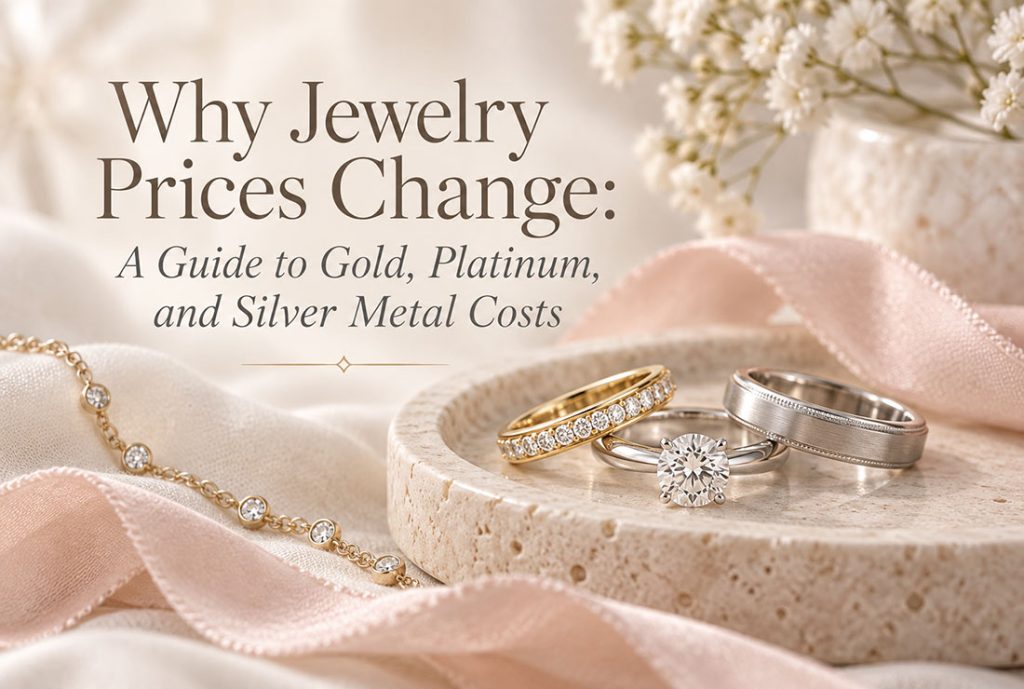
Why Jewelry Prices Change: A Guide to Gold, Platinum, and Silver Metal Costs
When you walk into a jewelry store to look for an engagement ring, a new chain, or a classic pair of earrings, it is incredibly easy to focus entirely on the diamonds.
Most consumers assume that the size of the center stone, the color of the gemstone, or the name on the designer box dictates the price tag.
While stones certainly matter, the hidden driver behind massive price differences is often the metal itself.
A plain wedding band might feature absolutely zero diamonds, yet similar-looking bands can vary wildly in price.
Have you ever wondered why a wide men’s band costs substantially more than a narrow women’s band?
Why does platinum sometimes seem outrageously expensive, and other times closer in price to gold?
Why did the quote for your custom ring change after a month?
Why are modern chain necklaces often much lighter than the ones your grandparents wore?
Precious metal is not just decoration. It provides the structure, weight, strength, and long-term foundation of the jewelry piece.
When global gold, platinum, or silver prices rise, those market changes influence everything from the width of a wedding band to the price of a simple repair.
Understanding how metal prices work helps you compare jewelry fairly and ask much smarter questions before making a purchase.
First, What Metal Prices Actually Mean
Precious metals like gold, silver, platinum, and palladium are global commodities.
They do not have fixed, static prices. Instead, they trade in global financial markets.
Their prices fluctuate constantly based on global supply, consumer demand, investment activity, economic uncertainty, and currency movements.
Jewelers, refiners, and manufacturers do not randomly invent metal prices. The industry references widely recognized global benchmarks.
The London Bullion Market Association (LBMA) runs electronic auctions that establish recognized global benchmark prices for unallocated gold, silver, platinum, and palladium.
Refiners, fabricators, and banks use these benchmarks to set their baseline material costs.
The price you see scrolling across a financial news ticker is not the final price of your jewelry.
Consumers often look up the price of gold “per ounce” and wonder why a half-ounce gold ring costs so much more than the raw metal value.
This happens because the retail price includes massive additional factors: refining the raw metal, creating the specific karat alloy, casting the mold, labor, stone setting, hand-polishing, quality control, shipping, store overhead, and long-term warranty support.
The market price of the metal is simply the starting point of the story, not the end.
Why Gold Prices Matter So Much in Jewelry
Gold serves as the absolute backbone of the fine jewelry industry.
It is utilized heavily in engagement rings, wedding bands, thick chains, heavy bracelets, and religious jewelry.
Because gold is so prevalent, sharp increases in gold prices aggressively affect consumer behavior.
High gold prices can quickly pressure consumer demand.
The World Gold Council reported that in the first quarter of 2026, the total financial value of global gold demand reached record levels specifically because of high prices, even while the actual volume of jewelry purchased remained under heavy pressure.
Gold prices influence not only what a piece costs, but how it is designed.
When gold becomes highly expensive, manufacturers respond to keep retail prices affordable.
They might make rings slightly lighter, offer narrower wedding bands, or push 10kt and 14kt gold over 18kt gold.
Actually – 18kt gold is too soft for rings that you wear daily. It’s a great choice if you plan to wear a ring on special occasions. Necklaces and earrings are fine.
You might see a massive increase in semi-hollow chain designs, or retailers aggressively promoting alternative metals for men’s bands to balance consumer budgets.
Understanding Karat: Why 10kt, 14kt, and 18kt Gold Price Differently
You have likely seen jewelry stamped with 10kt, 14kt, or 18kt.
These are not arbitrary marketing labels; they represent the exact amount of pure gold inside the piece.
Pure 24kt gold is also generally far too soft for daily wear, so it is mixed (alloyed) with other metals to provide strength and durability.
The Federal Trade Commission (FTC) provides strict consumer guidance outlining how these karat terms must be used to describe purity.
10kt Gold: Contains the lowest gold content of the three. It is usually the most affordable and incredibly durable for daily wear, though the yellow color might look slightly less rich than higher-karat pieces.
14kt Gold: The industry standard for bridal jewelry. It offers a highly popular balance of durability, beautiful color, and value.
18kt Gold: Features a much higher pure gold content, yielding a very rich, warm yellow color. It is usually more expensive and is slightly softer than 14kt gold, making it highly popular in luxury designer jewelry.
When global gold prices skyrocket, a heavy 18kt gold ring will jump in price much faster and sharper than a lighter 10kt gold piece, simply because it contains significantly more pure gold.
Metal Weight: The Hidden Price Factor Consumers Often Miss
Jewelry is priced largely by how much physical metal it contains.
Two rings might both be 14kt yellow gold, but one will cost significantly more if it is wider, thicker, or cast in a larger finger size.
Design features drastically alter metal weight.
Wide cigar bands, thick engagement ring shanks, solid heavy chains, large signet rings, and heavy bezel settings require a massive amount of gold or platinum.
Conversely, designers reduce metal weight by creating thinner bands, utilizing hollow or semi-hollow construction for chains and hoops, and carving out open galleries underneath diamonds.
A lighter piece of jewelry is not automatically “bad,” and a heavy piece is not always “better.”
You should know when you are comparing a substantial, solid piece of jewelry against a lightweight, hollowed-out piece.
A ring can look identical from a top-down photograph online, but contain drastically different amounts of precious metal underneath.
Why Wide Wedding Bands Cost More
Width directly dictates metal usage.
A thick 7mm men’s wedding band uses vastly more gold than a delicate 3mm women’s band.
A size 12 ring requires more metal to complete the circle than a size 6 ring.
Men’s bands illustrate this perfectly. Because they often range from 4mm up to 8mm wide, the difference in width creates a major price gap.
“Comfort-fit” bands feature a rounded interior of solid metal, requiring even more material than a flat, standard-fit band.
If a wide band seems expensive, you are not just paying for a style; you are paying for the physical weight of the gold.
Platinum Pricing: Why It Behaves Differently From Gold
Platinum is a completely different metal with a totally different global market.
While highly prized in jewelry, platinum also experienced massive industrial demand (especially in automotive manufacturing).
Because it responds to different supply and demand forces, platinum prices often move independently of gold.
Platinum is also incredibly dense. A platinum ring will feel noticeably heavier in your hand than the exact same ring cast in 14kt gold.
Even during market periods when the raw price of platinum falls below the raw price of gold, a finished platinum ring will almost always cost more at the retail counter.
This happens because platinum’s extreme density requires more physical weight to cast the ring.
Platinum requires specialized tools, higher heat, and significantly more labor-intensive finishing and polishing work from master jewelers.
You are paying for the difficulty of the craftsmanship just as much as the metal.
Silver: Lower Metal Cost, Different Retail Reality
Sterling silver provides a beautiful, highly affordable option because the raw metal price is drastically lower than gold or platinum.
Silver jewelry still carries real costs. Even with cheap raw material, the final retail price must cover the intricate design work, casting, labor, stone setting, brand packaging, and retail overhead.
Silver is also much softer than gold and tarnishes easily, which affects how designers utilize it in fine jewelry.
A low metal price does not mean the labor and craftsmanship are free.
How Metal Prices Influence Jewelry Design
Designers react aggressively to material costs.
When gold becomes overwhelmingly expensive, designers look for creative ways to preserve a beautiful aesthetic while ruthlessly controlling the physical weight of the piece.
During high-price periods, you will see a surge in slimmer bands, openwork settings, delicate chains, hollow hoop earrings, and designs utilizing negative space.
If consumers still demand bold, chunky looks during a high-market period, designers pivot.
They create hollow-formed links, stamp out lightweight components, or utilize extremely thin metal shaped into wide, domed profiles to create the illusion of weight.
Lightweight design is not automatically poor quality.
Extremely thin shanks or hollow construction will severely affect the item’s durability, dent resistance, and long-term repairability.
How Metal Prices Affect Retailer Inventory
High metal prices make holding inventory incredibly expensive for small retail stores.
If a local jeweler stocks fifty heavy gold chains, they have massive amounts of cash tied up in that metal.
When prices rise, retailers adapt. They might carry fewer heavy, solid pieces.
Instead of stocking a wedding band in every single size, they will stock brass samples and offer “made-to-order” or “just-in-time” manufacturing.
You might notice that local stores heavily promote special orders rather than offering immediate, out-of-the-case purchases.
How Metal Prices Affect Custom Jewelry and Repairs
Custom jewelry quotes are notoriously sensitive to metal markets.
If a jeweler quotes you a price for a custom heavy gold signet ring, that quote is based on today’s gold market.
If you wait two months to approve the design and gold prices surge, the jeweler must update the quote because their casting costs just increased.
Always ask how long a custom quote remains valid.
Consumers also frequently forget that repair costs include metal.
Resizing a ring larger, replacing a broken chain section, or retipping worn prongs all require the jeweler to add fresh gold or platinum to the piece.
Repair pricing is not just a “quick fix” labor fee; it directly reflects the cost of the raw metal required to make the jewelry safe again.
Why Chains React Strongly to Metal Prices
Unlike a diamond engagement ring—where the majority of the price tag comes from the center stone—the price of a plain gold chain is tied almost entirely to its physical metal weight.
When gold prices spike, chains are the first category where shoppers feel the pain. To combat this, manufacturers produce hollow chains.
A thick, hollow chain offers a massive, bold look for a fraction of the cost of a solid chain.
But there’s a downside! Hollow chains dent incredibly easily and are notoriously difficult for jewelers to repair if they snap.
Why Older Jewelry May Feel Heavier Than New Jewelry
Have you ever held your grandfather’s wedding band and noticed it feels significantly heavier than a brand-new band of the same size?
Older designs frequently utilized more metal simply because raw material costs were vastly different decades ago.
As global metal prices climbed over the years, manufacturing technology improved, allowing modern designers to cast much lighter, thinner pieces to control retail costs.
A lighter modern piece is not automatically inferior, but you should understand whether that weight difference will affect how the ring survives decades of daily wear.
Scrap Value vs. Jewelry Value
Consumers constantly confuse these two concepts.
The “scrap value” of your gold ring is absolutely not the same as the “retail value” of the finished piece.
Scrap value reflects only the raw, melted-down metal content. It completely strips away the labor, the intricate design, the brand name, the antique value, and the gemstones.
Scrap value only matters if you are selling broken, unwearable jewelry to a refiner, or trading in old gold to melt down for a custom project.
Fine jewelry is almost always worth significantly more than its scrap weight because of the craftsmanship involved.
How Consumers Can Shop Smarter When Metal Prices Are High
Compare metal weight: Ask the jeweler directly if the piece is solid, semi-hollow, or lightweight.
Consider karat options: 14kt gold often provides a superior balance of durability and price compared to 18kt gold for daily-wear items like wedding bands.
Prioritize durability: Do not sacrifice the thickness of your ring shank or your diamond prongs just to save a few dollars. Thin prongs lead to lost diamonds.
Ask about alternatives: If a solid gold heavy men’s band breaks the budget, explore highly durable alternative metals like tantalum or titanium, but ensure you understand their resizing limitations.
Questions Consumers Should Ask Before Buying
Metal Identity: What exact metal is this? Is it solid gold, hollow, or merely gold-plated over a base metal?
Weight and Construction: How much does this piece physically weigh? Is the ring shank thick enough to survive daily wear, or has it been thinned out to reduce the price?
Price and Value: How much of this price is driven by the metal weight versus the designer brand name? Is this custom quote locked in, or will it change if gold markets fluctuate?
Durability and Service: Can this specific ring be resized easily in the future? Are the prongs holding the diamond substantial enough? Can this hollow chain be repaired if it snaps?
Common Consumer Mistakes
The most common mistake is comparing jewelry strictly by top-down appearance. Two rings can look identical in an online photo, but if one is paper-thin and the other is solidly cast, the prices should be drastically different.
Another mistake is assuming a high price tag automatically guarantees heavy, solid construction.
Sometimes a high price purely reflects the brand name or the intricate hand-labor of the design, not the physical weight of the gold.
Finally, many forget that a “cheap” lightweight ring might end up costing them a fortune in repair bills when the thin metal inevitably bends out of shape.
The Bottom Line on Metal Prices
Precious metal prices influence the fine jewelry industry in ways shoppers rarely see. A ring’s width, its karat purity, its physical weight, and its internal construction all aggressively dictate the final price tag on the showcase glass.
Gold and platinum are not just shiny background materials; they are the absolute structural foundation of the piece.
This does not mean you should shop purely by metal weight. Jewelry is a delicate balance of stunning design, comfortable wearability, secure stone setting, and deep emotional meaning.
A lightweight, delicate ring might be absolutely perfect for one shopper’s style, while a heavy, solid platinum band is mandatory for someone working a hands-on job.
The smartest consumer does not just ask, “Why does this cost so much?” They ask, “What am I actually paying for?”
When you understand how metal prices work, you can compare jewelry with clear eyes, avoiding cheap construction and choosing pieces that perfectly balance beauty, budget, and long-term durability.
Related Amazon Products for Jewelry Care and Measurement
PepeTools Metal Ring Sizer Measuring Gauge
Ensure a perfect fit before ordering expensive heavy gold or platinum bands online. This durable metal ring sizer includes half sizes to help you measure accurately at different times of the day.
Magnasonic Professional Ultrasonic Jewelry Cleaner
Keep your solid gold and platinum jewelry sparkling clean at home. Uses gentle sound waves to safely lift daily dirt and lotion from intricate metal settings.
Diamond Dazzle Stik Cleaning Pen
A highly portable, twist-brush cleaning solution designed specifically for safely reaching beneath tight diamond prongs without scratching the surrounding precious metal.
Mayflower Microfiber Jewelry Polishing Cloths
A gentle, chemical-free way to quickly wipe away daily fingerprints and safely restore the high-polish shine to 14kt, 18kt, and platinum settings without scratching.
30X Jewelers Loupe Magnifier with LED Light
Perform your own at-home visual checks! This pocket-sized 30X magnifying loupe lets you inspect your gold prongs for wear and verify tiny karat hallmarks stamped inside your rings.
Feramox Invisible Ring Size Adjusters
A comfortable, clear, and temporary solution if your heavy platinum engagement ring fits slightly too loose, providing instant security so the top-heavy ring doesn’t spin.
Connoisseurs Silver Polishing Cloth
Specially treated cloths designed specifically to remove dark tarnish from sterling silver jewelry, leaving a protective anti-tarnish shield behind to keep the metal bright.
Bagsmart Travel Jewelry Organizer Case
Keep your heavy gold chains, engagement rings, and fine jewelry perfectly secure, padded, and separated while traveling so the metals do not scratch each other.
SentrySafe Compact Fireproof Lock Box
Keep your highly valuable solid gold heirlooms, GIA grading reports, and appraisal documents perfectly secure and protected from fire damage at home.
Digital Pocket Gram Scale
Curious about the actual metal weight of your jewelry? This highly accurate digital pocket scale allows you to weigh your gold chains and rings in precise grams.
Frequently Asked Questions About Precious Metal Prices and Jewelry
Why does the price of gold affect the price of jewelry so much?
Gold is one of the primary raw materials used throughout the fine jewelry business. It appears in engagement rings, wedding bands, chains, bracelets, earrings, pendants, and countless other pieces.
When the market price of gold rises, the cost of manufacturing those pieces rises as well. The effect is particularly noticeable with jewelry that contains a lot of metal, such as wide wedding bands, heavy chains, solid bracelets, and large signet rings.
The price of gold is not the entire retail price of a piece, but it is an important starting point.
If gold is quoted at a certain price per ounce, why does jewelry cost so much more?
The market price of gold represents the value of the raw precious metal. A finished piece of jewelry involves much more than raw material.
The metal has to be refined, alloyed to the correct karat, fabricated or cast, finished, polished, inspected, and sometimes set with diamonds or gemstones.
The final price can also include design work, skilled labor, packaging, shipping, retailer overhead, warranty service, repairs, and other costs involved in bringing the finished piece to market.
Comparing the spot price of gold directly with the price of a finished ring is therefore not an apples-to-apples comparison.
What does the spot price of gold mean?
The spot price is a market reference price for gold at a particular point in time.
It moves as global markets react to supply, demand, investment activity, currency movements, economic conditions, and other factors.
Jewelers and manufacturers pay attention to these markets because changes in precious metal prices affect what it costs them to manufacture and replace inventory.
The number you see quoted on a financial website is useful, but it should not be mistaken for the retail price of finished jewelry.
Why can the price of a ring change from one month to the next?
Precious metals do not have fixed prices.
If gold or platinum rises significantly after you receive a quote, the manufacturer’s cost of producing the ring may also increase.
That becomes especially important with heavier jewelry.
A small change in the metal market may not dramatically affect a delicate piece, but the same percentage change can make a much more noticeable difference in a heavy wedding band, bracelet, or chain.
Why do custom jewelry quotes sometimes expire?
A custom quote is generally based on the cost of materials and labor at the time it is prepared.
If a customer waits several weeks or months before approving the project, the price of gold or platinum may have changed.
For that reason, jewelers may place a time limit on a custom quote.
If you are considering a custom piece, ask how long the quoted price will remain valid and whether the metal portion of the price is subject to change.
Why does a wider wedding band usually cost more?
A wider band normally requires more metal.
A 7mm band, for example, generally contains substantially more material than a narrow 3mm band made in the same metal and finger size.
Thickness matters too.
Two rings can have the same width but very different weights if one has a heavier profile or thicker construction.
That is one reason photographs alone can make jewelry price comparisons difficult.
Does finger size affect the price of a wedding band?
It can.
A larger finger size requires a larger circumference, which generally means more metal is needed to make the ring.
The difference may be relatively small on a narrow, lightweight band, but it becomes more significant on wide or heavy designs.
When comparing prices, make sure you are comparing rings of similar width, thickness, profile, metal, and finger size.
Why can two 14kt gold rings that look almost identical have very different prices?
They may contain very different amounts of gold.
One ring may be thicker, heavier, wider, or completely solid. Another may have thinner walls, an open gallery, or other construction techniques that reduce its weight.
A top-down photograph rarely tells you the whole story.
Turn the ring over. Look at the underside. Ask about its weight and construction.
Those details can explain a substantial price difference between pieces that initially appear nearly identical.
Does heavier jewelry automatically mean better jewelry?
No.
Weight is one factor, not a complete measure of quality.
A heavier ring may feel more substantial and may contain more precious metal, but good jewelry also depends on design, construction, stone security, finishing, comfort, and how the piece will be worn.
Likewise, lightweight jewelry is not automatically poor quality.
The important question is whether the construction is appropriate for the piece and the way you intend to use it.
Is lightweight jewelry something I should avoid?
Not necessarily.
Modern manufacturing allows designers to create attractive jewelry while using less metal. That can keep a piece more affordable and make larger styles more comfortable to wear.
Problems can arise when reducing weight also means making important structural areas excessively thin.
For rings, that may include the bottom of the shank or the metal around stone settings. For chains and bracelets, very thin or hollow construction may affect resistance to dents and the ability to make future repairs.
The issue is not simply whether jewelry is light. It is whether it is well constructed for its intended use.
What is the difference between solid, hollow, and semi-hollow jewelry?
Solid jewelry uses metal throughout its structure.
Hollow jewelry is formed to create an empty interior, allowing the piece to appear larger while using substantially less precious metal.
Semi-hollow construction falls somewhere between the two.
Hollow construction is especially common in chains, hoops, and larger styles where making the same design completely solid could make it extremely heavy and expensive.
Each type has advantages. The important thing is knowing what you are buying.
Why are hollow gold chains less expensive than solid chains?
They contain less gold.
A hollow chain can create the appearance of a large, substantial piece without requiring the amount of metal that a solid chain of similar dimensions would need.
That can dramatically lower the price.
The tradeoff is that hollow links may dent more easily and can sometimes be difficult to repair.
If you are comparing chains, ask whether each one is solid, hollow, or semi-hollow rather than comparing appearance alone.
Why do some older gold chains and wedding bands feel heavier than newer ones?
Older jewelry was sometimes manufactured with more metal because the economics of precious metals and manufacturing were different.
As raw material costs increased, jewelry manufacturers developed ways to create attractive pieces with less weight.
Modern casting and fabrication techniques also allow designers to control thickness and metal distribution more precisely.
That does not mean every older piece is better or every modern piece is lighter. It simply means metal weight is an important part of the comparison.
Why is 18kt gold more expensive than 14kt or 10kt gold?
Higher-karat gold contains a larger percentage of pure gold.
Because pure gold is the most valuable part of the alloy, a piece containing more of it will generally carry a higher material cost when other factors are equal.
The differences in gold content also affect appearance and physical characteristics.
That is why consumers should compare more than color when choosing between 10kt, 14kt, and 18kt gold.
What is the practical difference between 10kt, 14kt, and 18kt gold?
The biggest difference is the percentage of pure gold contained in the alloy.
Lower-karat gold contains less pure gold and a greater proportion of other alloying metals. That generally lowers the material cost and can create a harder alloy.
Higher-karat gold contains more pure gold and usually has a richer gold color, particularly in yellow gold.
The best choice depends on budget, appearance, intended use, construction, and personal preference.
Why is 14kt gold so common in wedding jewelry?
It offers a useful middle ground.
It contains more gold than 10kt while generally costing less than 18kt. It also provides the strength and wear characteristics many consumers want from jewelry intended for regular use.
That combination of color, durability, availability, and price has made 14kt gold a common choice for engagement rings and wedding bands.
Why does platinum feel heavier than gold?
Platinum is a very dense precious metal.
A platinum ring and a gold ring with the same basic dimensions can feel noticeably different in the hand because the platinum piece may contain more physical metal by weight.
Some shoppers like that substantial feel.
Others prefer a lighter ring.
Neither preference is right or wrong, but the density difference helps explain why comparing platinum and gold by market price alone can be misleading.
If platinum is trading below gold, why can a platinum ring still cost more?
The raw commodity price is only one part of the calculation.
Platinum’s density means a finished ring can require considerable metal by weight.
Manufacturing platinum also involves different fabrication, casting, polishing, and finishing requirements.
As a result, a finished platinum ring cannot always be compared directly with a gold ring simply by looking at the quoted commodity prices.
Why does platinum move differently from gold in the market?
Gold and platinum have different supply-and-demand patterns.
Gold has enormous importance in jewelry and investment markets.
Platinum is used in jewelry too, but industrial applications also play a major role in its overall demand.
Because the two metals respond to different market forces, their prices do not necessarily rise and fall together.
There can be periods when gold is much more expensive than platinum on the commodity market and other periods when the relationship is quite different.
Why is sterling silver jewelry so much less expensive than gold jewelry?
The raw material cost of silver is much lower than gold or platinum.
That allows designers to create larger pieces without the same metal expense.
However, the cost of the silver itself is only part of the retail price.
A sterling silver piece still has to be designed, manufactured, polished, packaged, shipped, marketed, and sold. If stones are involved, they still have to be set.
A low raw-metal price does not eliminate the cost of skilled labor.
Why do high gold prices lead to thinner or lighter jewelry designs?
Manufacturers have to balance design with what customers are willing to spend.
If the price of gold rises sharply, making the exact same jewelry at the exact same weight can push retail prices much higher.
Designers may respond by adjusting widths, reducing thickness in appropriate areas, creating openwork patterns, using negative space, or developing hollow and semi-hollow construction.
These changes allow larger-looking designs to remain within a more accessible price range.
Why are gold chains especially sensitive to changes in gold prices?
A plain gold chain may contain relatively little besides gold and the labor needed to manufacture it.
That means metal weight can represent a large portion of its underlying cost.
A substantial increase in gold prices can therefore become very visible in chain pricing.
This is also why comparing the gram weight of similar chains can be useful when trying to understand why one costs more than another.
Why do jewelry stores carry fewer heavy gold pieces when gold prices rise?
Heavy inventory requires a lot of capital.
A retailer displaying dozens of substantial gold chains, bracelets, and wedding bands may have a large amount of money tied up in the precious metal sitting inside the showcases.
When metal costs rise, some stores reduce the number of heavy pieces they keep in stock.
They may display samples and special-order the finished piece after the customer chooses a style, size, width, and metal.
Why do some jewelers use sample wedding bands instead of stocking every ring in gold?
Stocking every width, finger size, profile, metal, color, and finish would require an enormous inventory.
High precious-metal prices make that even more expensive.
Using samples allows a customer to see and try the design while the finished ring is produced to order.
This can also give the buyer more choices because the store does not have to limit the selection to whatever sizes and combinations happen to be sitting in the showcase.
Do precious metal prices affect jewelry repair costs?
Yes.
Many repairs require fresh metal.
Sizing a ring larger, rebuilding worn areas, replacing missing sections, repairing certain chains, or restoring damaged settings can require additional gold or platinum.
The jeweler is therefore charging for more than time at the workbench.
Depending on the repair, the cost may include skilled labor, new precious metal, solder or other materials, finishing, polishing, and stone-setting work.
Why does sizing a ring larger usually cost more than sizing it smaller?
Making a ring larger can require adding metal.
The jeweler may need to cut the ring, insert an additional piece of matching alloy, solder or otherwise join it correctly, reshape the band, and refinish the surface.
The amount of material and labor depends on the ring.
A wide, heavy platinum or gold band can require more material than a narrow, lightweight ring.
What is the difference between the scrap value and retail value of jewelry?
Scrap value primarily considers the recoverable precious metal.
Retail value considers the finished piece.
A ring may include design work, skilled labor, stone setting, gemstones, finishing, branding, distribution, and retailer services that have nothing to do with the melt value of its gold.
That is why weighing a finished ring and calculating its raw gold content will not tell you what the ring should cost in a jewelry store.
Why does a gold buyer offer much less than the original retail price?
A buyer purchasing jewelry for scrap is usually interested in the recoverable precious metal.
The calculation is therefore very different from the price of a finished piece sold by a jeweler.
The original retail price may have included manufacturing, craftsmanship, gemstone setting, marketing, store expenses, design, and other costs.
Those expenses do not become additional ounces of gold when the jewelry is melted.
Is buying jewelry based on gram weight a good idea?
Weight is useful, but it should not be your only measure.
For relatively simple items such as plain chains or wedding bands, gram weight can help you understand why similar-looking pieces have different prices.
For more complicated jewelry, weight tells only part of the story.
Handwork, stone setting, manufacturing method, finishing, design complexity, gemstone quality, brand, and construction can all significantly affect the price.
Use weight as information, not as the entire buying decision.
Should I always choose the heaviest ring I can afford?
No.
A ring should make sense for your lifestyle, design preferences, comfort, budget, and expectations for long-term wear.
Some people enjoy a substantial, heavy band.
Others prefer a lighter ring that barely feels noticeable on the finger.
The goal is not to buy the maximum possible number of grams. It is to understand the construction so you know what you are paying for.
How can I tell whether a ring has been made too thin to save metal?
Look beyond the top of the ring.
Examine the underside of the shank, the thickness around stone settings, the shoulders of the ring, and any areas likely to receive daily wear.
Ask the jeweler about the ring’s construction and intended use.
A delicate design can be perfectly appropriate when it is intentionally designed that way. The concern is paying for what appears to be a substantial piece only to discover that important structural areas have been reduced more than you expected.
Does a higher price always mean a piece contains more precious metal?
No.
A more expensive piece may contain more gold or platinum, but price can also reflect craftsmanship, gemstones, intricate fabrication, designer branding, finishing, rarity, or specialized manufacturing.
That is why price alone cannot tell you whether jewelry is heavy or lightweight.
If metal content matters to you, ask about it directly.
What should I ask when comparing two wedding bands?
Start with the basics.
Ask what metal and karat each ring uses, how wide it is, whether it is solid, what profile it has, and whether the construction is full-weight, medium-weight, lightweight, or another manufacturer’s equivalent.
You can also ask about approximate gram weight and whether the ring can be resized later.
Once those details are known, the price comparison becomes much more meaningful.
What should I ask before buying a gold chain?
Ask whether it is solid, hollow, or semi-hollow.
Find out its gram weight, length, width, clasp style, and karat.
If it is hollow, ask what happens if it becomes dented or breaks and whether your jeweler can repair that particular construction.
A chain that looks large in a photograph can feel very different once you know how it was made.
Should I avoid hollow jewelry completely?
No.
Hollow construction serves a legitimate purpose.
It allows manufacturers to create larger-looking jewelry without the tremendous weight and expense that would come with making the same dimensions completely solid.
It can be an excellent option for someone who understands the tradeoffs.
The key is transparency. You should know that the piece is hollow and understand how that may affect dent resistance, repairs, and everyday handling.
Are alternative metals worth considering when gold becomes expensive?
They can be.
Alternative metals can provide a different combination of price, weight, appearance, durability, and maintenance requirements.
For wedding bands in particular, metals such as tantalum or titanium may appeal to shoppers who want something different from gold or platinum.
However, alternative metals do not all behave like traditional precious metals. Resizing, refinishing, cutting, and repair options can vary considerably.
Ask about those issues before buying rather than discovering the limitations years later.
Does a ring’s comfort-fit interior affect its price?
It can.
A comfort-fit band usually has a rounded interior rather than a flatter inside surface.
Depending on the design and manufacturer, that profile may require additional metal.
On a wide wedding band, relatively small dimensional differences can produce a meaningful change in total weight.
That is another reason two bands with the same visible width may not weigh or cost the same.
Why shouldn’t I compare jewelry based only on online photographs?
Photographs show appearance. They rarely show construction.
Two wedding bands can look virtually identical from above while having different thicknesses, interior profiles, gram weights, or amounts of metal removed from areas that are not visible in the photograph.
The same problem occurs with chains, earrings, and gemstone settings.
When price differences seem surprisingly large, ask for the specifications rather than assuming one seller is simply charging more.
What jewelry specifications are worth asking for before making an expensive purchase?
Depending on the piece, useful information may include the exact metal, karat or purity, width, approximate thickness, gram weight, finger size, construction method, and whether the piece is solid or hollow.
For rings, ask about resizing.
For chains and bracelets, ask about repairability.
For diamond jewelry, also look closely at the security and construction of the setting.
The goal is not to turn jewelry shopping into an engineering project. It is simply to understand what you are paying for.
If gold prices are high, should I wait before buying jewelry?
That is a personal purchasing decision, and future precious-metal prices are impossible to know with certainty.
Rather than trying to perfectly time the market, compare the actual pieces in front of you.
Look at metal content, construction, craftsmanship, design, and whether the jewelry fits your budget.
For an engagement ring or wedding band you expect to wear for many years, buying the right piece may matter more than trying to guess where gold will trade several months from now.
What is the most important thing to understand about precious metal prices and jewelry?
The metal market matters, but it does not tell the whole story.
Gold, platinum, silver, and other metals provide the physical foundation of jewelry, so their cost influences pricing, design, weight, inventory, repairs, and custom manufacturing.
But a finished piece is more than its melt value.
When comparing jewelry, look at the complete picture: metal, weight, construction, craftsmanship, comfort, durability, design, and how the piece fits your life.
A much better question than simply asking, “Why is this ring expensive?” is:
“What am I getting for the price?”
That question usually leads to a far more useful conversation with your jeweler.
Sources:
LBMA (London Bullion Market Association) – Precious Metal Prices
Description: The independent authority representing the global market for gold and silver, providing detailed information on how international benchmark prices are established via daily electronic auctions.
Link: https://www.lbma.org.uk/prices-and-data/precious-metal-prices
World Gold Council – Gold Demand Trends
Description: The market development organization for the gold industry, offering comprehensive quarterly reports on how global gold prices directly impact consumer jewelry demand and manufacturing volumes.
Link: https://www.gold.org/goldhub/research/gold-demand-trends
Federal Trade Commission (FTC) – Jewelry Guides
Description: Official U.S. government consumer protection guidelines detailing the legal requirements for marketing precious metals, including the strict definitions and acceptable markings for 10kt, 14kt, and 18kt gold alloys.
Link: https://www.ftc.gov/legal-library/browse/rules/jewelry-guides
Disclaimer: This blog post contains affiliate links. If you click on one of these links and make a purchase, I may earn a small commission at no additional cost to you. As an Amazon Associate I earn from qualifying purchases. Thank you for your support!