
Lost Jewelry on Vacation? A Step-by-Step Guide for Travelers
Losing fine jewelry while traveling can instantly make your stomach drop.
A diamond ring may have slipped off in the freezing ocean, an earring could be missing after the airport security checkpoint, or a valuable necklace might have disappeared somewhere between the hotel safe and dinner.
Travel losses are deeply stressful because they combine high financial value, heavy emotional weight, location confusion, and extreme time pressure.
The most important thing is not to panic.
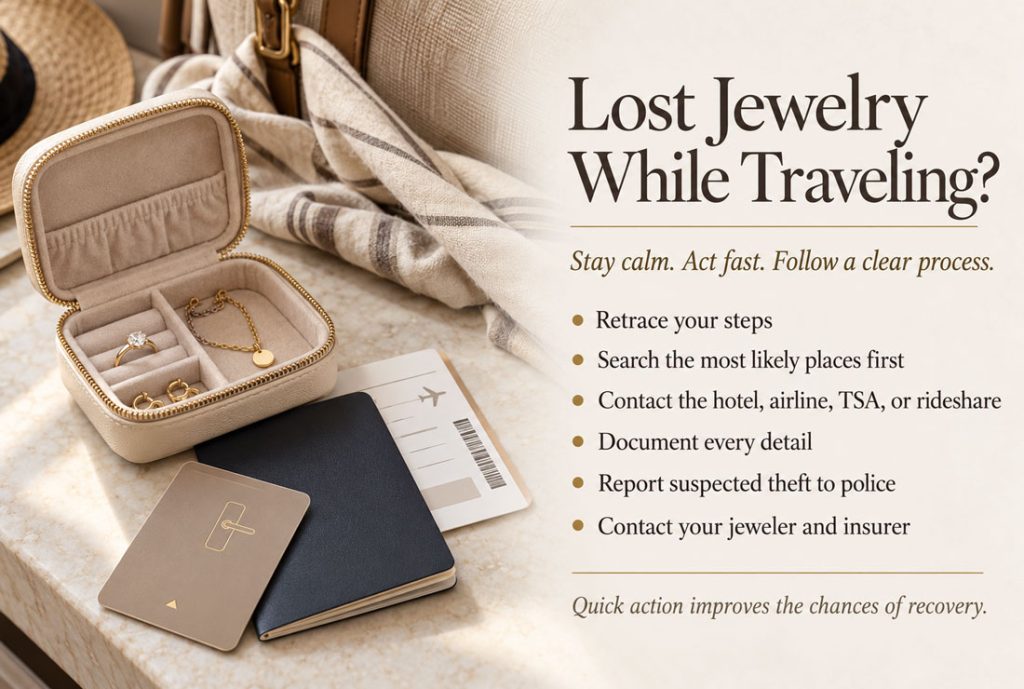
Most travel jewelry losses require a clear, calm process: stop, retrace your steps, search smart, contact the right people, document every detail, and report the loss as soon as possible.
Stay Calm, Then Act Fast
When you notice a piece is missing, the first few minutes matter immensely. Jewelry is usually found very close to where it was originally removed, dropped, or packed.
Travelers frequently lose jewelry inside hotel bathrooms, rental cars, gym bags, and airport security bins.
Wedding venues, cruise ship cabins, and hotel pools are major loss zones. The faster you organize your search, the better your chances of recovery.
Step One: Stop Moving and Reconstruct the Timeline
The first massive mistake travelers make is continuing their day while trying to search frantically from memory.
Instead, stop exactly where you are and rebuild your timeline.
Ask yourself these immediate questions:
- When was the absolute last time you definitely saw or wore the jewelry?
- Did you remove it to wash your hands, swim, apply sunscreen, sleep, or go through an airport scanner?
- Did you put it in a pocket, a purse, a hotel safe, a makeup bag, or on a bedside table?
- Did you change outfits, switch rental cars, or move hotel rooms?
Create a quick, written timeline.
For example: 8:00 AM: Wore ring to breakfast. 10:00 AM: Removed ring before the beach. 10:05 AM: Placed ring in the side zipper pocket of my beach bag. 1:00 PM: Returned to the hotel. 6:00 PM: Noticed ring missing.
The search starts entirely with the timeline.
The clearer your timeline, the easier it is to search the right places first.
Step Two: Search the Most Likely Places First
Jewelry is almost always lost exactly where the traveler intentionally took it off.
Focus your immediate search on common removal points: the hotel bathroom counter, the sink ledge, the nightstand, inside the room safe, or the bottom of a beach bag.
Jewelry easily slides into unlikely hiding spots.
Look deep inside pillowcases, folded within bed sheets, inside the pockets of the hotel robe, inside your shoe interiors, and thoroughly check your makeup bags and toiletry kits.
Use light and sound to your advantage.
For missing rings, earrings, and small stones, turn on your phone’s flashlight and hold it low to the ground to catch the reflection.
Gently shake bags over a soft towel, listening for a small metal “clink” when moving fabric.
Step Three: If You Are in a Hotel, Contact Staff Immediately
Call or visit the front desk the moment you realize the jewelry is missing.
Ask hotel staff to immediately check housekeeping carts, the laundry room, room service trays, and the hotel’s central lost and found.
If you recently changed rooms, ask them to check the prior room.
If you are still checked in and the room has not been cleaned yet, explicitly ask the hotel to pause housekeeping until you have completely searched the room yourself.
If you have already checked out, call immediately.
Provide your room number, checkout time, a highly detailed description of the jewelry, exactly where you think it was left, and clear photos if available.
Give them your contact information and clear shipping instructions if the item is recovered. Hotels move incredibly fast. Laundry, trash collection, cleaning carts, and room turnovers scatter evidence quickly.
Step Four: If You Lost Jewelry at an Airport or TSA Checkpoint
Determine exactly where the loss occurred.
Separate the possibilities: was it at the security checkpoint, the airline gate, inside the airplane, in a restroom, at baggage claim, or inside an airport restaurant?
You must contact the correct lost-and-found office. The airport lost-and-found, the airline lost-and-found, and the TSA checkpoint lost-and-found are usually entirely separate entities.
TSA provides specific guidance for travelers to contact their dedicated lost and found for items left directly at security checkpoints, while the airport or the specific airline handles items lost elsewhere.
Provide precise details. Include the date, airport code, terminal, exact checkpoint, airline name, flight number, gate, and the approximate time the item was lost. Include metal type, stone details, and any engraving.
Prevention Note: TSA strongly advises travelers to keep valuable items such as jewelry with them at all times and absolutely not place them inside checked baggage.
Step Five: If You Lost Jewelry on a Plane
If you notice the loss before exiting the aircraft, tell a flight attendant immediately.
If you have already left the plane, quickly contact the airline lost and found, the gate agent, the baggage service office, and airline customer service.
Airplanes are cleaned and turned around for their next flight rapidly.
Search likely airplane spots, including seat pockets, the cracks deep within the seat cushions, the floor under the seat, blanket folds, and the hinge area of the tray table.
Report the loss immediately with your exact flight number and seat assignment.
Step Six: If You Lost Jewelry in a Rental Car or Rideshare
Vehicle searches need to happen fast because cars are cleaned, reassigned, or rented again within hours.
For rental cars, call the exact branch where the car was returned.
For rideshare apps, use the app’s internal “lost item” reporting process immediately.
For taxis, contact the local taxi commission or the taxi company if you have the receipt.
Provide your pickup and drop-off times, vehicle description, rental agreement number, and exactly where you sat in the vehicle.
If you still have access to the car, search the seat tracks, cup holders, door pockets, underneath the floor mats, inside the center console, and deep within the seat belt gaps.
Step Seven: If You Lost Jewelry at the Beach or Pool
Beach losses are incredibly time-sensitive. Shifting sand, ocean water, heavy waves, towels, and moving crowds make jewelry recovery extremely difficult.
Stop walking around the immediate area. Mark your exact location.
Search your towels and bags first. Check your sunscreen bags and clothing pockets.
If it is evening, use a flashlight held at a very low angle to cast a shadow over the sand.
Consider hiring a local metal detector. For rings lost in deep sand, a local metal-detecting service or hobbyist group can often assist with ring recovery.
For pool or spa losses, ask staff to check locker rooms, towel return bins, pool drains, the surrounding pool deck, and spa treatment rooms.
Step Eight: If You Think the Jewelry Was Stolen
Treat suspected theft entirely differently from a simple loss. Do not rely only on the lost and found.
Notify hotel security, venue security, or local management immediately. File a police report with the local authorities.
Request a copy of the report or a case number. Document exactly who you spoke with.
Jewelers Mutual’s claims guidance explicitly states that if jewelry has been stolen, the incident should absolutely be reported to the police.
Report facts clearly and calmly without making unsupported accusations against specific hotel staff or travel companions.
If theft is a possibility, a police report is crucial for both the investigation and your eventual insurance claim.
Step Nine: Document Everything
Documentation helps significantly with lost-and-found reports, police reports, insurance claims, and eventual replacement.
Create a comprehensive loss file. Include the date and time you discovered the item missing, the last confirmed sighting, your full travel itinerary, hotel name, airline details, and the police report number if applicable.
Keep a strict communication log. Write down exactly who you called, the date and time of the call, what they told you, the next steps, and any claim or case numbers provided.
The more organized your documentation, the easier it is to support a claim.
Step Ten: Contact Your Jewelry Insurance Provider
File early if the jewelry is insured. Even if you are still actively searching, reporting the loss early helps jump-start the process.
Jewelers Mutual advises policyholders to report a loss or damage as soon as possible, noting that a claims examiner follows up promptly after submission.
The insurer will likely ask what happened, when and where it occurred, and request proof of ownership.
Have your appraisals, photos, police reports, repair estimates, original receipts, and diamond grading reports ready.
If you find the jewelry later, you can simply close the claim.
Jewelers Mutual notes that a loss can be reported while the search continues, and the file can be easily closed if the jewelry is eventually recovered.
Step Eleven: Check Homeowners or Renters Coverage
Do not assume your regular homeowners insurance covers the full value of lost jewelry while traveling.
Standard policies generally cover personal property, but jewelry usually carries strict special limits or major exclusions for “mysterious disappearance.”
The National Association of Insurance Commissioners (NAIC) explains that scheduled personal property endorsements or personal article floaters are heavily used for items such as jewelry that may exceed normal policy limits.
Check your policy to see if international travel, accidental loss, or theft is covered, and understand what deductible applies.
Step Twelve: Contact Your Jeweler
Your original jeweler is your best asset for replacement.
Your jeweler can help provide duplicate receipts, copies of original appraisals, diamond or gemstone grading reports, and exact ring specifications.
If the piece was completely custom, ask whether the jeweler still has the original CAD files, wax model records, precise stone measurements, or engraving details.
A good jeweler can help turn a chaotic, vague loss into a highly specific replacement plan.
What to Do If You Lost Only Part of the Jewelry
Common partial losses include losing one single earring, dropping a pendant while keeping the chain, or losing a center stone while the empty ring remains on your finger.
Store the remaining piece safely immediately. Photograph the damage or the missing component.
Contact your jeweler regarding the possibility of a replacement. Avoid wearing the remaining piece if it is damaged.
Replacing one earring, one specific stone, or one half of a bridal set requires incredibly careful matching of metal color, finish, diamond size, and gemstone hue.
Even a partial loss should be documented quickly because finding an exact matching replacement can take serious time.
What Not to Do After Losing Jewelry
Do not keep moving without searching. Every passing hour makes recovery harder.
Do not blame staff without facts. Stick to timelines and hard evidence.
Do not post identifying details publicly. Posting exact values, hotel names, or your travel itinerary online creates severe security concerns.
Do not throw away towels or packaging. Small jewelry pieces hide flawlessly in fabric.
Do not delay police or insurance reporting. Waiting severely complicates the claim.
Do not assume it is gone forever. Many pieces are recovered days later after hotel laundry is processed or airplanes are deep-cleaned.
How to Write a Lost Jewelry Description
A vague description like “gold ring with a diamond” is useless to a busy lost-and-found department.
Include highly specific details: item type, exact metal color, metal karat, gemstone type, center stone shape, approximate carat weight, designer brand, ring size, and unique laser inscription numbers.
Example: “Women’s 14kt yellow gold engagement ring with an oval center diamond, hidden halo underneath the stone, pavé diamond band, engraving inside reading ‘R & M 6.12.21,’ approximately size 6.5. Last seen on room 814 bathroom counter at 9:30 AM.”
How Long Should You Keep Following Up?
Recovery takes time. Jewelry frequently turns up days or weeks later when rental cars are detailed or lost-and-found inventory is finally reviewed by management.
Do not rely on one single phone call. Call everywhere relevant on the same day.
The next day, call again with your case numbers. Three days later, follow up with the hotel, airline, and venue.
Check the final status two to four weeks later. Record every single follow-up attempt in your log.
What If the Jewelry Is Found?
Before celebrating, verify the identity of the item. Ask the finder for identifying details before arranging the return.
Arrange safe return steps. Ask how it will be shipped. Request tracking and full insurance on the package, and require a signature upon delivery.
Once it arrives, take it straight to a jeweler.
If the piece was lost outdoors, in sand, in water, or in transit, have a professional inspect it for loose stones, bent prongs, heavy scratches, moisture damage, and gemstone chips before wearing it again.
What If the Jewelry Is Not Found?
Once reasonable search and reporting steps are complete, you must move from search mode to replacement mode.
Options include ordering an exact remake, choosing a similar replacement, redesigning a new piece inspired by the original, or replacing it with a simpler travel-safe version.
Acknowledge the emotional reality. Replacement solves the financial loss, but sentimental loss requires patience.
Losing an irreplaceable family heirloom or original wedding ring feels devastating. Recovery efforts matter emotionally, even if insurance cannot restore the original piece.
Special Scenarios
Lost Engagement Ring
This feels especially devastating because of the emotional, financial, and symbolic value.
Emphasize immediate searching, retracing every removal point, and gathering your appraisal and diamond reports quickly for insurance.
Lost Wedding Band
Wedding bands are often lost because fingers shrink in cold water, or rings are removed for sunscreen application and forgotten.
Replacement should honor both the fit and the meaning, matching the original metal and engraving if possible.
Destination Weddings
Destination weddings involve high-pressure situations with multiple important pieces. Assign one highly responsible person to coordinate the search.
Check the bridal suite, photographer staging areas, garment bags, makeup stations, and floral boxes immediately.
How to Prevent Jewelry Loss on Future Trips
The absolute best way to handle lost jewelry while traveling is to reduce the chance of losing it in the first place.
Bring less. Pack only what you will realistically wear. Leave irreplaceable, highly sentimental pieces locked in a safe at home.
Keep your jewelry strictly in your carry-on bag.
TSA advises travelers not to place valuable jewelry inside checked baggage.
Jewelers Mutual strongly recommends packing only what you will wear, using a dedicated travel jewelry case with compartments, keeping jewelry in carry-on luggage, and utilizing hotel safes.
Avoid high-risk situations entirely. Remove jewelry before swimming, beach visits, hot tubs, spa treatments, workouts, hiking, boating, or applying heavy sunscreen.
Consider using substitute jewelry, such as a silicone wedding band or a simple travel ring, when the risk of loss is higher than normal.
Simple Lost Jewelry Travel Checklist
As soon as you notice it missing:
Stop and stay calm.
Rebuild the timeline.
Search the most likely locations first.
Check clothing, towels, bags, and bathroom areas.
Do not let housekeeping clean the room until you search.
Within the first hour:
Notify the hotel, venue, airline, or transportation provider.
Provide photos and a detailed description.
Record names and case numbers.
If theft is possible:
Notify security.
File a police report.
Get a report number.
If not found quickly:
Contact your jeweler.
Contact your insurer.
Follow up repeatedly.
Keep all documentation organized.
Plan Ahead and Travel Smarter
Losing jewelry while traveling is deeply upsetting, but it is not the moment to freeze.
The best response is calm and immediate: retrace the timeline, search the most likely places, contact the right lost-and-found offices, document every detail, and file a police report if theft is possible.
f the piece is insured, start the claim process early.
Some jewelry is recovered quickly.
Some turns up weeks later in hotel laundry or airport systems.
Some is never found, which is exactly why insurance, meticulous documentation, and smart travel habits matter so much.
The lesson for future trips is highly simple: bring less, pack better, keep valuables entirely under your control in your carry-on, avoid wearing fine jewelry in high-risk places like the ocean or the gym, and leave irreplaceable pieces at home when the risk is simply not worth the reward.
Related Amazon Products for Safe Jewelry Travel
Bagsmart Travel Jewelry Organizer Case
Keep your engagement rings, necklaces, and earrings perfectly secure, padded, separated, and untangled while traveling for vacations or weekend getaways to prevent loss and damage.
ROQ Silicone Wedding Band Multipack
Protect your fine jewelry from heavy impact and loss! Swap your expensive diamond engagement ring for a safe, flexible silicone band during beach trips, swimming, or gym workouts.
Diamond Dazzle Stik Cleaning Pen
A highly portable, twist-brush cleaning solution designed to safely reach beneath tight diamond prongs and wash away heavy vacation sunscreen and lotion buildup on the go.
ProCase Hard Shell Travel Jewelry Case
A rigid, hard-shell compact travel box designed specifically to protect delicate gemstone rings, watches, and easily crushed hoop earrings safely inside a packed carry-on bag.
Mayflower Microfiber Jewelry Polishing Cloths
A gentle, chemical-free way to quickly wipe away daily vacation sweat, fingerprints, and sunscreen from delicate stones and safely restore the shine to gold settings before dinner.
SentrySafe Compact Portable Travel Safe
A small, heavy-duty portable lockbox featuring a steel tethering cable, designed specifically to properly and safely secure your valuable jewelry inside an unfamiliar hotel room or rental car.
Feramox Invisible Ring Size Adjusters
A comfortable, clear, and temporary solution if your engagement ring fits slightly too loose. Provides instant security so the ring doesn’t slip off into the ocean or pool.
Benevolence LA Plush Velvet Travel Jewelry Box
A small, elegant velvet travel case featuring dedicated ring rolls and earring compartments, perfect for safely transporting minimal bridal jewelry to a destination wedding.
Connoisseurs Jewelry Cleaning Wipes
Dry, disposable jewelry cleaning wipes perfect for carrying in a purse or beach bag to quickly polish gold and silver jewelry without needing water or messy liquid cleaners.
Travel Document Organizer Folder
Keep your vital travel documents safe. Store physical copies of your diamond grading reports, jewelry appraisals, and insurance policies securely in your carry-on luggage for international trips.
Frequently Asked Questions About Losing Jewelry While Traveling
What should I do first if I realize my jewelry is missing while traveling?
Stop moving and try to reconstruct exactly when you last remember seeing or wearing the jewelry.
Think through your day in order. Ask yourself when you last removed the piece, whether you changed clothes, went swimming, used a hotel safe, passed through airport security, rode in a rental car, or moved bags.
Write the timeline down if possible. Even a rough sequence of events can help narrow a large search area down to one hotel room, airport checkpoint, restaurant, vehicle, beach chair, or piece of luggage.
Then search the most likely location before expanding outward.
How quickly should I report lost jewelry?
As quickly as possible.
Hotels clean rooms, airlines turn aircraft around, rental cars are detailed and reassigned, and airport lost-and-found departments receive new items constantly.
The sooner you report the loss, the greater the chance that employees can check the location before it changes.
If the jewelry is insured, you should also review your policy and consider notifying the insurer promptly rather than waiting several days to see whether the piece turns up.
Where is jewelry most commonly lost during a trip?
Many losses happen in places where jewelry is intentionally removed rather than accidentally dropped.
Common locations include hotel bathrooms, bedside tables, room safes, swimming pools, beaches, airport security areas, airplanes, rental cars, gyms, spas, changing rooms, makeup bags, purses, garment bags, and luggage.
Rings are particularly easy to lose after washing hands, applying sunscreen, swimming, showering, working out, or removing them before bed.
Small earrings and pendants can also disappear into towels, sheets, carpeting, seat cushions, or the lining of a bag.
What should I check in a hotel room before reporting jewelry missing?
Search slowly and methodically.
Check the bathroom counter, around the sink, underneath towels, beside the bed, behind furniture, inside drawers, in the room safe, under the mattress edge, inside bedding, and beneath furniture.
Check every compartment of your luggage, purse, toiletry bag, makeup case, backpack, and clothing.
Also inspect robe pockets, jacket pockets, shoes, laundry bags, pillowcases, folded blankets, and towels.
Using your phone flashlight from a low angle can sometimes make a small metal object or gemstone easier to spot.
What should I do if I think I left jewelry in a hotel after checking out?
Call the hotel immediately.
Provide your name, room number, dates of stay, checkout time, and a detailed description of the missing piece.
Explain exactly where you believe the jewelry may have been left.
Ask the hotel to check the room, housekeeping carts, laundry areas, lost and found, linen processing areas, and any other location where belongings from the room may have been moved.
If you have a clear photograph of the jewelry, offer to send it.
Ask for the name of the person handling the report and keep a record of every conversation.
Can hotel housekeeping help find lost jewelry?
Yes.
Housekeeping employees may be among the first people to encounter an item left in a guest room.
If you are still staying at the hotel and believe the jewelry is somewhere in your room, ask the front desk to delay housekeeping until you have finished searching.
If the room has already been cleaned, hotel staff may need to check cleaning carts, vacuum bags, linen bags, laundry areas, trash collection areas, and the hotel’s lost-and-found system.
What should I do if I lose jewelry at an airport?
First determine where inside the airport the item was probably lost.
An item left at a TSA security checkpoint may be handled differently from something lost in a terminal restaurant, restroom, gate area, baggage claim, airport lounge, or airplane.
Contact the appropriate lost-and-found department and provide as much information as possible.
Useful details include the airport, terminal, checkpoint, airline, gate number, flight number, date, approximate time, and a complete description of the jewelry.
What if I left a ring or other jewelry in a TSA security bin?
Contact the lost-and-found operation responsible for the security checkpoint as quickly as possible.
Include the approximate time you passed through security, terminal, checkpoint location, and a detailed description of the item.
Avoid vague descriptions such as “gold ring.”
Mention the metal, karat, gemstones, shape, size, engraving, inscription, brand, or other distinguishing details that could help staff identify it.
What should I do if I think I lost jewelry on the airplane?
If you are still on the aircraft, tell a flight attendant before leaving.
If you have already exited, contact the airline immediately.
Provide your flight number, date, departure and arrival cities, seat assignment, and a detailed description of the jewelry.
Potential hiding places include seat pockets, beneath the seat, between seat cushions, around seat rails, inside blankets, and near tray-table hardware.
Airplanes may be cleaned and returned to service quickly, which makes prompt reporting especially important.
How do I report jewelry left in a rental car?
Contact the exact rental location where you returned the vehicle.
Provide the rental agreement number, vehicle information, return time, and a description of where you were sitting or where the jewelry may have been placed.
Jewelry can slip underneath seats, into seat tracks, between the seat and center console, underneath floor mats, into cup holders, and inside door pockets.
Because rental vehicles can be cleaned and rented again quickly, report the missing item immediately.
What should I do if I leave jewelry in an Uber, Lyft, taxi, or other rideshare?
Use the rideshare company’s lost-item reporting system as soon as possible.
Provide the date, approximate pickup and drop-off times, route, vehicle description, and where you were sitting.
For a traditional taxi, use your receipt if you have one because it may contain identifying information about the cab or driver.
If the rideshare platform allows communication with the driver, keep the conversation focused on identifying and recovering the item.
Can a ring really disappear in the ocean or at the beach?
Unfortunately, yes.
Cold water can temporarily shrink fingers, making rings fit more loosely. Sunscreen can also make a ring easier to slide off.
If you lose a ring at the beach, stop walking around the area unnecessarily and mark the approximate location immediately.
Search towels, bags, clothing, chairs, and sunscreen containers before assuming the ring is buried.
If you believe it is in the sand, a local metal-detecting service or experienced hobbyist may be able to help.
What should I do if my wedding ring falls into a pool?
Tell pool staff immediately.
Avoid disturbing the area more than necessary.
Ask staff whether they can inspect the pool deck, drains, filtration areas, locker rooms, towel bins, changing areas, and surrounding furniture.
If you know approximately where the ring came off, give staff that information.
Do not attempt to enter restricted mechanical or filtration areas yourself.
Should I file a police report if jewelry is simply lost?
A police report is most important when theft is suspected or when your insurance policy requires one.
A simple accidental loss may be handled differently.
However, expensive jewelry can involve substantial insurance documentation, so check your specific policy or ask your insurer what documentation is required.
If you have reasonable grounds to believe the piece was stolen, contact local authorities promptly.
What should I do if I think someone stole my jewelry?
Notify the appropriate security personnel and local police.
If the suspected theft occurred at a hotel, cruise ship, resort, event venue, or airport, notify onsite security or management as well.
Provide factual information rather than accusing a particular employee, guest, or traveler unless you have evidence.
Request a police report number or case number and save copies of any documentation you receive.
Should I contact my insurance company immediately or keep searching first?
You can usually continue searching while beginning the insurance process.
If your jewelry is insured, reporting the loss early can establish a record of when and where the loss occurred.
Gather your appraisal, purchase receipt, photographs, gemstone grading reports, police report if applicable, and any other proof of ownership.
If the jewelry is later recovered, contact the insurer and update the claim.
Does homeowners or renters insurance automatically cover lost jewelry while traveling?
Not necessarily.
Jewelry coverage under homeowners and renters policies may have special limits, deductibles, exclusions, or restrictions.
Coverage for theft can also differ from coverage for accidental loss or unexplained disappearance.
Higher-value pieces are sometimes separately scheduled or covered through a personal articles policy or jewelry-specific policy.
Check the actual language of your policy rather than assuming the full value of the jewelry is protected.
What documents should I have if I need to make a jewelry insurance claim?
Useful records may include:
- The original purchase receipt
- A recent jewelry appraisal
- Photographs of the piece
- Diamond or gemstone grading reports
- Serial numbers or laser inscription information
- Repair records
- Credit card purchase records
- A police report when applicable
- Lost-and-found case numbers
- Travel records showing where you were
- Written communication with hotels, airlines, rental companies, or other businesses
The more information you can provide, the easier it becomes to establish ownership and accurately describe the missing piece.
What if I don’t have the original receipt for the jewelry?
Contact the jeweler where you purchased it.
The jeweler may still have purchase records, invoices, appraisals, stone specifications, repair records, photographs, or other documentation.
For custom jewelry, the jeweler may also have CAD files, design information, gemstone measurements, or production records.
Old photographs showing you wearing the jewelry may also help establish what the piece looked like.
How detailed should my lost-jewelry description be?
Very detailed.
Instead of saying “diamond ring,” describe the piece using information that would distinguish it from dozens of similar items.
Include the jewelry type, metal, karat or purity, approximate dimensions, gemstone type, stone shape, approximate carat weight, ring size, engraving, brand name, design details, and any identifying marks.
A clear photograph is especially useful.
Should I publish photos of my lost jewelry on social media?
You can ask for help online, but avoid publishing unnecessary information that could create security problems.
Do not announce the jewelry’s exact value, your full travel itinerary, hotel room number, home address, or details that would make it easy for someone to falsely claim ownership.
Consider holding back one unique identifying detail so you can verify that someone who claims to have found the piece actually has it.
How can I prove a found piece of jewelry is mine?
Use identifying information that would be difficult for another person to guess.
That might include an interior engraving, laser inscription, gemstone grading report number, unusual repair, exact ring size, distinctive design feature, or a detailed photograph.
You may also have an appraisal or receipt describing the piece.
When possible, have a jeweler verify the item after it has been returned.
How often should I follow up with a hotel, airline, or lost-and-found office?
Do not assume that one report is enough.
Follow up again after the initial report, particularly if you have a claim or case number.
Some jewelry is not discovered until a hotel room receives a deeper cleaning, laundry is processed, a vehicle is detailed, or an airplane undergoes additional maintenance.
Keep a record of each follow-up, including the date, person you spoke with, and any new information.
Can jewelry show up weeks after being lost?
Yes.
Small items can remain hidden in hotel linens, furniture, vehicles, luggage compartments, airplane seats, or lost-and-found inventories for days or weeks.
That is why continued follow-up can be worthwhile even after the initial search has ended.
Keep your case numbers and contact information readily available.
What should I do if only one earring is lost?
Keep the remaining earring somewhere safe and photograph it clearly.
Contact the original jeweler or a qualified jeweler to determine whether a matching replacement can be made.
Matching a single earring can be more difficult than it sounds because metal color, gemstone size, setting style, finish, and wear can vary.
Do not discard the remaining earring simply because its mate is missing.
What should I do if the diamond falls out but I still have the ring?
Stop wearing the ring immediately.
Store it safely and have a jeweler inspect the setting.
A missing center stone can indicate a damaged or worn prong, bezel, head, or other structural problem.
Photograph the ring before having repairs performed, particularly if you intend to make an insurance claim.
What should I do if I recover jewelry that was lost outside?
Have it inspected before wearing it again.
Jewelry recovered from sand, salt water, a pool, pavement, luggage systems, vehicles, or other harsh environments may have damage that is difficult to see.
A jeweler can check the prongs, stones, clasps, solder joints, settings, and overall structure.
A recovered ring may look perfectly fine while still having a loose stone.
How should valuable jewelry be shipped back to me if someone finds it?
Use a secure shipping method with tracking, adequate insurance, and signature confirmation.
Ask the hotel, airline, or person returning the jewelry how the package will be handled before giving approval.
For exceptionally valuable jewelry, speak with your insurer or jeweler about the safest return method.
Avoid ordinary untracked mail.
What if the lost jewelry is an heirloom that cannot truly be replaced?
Financial replacement and emotional replacement are two different things.
An insurer or jeweler may be able to reproduce the design, but a new piece cannot recreate the history of an original family heirloom.
That makes a thorough search especially worthwhile.
If the original cannot be recovered, photographs, appraisals, old family records, and the knowledge of an experienced jeweler may help create a respectful reproduction.
Can a jeweler recreate my lost engagement ring or wedding band?
Often, yes.
The process is easier when the jeweler has detailed records.
Useful information includes photographs, original receipts, appraisals, stone measurements, grading reports, ring dimensions, CAD files, engraving details, metal specifications, and ring size.
Even when the original jewelry was handmade or custom, an experienced jeweler may be able to reproduce it closely.
Should I travel with my engagement ring or wedding band at all?
That depends on the trip and your comfort level.
A low-risk business trip may be very different from a vacation involving swimming, scuba diving, hiking, boating, skiing, beaches, spas, or other activities where jewelry can easily be damaged or lost.
For higher-risk trips, leaving irreplaceable jewelry at home may be the safer choice.
Some travelers wear an inexpensive travel ring or silicone band instead.
Is it safe to put jewelry in checked luggage?
Valuable jewelry is generally better kept under your personal control rather than placed in checked luggage.
If you choose to travel with fine jewelry, keep it securely packed in your carry-on belongings and maintain possession of the bag whenever possible.
Avoid casually placing loose jewelry in pockets, cosmetic bags, or exterior luggage compartments.
Is a hotel safe the best place for jewelry?
A hotel safe may reduce some risks, but it does not eliminate every risk.
If you use one, develop a consistent routine.
Put jewelry in the same container each time rather than leaving individual pieces loose inside the safe.
Before checking out, make checking the safe part of your final room inspection.
It can also help to place an item you know you must retrieve—such as a shoe, car key, or another essential travel item—near the safe as a reminder.
How can I keep rings from becoming loose while traveling?
Changes in temperature can affect how tightly a ring fits.
Cold weather and cold water can make fingers temporarily smaller.
If your ring is already loose, ask a jeweler whether resizing or another professional adjustment is appropriate.
Temporary ring-size adjusters may also help in certain situations, but they should not replace proper sizing for a valuable ring you wear regularly.
Should I remove my rings before swimming?
For valuable rings, removing them before swimming is usually the safer choice.
Cold water can make fingers shrink, while sunscreen and lotion can make rings slippery.
Ocean currents, waves, sand, pool drains, and low underwater visibility can make recovery extremely difficult.
If you remove your jewelry, put it directly into a secure travel jewelry case rather than wrapping it in a towel or placing it loosely inside a beach bag.
What is the biggest mistake people make after losing jewelry while traveling?
Continuing to move from place to place without first establishing where the jewelry was last definitely seen.
Every additional location makes the search more complicated.
A calm timeline usually gives you a much better starting point than frantic searching.
Once you identify the most likely location, search carefully, notify the people who control that location, document what happened, and continue following up.
What is the best way to prevent losing jewelry on a future trip?
Travel with less jewelry.
Leave pieces at home that are emotionally irreplaceable or unnecessary for the trip.
Use a dedicated jewelry organizer, keep valuables with you rather than in checked baggage, and avoid wearing fine jewelry during activities where loss is especially likely.
Before leaving a hotel, rental car, cruise cabin, or vacation rental, perform one final jewelry check.
The simplest rule is also one of the most effective: if losing a particular piece would seriously affect you emotionally or financially, think carefully about whether it needs to travel with you at all.
Disclaimer: This blog post contains affiliate links. If you click on one of these links and make a purchase, I may earn a small commission at no additional cost to you. As an Amazon Associate I earn from qualifying purchases. Thank you for your support!
Bibliography and Further Reading
- American Airlines. “Lost and Found Support.” American Airlines. Useful for distinguishing between property lost on an aircraft or at a gate, property lost elsewhere in an airport, and items left at a TSA checkpoint. American Airlines
American Airlines — Lost and Found - Delta Air Lines. “Damaged, Delayed or Lost Baggage — Lost Items on Plane or Airport.” Delta Air Lines. Provides procedures for reporting personal belongings left aboard an aircraft, at an airport counter, gate, or Delta Sky Club. Delta Air Lines
Delta Air Lines — Lost Items - Enterprise Rent-A-Car. “What Should I Do If I Leave an Item in My Enterprise Rental Car?” Enterprise Rent-A-Car. Explains Enterprise’s process for locating belongings left in rental vehicles and submitting lost-and-found reports. Enterprise
Enterprise — Lost and Found - Gemological Institute of America (GIA). “Natural Diamond Reports & Services.” Gemological Institute of America. Useful background for the article’s discussion of diamond grading reports, documentation, identification information, and laser-inscribed report numbers. gia
GIA — Natural Diamond Reports & Services - Gemological Institute of America (GIA). “The Difference Between a Diamond Grading Report and an Appraisal.” GIA 4Cs. Explains the different roles of laboratory grading reports and jewelry appraisals—both potentially important when documenting a lost piece or working with an insurer or jeweler. GIA 4Cs
GIA — Diamond Grading Reports vs. Appraisals - Gemological Institute of America (GIA). “What Is a Laser Inscription and Is It Important?” Gemological Institute of America. Explains how a microscopic GIA report number or other inscription can help identify an individual diamond. gia
GIA — Laser Inscription Information - Hertz. “I Left Something in the Vehicle, How Do I Retrieve It?” Hertz Customer Support. Gives travelers instructions for filing a lost-and-found report after leaving personal property in a Hertz rental vehicle. https://www.hertz.com
Hertz — Lost Items in Rental Vehicles - Insurance Information Institute (Triple-I). “Do I Need Special Coverage for Jewelry and Other Valuables?” Triple-I. Explains jewelry limits under standard homeowners policies and discusses scheduling valuable pieces or purchasing a personal articles floater for broader coverage. Triple-I
Triple-I — Insurance for Jewelry and Valuables - Jewelers Mutual Group. “How to File a Jewelry Insurance Claim.” Jewelers Mutual. Covers the basic jewelry-claim process, documentation, working with a jeweler, and the importance of reporting suspected theft to police. Jewelers Mutual Group
Jewelers Mutual — How to File a Jewelry Insurance Claim - Jewelers Mutual Group. “How to Travel With Jewelry Safely.” Jewelers Mutual. Addresses traveling with fine jewelry, preventing loss and theft, using secure storage, reporting suspected theft, filing police reports, and considering specialized jewelry insurance. Jewelers Mutual Group
Jewelers Mutual — How to Travel With Jewelry Safely - Jewelers Mutual Group. “Does Travel Insurance Cover Lost Jewelry? What to Know.” Jewelers Mutual. Discusses potential limits, exclusions, and per-item restrictions that can apply when travelers rely on general travel insurance for valuable jewelry. Jewelers Mutual Group
Jewelers Mutual — Does Travel Insurance Cover Lost Jewelry? - Jewelers Mutual Group. “Travel Study: Jewelry Losses 2.5x More Likely When Worn During Travel.” Jewelers Mutual Newsroom, 2026. Recent research examining how travelers carry, wear, document, and lose jewelry while away from home. Because this is research published by a jewelry insurer, its methodology and commercial context should be kept in mind when citing the findings. Jewelers Mutual Group
Jewelers Mutual — 2026 Travel Study - Jewelers Mutual Group. “What to Do When You’re Missing Your Ring.” Jewelers Mutual. Particularly relevant to the article’s recommendations to retrace your steps, contact police when theft is possible, and begin the insurance process while continuing to search. Jewelers Mutual Group
Jewelers Mutual — What to Do When You’re Missing Your Ring - National Association of Insurance Commissioners (NAIC). “Homeowners and Renters Insurance: Jewelry Needs Protection, Too.” NAIC. Discusses policy limits for jewelry, appraisals, photographs, additional coverage, worldwide coverage questions, and the difference between replacement coverage and actual cash value. NAIC Content
NAIC — Homeowners, Renters and Jewelry Insurance - National Association of Insurance Commissioners (NAIC). “What You Need to Know About Adding an Endorsement or Rider to an Existing Insurance Policy.” NAIC, March 6, 2023. Explains how endorsements or riders can add or modify insurance protection for valuable property such as engagement rings. NAIC Content
NAIC — Insurance Riders and Endorsements - The Ring Finders. “The Ring Finders Metal Detecting Service.” The Ring Finders. A worldwide directory of independent metal-detecting specialists who assist with searches for rings and other jewelry lost on beaches, in parks, lakes, yards, and similar locations. This is a service directory rather than a governmental or academic source, but it is directly relevant to the article’s beach-recovery section. The Ring Finders
The Ring Finders — Lost Jewelry Recovery Directory - Transportation Security Administration (TSA). “What Can I Bring? — Jewelry.” U.S. Department of Homeland Security, Transportation Security Administration. TSA states that travelers carrying valuable items such as jewelry should keep them with them rather than placing them in checked baggage and notes that private screening can be requested for valuables. Transportation Security Administration
TSA — Traveling With Jewelry - Uber. “Tips for Getting Your Item Back.” Uber Help. Explains the process for contacting a driver after leaving personal property in a rideshare vehicle and arranging its return. Uber
Uber — Recovering a Lost Item